Liber IX · Gnosticism · Chapter IV: Christian Theosophy
Jane Lead and the Philadelphian Society: Sophia Visions in London
Jane Lead and the Philadelphian Society: the English visionary of the Virgin Sophia, her circle with John Pordage and Francis Lee, and her German legacy.

Jane Lead (or Leade, 1624–1704) was an English visionary and theosopher who, from 1670 until her death, recorded a long series of revelations from the divine Virgin Wisdom, or Sophia, and became the spiritual leader of a small London group called the Philadelphian Society. Drawing on the writings of Jacob Boehme and the circle of the clergyman John Pordage, she taught that a pure "Philadelphian" church of brotherly love was about to appear and that, in the end, all creatures would be restored to God. Her books, little read in England, were translated into German and Dutch and had a lasting influence on radical Pietism.
Jane Lead's Early Life and Calling§
Jane Ward was born in 1624 at Letheringsett in Norfolk, into a well-established gentry family. According to her own later account, the decisive moment of her youth came at about the age of fifteen, during the Christmas festivities in the family home, when she heard an inner voice rebuking her for frivolity. A period of religious anxiety followed, which she later described in terms familiar from Puritan conversion narratives: searching among preachers, a sense of sin, and eventually an assurance of forgiveness.
In 1644 she married a distant relative, William Lead, a merchant, with whom she had four daughters. The marriage seems to have been conventional and she said little about it. When William died in 1670 he left her in financial difficulty, and Lead resolved to give herself wholly to what she called "the Virgin Wisdom". From that time her life was organised around prayer, visionary experience and writing.
John Pordage and the Behmenist Circle§
Lead's spiritual formation took place in the English Behmenist milieu, the readers of Jacob Boehme whose works had appeared in English translation during the 1640s and 1650s. Its most remarkable figure was John Pordage (1607–1681), a physician and clergyman who had been rector of Bradfield in Berkshire. In the 1650s Pordage and his household reported extraordinary experiences — visions of the angelic world and of dark spirits — and in 1654 he was ejected from his living after a hearing in which these claims, among others, were held against him.
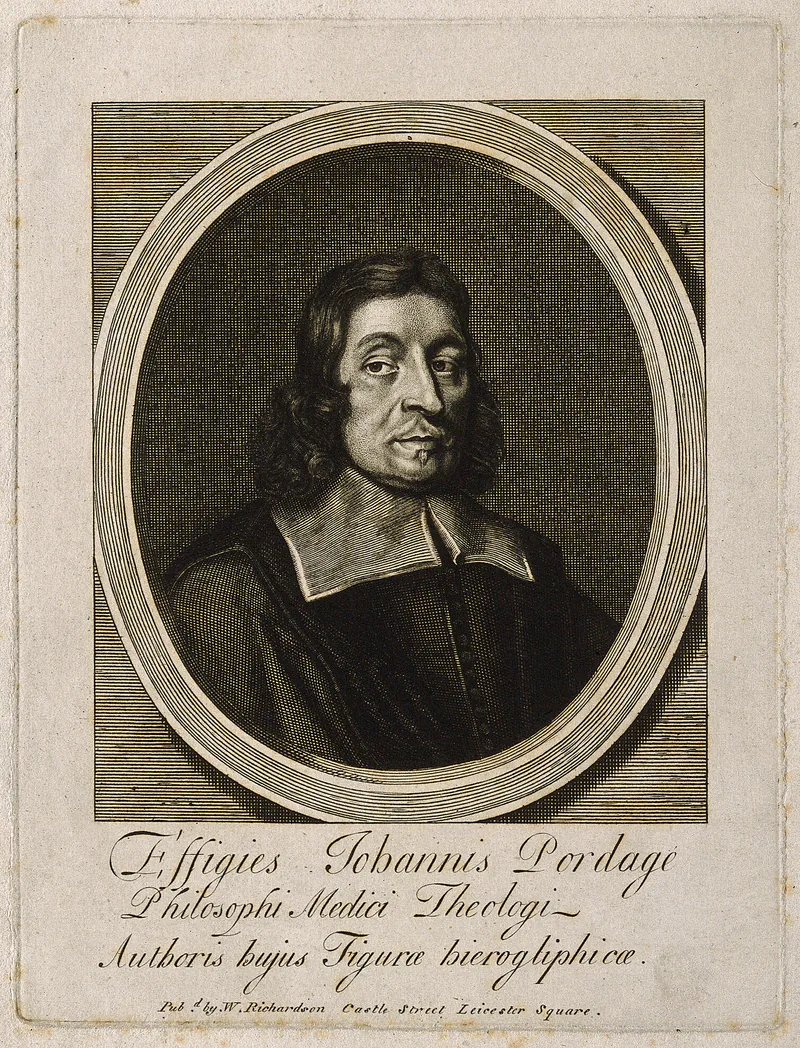
Lead appears to have known Pordage's circle in the 1660s, and after her husband's death she joined his household. For the next decade they shared a common life of prayer, and Pordage regarded her as a fellow seer. When he died in 1681, she became the recognised leader of the remaining group. Pordage's own Theologia Mystica appeared posthumously in 1683, and the two bodies of writing share many themes: the inner worlds of light and darkness, the "eternal nature", and the role of Sophia as mediator of divine life.
Visions of Sophia, the Virgin Wisdom§
Lead dated the beginning of her revelations to April 1670, when, she wrote, a figure of Wisdom appeared to her as a woman clothed in light and promised to be her constant companion. In later visions Sophia was described as an "eye" of divine knowledge and as a mirror in which God beholds himself — images drawn directly from Boehme, for whom the heavenly Virgin was the lost bride of Adam. For Lead, union with Sophia meant a kind of spiritual marriage through which the believer recovers the angelic, androgynous state lost in the fall and is gradually transformed into a "paradisical" body.
This feminine image of the divine has made Lead an important figure for historians of women's religion and for modern readers interested in the long history of Sophia in Gnostic and Christian thought. Scholars stress, however, that her Sophia belongs to the Behmenist tradition rather than to ancient Gnosticism: Lead's Wisdom is not a fallen aeon but the eternal, unfallen mirror of God, and Lead remained firmly Trinitarian and Christ-centred.
The Writings: A Fountain of Gardens and After§
For many years Lead wrote only for herself and her friends. Her first book, The Heavenly Cloud Now Breaking, appeared in 1681, followed by The Revelation of Revelations (1683), a visionary reading of the Apocalypse. After a pause, a stream of publications began in the 1690s, financed in part by a Dutch admirer, Baron Dodo von Knyphausen, and accompanied by German and Dutch translations prepared through the publisher Loth Fischer. Among them were The Enochian Walks with God (1694), The Wonders of God's Creation Manifested (1695), The Laws of Paradise (1695), The Tree of Faith (1696), The Ark of Faith (1696) and A Revelation of the Everlasting Gospel-Message (1697).

Her largest work is A Fountain of Gardens (1696–1701), a spiritual diary covering her visions from 1670 onward, published in several volumes. It mixes dream-like visionary scenes, prayers, doctrinal reflections and messages she believed she had received from Wisdom. By the 1690s Lead was nearly blind, and her texts were taken down and edited by her younger collaborator Francis Lee, which raises questions about how far the published wording is hers alone.
Francis Lee, Richard Roach and the Philadelphian Society§
Francis Lee (1661–1719) was an Oxford-trained physician and former fellow of St John's College who had lost his fellowship as a Nonjuror after 1688. He came across Lead's books in the Netherlands, travelled to London to meet her in 1694, and soon settled in her household; he married her widowed daughter Barbara and called Lead his spiritual mother. Together with the Anglican clergyman Richard Roach (1662–1730), Lee organised the group that came to be called the Philadelphian Society.
The name came from the sixth of the seven churches addressed in Revelation 3, the church of Philadelphia, which is promised an open door and a crown. Lead and her friends saw themselves as the forerunners of this end-time church of "brotherly love" (the meaning of the Greek philadelphia), drawing true believers out of all denominations without forming a new sect. In 1697 they published a short-lived periodical, Theosophical Transactions by the Philadelphian Society, and held public meetings in London, which attracted curiosity, some ridicule and disputes among the members. By 1703 the public phase had ended, and Lead died in London on 19 August 1704. Roach continued to write on Philadelphian themes, notably in The Great Crisis (1725).
Universal Restoration and the German Reception§
The most controversial of Lead's teachings was the doctrine of universal restoration (apokatastasis): the belief that the punishments of hell are not eternal and that every fallen being, perhaps even the fallen angels, will finally be purified and restored to God. She presented this as a new revelation entrusted to her, the "everlasting gospel" of Revelation 14:6. The idea had ancient precedents in Origen and Gregory of Nyssa, but in Lead's day it was strongly opposed by most Protestant churches.
In Germany her books found a receptive audience. The Lutheran theologian Johann Wilhelm Petersen and his wife Johanna Eleonora Petersen adopted and defended the doctrine of universal restoration, and Lead's writings circulated among radical Pietists and Philadelphian groups in the German states and the Netherlands. Relations with the Amsterdam Boehme editor Johann Georg Gichtel, by contrast, turned sour after a quarrel over money and authority. Historians have also suggested Philadelphian influence on later communal and mystical groups in colonial Pennsylvania, though the precise lines of transmission are debated. Within the broader story of Christian theosophy, Lead stands out as one of the very few women to lead a theosophical circle and to publish under her own name.
Frequently asked questions§
Who was Jane Lead?§
Jane Lead was a seventeenth-century English mystic and author who reported visions of the divine Wisdom, Sophia, from 1670 onward. A follower of Jacob Boehme's teachings and a companion of John Pordage, she became the leader of the Philadelphian Society in London in the 1690s and published around fifteen visionary books.
What was the Philadelphian Society?§
It was a small group of English and continental followers of Jane Lead, led practically by Francis Lee and Richard Roach, which in the 1690s sought to prepare for a coming church of brotherly love. It took its name from the church of Philadelphia in Revelation 3, published a periodical in 1697 and held public meetings before dissolving in the early 1700s.
Did Jane Lead believe in universal salvation?§
Yes. She taught that all fallen creatures would in the end be purified and restored to God, a doctrine known as universal restoration or apokatastasis. This teaching was rejected by most churches of her time but was taken up by German radical Pietists.
Was Jane Lead a Gnostic?§
Not in the historical sense. Her emphasis on revealed knowledge and on Sophia resembles some Gnostic themes, but her theology comes from Jacob Boehme and the Bible, she regarded creation as good, and she remained an orthodox Trinitarian Christian in her own understanding.
Sources and further reading§
- Jane Leade: Biography of a Seventeenth-Century Mystic — Julie Hirst, 2005
- Jane Lead and Her Transnational Legacy — Ariel Hessayon (ed.), 2016
- The Behmenists and the Philadelphians — Nils Thune, 1948
- Wisdom's Children: A Christian Esoteric Tradition — Arthur Versluis, 1999
- A Fountain of Gardens — Jane Lead, 1696