Liber IX · Gnosticism · Chapter V: Gnostic Cosmology
Gnostic Cosmology: Pleroma, Aeons, Archons and the Soul's Ascent
Gnostic cosmology explained: the unknowable God and the Pleroma, the aeons, Sophia's fall, the archons of the seven heavens, fate and the ascent of the soul.

Gnostic cosmology is the picture of the universe found in the ancient Gnostic writings of the second to fourth centuries: a perfect, unknowable God surrounded by a realm of divine beings called the Pleroma ("fullness"), a fall within that realm, and a lower world of matter fashioned by an ignorant creator and ruled by planetary powers called archons. Human beings, in this view, carry a spark of the higher world imprisoned in body and fate, and salvation is the knowledge (gnosis) that lets the soul pass the archons and return home. The details vary greatly from text to text, but this three-storey shape — the divine world, the realm of the rulers, and the earth — is common to most Gnostic systems.
The Basic Shape of Gnostic Cosmology§
Ancient Gnostic texts never present a single fixed cosmology; their myths differ even between copies of the same work. Yet scholars from Hans Jonas to Kurt Rudolph have pointed to a recurring architecture. At the top is a transcendent realm of light and spirit, wholly good and wholly beyond the world. At the bottom is the material cosmos, which is at best a blurred image of that realm and at worst a prison. Between them lie the heavens, ruled by powers who are not evil in every text but who are always ignorant of the true God.
This architecture inherits much from the learned cosmology of the Roman Empire. Educated people imagined the earth surrounded by the concentric spheres of the seven planets (Moon, Mercury, Venus, Sun, Mars, Jupiter, Saturn) and, beyond them, the sphere of the fixed stars. Platonists placed the highest God beyond all spheres and treated the planets as agents of providence. Gnostic myth took over the same map but changed its moral colours: the planetary rulers became jailers rather than guardians, and the beauty of the ordered cosmos became a sign of a power that wished to hold souls captive. Jonas called this attitude "anticosmic", though later scholars find many texts more ambivalent.
The Unknowable Father and the Pleroma of Aeons§
The fullest account of the divine world is in the Apocryphon of John, preserved in four Coptic copies, three of them in the Nag Hammadi library. It begins with a long negative description of the highest God, the Invisible Spirit or Monad, who is neither finite nor infinite, neither corporeal nor incorporeal, beyond time and beyond any name — a striking early example of the language later called apophatic theology. The Spirit contemplates itself in the luminous water surrounding it, and its thought becomes a second being, Barbelo, the first aeon and the divine Mother.
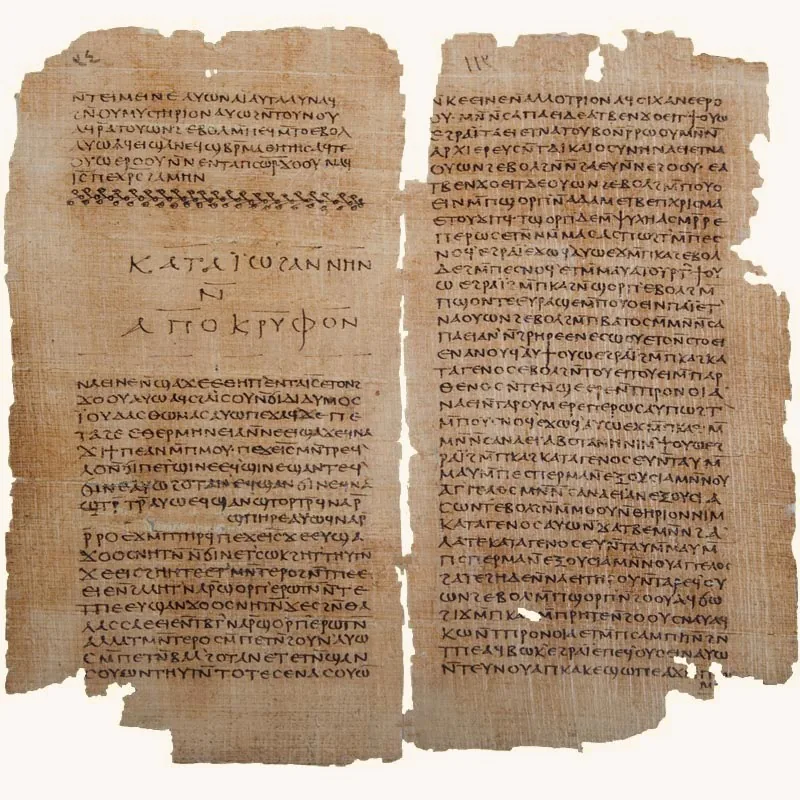
From Barbelo and the Spirit come further aeons: the self-generated Son (Autogenes or Christ), the four great Luminaries named Harmozel, Oroiael, Daveithai and Eleleth, and the heavenly prototypes of Adam and Seth. This Sethian Pleroma is a kind of ordered family of divine qualities — Thought, Foreknowledge, Incorruptibility, Life, Truth — which together make up the fullness of God.
Valentinian writers built a more systematic version. In the account Irenaeus attributes to the followers of Ptolemy, the unknowable Depth (Bythos) and his consort Silence produce thirty aeons in male–female pairs, grouped as an Ogdoad, a Decad and a Dodecad. A boundary-power named Horos ("Limit") guards the edge of the Pleroma and keeps each aeon in its place. In both systems the Pleroma is not a set of separate gods but the self-expression of one hidden source.
Sophia's Fall and the Making of the Demiurge§
The drama begins at the lowest edge of the Pleroma. In most versions the aeon Sophia ("Wisdom") desires to know or to imitate the Father on her own, without her partner or without the consent of the Spirit. Her act produces something incomplete and misshapen. In the Apocryphon of John it is a lion-faced serpent with eyes of fire, whom she names Yaldabaoth and hides in a cloud outside the Pleroma so that the other aeons will not see him.
Yaldabaoth, also called Saklas ("fool") and Samael ("blind god"), is the Gnostic Demiurge. He has stolen a portion of his mother's power, and with it he creates a world in imitation of the higher realm he cannot see. Ignorant of anything above himself, he declares, in words borrowed from Isaiah, that he is God and there is no other — a boast that the texts use to show both his arrogance and his blindness. Valentinian sources soften the picture: their Demiurge is ignorant rather than malicious and serves, without knowing it, the plan of salvation.
Archons, the Seven Heavens and Fate§
Yaldabaoth does not rule alone. He brings forth subordinate powers, the archons ("rulers"), to govern the heavens. The Apocryphon of John speaks of twelve authorities and of seven kings set over the seven heavens, together with 365 angels, a number matching the days of the solar year. Their names — Athoth, Eloaios, Astaphaios, Yao, Sabaoth, Adonin and others — are often distorted forms of Hebrew divine names, a pointed claim that the God worshipped in the Jewish scriptures is the lower ruler. Other texts give them animal faces or link them to the seven planets and the twelve signs of the zodiac.

Through these powers the Demiurge imposes heimarmene, the fixed fate of astrology. In the Gnostic view, planetary influence is not a neutral cause but a chain forged by the rulers to keep souls ignorant and enslaved. The longer version of the Apocryphon of John even says that the chief ruler and his powers begot Fate in order to bind gods, angels, demons and humans alike. Christian teachers of the second century, and Manichaeans after them, offered liberation from fate as one of the gifts of the Saviour.
A famous lost image gives a glimpse of how some groups pictured this order. The pagan critic Celsus, as quoted and answered by Origen in Against Celsus, described a diagram used by a group often called Ophites: a set of concentric circles, with the names of the archons and a great serpent called Leviathan encircling the world.
The Human Being as a Divine Spark Trapped in Matter§
The making of humanity sits at the centre of the myth. In the Apocryphon of John the archons see the image of the heavenly Human reflected in the waters below and try to copy it, creating a soul-body that lies motionless. The higher powers trick Yaldabaoth into breathing his mother's stolen power into it, and Adam rises, brighter than his makers. Jealous, the archons cast him down into a material body, the "tomb" of flesh, and surround him with the passions and forgetfulness.
The Hypostasis of the Archons and On the Origin of the World tell parallel stories in which spiritual Eve or Norea outwits the rulers. Valentinian teachers developed the idea into a threefold anthropology — spiritual, psychic and material — in which only the spiritual element is fully at home in the Pleroma. In every version, the human being is more than the world that produced it, and this is why gnosis is possible: the spark of light recognises its origin.
The Ascent of the Soul and the Passwords§
If the archons guard the heavens, the soul's journey back after death must pass them. Several texts describe this ascent. In the Gospel of Mary the soul answers a series of powers, including Darkness, Desire, Ignorance and Wrath, and leaves each one behind. In the First Apocalypse of James Jesus teaches James the answers to give to the "toll collectors" who will try to seize him. Irenaeus reports that followers of the teacher Mark used formulas for the dying so that they would become invisible to the powers.
The later Coptic writings, such as the Pistis Sophia and the Books of Jeu, multiply these structures into vast systems of treasuries, seals, names and numbers that the initiated soul must know. The idea of an ascent past heavenly guardians has parallels in Merkavah mysticism and in the Hermetic Poimandres.
Variants: Valentinian, Sethian, Manichaean and Mandaean Cosmologies§
Sethian texts dwell on the heavenly world and the descent of the Saviour; Valentinian writings such as the Tripartite Tractate treat the fall as part of a providential plan. Marcion, though often grouped with the Gnostics, had no Pleroma at all: he simply distinguished a just creator from the good, unknown God revealed by Christ.
Mani in the third century turned the structure into a cosmic dualism of two eternal principles, Light and Darkness, whose mixture produced the world; the cosmos itself becomes a machine for refining the captured light. The Mandaeans of Iraq and Iran, the only ancient Gnostic community to survive, describe a World of Light ruled by the Great Life and a dark world below, with a demiurgic figure, Ptahil, who builds the earth; their cosmology is outlined in the guide to Manichaeism and Mandaeism.
Frequently asked questions§
What is the Pleroma in Gnosticism?§
The Pleroma, Greek for "fullness", is the divine realm surrounding the highest God. It is made up of aeons, emanations or aspects of God, often arranged in male and female pairs. Gnostic myths locate the origin of the world in a disturbance at the edge of this realm.
Who are the archons?§
The archons ("rulers") are the powers created by or alongside the Demiurge to govern the heavens and the material world. They are often linked with the seven planets and the signs of the zodiac, and they enforce fate and ignorance. Gnostic texts teach that the enlightened soul can pass them at death.
Did the Gnostics believe the world was evil?§
Many Gnostic texts portray the material world as flawed, ignorant or imprisoning, but views vary. Some, especially Valentinian writings, present creation as a stage in a divine plan, and scholars caution against reducing all Gnostic thought to simple world-hatred.
Where can I read the Gnostic creation myth?§
The most complete version is the Apocryphon of John, found in the Nag Hammadi codices and the Berlin Codex. Related accounts appear in the Hypostasis of the Archons, On the Origin of the World and the reports of Irenaeus of Lyon.
Sources and further reading§
- The Gnostic Religion — Hans Jonas, 1958
- Gnosis: The Nature and History of Gnosticism — Kurt Rudolph, 1983
- The Gnostic Scriptures — Bentley Layton, 1987
- The Secret Revelation of John — Karen L. King, 2006
- The Apocryphon of John: Synopsis of Nag Hammadi Codices II,1; III,1; and IV,1 with BG 8502,2 — Michael Waldstein and Frederik Wisse, 1995
- The Nag Hammadi Scriptures — Marvin Meyer (ed.), 2007
- The Gnostic New Age — April D. DeConick, 2016