Liber XII · Hermeticism · Chapter II: Corpus Hermeticum
Poimandres: The First Treatise of the Corpus Hermeticum
The Poimandres explained: the Hermetic vision of divine Mind, the creation, the fall of the primal Human and the soul's ascent through seven spheres.

The Poimandres is the first and best-known treatise of the Corpus Hermeticum, a Greek text probably written in Roman Egypt between the first and third centuries CE. In it a seeker falls into a trance and receives a vision from Poimandres, the divine Mind, who explains how the world was made, how the human soul fell into the body, and how it can rise again through the seven planetary spheres to God. Its themes of revelation, cosmic descent and saving knowledge made it the founding text of Hermetic spirituality.
The Name and Setting of the Poimandres§
The text opens in the first person. The narrator, unnamed in the treatise itself but identified with Hermes Trismegistus by later readers (and by Treatise XIII, which refers back to Poimandres), recounts that his bodily senses were stilled "as in heavy sleep", when an enormous being called him by name and asked what he wished to see and know. The being introduces himself as Poimandres, "the Mind of the Sovereignty" (ho tēs authentias nous).
The meaning of the name is disputed. Since antiquity it has been read as Greek for "shepherd of men" (from poimēn, shepherd, and anēr, man), an image that resonates with the biblical and early Christian Good Shepherd and with the early Christian Shepherd of Hermas. Some Egyptologists have proposed instead that the name renders a Coptic or late Egyptian phrase meaning "the knowledge of Re", which would fit the treatise's Egyptian milieu. Neither derivation is proven.
Dating relies on content rather than external evidence. It knows Platonic and Stoic cosmology and the Greek Bible but not developed Christian doctrine, and most scholars place it in the second century CE, with a broader range of the first to third centuries.
The Cosmogonic Vision of Light and Darkness§
Poimandres answers the narrator's request by changing his appearance, and the narrator sees an endless, joyful light. Then a darkness appears below, "frightful and gloomy", coiling like a serpent and changing into a watery, smoky nature that gives out an inarticulate cry. From the light a holy Word (Logos) descends upon the watery nature, and pure fire leaps upward, followed by air, while earth and water remain mixed below, moved by the Word.
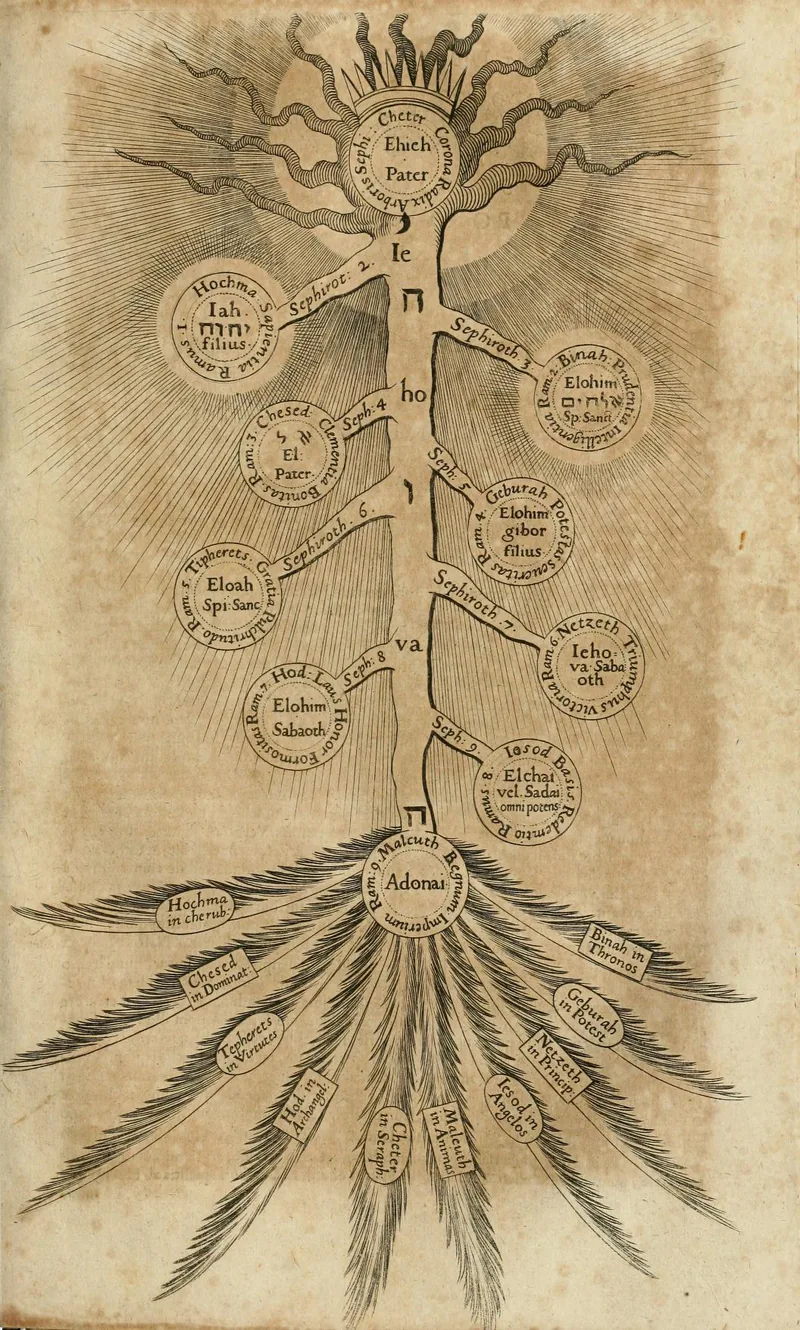
Poimandres interprets the vision: the light is himself, Mind, the narrator's God; the luminous Word that issues from Mind is the "son of God". The two are not separated, for their union is life. The account reads in part like a philosophical meditation on the opening of Genesis, where darkness lies over the deep and God's spirit moves upon the waters; C. H. Dodd's The Bible and the Greeks (1935) argued for direct dependence on the Greek Septuagint.
The craftsman Mind and the seven governors§
The first Mind, which is "both male and female, existing as life and light", brings forth by speech a second, craftsman Mind (nous dēmiourgos), god of fire and spirit. This demiurge fashions seven governors, the planetary powers, who encompass the sensible world in their circles; their government is called fate (heimarmenē). The Word then leaps up from the lower elements and unites with the craftsman Mind, leaving the lower nature without reason, to bring forth irrational animals. The scheme recalls the craftsman of Plato's Timaeus, but unlike the ignorant creator of some Gnostic myths described in our article on the demiurge, this maker is good and consubstantial with the first Mind.
The Myth of the Primal Human§
The heart of the treatise is its account of humanity. The Father, Mind, gives birth to a Human (anthrōpos) equal to himself and very beautiful, bearing the Father's image, and loves him as his own offspring. The Human wishes to create in his turn, and the seven governors, delighted with him, each give him a share of their own rank. Breaking through the vault of the spheres, the Human leans down and shows Nature the beautiful form of God. Nature smiles in love, for she sees his form reflected in the water and his shadow upon the earth. He, seeing his own likeness in Nature, loves it and wishes to dwell there; at once his wish is fulfilled, and Nature embraces him. The two are joined as lovers.
For this reason, Poimandres explains, the human being alone among earthly creatures is twofold: mortal because of the body, immortal because of the essential Human; subject to fate though above it, enslaved though master of the spheres. Nature then brings forth seven androgynous humans corresponding to the seven governors. At the end of an age these beings are divided into male and female, and God speaks a holy word commanding them to increase and multiply, words that clearly echo Genesis 1:28.
The moral follows: the one who recognises himself as coming from life and light returns to life, while the one who loves the body that came from the error of desire remains wandering in darkness. Self-knowledge, not ritual, is the turning point.
The Ascent of the Soul through the Seven Zones§
The narrator asks how he will return. Poimandres describes the fate of the soul after death. The body is surrendered to dissolution, the outward character is handed back to the daimon, and the senses return to their sources. The person then rises upward through the framework of the spheres, giving back to each zone an energy received in the descent:

- to the first zone, the power of growth and decrease;
- to the second, the devices of evil and guile;
- to the third, the illusion of desire;
- to the fourth, domineering arrogance;
- to the fifth, unholy daring and reckless audacity;
- to the sixth, evil striving after wealth;
- to the seventh, the falsehood that lies in ambush.
The treatise does not name the planets, but commentators usually assign the zones in ascending order from the Moon to Saturn. Stripped of these energies, the soul enters the eighth, "ogdoadic" nature, where it hymns the Father with those already present, hears the powers above singing, becomes like them, and finally enters into God. "This is the good end for those who have received knowledge," Poimandres says: to be made god. The same pattern of eighth and ninth spheres appears in the Discourse on the Eighth and Ninth found at Nag Hammadi.
Preaching, Thanksgiving and the Closing Hymn§
Poimandres then mingles with the powers and departs, and the narrator, empowered and instructed, begins to preach to humanity, calling on people who have given themselves to drunkenness and sleep to wake up and repent. Some mock him; others ask to be taught, and at sunset he leads them in thanksgiving.
The treatise ends with a hymn beginning "Holy is God, the Father of all", followed by a petition that the speaker may enlighten those in ignorance. A version of this prayer appears in a third-century papyrus in Berlin within a collection of Christian prayers, evidence that Hermetic devotional language could pass readily between communities.
Gnostic, Jewish and Platonic Echoes§
The Poimandres has been central to debates about the origins of Gnosticism. In Poimandres (1904) Richard Reitzenstein argued that it reflected an Egyptian religious community devoted to the god, and he placed it among the sources of Gnostic and early Christian salvation myths. Later scholars rejected many of his hypotheses but agreed that the treatise shares with Gnostic texts a myth of a heavenly Human who descends into matter, a sevenfold planetary power and an ascent beyond fate. The comparison is explored in what Gnosticism is.
The differences matter as much as the parallels. In the Poimandres the cosmos is beautiful, its maker is good, and the fall of the Human results from love rather than from a cosmic error or a hostile power. Its concepts of Mind, Word and Soul belong to the Middle Platonic philosophy of the period, while its language of the Logos and of creation reveals Hellenistic Jewish influence.
Reception from Ficino to the Golden Dawn§
Byzantine scholars placed the Poimandres at the head of the Hermetic collection, and when Marsilio Ficino translated it in 1463 he titled the whole Latin volume Pimander. Printed in 1471 and reprinted many times, it became one of the most widely read philosophical texts of the Renaissance (see the main article on the Corpus Hermeticum). John Everard's English translation, published as The Divine Pymander in 1650, made it available to English readers; its opening books can be read in the library's Divine Pymander.
Modern esotericists continued to treat it as the archetypal Hermetic revelation. The founders of the Hermetic Order of the Golden Dawn knew it chiefly through Everard's version, which was reprinted in the 1880s, and G. R. S. Mead's Thrice-Greatest Hermes (1906) gave it an extensive commentary. Its account of the soul passing through the planetary spheres has influenced modern ideas of astral magic and spiritual ascent.
Frequently asked questions§
What does the name Poimandres mean?§
The traditional explanation is "shepherd of men", from Greek words for shepherd and man. Some scholars have suggested an Egyptian origin meaning "knowledge of Re". Within the treatise Poimandres identifies himself as the Mind of absolute sovereignty.
Is the Poimandres a Gnostic text?§
It shares several motifs with Gnostic writings, including a heavenly Human who falls into matter and an ascent through planetary spheres. But it regards the cosmos and its craftsman as good, so most scholars classify it as Hermetic rather than Gnostic in the narrower sense.
Who wrote the Poimandres?§
The author is unknown. The text presents itself as a revelation received by an unnamed narrator later identified with Hermes Trismegistus. It was most likely written by a Greek-speaking author in Roman Egypt.
What happens to the soul in the Poimandres?§
After death the soul ascends through seven zones, surrendering a passion or vice at each one. Freed of them, it enters the eighth sphere, sings with the powers there and finally becomes one with God.
Sources and further reading§
- Hermetica: The Greek Corpus Hermeticum and the Latin Asclepius — Brian P. Copenhaver, 1992
- Corpus Hermeticum (Budé edition, 4 vols.) — A. D. Nock & A.-J. Festugière, 1945
- The Way of Hermes: New Translations of the Corpus Hermeticum — Clement Salaman, Dorine van Oyen, William D. Wharton & Jean-Pierre Mahé, 1999
- Poimandres: Studien zur griechisch-ägyptischen und frühchristlichen Literatur — Richard Reitzenstein, 1904
- The Bible and the Greeks — C. H. Dodd, 1935
- The Gnostic Religion — Hans Jonas, 1958
- Thrice-Greatest Hermes — G. R. S. Mead, 1906