Liber XII · Hermeticism · Chapter II: Corpus Hermeticum
Kore Kosmou: Isis, Horus and the Hermetic Creation of Souls
The Kore Kosmou, or Virgin of the World: the Hermetic dialogue of Isis and Horus preserved by Stobaeus, on hidden books, fallen souls, Momus and Osiris.

The Kore Kosmou is the longest Hermetic text outside the Corpus Hermeticum: a dialogue in which the goddess Isis teaches her son Horus how the world was ordered, how souls were created and imprisoned in bodies, and why Osiris and Isis were sent to civilise humanity. It survives only as an excerpt in the fifth-century anthology of John Stobaeus, and its title is usually rendered "Virgin of the World" or "Pupil of the World". Its blend of Platonic myth and Egyptian theology makes it a key witness to how Hermetic authors imagined Egypt as the home of divine wisdom.
John Stobaeus and the Hermetic Excerpts§
John of Stobi, known as Stobaeus, compiled a large anthology of extracts from Greek poets, philosophers and historians, probably in the early fifth century CE, for the education of his son. Arranged by topic (God, the soul, fate, virtue, marriage and so on), it preserves many texts that are otherwise lost. Among them are about thirty passages attributed to Hermes Trismegistus, which modern editors number as Stobaean Hermetica (SH) 1–29.
The excerpts vary greatly. Some are brief maxims, others substantial discourses of Hermes to his son Tat or to Ammon, on topics such as truth, matter, fate and the decans of the zodiac. A group of them (SH 23–27) are speeches of Isis to Horus. The Kore Kosmou is SH 23, and with SH 24–26 it forms a small Isis cycle on the creation, nature and destiny of souls.
These texts matter because the surviving Corpus Hermeticum is a Byzantine selection. Stobaeus shows that a much wider Hermetic literature circulated in late antiquity, including works that gave goddesses rather than Hermes the role of revealer. The complete corpus of these fragments is edited in the third and fourth volumes of the Nock–Festugière Budé edition and translated in M. David Litwa's Hermetica II (2018).
Isis Teaches Horus: Title, Setting and Date§
The title is puzzling. Korē in Greek can mean a girl or daughter, and also the pupil of the eye; kosmou means "of the world". Translators have therefore proposed "Virgin of the World", "Daughter of the Cosmos" and "Pupil of the World's Eye". The last may refer to the knowledge revealed in the text as the "eye" through which the world is seen, or to Isis herself; there is no agreed solution.
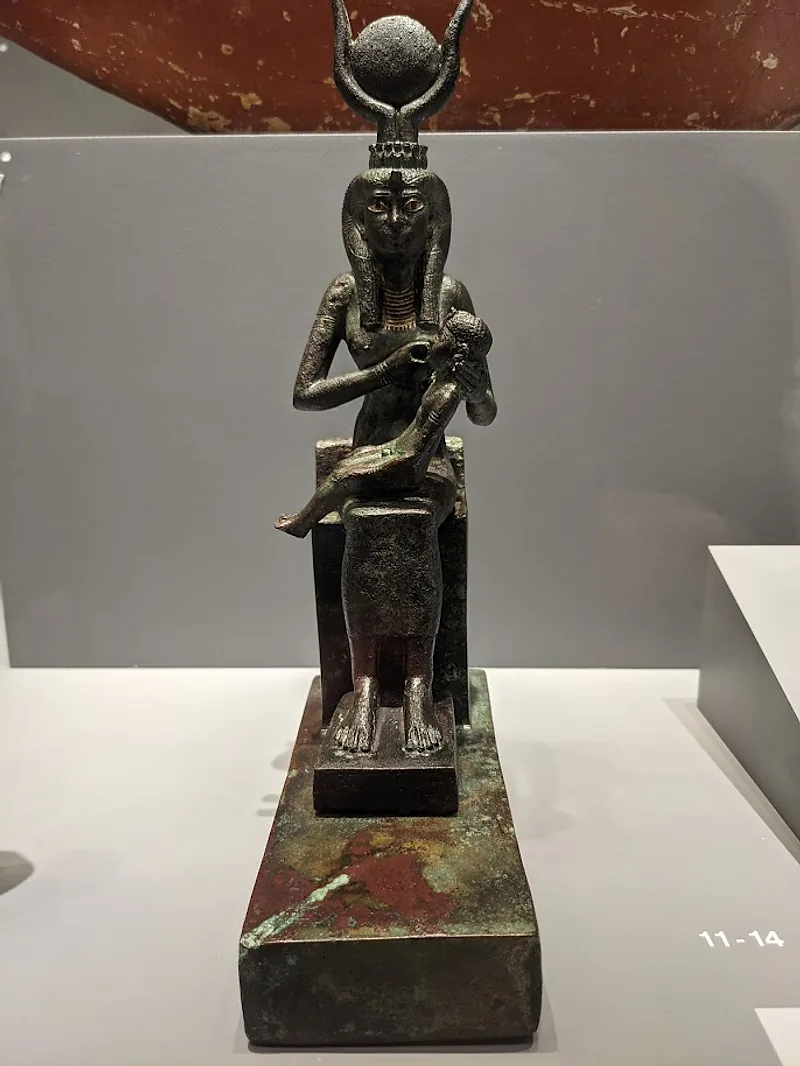
The setting is Egyptian. Isis speaks as the guardian of ancient knowledge, and Horus as the eager pupil who interrupts with questions, a reversal of the usual Hermetic pattern in which Hermes instructs Tat or Asclepius. In the Egyptian religion of the Ptolemaic and Roman periods (see Ancient Egyptian Religion), Isis had become a universal goddess of wisdom and magic, worshipped across the Mediterranean, and Horus was the model of the divine king. Hermetic authors exploited this prestige: Isis says that she received the secret teaching through an ancestor called Kamephis, who in turn had received it from Hermes.
Like most philosophical Hermetica, the Kore Kosmou cannot be dated precisely. Its Platonism, its astrology and its interest in Egyptian cult point to the Roman period, and scholars usually place it in the second or third century CE.
The Hidden Books of Hermes and the Creation of Souls§
The dialogue opens with a description of the cosmos before knowledge. The heavenly realm was ordered and glorious, but the lower world did not yet know the creator. God therefore sent Hermes, a soul in sympathy with the heavenly mysteries, who saw all things, understood them and recorded them. Before returning to heaven, Hermes hid his sacred writings near the secret things of Osiris, uttering a prayer that they should remain unknown until worthy seekers were born. This story of hidden books belongs to a widespread Egyptian and Hermetic motif: the wisdom of Hermes Trismegistus was preserved in temples, inscribed on stelae or concealed, and later rediscovered.
Isis then describes creation. God mixes a substance from his own breath and other elements, from which he forms a great number of souls, ranked in orders and assigned regions of the upper world. They are given rules and told not to transgress them. The souls, however, become restless and curious, leave their appointed places and interfere in things that do not concern them. As punishment, God decrees that they must be bound into bodies. Hermes is given a part in fashioning human bodies from the mixture of the elements, and the souls lament bitterly at their coming imprisonment. God answers them: those who live without sin will return to heaven, while those who sin will descend into the bodies of animals.
The myth combines several sources. The mixing of souls recalls Plato's Timaeus, in which the craftsman god blends soul-stuff in a bowl; the fall of souls through their own presumption recalls the descent of the primal Human in the Poimandres; and the threat of animal rebirth reflects Platonic and Pythagorean teaching on transmigration.
Momus and the Complaint of the Elements§
Two scenes give the text its drama. In the first, after humans have been made, Momus, the Greek personification of blame and criticism, addresses Hermes. He warns that this new creature, endowed with intelligence and curiosity, will be bold enough to explore the roots of plants, the properties of stones, the depths of the sea and even the heavens. He advises that humans be held in check by desires, fears, sorrows and illness, so that their daring does not go unpunished. Hermes accepts the warning, and the text describes how fate and the movements of the stars are set over human lives. The passage is an early reflection on human technical ambition, comparable to the Greek stories of Prometheus.

In the second scene, the four elements come before God to complain. Humans, they say, have become violent and impious. Each element in turn describes how it has been defiled by bloodshed, by the dead and by impious use, and asks for help. The scene is an unusual piece of ancient environmental imagination, in which the parts of nature protest against human misuse.
Osiris and Isis as Bringers of Civilisation§
God answers the elements by sending an emanation of his own nature into the world: Osiris and Isis. Isis recounts what she and her brother-husband accomplished. They filled the world with divine things, established sacred rites corresponding to heavenly mysteries, introduced laws and justice, taught burial of the dead, gave people the arts of life, and instituted oaths, so that violence gave way to order. Having learned from the hidden writings of Hermes, they set up the cults and then were recalled to heaven.
This section reworks a long Greek tradition of Osiris and Isis as culture-bringers, already found in Diodorus of Sicily and in Plutarch's essay On Isis and Osiris. In the Hermetic version their civilising work depends on the books of Hermes, so that Egyptian religion itself appears as the application of Hermetic wisdom. The neighbouring excerpts continue the theme: SH 24 explains why some souls are royal and others base, and presents Egypt as the holiest land of the earth, set at its centre like the heart in a body.
Read alongside the Asclepius, which praises Egypt as the image of heaven and the temple of the whole world, the Kore Kosmou shows how Hermetic writers in Roman Egypt presented their homeland and its cults as the earthly reflection of the divine order.
Reception from the Renaissance to the "Virgin of the World"§
Because it was not part of the Byzantine Corpus Hermeticum translated by Marsilio Ficino in 1463, the Kore Kosmou had a quieter Renaissance history than the Poimandres. It became available as Stobaeus' anthology was printed in the sixteenth century, and Francesco Patrizi included Hermetic excerpts from Stobaeus in the Hermetic collection printed with his Nova de universis philosophia (1591).
Its modern fame began in the nineteenth century. The French scholar Louis Ménard translated it in his Hermès Trismégiste (1866), and from his French the Christian esotericists Anna Kingsford and Edward Maitland made the English version The Virgin of the World (1885), which circulated widely in Theosophical and occult circles. G. R. S. Mead included a new translation in Thrice-Greatest Hermes (1906), and Walter Scott printed and heavily emended it in his Hermetica (1924–1936).
Today it is read in the critical editions of Nock and Festugière and in Litwa's translation. Scholars value it for its evidence of Isis as a revealer within Hermetism, for its mythic version of the soul's fall, and for its portrait of Egypt as the seat of the oldest wisdom, the idea that later fed the Renaissance belief in a prisca theologia.
Frequently asked questions§
What does Kore Kosmou mean?§
The Greek words can be translated "Virgin of the World", "Daughter of the Cosmos" or "Pupil (of the eye) of the World". The meaning intended by the author is uncertain, and different translators have chosen different renderings.
Is the Kore Kosmou part of the Corpus Hermeticum?§
No. It is preserved only in the anthology of John Stobaeus, where it is Hermetic Excerpt 23. It belongs to the wider body of philosophical Hermetica outside the seventeen Greek treatises of the Corpus Hermeticum.
Who are the speakers in the Kore Kosmou?§
The goddess Isis speaks to her son Horus. She recounts teachings that go back to Hermes Trismegistus, who appears as a figure of the mythical past who recorded and hid the secrets of heaven.
Who is Momus in the Hermetic text?§
Momus is the Greek personification of blame and fault-finding. In the Kore Kosmou he warns Hermes that intelligent, curious humans will become too daring, and advises that they be restrained by desires, fears and suffering.
Sources and further reading§
- Hermetica II: The Excerpts of Stobaeus, Papyrus Fragments, and Ancient Testimonies — M. David Litwa, 2018
- Corpus Hermeticum (Budé edition, 4 vols.) — A. D. Nock & A.-J. Festugière, 1945
- Hermetica: The Ancient Greek and Latin Writings Which Contain Religious or Philosophic Teachings Ascribed to Hermes Trismegistus — Walter Scott, 1924
- The Virgin of the World of Hermes Mercurius Trismegistus — Anna Kingsford & Edward Maitland, 1885
- Thrice-Greatest Hermes — G. R. S. Mead, 1906
- The Egyptian Hermes — Garth Fowden, 1986
- The Tradition of Hermes Trismegistus: The Egyptian Priestly Figure as a Teacher of Hellenized Wisdom — Christian H. Bull, 2018