Liber XVI · Indigenous & Ancient Religions · Chapter II: Ancient Egyptian Religion
Ancient Egyptian Religion: Gods, Temples, Ma'at and Afterlife
Ancient Egyptian religion explained: the gods, creation myths, Ma'at, the pharaoh and temple cult, Akhenaten, mummification and the Book of the Dead.

Ancient Egyptian religion was the system of belief and worship that flourished along the Nile for more than three thousand years, from before the first dynasties around 3000 BCE until the closing of the last temples in the sixth century CE. Egyptians honoured hundreds of gods, among them Ra, Osiris, Isis, Horus, Amun, Ptah and Hathor, in temples served by priests on behalf of the king, and they developed an elaborate vision of the afterlife preserved in the Pyramid Texts, the Coffin Texts and the Book of the Dead. At its centre stood Ma'at, the principle of cosmic order, truth and justice that gods, king and people were bound to uphold.
Gods and Goddesses of Egypt§
Egyptian deities (netjeru, singular netjer) were many and their forms fluid. A god could be shown as a human, an animal or a human with an animal head: Horus as a falcon, Anubis as a jackal, Thoth as an ibis or baboon, Sekhmet as a lioness, Hathor as a cow or a woman with cow's horns. These images were not believed to be the god's literal appearance but visible signs of their character. Gods could also be combined: Amun of Thebes joined with the sun god as Amun-Ra, king of the gods in the New Kingdom (c. 1550–1070 BCE).
Each city had its patrons. Ptah was the creator and craftsman god of Memphis; Amun, Mut and Khonsu formed the divine family of Thebes; Osiris was lord of Abydos and of the dead. The Egyptologist Erik Hornung argued in Conceptions of God in Ancient Egypt (German 1971) that Egyptians held "the one and the many" together, speaking of a single supreme god in some hymns while worshipping many gods in practice, without seeing a contradiction.
Creation Myths and Ma'at§
Egypt had several creation accounts, linked to different cult centres, which were never harmonised into one canon:
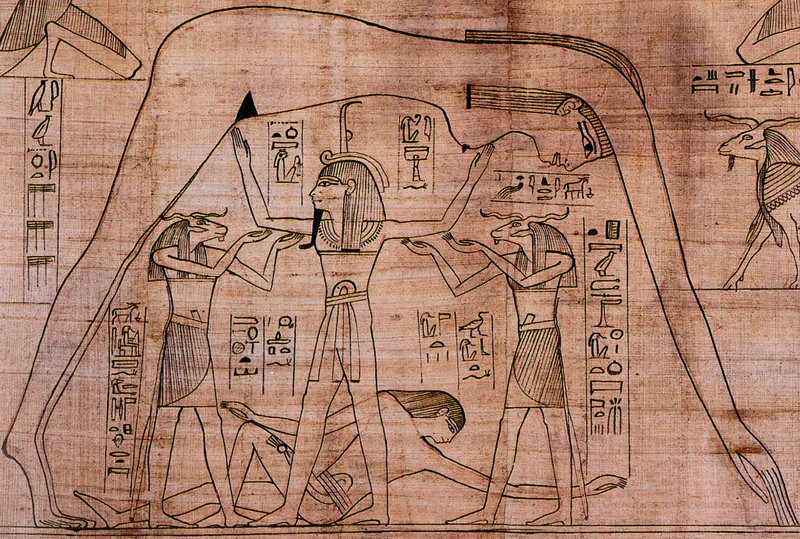
- At Heliopolis, the creator Atum arose from the waters of chaos, Nun, on a primeval mound and produced Shu (air) and Tefnut (moisture), who bore Geb (earth) and Nut (sky), whose children were Osiris, Isis, Seth and Nephthys. These nine form the Ennead.
- At Hermopolis, an Ogdoad of eight primordial beings personified the qualities of the waters before creation, such as darkness and infinity.
- At Memphis, the text on the Shabaka Stone, carved around 710 BCE but claiming to copy an older original, describes Ptah creating the world through thought ("heart") and speech ("tongue"). Its date of composition is debated.
Creation was never finished once and for all. Each sunrise repeated the first morning, as Ra sailed his barque across the sky by day and through the underworld (the Duat) by night, defeating the chaos serpent Apep. Ma'at, personified as a goddess with an ostrich feather, was the right order established at creation. The king's duty was to "set Ma'at in place of isfet" (disorder), and every Egyptian was expected to live by it.
The Pharaoh, Temples and Priests§
In theory the king alone served the gods; in practice priests acted on his behalf in every temple. A temple was the house of the god, built as a model of the cosmos: the pylon gateway represented the horizon, the columned hall the papyrus marsh of creation, and the dark inner sanctuary the primeval mound. There the cult statue, believed to be inhabited by the god's presence, was woken each morning, purified, clothed, anointed and offered food, after which the offerings "reverted" to feed the priests.
Most people never entered a sanctuary. They encountered the gods during festivals, when statues were carried out in portable barques, as in the Opet festival at Thebes or the Beautiful Festival of the Valley. Oracles were delivered by the movements of the god's barque. Ordinary devotion also flourished at household shrines, in prayers to protective deities such as Bes and Taweret, and in votive offerings at local temples. Practical rituals for healing and protection, called heka, are discussed in What Is Ancient Magic? and in the library's article on Amulets and Talismans.
Osiris, Isis and the Afterlife§
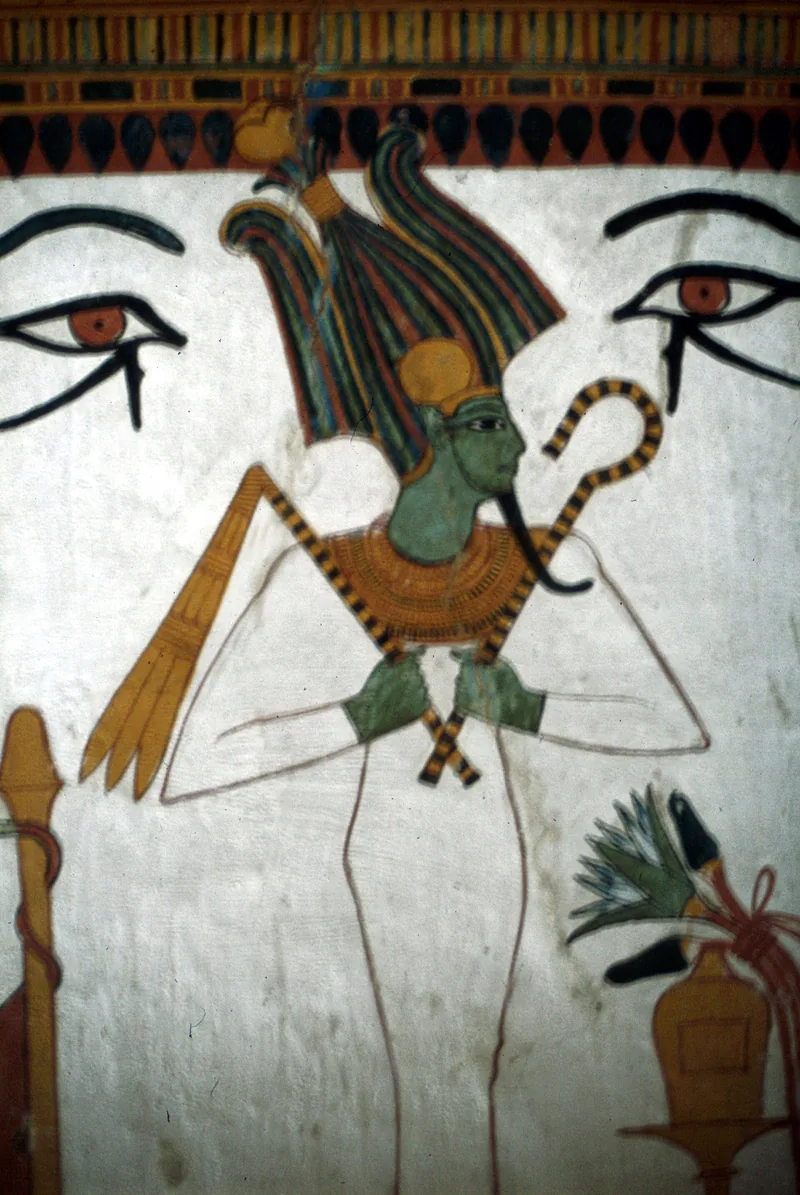
The fullest connected version of the Osiris myth comes late, from the Greek writer Plutarch (c. 100 CE), but its elements are present in Egyptian texts from the Old Kingdom. Osiris, a good king, is murdered by his brother Seth and his body dismembered. His sister-wife Isis, with Nephthys, gathers and revives him long enough to conceive Horus, who grows up to defeat Seth and claim the throne, while Osiris becomes ruler of the dead. Every living king was identified with Horus and every dead king with Osiris; over time the hope of becoming "an Osiris" extended to all who could afford proper burial.
Egyptians described the person as made of several parts: the body, the name, the shadow, the ka (vital force, sustained by offerings), the ba (often drawn as a human-headed bird, able to move between tomb and world) and the akh (the transfigured, effective spirit). Mummification preserved the body as a home for these, and tombs received food offerings and inscriptions so that the dead would be remembered.
Funerary literature developed over time. The Pyramid Texts, first carved in the pyramid of Unas around 2350 BCE, were royal spells for the king's ascent to the sky. The Coffin Texts of the Middle Kingdom adapted them for officials. From about 1550 BCE the Book of the Dead, which Egyptians called the "spells for going out by day", was written on papyrus rolls for wealthier people. Its spell 125 describes the judgment in the hall of the two truths, where the deceased declares innocence of a list of wrongs and the heart is weighed against the feather of Ma'at before Osiris.
Akhenaten and the Religion of the Aten§
The most radical episode in Egyptian religion came under Amenhotep IV, who reigned c. 1353–1336 BCE and renamed himself Akhenaten. He elevated the Aten, the visible sun disc, as the sole object of royal worship, built a new capital at Amarna, and in time closed the temples of other gods and had Amun's name erased from monuments. The Great Hymn to the Aten celebrates the sun as the giver of life to all lands. Scholars debate whether this was true monotheism, a royal cult centred on the king and his family, or something in between. After his death the old cults were restored under Tutankhamun, and Akhenaten was later treated as a heretic whose name was left off king lists.
Late Egypt, Isis and the Legacy of Egyptian Religion§
Under the Ptolemies (305–30 BCE) and Rome, Egyptian religion continued and also spread abroad. Greek rulers promoted Serapis, a composite of Osiris and the Apis bull, and the cult of Isis became one of the most popular in the Roman world, with temples from Pompeii to Britain. Animal cults, such as the burial of millions of mummified ibises, cats and falcons as offerings, reached their height in this late period. Christianity gradually displaced the old religion; the temple of Isis at Philae, the last to function, is traditionally said to have been closed by order of Justinian around 535–537 CE.
Egypt's prestige outlived its religion. Greek writers credited Egyptian priests with ancient wisdom, and the Hermetic writings attributed to Thoth as Hermes Trismegistus, discussed in Corpus Hermeticum, carried an idealised Egypt into Renaissance and modern esotericism, alongside stories of Egyptian magicians such as those in Moses as Magician. Modern Kemetic groups now revive the worship of the Egyptian gods. Comparisons with Egypt's great neighbour are drawn in Mesopotamian Religion.
Frequently asked questions§
Who was the most important Egyptian god?§
It depended on period and place. Ra the sun god was pre-eminent in the Old Kingdom; Amun-Ra was king of the gods in the New Kingdom; Osiris was the most important god of the dead, and Isis became the most widely worshipped goddess in late antiquity.
What is the Book of the Dead?§
It is a modern name for a collection of about two hundred funerary spells, written on papyrus and placed in tombs from about 1550 BCE. No two copies are identical; owners chose spells to guide and protect them in the afterlife, including the famous judgment scene of spell 125.
Was Akhenaten the first monotheist?§
He is often called so, because he promoted the Aten above all other gods and suppressed some of their cults. Many Egyptologists prefer to speak of a henotheistic or royal sun cult, since the king and queen remained mediators of the Aten and older ideas persisted.
Did ordinary Egyptians believe in the afterlife?§
Yes, though the elaborate tombs and texts were mostly for the elite. Ordinary people were buried with simpler goods, amulets and offerings, and the hope of joining Osiris spread widely from the Middle Kingdom onwards.
Sources and further reading§
- The Ancient Egyptian Pyramid Texts — R. O. Faulkner (trans.), 1969
- The Ancient Egyptian Book of the Dead — R. O. Faulkner (trans.), 1985
- Conceptions of God in Ancient Egypt: The One and the Many — Erik Hornung, 1982
- The Search for God in Ancient Egypt — Jan Assmann, 2001
- The Complete Gods and Goddesses of Ancient Egypt — Richard H. Wilkinson, 2003
- Handbook of Egyptian Mythology — Geraldine Pinch, 2002
- Exploring Religion in Ancient Egypt — Stephen Quirke, 2015
- Ancient Egyptian Literature — Miriam Lichtheim, 1973