Liber XVI · Indigenous & Ancient Religions · Chapter II: Ancient Egyptian Religion
The Osiris Myth: Isis, Horus, Seth and the Egyptian Afterlife
The Osiris myth explained: its Egyptian sources and Plutarch, the murder by Seth, Isis's search, Horus's contest for the throne, Abydos and Osiris the judge.

The Osiris myth is the central story of ancient Egyptian religion: the good king Osiris is murdered by his brother Seth, his body is found and restored by his sister-wife Isis, who conceives their son Horus, and Horus grows up to defeat Seth and take the throne while Osiris becomes ruler of the dead. The myth explained kingship, death and renewal, and it shaped Egyptian funerary religion for nearly three thousand years. No single Egyptian narrative of it survives; the familiar version is pieced together from hymns, spells and stories, and above all from the Greek writer Plutarch.
Egyptian Texts and Plutarch: Where the Osiris Myth Comes From§
Egyptian texts treat the death of Osiris with notable reticence. The event was so charged that it is mostly referred to obliquely, as something that happened "on the riverbank" or as the god being "laid low". The earliest evidence is the Pyramid Texts, carved in royal tombs from the reign of Unas onward, which repeatedly identify the deceased king with Osiris and speak of Isis and Nephthys gathering his limbs and of Horus avenging his father. The Middle Kingdom Coffin Texts and the New Kingdom Book of the Dead extend the same imagery to non-royal people.
The fullest Egyptian account is the Great Hymn to Osiris on the stela of Amenmose, an Eighteenth Dynasty official, now in the Louvre. It praises Osiris as ruler of the Two Lands and describes Isis searching for him tirelessly, shading him with her wings, reviving him and conceiving his heir. The Contendings of Horus and Seth, written on Papyrus Chester Beatty I in the reign of Ramesses V (twelfth century BCE), narrates the aftermath. The so-called Memphite Theology on the Shabaka Stone, carved around 700 BCE but claiming to copy an older text, places the drowning of Osiris and the division of Egypt between Horus and Seth in a cosmology centred on the god Ptah.
The connected story most people know comes from Plutarch, a Greek priest at Delphi, whose treatise On Isis and Osiris was written for a priestess of Isis around 100 CE. Plutarch drew on Egyptian informants and Greek writers, and many of his details match Egyptian evidence, but he also interpreted the myth through Platonic philosophy. His version must therefore be used with care as a guide to earlier belief.
The Story: Murder, Search and Restoration§
In Plutarch's telling, Osiris reigned as a civilising king who taught Egyptians agriculture, laws and the worship of the gods. His brother Seth (whom Plutarch calls Typhon) plotted with seventy-two conspirators. At a banquet he produced a beautiful chest and promised it to whoever fitted inside; when Osiris lay down in it, the conspirators shut the lid, sealed it with lead and threw it into the Nile. The chest drifted to Byblos on the Phoenician coast, where a tree grew around it and was cut down to become a pillar in the king's palace. Isis, searching in mourning, found it and brought the body home.
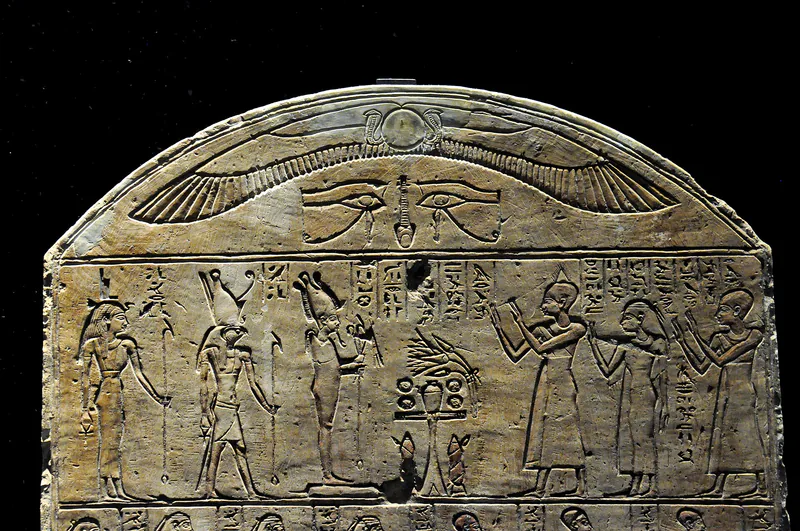
Seth discovered the body while hunting by moonlight and tore it into fourteen pieces, which he scattered across Egypt. Isis and her sister Nephthys sought them out, and each place where a piece was buried claimed a tomb of Osiris, an explanation for the many Osiris shrines in Egypt. Plutarch adds that the phallus could not be found because fish had eaten it, and that Isis fashioned a replica.
Egyptian sources emphasise the restoration more than the dismemberment. Isis and Nephthys lament over the body, Anubis embalms it, making Osiris the first mummy, and Isis, in the form of a kite, hovers over him and conceives Horus. She then hides in the papyrus marshes of Chemmis in the Delta, protecting the infant from Seth, snakes and scorpions, episodes that made Isis the great protector of children in later magic.
Horus and Seth: The Struggle for the Throne§
The Contendings of Horus and Seth opens with a tribunal of the gods, the Ennead, that has already been deliberating for eighty years. The sun god favours Seth, the strong elder; others support the claim of Osiris's son. A letter is sent to the ancient goddess Neith, who advises giving the office to Horus. The proceedings descend into a series of contests and tricks: the rivals turn into hippopotamuses and try to stay underwater, race in boats of stone, and quarrel in episodes of startling crudeness. Isis tricks Seth into condemning himself, and Horus cuts off his mother's head in anger before it is restored.
In the course of the conflict Seth tears out Horus's eye, and Horus injures Seth's testicles. The healing of Horus's eye by Hathor or Thoth gave rise to the wedjat, the restored eye that became one of the most common Egyptian amulets and the symbol of wholeness and offering. Finally a letter from Osiris in the underworld, threatening to send his demons against the gods, settles the case: Horus is crowned king, and Seth is given a place in the sun god's boat, where his strength is used to repel the serpent Apophis.
Seth's character was never wholly evil in Egyptian thought. He was the god of the desert, foreign lands and storms, a necessary force of disorder, and he enjoyed favour under the Ramesside kings, some of whom bore his name. His demonisation increased in the Late Period, when foreign invasion made him a symbol of enemies.
Osiris, Kingship and the Afterlife§
At its core the myth explains Egyptian kingship. The living king was Horus; when he died, he became Osiris, and his successor became Horus in turn, avenging and burying his father. Funerary rites re-enacted the work of Isis, Nephthys and Anubis, and the son's duty to bury his father mirrored that of Horus.
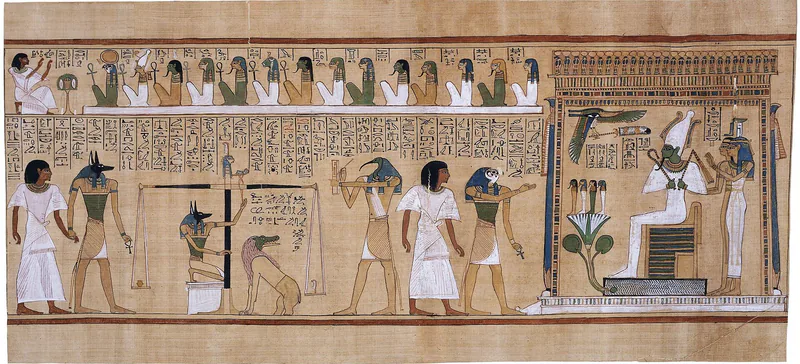
From the end of the Old Kingdom the identification with Osiris spread beyond royalty. In the Coffin Texts and the Book of the Dead, the deceased is named "the Osiris N", and the hope of every Egyptian was to be found "true of voice" and join him. Osiris presides over the judgment of the dead, enthroned in his hall while the heart of the deceased is weighed against the feather of Ma'at, as described in the overview of ancient Egyptian religion.
Osiris was also a god of renewal in nature. He is often shown with green or black skin, colours of vegetation and of the fertile Nile silt, and texts associate him with the inundation and the sprouting grain. The djed pillar, interpreted as his backbone, symbolised stability and resurrection; its ritual raising was part of royal festivals.
Abydos, Khoiak and the Mysteries of Osiris§
Abydos in Upper Egypt became the chief centre of Osiris's cult by the Middle Kingdom, when the tomb of the First Dynasty king Djer was identified as the god's own grave. Pilgrims set up stelae and cenotaphs along the processional way to be near him. The stela of Ikhernofret, an official of Senusret III (nineteenth century BCE), describes his role in the annual festival: a procession of the god's image, a mock battle against his enemies, a journey to the tomb at Poqer, and the god's triumphant return to his temple. The parts performed inside the temple remained secret, which is why Greek writers later spoke of the "mysteries" of Osiris.
In the month of Khoiak, at the end of the inundation, temples across Egypt celebrated the death and revival of Osiris. Ptolemaic inscriptions in the Osiris chapels on the roof of the temple at Dendera describe the making of figures of Osiris from earth and grain, which were watered until the grain sprouted, then buried. Similar "Osiris beds", trays in the god's shape planted with grain, were placed in some tombs, including that of Tutankhamun, and small "corn mummies" survive in many museums.
Isis and Osiris Beyond Egypt§
Under the Ptolemies a new god, Sarapis, combining Osiris with the Apis bull and Greek features, was promoted at Alexandria, where his great temple stood until its destruction in 391 or 392 CE. The cult of Isis spread across the Mediterranean and the Roman Empire, with temples from Pompeii to Britain and initiations described in the eleventh book of Apuleius's Golden Ass. Plutarch's allegory, in which Osiris is reason and order and Seth the irrational and destructive, became the lens through which Renaissance scholars and later esotericists read Egypt.
Modern interpretations vary. James George Frazer made Osiris a prime example of the "dying and rising god" of vegetation, a category Jonathan Z. Smith and other scholars later criticised as a modern construction that blurs important differences; Osiris does not return to life on earth but reigns among the dead. In Western occultism Osiris and Isis became major symbols of initiation, and Aleister Crowley named the age of patriarchal, sacrificial religion the Aeon of Osiris, to be followed by the Aeon of Horus.
Frequently asked questions§
Who killed Osiris?§
According to the myth, Osiris was killed by his brother Seth, the god of storms and the desert, who envied his kingship. Egyptian texts allude to the murder only indirectly; Plutarch's later account describes Seth trapping him in a chest and later dismembering his body.
Why is Osiris green?§
Osiris is often painted with green or black skin. Green was the colour of vegetation and new growth, and black the colour of the fertile Nile silt, so both expressed his role as a god of regeneration as well as of the dead.
How did Horus become king?§
After a long dispute before the tribunal of the gods, told in The Contendings of Horus and Seth, Horus was awarded his father's throne. The decision affirmed that kingship passed from father to son, and every Egyptian king ruled as Horus.
Is Plutarch's account of Osiris reliable?§
Plutarch preserves many details that agree with Egyptian sources and is the only continuous narrative. But he wrote in Greek around 100 CE and interpreted the myth through Platonic philosophy, so scholars check his version against Egyptian texts.
Sources and further reading§
- Osiris: Death and Afterlife of a God — Bojana Mojsov, 2005
- The Conflict of Horus and Seth from Egyptian and Classical Sources — J. Gwyn Griffiths, 1960
- Plutarch's De Iside et Osiride — J. Gwyn Griffiths (ed. and trans.), 1970
- Ancient Egyptian Literature, Volume II: The New Kingdom — Miriam Lichtheim, 1976
- Death and Salvation in Ancient Egypt — Jan Assmann, 2005
- The Complete Gods and Goddesses of Ancient Egypt — Richard H. Wilkinson, 2003
- Egyptian Mythology: A Guide to the Gods, Goddesses, and Traditions of Ancient Egypt — Geraldine Pinch, 2004