What Is Ancient Magic? Egypt, Mesopotamia, Greece and Rome
What was ancient magic? An overview of heka in Egypt, Mesopotamian exorcists, Greek curse tablets, the magical papyri and Roman laws against sorcery.

Ancient magic is the modern name for a wide range of ritual practices in the ancient Near East and Mediterranean, from about the third millennium BCE to late antiquity, that sought practical results such as healing, protection, love, victory or harm to an enemy through spoken formulas, written charms, images and divine names. In Egypt and Mesopotamia much of this work was carried out by respected temple specialists, while in Greece and Rome "magic" increasingly became a label for suspect, private or foreign rites.
The Word "Magic" and the Problem of Definition§
When the Greek historian Herodotus wrote in the fifth century BCE, the magoi were a priestly caste of the Medes and Persians, experts in sacrifice and dream interpretation. Within a few generations Greek writers were using mageia and the related term goēteia (from goēs, a wailer or sorcerer) for itinerant ritual specialists who offered purifications, binding spells and private initiations for a fee. Plato, in the Republic and the Laws, criticised such figures and proposed punishments for those who tried to harm others with incantations or wax images.
This history matters, because the category of magic was born as an outsider's term. In most periods people did not describe their own rites as "magic"; they spoke of prayers, remedies, protective writings or the knowledge of the gods. Historians such as Fritz Graf and Matthew Dickie have therefore emphasised that ancient magic must be studied through the vocabulary of each culture, and that the boundary between religion and magic shifted according to who was speaking. The wider debate about how scholars define magic is set out in Theories of Magic.
Heka: Magic in Ancient Egypt§
Egyptian religion had no sharp division between legitimate worship and magic. Heka was the name of a god who embodied the power by which the creator brought the world into being, and the same word denoted the effective power of ritual speech. Kings, priests and the dead could all possess heka. The lector priest (ḫry-ḥb), who read sacred books in temple and funerary rites, is the figure most often associated with magical expertise, and later Egyptian stories, such as the tales of the magician-prince Setna Khaemwaset, celebrate learned priests who could animate wax figures or recover lost books of Thoth.
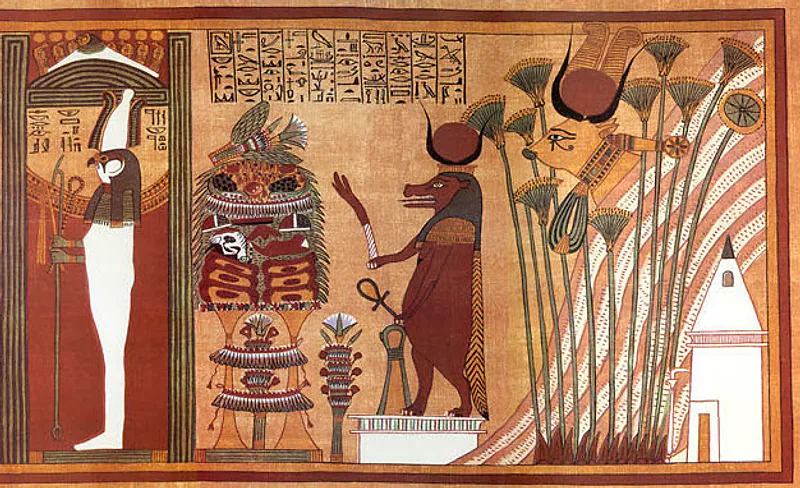
Egyptian magic survives in many forms. The Pyramid Texts, carved inside royal pyramids from around 2400 BCE, contain spells to protect the king and secure his ascent to the sky, and they developed into the Coffin Texts and the Book of the Dead. Medical papyri such as the Ebers Papyrus (around 1550 BCE) combine practical treatments with incantations. Execration rituals involved writing the names of enemies on pots or figurines that were then broken or buried. Robert Ritner's study of these practices showed how many of them rested on concrete ritual acts such as spitting, binding, trampling and licking ink from a written spell.
Egypt's reputation for wisdom made it, in Greek and Roman eyes, the homeland of magic. The figure of Moses as a rival of Pharaoh's magicians, discussed in Moses as Magician, shows how this reputation entered Jewish and Christian tradition.
Exorcists and Incantations in Mesopotamia§
In Sumer, Babylonia and Assyria, protection against demons, witchcraft and divine anger was the responsibility of the āšipu, often translated "exorcist" or "incantation priest". He worked alongside the asû, a healer specialising in medicinal plants, and the bārû, a diviner who read omens in the entrails of sacrificed animals. The āšipu invoked Ea, god of wisdom and fresh water, and his son Asalluhi, later identified with Marduk, in incantations that often recount a dialogue between the two gods before prescribing a ritual remedy.
Cuneiform tablets preserve long, organised series of incantations. Maqlû ("Burning") was a night-long ceremony against witches in which figurines representing the sorcerers were burned. Šurpu sought release from the consequences of broken oaths and hidden offences. Other series dealt with the demoness Lamaštu, who was believed to threaten pregnant women and infants, and with evil spirits in general. These texts and the specialists who used them are described in Mesopotamian Magic.
Greek and Roman Magic§
The most abundant evidence for Greek and Roman magic is physical. More than a thousand curse tablets (Greek katadesmoi, Latin defixiones) have been found, mostly thin sheets of lead inscribed with formulas binding a rival in court, in love, in business or in the chariot races. The earliest come from Sicily and Attica in the sixth and fifth centuries BCE, and the practice lasted well into late antiquity. Engraved gemstones, gold and silver lamellae and small figurines pierced with nails show the same desire to fix and control.

The Greek Magical Papyri (Papyri Graecae Magicae, PGM), a body of handbooks and single spells written in Greek, Demotic and Coptic, mostly between the second century BCE and the fifth century CE, reveal how such rituals were taught. They mix Egyptian, Greek, Jewish and Persian elements: invocations of Helios, Hermes, Hecate and Iao, strings of unintelligible voces magicae, drawn figures and instructions for amulets, dream oracles and divination with lamps or bowls.
Roman law treated harmful magic as a crime from an early date. The Twelve Tables (traditionally 451–450 BCE) prohibited charming away a neighbour's crops, and the Lex Cornelia of 81 BCE punished poisoners and, as later jurists interpreted it, sorcerers. The orator and philosopher Apuleius had to defend himself against a charge of magic around 158–159 CE, and his speech, the Apologia, is one of the most vivid sources for how accusations worked. The full picture is set out in Greco-Roman Magic.
Jewish and Early Christian Magic§
Jewish communities of antiquity also used amulets, incantations and divine names, despite biblical prohibitions of sorcery and divination. Two small silver scrolls from Ketef Hinnom in Jerusalem, usually dated to the late seventh or sixth century BCE, carry a version of the priestly blessing and probably served as protective amulets. Later evidence includes Aramaic incantation bowls from Sasanian Mesopotamia (roughly the fifth to seventh centuries CE), buried under house floors to trap demons, and the handbook Sefer ha-Razim, which blends angelology with practical rituals. Gideon Bohak's study of this material has shown how widespread and learned Jewish magic was.
The legend of King Solomon as a master of demons, preserved in the Testament of Solomon and in the traditions about Solomon's ring, grew out of this world. Early Christians condemned magic as dealing with demons, yet Coptic and Greek Christian amulets invoke Christ, the saints and Gospel verses in ways very close to older practice.
Theurgy and the Philosophical Defence of Ritual§
In late antiquity some Platonist philosophers developed theurgy (theourgia, "divine work"), a ritual path to union with the gods. The Chaldean Oracles, verses composed in the second century CE, and Iamblichus's On the Mysteries (around 300 CE) defended rites using sacred names, symbols and statues as means of purifying the soul. Theurgists insisted that they did not compel gods as sorcerers did; their critics were less sure. This distinction between elevated ritual and vulgar sorcery would shape later discussions of white magic and black magic. Iamblichus's work is described in the catalogue entry for On the Mysteries.
How Ancient Magic Shaped Later Traditions§
Ancient magic did not disappear with the end of the Roman Empire. Greek and Egyptian techniques passed into Byzantine, Arabic and Hebrew handbooks, and from there into medieval Latin grimoires. Divine names such as Iao and Sabaoth, magical characters, seals and the habit of addressing angels and demons by name all have ancient roots. The amulet traditions surveyed in Amulets and Talismans and the everyday charms described in Folk Magic show strong continuities across many centuries, even where meanings changed.
For modern readers the main lesson of ancient magic is how ordinary it often was. People turned to ritual specialists for the same reasons they turned to doctors, lawyers or priests: illness, debt, love, rivalry and fear of the dead. The texts and objects that survive allow historians to reconstruct those concerns with unusual intimacy.
Frequently asked questions§
Where does the word "magic" come from?§
It comes from the Greek mageia, derived from magos, a term for the priests of the Medes and Persians. Greek writers came to use it for exotic or suspect ritual expertise, and it passed through Latin magia into European languages.
Did ancient Egyptians distinguish between magic and religion?§
Not in the way modern Europeans have. Heka was a divine power that priests used openly in temples, medicine and funerary rites. Disapproval was directed at harmful uses, such as rites against the king, rather than at ritual power as such.
What are the Greek Magical Papyri?§
They are a modern collection of magical handbooks and spells written on papyrus in Roman Egypt, mostly between the second century BCE and the fifth century CE. Many came to European museums in the nineteenth century and were edited by Karl Preisendanz and translated into English under the direction of Hans Dieter Betz in 1986.
Was magic illegal in ancient Rome?§
Harmful magic was. Roman law punished attempts to injure people or crops by incantation and poison, and penalties grew harsher under the later emperors. Divination about the emperor's health and private nocturnal rites were also treated as dangerous.
Sources and further reading§
- The Greek Magical Papyri in Translation — Hans Dieter Betz (ed.), 1986
- Magic in the Ancient World — Fritz Graf, 1997
- The Mechanics of Ancient Egyptian Magical Practice — Robert K. Ritner, 1993
- Magic and Magicians in the Greco-Roman World — Matthew W. Dickie, 2001
- Curse Tablets and Binding Spells from the Ancient World — John G. Gager, 1992
- Ancient Jewish Magic: A History — Gideon Bohak, 2008
- Magic in Ancient Egypt — Geraldine Pinch, 1994
- Mesopotamian Witchcraft: Toward a History and Understanding of Babylonian Witchcraft Beliefs and Literature — Tzvi Abusch, 2002
- Apologia — Apuleius, c. 158–159 CE
- On the Mysteries — Iamblichus, c. 300 CE