Liber II · Ancient Magic · Chapter I: African Diasporic Religions
Abakuá: Cuba's Leopard Society and Its Cross River Roots
Abakuá, Cuba's all-male initiatory society: its Ekpe leopard origins in Calabar, the Sikán myth, íreme dancers, anaforuana signs, persecution and modern life.

Abakuá is an all-male initiatory fraternity in Cuba, founded in 1836 in the port district of Regla across the bay from Havana by Africans from the Cross River region of present-day south-eastern Nigeria and south-western Cameroon. It recreates the Ekpe or "leopard" societies of that region, with their secret sacred voice, masked dancers called íremes and a script of ritual signs, and it remains an important institution of mutual aid, ritual and identity in Havana and Matanzas.
What Abakuá Is: A Brotherhood and Its Lodges§
Abakuá is not a religion of gods in the way that Santería is a religion of the orishas, nor a cult of the dead like Palo Mayombe. It is a sworn brotherhood with a body of sacred knowledge, ritual and law, comparable in some respects to the initiatory fraternities discussed in What Are Secret Societies?, though its roots are wholly African. Members call one another ekobio, "brother", and owe each other loyalty and support in work, illness and death. Its moral code stresses manliness in the sense of honour, courage, keeping one's word and protecting one's family and fellow members.
Each lodge, called a potencia, juego or tierra, possesses its own sacred objects and is led by a set of titled officers, or plazas, whose names derive from Cross River languages. Among the principal titles are Iyamba, Mokongo, Isué and Isunekue, with ritual specialists such as Nasakó, Ekueñón and Empegó and the masked íremes who embody ancestral spirits. Lodges trace their descent from older lodges that sponsored them, creating lineages that members recite with pride.
Women are excluded from membership, a feature inherited from the African models and explained by the founding narrative. Membership is also restricted geographically: Abakuá developed only in the port cities of Havana, Regla, Guanabacoa, Matanzas and Cárdenas, and many Cuban elders hold that it cannot legitimately be established elsewhere.
Ekpe and the Cross River Origins of Abakuá§
The Cross River basin, around the Efik trading towns of Old Calabar and the neighbouring Ejagham, Efut and Qua peoples, was home to powerful men's associations known as Ekpe in Efik and Ngbe in Ejagham, both meaning "leopard". Ekpe functioned as a government above the level of the lineage. It made and enforced laws, judged disputes, collected debts and regulated the trade with European ships that brought palm oil and, for centuries, enslaved people out of the region. Its members communicated through nsibidi, a system of graphic signs, gestures and coded speech known fully only to initiates.
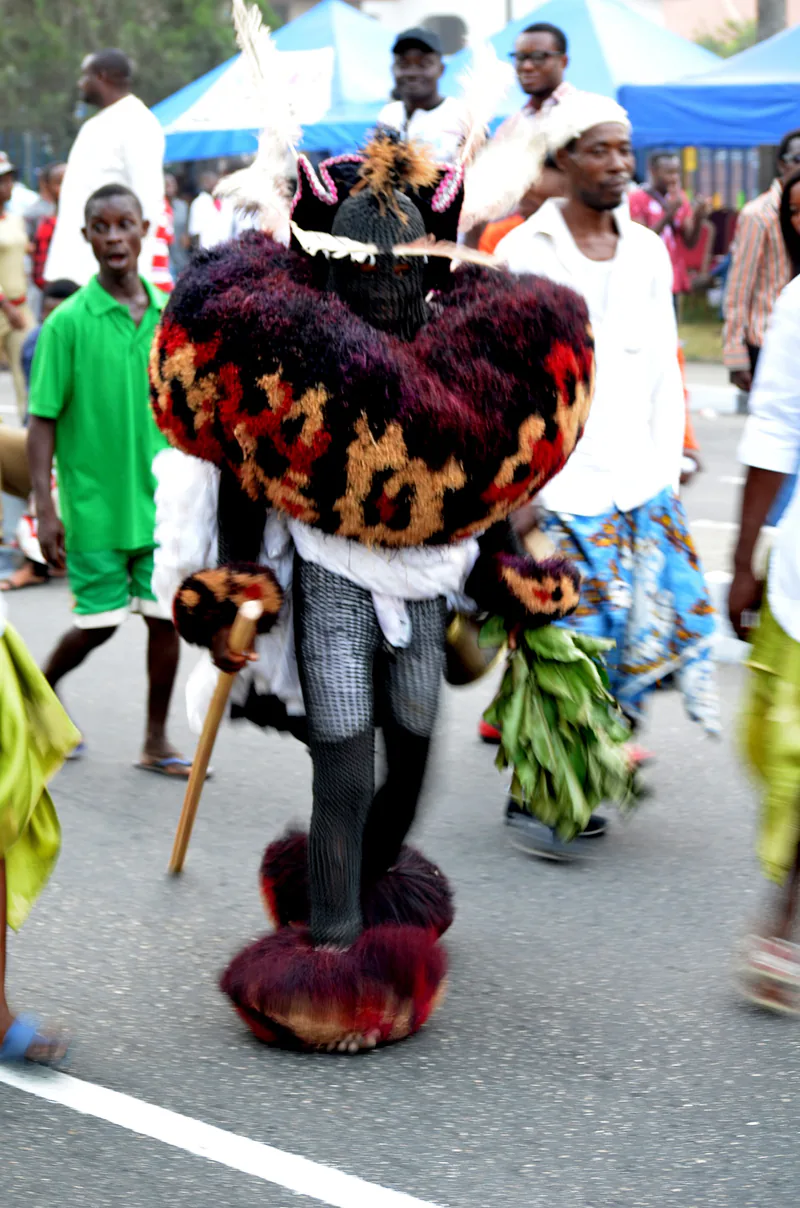
Many people from this region were carried to Cuba, where they were known as Carabalí, from Calabar. Like other African nations in colonial Cuba they organised mutual-aid associations, the cabildos de nación, which held dances and processions and maintained burial and welfare funds. Abakuá emerged from this Carabalí milieu as a deliberate re-founding of the leopard society on Cuban soil. The historian and ethnographer Ivor Miller has documented how Abakuá ritual language preserves Efik, Ejagham and other Cross River vocabulary and place names, such as Usagaré, a locality associated with the founding myth, and how closely the society's structure mirrors its African models.
Sikán, the Ekue and the Voice of the Leopard§
At the heart of Abakuá lies a sacred sound. In Ekpe, the voice of the leopard was produced in seclusion and heard by the community as the presence of the society's power. In Abakuá, this voice is identified with the Ekue, a sacred object kept in the lodge's inner room, the fambá, and never shown to the uninitiated. Its sound marks the presence of the founding mystery during ceremonies.
The principal Abakuá narrative, recorded by the Cuban ethnographer Lydia Cabrera and others, explains its origin. A woman named Sikán, of the Efut people, went to the river to fetch water and caught in her calabash a sacred fish, Tanze, whose voice was the voice of the founding power. Because she had seen and possessed the secret, she was put to death, and the mystery passed to the men who formed the society. Sikán is nevertheless honoured as a sacred mother of Abakuá, and her story is remembered in chants and signs. The myth expresses, in narrative form, both the reason for women's exclusion and the society's debt to a woman's discovery; scholars have read it as a charter for male ritual authority that still acknowledges a female origin.
Abakuá initiation, known as plante or juramento, involves an oath of secrecy and loyalty, ritual marking with chalk signs and the presentation of new members, or abanékues, to the brotherhood. Published accounts describe its outline; its inner content is reserved for members, and responsible scholarship has respected that boundary.
Colonial Havana: Founding, Día de Reyes and Persecution§
According to Abakuá tradition and documentary research, the first lodge, Efik Butón, was founded in 1836 in Regla by Carabalí leaders. New lodges multiplied in the following decades among free and enslaved Black men, particularly those working on the docks, in warehouses and in skilled trades. In 1863 Andrés Facundo Petit, a figure also associated with the Kongo-derived Regla Kimbisa, sponsored a lodge for white members, opening the society to men of all colours and creating lineages that continue today.

The public face of Abakuá in colonial Havana was the Día de Reyes, the feast of the Epiphany on 6 January, when the cabildos were allowed to parade through the city. Spanish and Cuban artists of the nineteenth century, notably Víctor Patricio Landaluze, painted the masked íremes, popularly called diablitos ("little devils"), dancing in these processions. The celebrations were suppressed in the 1880s.
Colonial authorities, alarmed by a sworn society among Black and mixed-race workers, repeatedly prosecuted ñañiguismo, as they called it. From the mid-nineteenth century members arrested at gatherings were deported to Spanish penal settlements in Africa, including Fernando Po, Ceuta and the Chafarinas islands. After independence, Cuban criminologists, beginning with the young Fernando Ortiz in Los negros brujos (1906), treated Abakuá as a criminal subculture, a view Ortiz himself later abandoned as he became the leading scholar of Afro-Cuban culture.
Íremes and Anaforuana: Masks and Sacred Signs§
The íremes are among the most recognisable images of Afro-Cuban culture. They wear full-body costumes, often in checked or patterned cloth, with a conical hood topped by a tuft and fringes at wrists and ankles; the face is covered, so that the dancer becomes the ancestral spirit he represents. Íremes carry a short staff and a sprig of leaves, communicate through gesture rather than speech, and perform specific tasks in ceremonies, such as purifying the space, guarding the temple and escorting officials. Their costumes and movements closely resemble Ekpe masquerades in Calabar.
The anaforuana, also called firmas (signatures), are chalk signs drawn on the ground, on objects and on the bodies of initiates to mark and consecrate them. Each office, ritual action and lodge has its own signs, built from circles, crosses, arrows and lines. Lydia Cabrera published hundreds of them in Anaforuana (1975), and the art historian Robert Farris Thompson linked them to nsibidi. Like the Kongo cosmogram and the vèvè of Haitian Vodou, they show how Atlantic African religions used drawn signs to make sacred presence visible in space.
Abakuá in Modern Cuba: Music, Docks and the Return to Calabar§
Abakuá has had an influence on Cuban popular culture out of proportion to its size. Its chants, drum rhythms and vocabulary entered rumba, especially the columbia, and later Cuban dance music and Latin jazz; the percussionist Chano Pozo, who brought Cuban rhythm to Dizzy Gillespie's big band in the 1940s, was an Abakuá member. Abakuá terms and references are scattered through Cuban song lyrics, often unrecognised by outsiders.
The society has also been significant in labour history. Abakuá lodges were strongly represented among stevedores on the Havana and Matanzas waterfronts, where brotherhood networks influenced hiring and solidarity. After the 1959 revolution, Abakuá, like other Afro-Cuban religions, faced official suspicion for several decades, before a more tolerant climate from the 1990s.
Since the late twentieth century, research by Ivor Miller and others, and direct exchanges between Abakuá members and Ekpe leaders in Calabar, have confirmed the depth of continuity across the Atlantic. Ekpe titleholders have recognised Abakuá chants and terms as their own, and these encounters, discussed in African Diasporic Religions, are among the most striking examples of memory preserved through ritual across nearly two centuries of separation.
Frequently asked questions§
What is Abakuá?§
Abakuá is an all-male initiatory brotherhood in Cuba, founded in 1836, that recreates the Ekpe or leopard societies of the Cross River region of Nigeria and Cameroon. It combines ritual, mutual aid and a moral code of loyalty and honour.
Who are the ñáñigos?§
Ñáñigo is a popular and historically often pejorative name for members of Abakuá, used especially by colonial police and the press. Members usually prefer abakuá or ekobio (brother).
Can women join Abakuá?§
No. Like its Ekpe model, Abakuá admits only men. The founding story of Sikán, the woman who discovered the sacred voice, is told to explain this exclusion, while Sikán herself is honoured as a mother of the society.
What are íremes?§
Íremes, popularly called diablitos, are masked dancers in full-body costumes who represent ancestral spirits in Abakuá ceremonies. They purify and guard the ritual space and communicate through gesture.
Sources and further reading§
- Voice of the Leopard: African Secret Societies and Cuba — Ivor L. Miller, 2009
- La sociedad secreta Abakuá: narrada por viejos adeptos — Lydia Cabrera, 1958
- Anaforuana: ritual y símbolos de la iniciación en la sociedad secreta Abakuá — Lydia Cabrera, 1975
- Los ñáñigos — Enrique Sosa Rodríguez, 1982
- Los negros brujos — Fernando Ortiz, 1906
- Flash of the Spirit: African and Afro-American Art and Philosophy — Robert Farris Thompson, 1983