Liber II · Ancient Magic · Chapter I: African Diasporic Religions
The Kongo Cosmogram: Dikenga, the Kalunga Line and the Debate
The Kongo cosmogram (dikenga) explained: the kalunga line, the four moments of the sun, Kongo crosses, its diaspora echoes and the scholarly debate about it.

The Kongo cosmogram is a cross set within a circle or with small discs at its four ends, used by scholars to summarise the cosmology of the BaKongo peoples of west-central Africa: the horizontal line, the kalunga, divides the world of the living from the world of the dead, and the four points mark the sun's daily course and the stages of a human life. Known in Kikongo as dikenga or tendwa kia nza-a-Kongo, it was made famous by the Congolese scholar Fu-Kiau Bunseki and the art historian Robert Farris Thompson, and it has been used to interpret signs and objects across the African diaspora, though how ancient and widespread it was remains debated.
What the Kongo Cosmogram Represents§
The BaKongo, speakers of Kikongo living in what are now the Democratic Republic of the Congo, the Republic of the Congo and northern Angola, describe the universe as two worlds that mirror each other. Above is the world of the living, the land of earth and daylight. Below is mpemba, the land of the dead, associated with white clay and imagined as a place where the ancestors live, often thought of as lying under water or beyond the sea. Between them runs the kalunga, a word that also means the great water or ocean. To cross the kalunga is to die, and the dead may return across it as ancestral power, in dreams or in the medicines and figures described in Minkisi: Kongo Sacred Medicines.
In the cosmogram, the horizontal bar is the kalunga and the vertical bar joins the high God, Nzambi a Mpungu, above with the dead below, so that the cross marks the meeting point of human and spiritual realms. The sun's path gives the four points. In Fu-Kiau's presentation they are called musoni, kala, tukula and luvemba, and correspond respectively to the beginning of life in the other world, birth or sunrise, maturity or noon, and death or sunset, after which the soul passes below the kalunga and the cycle begins again. A human life, like the sun, rises, culminates, sets and returns.
The sign therefore expresses a cyclical view of existence in which death is a passage rather than an end, and in which the dead remain active members of the community. It also explains why the crossroads, the point where the axes meet, is a charged place for oaths, offerings and communication with spirits.
Crosses in the Kingdom of Kongo: Oaths, Graves and Crucifixes§
Cruciform signs had ritual uses in Kongo before and after European contact. Accounts summarised by Thompson describe people swearing oaths while standing on a cross traced on the ground, placing themselves between the living and the dead as witnesses. Graves were decorated with objects associated with the deceased and with water, such as broken vessels, shells and mirrors, signalling the passage into the other world.
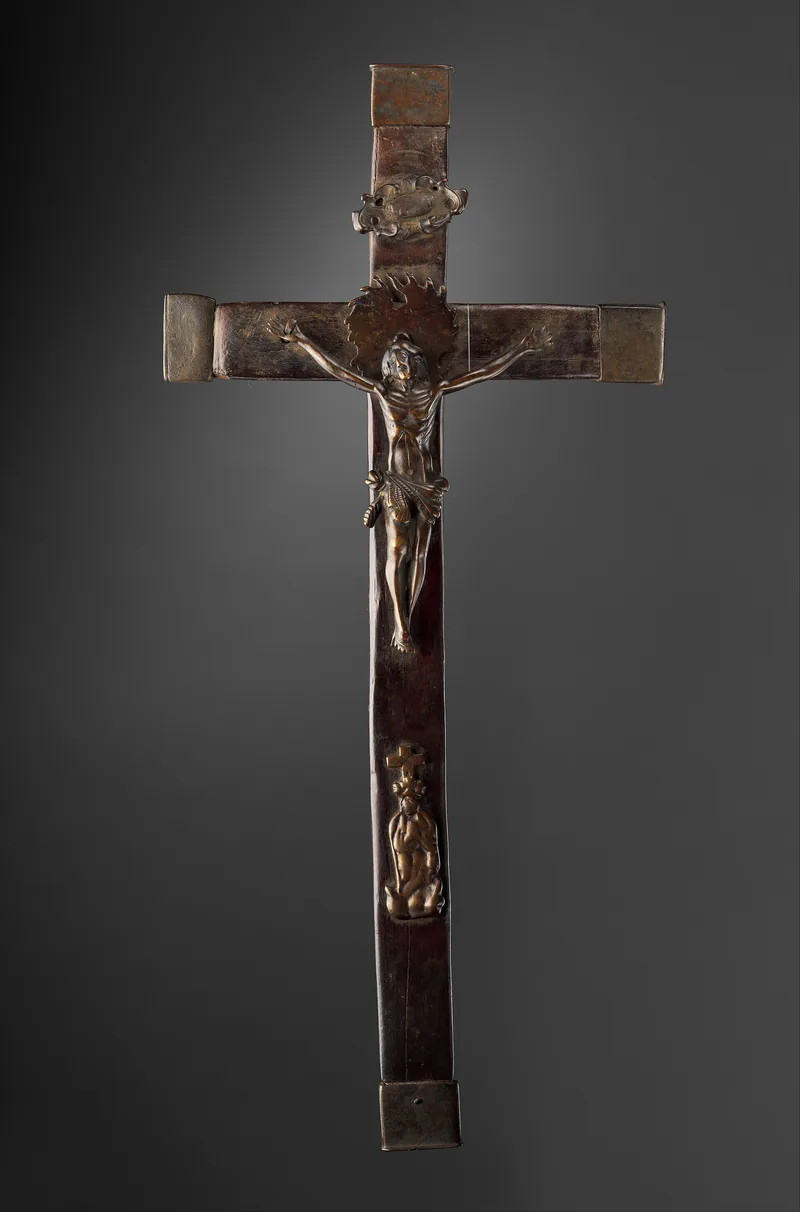
The Kingdom of Kongo also became a Christian kingdom. Its ruler Nzinga a Nkuwu was baptised as João I in 1491, and his son Afonso I made Catholicism a royal religion. Over the following centuries Kongo artists produced brass crucifixes, known locally by names such as nkangi kiditu, in which Christ often has African features and the cross is surrounded by small mourning figures. The art historian Cécile Fromont has argued that the cross in Kongo became a "space of correlation", where Christian and local meanings of the crossing sign reinforced each other rather than one simply replacing the other.
This history matters for the cosmogram debate. Many of the Africans carried from west-central Africa to the Americas were already familiar with Christian symbolism, and a cross on a Kongo object or in diaspora practice may reflect Catholic, local or combined understandings.
Fu-Kiau, Thompson and the Making of a Symbol§
The cosmogram as a single diagram with a fixed vocabulary owes much to two twentieth-century writers. Fu-Kiau Bunseki (Kimbwandende Kia Bunseki Fu-Kiau, 1934–2013), a Kongo scholar trained in his own tradition, set out its terms in a Kikongo work published in 1969 and later in English as African Cosmology of the Bantu-Kongo, originally titled The African Book Without Title. He presented the dikenga as the key to Kongo philosophy, linking it with the life cycle, social institutions and healing.
Robert Farris Thompson, the Yale art historian, collaborated with Fu-Kiau and with the Belgian scholar Joseph Cornet on the exhibition catalogue The Four Moments of the Sun: Kongo Art in Two Worlds (1981). In Flash of the Spirit (1983) he used the cosmogram as a master key to Kongo art and, crucially, to African American art and religion, finding it in Cuban Palo signs, Haitian vèvè, grave decorations in the American South and the symbolism of the crossroads. His vivid writing made the sign widely known among artists, practitioners and students of the diaspora.
The Cosmogram in the Americas: Palo, Vodou and Hoodoo§
In Cuba, practitioners of Palo Monte draw firmas, signatures, in chalk or on the ground to call and fix spirits; many are built on crosses with arrows and circles, and some practitioners explicitly identify them with the meeting of worlds (see Palo Mayombe and the Reglas de Congo). In Haiti, the cruciform structure of many vèvè, especially that of Papa Legba, the guardian of the crossroads, has been read as a fusion of Kongo and Fon ideas, discussed in Vèvè and Sacred Symbols. In the United States, the importance of crossroads in hoodoo and rootwork, where objects are buried or left at a junction of roads, and the decoration of Black graves with broken dishes, shells and personal items have been interpreted in the same frame.
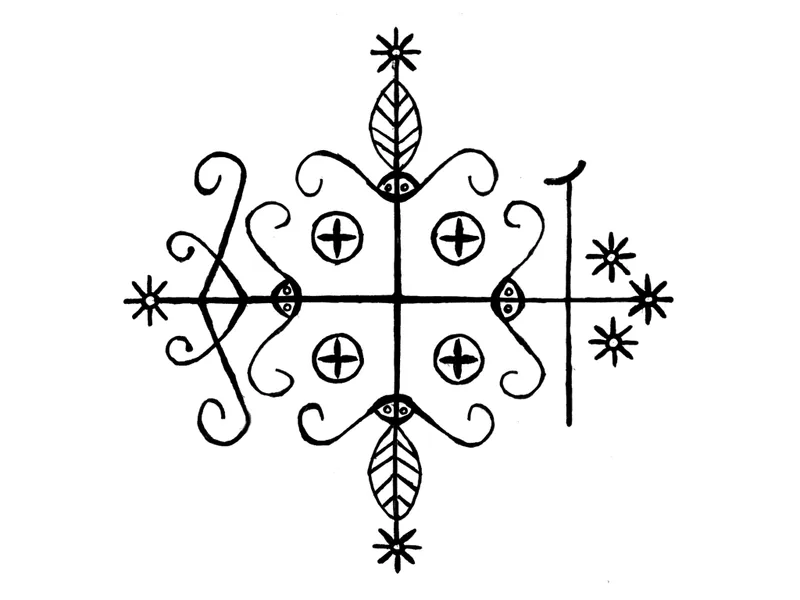
Similar drawn signs appear in other Afro-Cuban traditions, such as the anaforuana of the Abakuá society, whose roots are in the Cross River region rather than Kongo. Their parallel existence shows that drawing sacred signs was a widespread Atlantic African practice, which makes attributing any single cross to Kongo more difficult.
Archaeology: Marked Bowls, Hidden Caches and the Crossroads§
From the 1980s, historical archaeologists began to test the cosmogram thesis against excavated material. Leland Ferguson, in Uncommon Ground (1992), studied colonoware, locally made pottery used by enslaved people in eighteenth-century South Carolina, and noted bowls with incised crosses or X-shaped marks on their bases, some recovered from rivers near plantations. He suggested that these marks might be Kongo cosmograms and the bowls ritual vessels deposited in water.
Excavations of slave and servant quarters in Maryland and Virginia uncovered caches of objects hidden beneath floors or near hearths: quartz crystals, pierced coins, beads, buttons and bent nails, sometimes placed at the corners or centre of a room. At the Charles Carroll House in Annapolis, archaeologists led by Mark Leone found such a cache in the 1990s and interpreted it in light of Kongo and hoodoo practice. Christopher Fennell's Crossroads and Cosmologies (2007) compared these finds with Kongo and European folk practices, including concealed objects in European houses (see Apotropaic Marks: Daisy Wheels and Witch Marks), and argued for a nuanced reading in which simple core symbols could be elaborated differently by different communities.
Debates and Criticisms§
The cosmogram has also attracted sustained criticism. The anthropologist Wyatt MacGaffey, the leading ethnographer of the BaKongo, accepted the importance of the living-dead opposition and the water boundary in Kongo thought but questioned whether the elaborate four-moments diagram was an ancient, widely shared symbol rather than a modern systematisation, shaped partly by Fu-Kiau's own synthesis and by the needs of exhibition and teaching. Historians have pointed out that crosses and X marks are among the simplest signs humans make, and that many marks on colonoware could be ownership marks, Christian crosses or decoration.
Others reply that the question is not whether every cross is a cosmogram, but whether Kongo ideas about the crossing of worlds shaped how enslaved people used and understood such signs. Historical research, such as John Thornton's work on Kongo Christianity and on Kongolese participants in colonial American history, supports a substantial Kongo presence in the early diaspora. Most scholars now treat the cosmogram as a valuable interpretive model, grounded in genuine Kongo concepts, that must be applied case by case rather than as a universal decoder.
Frequently asked questions§
What is the Kongo cosmogram?§
It is a cross, often inside a circle or with discs at its four ends, that represents BaKongo cosmology: the world of the living above, the world of the dead below, the kalunga water line between them, and the sun's cycle as an image of human life, death and return.
What does kalunga mean?§
In Kikongo, kalunga refers to the great water or ocean and to the boundary between the living and the dead. In the cosmogram it is the horizontal line; crossing it means dying, and the dead may return across it as ancestral power.
Who made the Kongo cosmogram famous?§
The Kongo scholar Fu-Kiau Bunseki set out its terminology, and the art historian Robert Farris Thompson popularised it in The Four Moments of the Sun (1981) and Flash of the Spirit (1983), applying it to art and religion throughout the African diaspora.
Is the cosmogram an ancient symbol?§
Cross signs were used in Kongo rituals and oaths in earlier centuries, and the underlying ideas are well attested. Whether the full four-moments diagram is ancient or a twentieth-century synthesis is debated, notably by Wyatt MacGaffey.
Sources and further reading§
- Flash of the Spirit: African and Afro-American Art and Philosophy — Robert Farris Thompson, 1983
- The Four Moments of the Sun: Kongo Art in Two Worlds — Robert Farris Thompson and Joseph Cornet, 1981
- African Cosmology of the Bantu-Kongo: Tying the Spiritual Knot, Principles of Life and Living — Kimbwandende Kia Bunseki Fu-Kiau, 2001
- Religion and Society in Central Africa: The BaKongo of Lower Zaire — Wyatt MacGaffey, 1986
- Uncommon Ground: Archaeology and Early African America, 1650–1800 — Leland Ferguson, 1992
- Crossroads and Cosmologies: Diasporas and Ethnogenesis in the New World — Christopher C. Fennell, 2007
- The Art of Conversion: Christian Visual Culture in the Kingdom of Kongo — Cécile Fromont, 2014