Liber XXXIV · Vodou & Hoodoo · Chapter VIII: Vèvè & Sacred Symbols
Vèvè and Sacred Symbols of Haitian Vodou Explained
What is a vèvè? The cornmeal ground drawings of Haitian Vodou, their Fon, Kongo and European roots, the vèvè of the lwa, the poto mitan, ason and Vodou flags.
A vèvè is a sacred ground drawing used in Haitian Vodou to call and honour a particular spirit, or lwa. Traced by a priest or priestess with cornmeal or another powder on the floor of the temple at the beginning of a ceremony, each vèvè is a symbolic emblem of one lwa: it marks the place where the spirit is invited to arrive, receives offerings, and is gradually erased by the feet of dancers. Vèvè are part of a wider visual language of Vodou that includes the central post, the sacred rattle, sequined flags and the images of the saints.
What a Vèvè Is and How It Is Made§
In a Vodou ceremony the officiant, an oungan or manbo, traces vèvè on the floor of the peristil, the dance space of the temple, usually around the central post. The design is made freehand by letting a fine stream of powder fall between thumb and fingers. Cornmeal (farin mayi) is the most common material for the Rada spirits; other materials, such as ash, coffee grounds, powdered brick or flour, may be used in different rites and houses. Drawing a complex vèvè quickly and evenly is a recognised skill, and the act of drawing is itself a form of prayer, accompanied by songs and salutes.
Once drawn, the vèvè becomes a focal point of ritual. Offerings of food, drink and candles may be placed on it, libations poured over it, and in some ceremonies the officiant and assistants salute it with the ason rattle. As drumming and dance proceed, the lines are scuffed and dispersed. The impermanence matters: the vèvè has done its work by bringing the spirit into the community's space, and it is not meant to be preserved.
The word vèvè is sometimes said to come from the Fon, but its etymology is uncertain. In older writing it also appears as vévé or vever.
Origins: Fon, Kongo and European Threads§
Where vèvè come from is a question scholars still discuss, and the honest answer is that several streams probably met.
- West African ground drawings. Among the Fon and Yoruba, sacred signs are traced in powder for divination and ritual; Fa and Ifá diviners, for instance, mark signs in powder on a divining board. Similar practices are known elsewhere in West Africa.
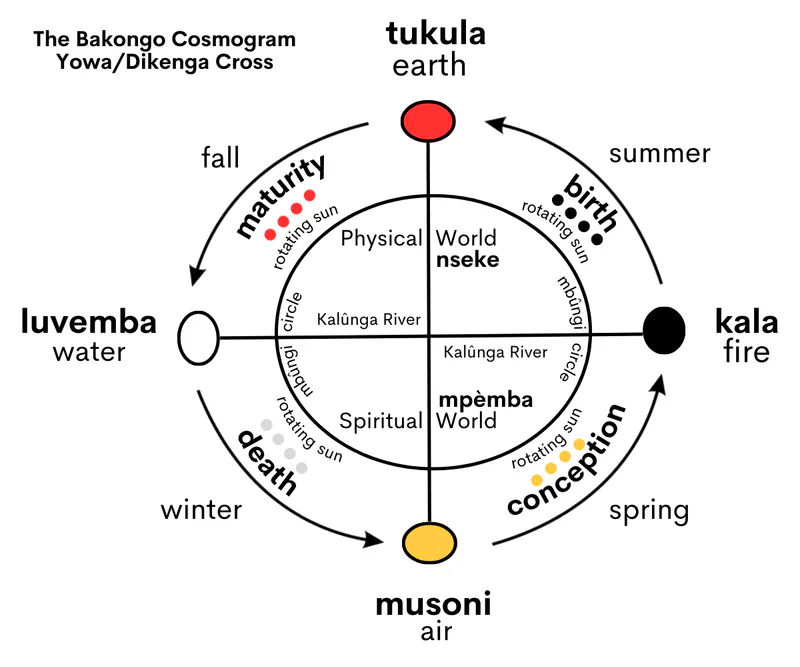
- Kongo cosmograms. The art historian Robert Farris Thompson, in Flash of the Spirit (1983), argued that the Kongo cross-shaped sign representing the boundary between the world of the living and the world of the dead, and the path of the sun around it, lies behind the cruciform structure of many vèvè. Kongo influence is strong in Haitian religion, especially in the Petwo rite.
- European designs. Several writers, including Alfred Métraux, noted the resemblance of some vèvè to European wrought-iron work and embroidery patterns, and others have compared them with the seals and characters of European grimoires such as those attributed to Solomon (see Solomon's Ring and the Seal of Solomon). Popular magical books did circulate in Haiti, but how much they shaped the vèvè is debated.
What is clear is that the vèvè, like Vodou itself, is a Haitian creation: a new form built from African and European materials by people who had to recreate their religious life in the Caribbean.
Reading the Vèvè of the Major Lwa§
Every lwa has its vèvè, and many lwa have several, varying between regions, houses and individual priests. The following motifs are widely recognised, though practitioners would caution that a vèvè is learned in practice and not from a chart.
Legba§
The vèvè of Papa Legba, guardian of the gate, is commonly built on a cross, signifying the crossroads and the meeting of worlds, often with a cane or crook beside it. Because Legba opens the way for all other spirits, his vèvè is often drawn first.
Danbala and Ayida-Wedo§
The serpent lwa are represented by two serpents, frequently facing one another or rising on either side of a central post, sometimes with stars or eggs. Danbala and his consort Ayida-Wedo, the rainbow, together express continuity and fertility.
Ezili Freda§
Ezili Freda, spirit of love and beauty, is known for the heart, usually filled with a lattice of cross-hatching and surrounded by ornamental flourishes. Ezili Dantò's vèvè is often a heart pierced by a dagger.
Ogou§
The warrior Ogou is associated with a sabre or machete, flags and sometimes a cross-hilt design, reflecting his iron and military character.
Agwe and the Gede§
Agwe, master of the sea, is identified by a boat, often with sails and a flag. The vèvè of the Gede and of Bawon Samdi, lords of the dead, feature crosses and coffins, echoing the cross that stands over the first grave in every Haitian cemetery.
The Poto Mitan, Ason and Other Ritual Objects§
The vèvè is one element in a larger sacred landscape.
- Poto mitan. The central post of the peristil is the axis along which the lwa are said to travel between the waters of Ginen and the world of the living. Often painted with spiralling serpents, it is the centre around which vèvè are drawn and dances circle.
- Ason. The sacred rattle, a gourd covered with a net of beads or snake vertebrae and accompanied by a small bell, is the emblem of the priesthood in many lineages. Receiving the ason marks the highest grade of initiation.
- Govi. Clay jars in which the spirits of the dead or of lwa may be housed after the ceremony that "calls them from the waters".
- Pakèt kongo. Bundles of cloth wrapped around consecrated materials, crowned with feathers, used for protection and healing; they recall the minkisi power objects of Central Africa.
- Altars. Altars hold bottles, candles, images of saints and objects in the colours of each lwa.
Drapo, Paintings and Vodou Sacred Art§
Vodou's visual culture extends well beyond the temple floor. Ceremonial flags, drapo, are sewn with thousands of sequins and beads, often bearing the vèvè or the image of a lwa. They are carried at the opening of ceremonies to salute the spirits and the house. Since the late twentieth century they have also become sought-after works of art, and artists in Port-au-Prince have produced flags for collectors as well as temples.
Haitian painting has a deep relationship with Vodou. When the Centre d'Art opened in Port-au-Prince in 1944, painters such as Hector Hyppolite, himself an oungan, brought images of the lwa into a new art market. The 1995 exhibition Sacred Arts of Haitian Vodou, organised at the Fowler Museum in Los Angeles and published in a landmark catalogue edited by Donald Cosentino, presented these objects as a sophisticated religious art.
Vèvè Outside the Peristil: Reproduction and Respect§
Today vèvè appear on T-shirts, tattoos, jewellery and websites far from any temple. Some practitioners welcome the wider recognition of Haitian art; others are uncomfortable with sacred designs used as decoration or sold as "magic symbols" with promised effects. It is worth remembering that a vèvè's function within Vodou depends on context: the initiated hand that draws it, the songs that accompany it, and the community that serves the lwa.
Respectful use means acknowledging the source, avoiding presenting vèvè as spells or curses, and recognising that variation between houses is normal. For the spirits behind the designs, see The Lwa of Haitian Vodou; for the religion as a whole, see Haitian Vodou and What Is Voodoo?.
Frequently asked questions§
What is a vèvè used for?§
A vèvè is drawn during a Vodou ceremony to call and honour a specific lwa. It marks the place where the spirit is welcomed, receives offerings and libations, and is erased by dancing as the ceremony goes on.
What is Papa Legba's vèvè?§
Legba's vèvè is usually based on a cross representing the crossroads, often with a cane or crook. Because he opens the gate for the other spirits, it is frequently the first vèvè drawn in a ceremony.
Are vèvè the same in every Vodou temple?§
No. The core motifs of major lwa are widely shared, but designs vary between regions, lineages and individual priests, and each lwa may have several vèvè for different aspects.
Can a vèvè be used as a tattoo or decoration?§
Many people do so, but some Vodou practitioners regard vèvè as sacred ritual signs whose meaning depends on ceremony. Learning about the tradition and acknowledging its Haitian origin is the respectful starting point.
Sources and further reading§
- Divine Horsemen: The Living Gods of Haiti — Maya Deren, 1953
- Voodoo in Haiti — Alfred Métraux, 1959
- Flash of the Spirit: African and Afro-American Art and Philosophy — Robert Farris Thompson, 1983
- Sacred Arts of Haitian Vodou — Donald J. Cosentino (ed.), 1995
- Ve-Ve: Diagrammes rituels du voudou — Milo Rigaud, 1974
- The Faces of the Gods: Vodou and Roman Catholicism in Haiti — Leslie G. Desmangles, 1992