What Is Voodoo? Vodun, Vodou, Hoodoo and Their True History
What is Voodoo? A clear guide to West African Vodun, Haitian Vodou, Louisiana Voodoo and Hoodoo: their origins, shared beliefs, spirits and common myths.

"Voodoo" is an English word for a family of related religious traditions that began among the Fon and Ewe peoples of West Africa and were carried to the Americas by the Atlantic slave trade. Properly understood, it covers West African Vodun, Haitian Vodou and Louisiana Voodoo, religions centred on a distant creator God, a host of intermediary spirits, the ancestors, and communal ritual of song, drumming, offering and spirit possession. The pin-stuck dolls and flesh-eating zombies of popular culture belong to Western fiction, not to the faiths themselves.
The Word Voodoo and Its Spellings§
The root of every spelling is vodun (also written vodoun or vodu), a word in the Gbe languages of present-day Benin, Togo and south-western Nigeria. It refers to the invisible powers that surround human life, and by extension to the spirits that are served in shrines. In the colonial Caribbean the word was recorded by French writers as vaudoux, and over time three conventions have settled into use:
- Vodun for the religion of the Fon, Ewe and related peoples in West Africa;
- Vodou, the official Haitian Creole spelling, for the religion of Haiti and its diaspora;
- Voodoo (sometimes Voudou) for the historical tradition of New Orleans and Louisiana.
Many Haitians and scholars avoid "voodoo" for the Haitian religion, because the English spelling carries a century of racist and sensational associations. On this site the spellings follow these conventions, while "voodoo" in quotation marks refers to the popular stereotype.
West African Origins Among the Fon and Ewe§
The oldest form of the tradition is the West African Vodun of the Gbe-speaking peoples, especially in the kingdoms of Allada, Hueda (Ouidah) and Dahomey, which rose to power in the seventeenth and eighteenth centuries. In this religion the paired creator Mawu-Lisa stands above a large and open-ended company of vodun: Legba the guardian of thresholds, Sakpata of the earth and disease, Hevioso of thunder, Dan the serpent of continuity and wealth, Gu of iron, and many local and family spirits. Priests and initiated devotees (vodunsi) serve these powers in shrines and convents, and the system of Fa divination, closely related to Yoruba Ifá, guides individual destinies.
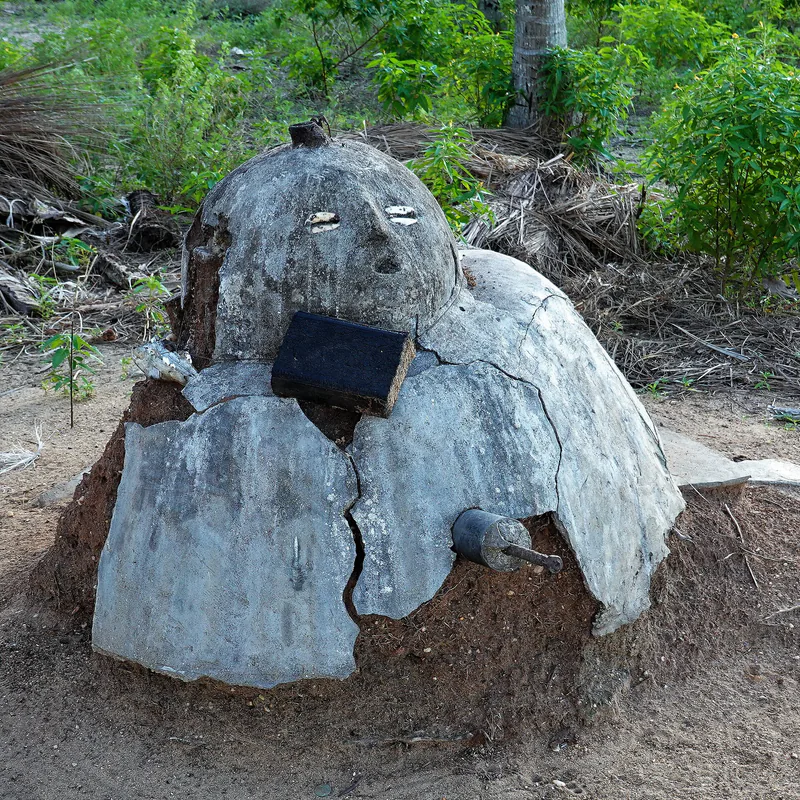
Vodun was never a single church. It is a living set of cults that absorb new spirits, honour royal and lineage ancestors and adapt to new conditions, which is one reason it survived colonial rule and a Marxist government's campaign against it in the 1970s and 1980s. Today Benin celebrates a national Vodun holiday each 10 January.
The Atlantic Crossing and New Religions in the Americas§
Between the sixteenth and nineteenth centuries more than twelve million Africans were forced across the Atlantic. Captives from the Bight of Benin, West Central Africa (the Kongo and Angola region) and the Yoruba-speaking lands brought their religious knowledge with them, and in the plantation colonies these streams met one another and Roman Catholicism. The results were not copies of African religions but new ones, built by people who had to reconstruct community under slavery.
- In French Saint-Domingue, Fon, Yoruba and Kongo traditions merged into Haitian Vodou, whose spirits, the lwa, are grouped into "nations" such as Rada and Petwo. Vodou became bound up with the memory of the Haitian Revolution, traditionally dated from the Bois Caïman ceremony of August 1791.
- In Louisiana, enslaved Africans and later refugees from Saint-Domingue (who arrived in large numbers around 1809–1810) shaped a New Orleans tradition of Voodoo, remembered above all through the nineteenth-century priestess Marie Laveau; see Louisiana Voodoo and Marie Laveau.
- In Cuba, Yoruba religion gave rise to the orisha worship of Santería or Lucumí, alongside the Kongo-derived Palo Monte.
- In Brazil, the religions of Candomblé and, later, Umbanda emerged; see Candomblé and Umbanda.
Scholars often call these traditions the religions of the "Black Atlantic", stressing the continuing exchange between Africa and the Americas rather than a one-way survival of the past.
Shared Beliefs: God, Spirits, Ancestors and Possession§
Although each tradition has its own theology, several features recur across the family.

A distant creator and near spirits§
Practitioners affirm a single supreme God: Mawu-Lisa or Nana Buluku in Dahomey, Bondye ("good God", from French bon Dieu) in Haiti, Olodumare among the Yoruba and in Santería. This God is too vast to be approached directly in daily affairs, so worship is directed to intermediary spirits who have personalities, preferences, colours, songs and favoured offerings.
The dead and the family§
The ancestors are a constant presence. Families maintain obligations to their dead, and in Haiti certain lwa are inherited along family lines, tied to ancestral land. Good relationships with the dead are seen as essential to health and prosperity.
Ritual, music and possession§
Ceremonies combine drumming, call-and-response song and dance. At their height a spirit may "mount" a devotee, who then speaks and acts as the spirit for a time, giving counsel, blessing and sometimes rebuke to the community. Practitioners understand this possession trance as a form of communion, not as a loss of control to something evil.
Healing and divination§
Much everyday activity is concerned with healing body and soul, resolving conflicts and finding a path through hardship. Priests use herbal medicine, divination, ritual baths and protective charms. The aim is balance between the living, the dead and the spirits, rather than domination of others.
Haitian Vodou, Louisiana Voodoo and Hoodoo Compared§
The three terms most often confused in English are worth separating clearly.
Haitian Vodou is an organised religion with initiated clergy (the oungan and manbo), temples (ounfò), a calendar of feasts, an elaborate liturgy and a large community of practitioners in Haiti, the United States, Canada and France. It recognises its own spirits, music and sacred art, including the ground drawings called vèvè (see Vèvè and Sacred Symbols).
Louisiana Voodoo was the religion of a nineteenth-century New Orleans community of free and enslaved people of colour, with public gatherings such as the St John's Eve ceremonies on Bayou St John. By the early twentieth century it had largely given way to private spiritual practices and to a commercial trade in charms and candles; modern New Orleans Voodoo includes both revived temple practice and tourism.
Hoodoo, also called conjure or rootwork, is the African American tradition of practical magic that developed across the American South. It uses roots, herbs, minerals, candles, the Psalms and charm bags to protect, heal, find love or work justice. Most practitioners historically considered themselves Christians, and Hoodoo has no pantheon of spirits of its own; see Hoodoo and Rootwork.
How "Voodoo" Became a Western Myth§
The sensational image of "voodoo" was constructed largely by outsiders. Colonial authorities feared African religious gatherings as possible conspiracies, and after Haitian independence in 1804 the new Black republic was portrayed in Europe and the United States as a land of savagery. Sir Spenser St John's Hayti, or the Black Republic (1884) spread lurid claims of cannibalism, based heavily on a single contested trial. During the United States occupation of Haiti (1915–1934), travel writers such as William Seabrook, whose The Magic Island appeared in 1929, popularised the zombie, and Hollywood followed with White Zombie in 1932.
These images bore little relation to the religion as practised. The ethnographers Zora Neale Hurston, Maya Deren and Alfred Métraux, and later Haitian scholars such as Laënnec Hurbon, described a faith concerned with healing, memory and community. Our article on Voodoo myths and misconceptions examines the dolls, zombies and curses one by one.
In legal terms the situation has improved. Haiti's 1987 Constitution guaranteed religious freedom and a government decision of 2003 recognised Vodou as a religion; in the United States, the Supreme Court's 1993 decision in Church of the Lukumi Babalu Aye v. City of Hialeah protected the ritual practices of Santería under the First Amendment.
Frequently asked questions§
Is Voodoo a real religion?§
Yes. West African Vodun and Haitian Vodou are established religions with clergy, theology, ritual calendars and millions of adherents. Louisiana Voodoo was a historical religion of New Orleans that survives in revived and adapted forms today.
What is the difference between Voodoo and Hoodoo?§
Vodou and Voodoo are religions that serve spirits through initiated priests and communal ceremony. Hoodoo is a system of African American folk magic and healing, usually practised by Christians, that does not involve serving a pantheon of spirits.
Do Voodoo practitioners worship the devil?§
No. Practitioners believe in one supreme God and serve spirits who mediate between God and humanity. The identification of Voodoo with Satan comes from colonial and missionary polemic, not from the beliefs of practitioners.
Where is Voodoo practised today?§
Vodun is practised in Benin, Togo, Ghana and Nigeria; Vodou in Haiti and its diaspora, especially in New York, Miami, Montreal and Paris; and Voodoo and Hoodoo in Louisiana and across the United States.
Sources and further reading§
- Divine Horsemen: The Living Gods of Haiti — Maya Deren, 1953
- Voodoo in Haiti — Alfred Métraux, 1959
- Mama Lola: A Vodou Priestess in Brooklyn — Karen McCarthy Brown, 1991
- Flash of the Spirit: African and Afro-American Art and Philosophy — Robert Farris Thompson, 1983
- Working the Spirit: Ceremonies of the African Diaspora — Joseph M. Murphy, 1994
- Hoodoo, Voodoo, and Conjure: A Handbook — Jeffrey E. Anderson, 2008
- African Vodun: Art, Psychology, and Power — Suzanne Preston Blier, 1995
- Voodoo: Search for the Spirit — Laënnec Hurbon, 1995