Liber XXXIV · Vodou & Hoodoo · Chapter IV: Louisiana Voodoo
Louisiana Voodoo and Marie Laveau: History Beyond the Legend
Louisiana Voodoo explained: colonial roots, Saint-Domingue refugees, Congo Square, Marie Laveau's life and legend, Doctor John and the modern revival.

Louisiana Voodoo, also spelled Voudou, is the Afro-Creole religion that developed in French and Spanish colonial Louisiana and flourished in nineteenth-century New Orleans, led by famous "Voodoo queens" such as Marie Laveau (1801–1881). It combined West and Central African spirit traditions, influences from Haitian Vodou brought by refugees, and Catholic devotion. After the late nineteenth century it largely dissolved into hoodoo and the spiritual churches, before a modern revival and a large tourist industry gave it new public life.
Colonial Louisiana: African Roots Under French and Spanish Rule§
New Orleans was founded by the French in 1718. In the following decade the Company of the Indies brought several thousand enslaved Africans to the colony, a large proportion from the Senegambia region, as the historian Gwendolyn Midlo Hall showed in Africans in Colonial Louisiana (1992). Louisiana's own Code Noir of 1724, modelled on the French code of 1685, required the baptism and Catholic instruction of enslaved people.
After 1763 Louisiana passed to Spain. Spanish law made it comparatively easier for enslaved people to purchase their freedom (coartación), and the colony developed a substantial population of gens de couleur libres, free people of colour. Under Spanish rule larger numbers of captives arrived from Central Africa, especially the Kongo region, adding to the mix of religious traditions. Colonial officials periodically expressed fear of African religious gatherings and of "poisoners", but documentary evidence for organised Voodoo in the eighteenth century is thin. Most of what we know comes from the nineteenth century.
Saint-Domingue Refugees and the Haitian Connection§
The revolution in Saint-Domingue (1791–1804) sent waves of refugees across the Caribbean. Many first settled in eastern Cuba, and when Spain expelled French nationals from Cuba in 1809, roughly ten thousand people arrived in New Orleans in 1809–1810. They were divided into roughly equal numbers of white colonists, free people of colour and enslaved people, and they nearly doubled the city's population.
The refugees reinforced New Orleans's French-speaking Creole culture and almost certainly brought practitioners of the religion that was becoming Haitian Vodou. Some names of spirits recorded in nineteenth-century New Orleans echo Haitian and Dahomean ones: sources mention a Papa Lébat, comparable to Legba, and a serpent spirit sometimes called Blanc Dani, comparable to Danbala. Yet the New Orleans religion was never simply Haitian Vodou transplanted. It had no fixed system of nations, and its practice centred more on charismatic individual leaders, healing, protection and personal spiritual work than on the temple-based service of a large pantheon.
Congo Square and the Sunday Gatherings§
Under French and Spanish custom, enslaved people in Louisiana generally had Sunday free from field labour. In New Orleans they gathered to trade, socialise, drum and dance at an open space on the edge of the old city, which became known as Congo Square (Place des Nègres). An 1817 city ordinance restricted such assemblies to a single location, and that location was Congo Square.
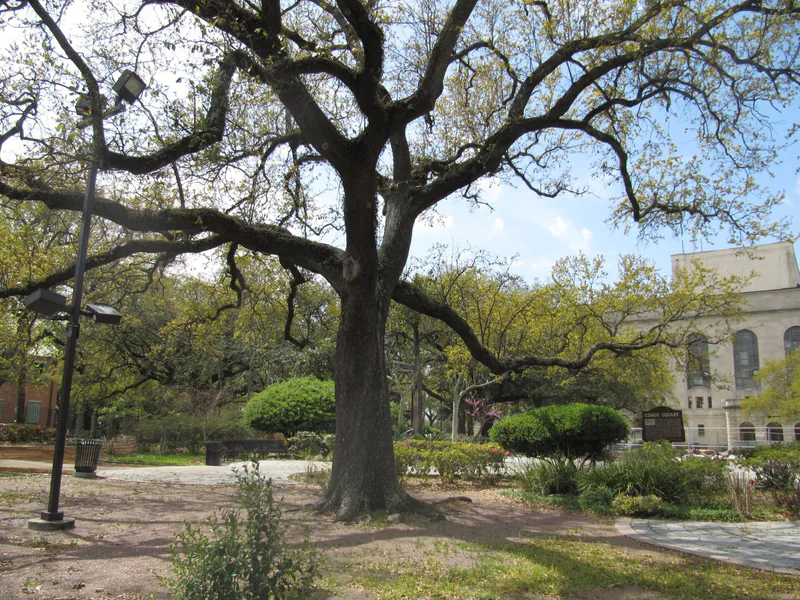
The architect Benjamin Henry Latrobe, visiting in 1819, described hundreds of people dancing in circles to drums, stringed instruments and calabash rattles, and sketched several instruments. The gatherings continued into the mid-nineteenth century before fading under increasing restrictions. Congo Square, now part of Louis Armstrong Park, is remembered as a birthplace of African American musical traditions that fed into jazz.
Popular accounts often describe Congo Square as the site of Voodoo ceremonies led by Marie Laveau. The historical sources describe social dances, music and markets rather than religious services, and the more secretive Voodoo ceremonies took place in private houses, yards and along Bayou St. John and Lake Pontchartrain. The two worlds certainly overlapped, since the same communities took part in both, but the image of Congo Square as an open-air Voodoo temple is a later romanticisation.
Marie Laveau: Life and Legend§
The historical Marie Laveau§
Marie Laveau was born a free woman of colour in New Orleans in 1801; the historian Carolyn Morrow Long dates her birth to 10 September 1801 on the basis of archival research. Her father, Charles Laveaux, was a free man of colour with property, and her mother, Marguerite, was also of mixed African and European ancestry. In 1819 she married Jacques Paris, a free man of colour from Saint-Domingue, at St. Louis Cathedral. Paris disappeared from the records within a few years, and she became known as the "Widow Paris".
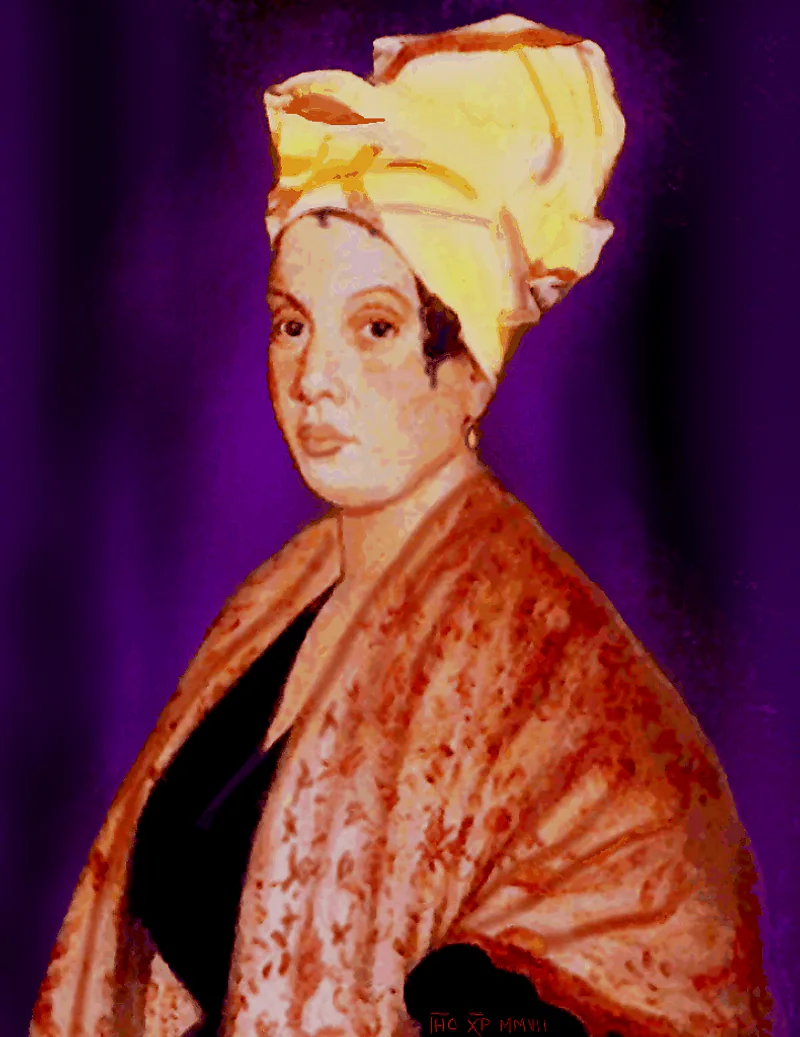
She later formed a long-term domestic partnership with Christophe Glapion, a white Louisianan, with whom she had several children, most of whom died young. The family lived on St. Ann Street in the French Quarter. Laveau is traditionally described as a hairdresser, an occupation that would have given her access to the homes and confidences of wealthy families, though the documentary evidence for this is limited.
Laveau was a practising Catholic throughout her life. Contemporary records show her nursing victims of yellow fever and attending condemned prisoners in the Parish Prison, where she prayed with them and decorated altars. By the 1850s newspapers were describing her as the leading Voodoo priestess of the city, and by the 1870s reporters wrote of the St. John's Eve (23 June) gatherings on Bayou St. John associated with her name. Her clientele reportedly included people of every colour and class who sought healing, protection, success in love or help with legal troubles.
When she died on 15 June 1881, obituaries in New Orleans newspapers praised her charity and piety, while others dwelt on her reputation as a Voodoo queen. She was buried in St. Louis Cemetery No. 1, in the tomb of the Glapion family.
The making of a legend§
Almost at once, Laveau's story began to expand. Writers in the late nineteenth and early twentieth centuries attributed to her magical control of judges and politicians, a pet snake called Zombi, orgiastic rites at the lakeshore, and a network of informants among servants. A widespread story holds that her daughter, also named Marie, took over her role and that the two were confused, giving rise to the belief that Laveau never aged. Scholars disagree about how far this "Marie II" was a real successor: Martha Ward accepts a dual career, while Carolyn Morrow Long finds the evidence weak.
Much of this material entered popular culture through interviews collected by the Louisiana Writers' Project in the 1930s and the books of Robert Tallant, especially Voodoo in New Orleans (1946), which mixed oral testimony with lurid embellishment. Laveau's tomb became a pilgrimage site where visitors marked crosses ("XXX") and left offerings, a practice that damaged the structure. Since 2015 the Archdiocese of New Orleans has restricted access to the cemetery to family members and licensed tour guides.
The scholar Ina Johanna Fandrich has interpreted Laveau as a religious leader in a West African mould, comparable to the priestesses of Vodun, whose authority came from service and community rather than mere fortune-telling. Long's biography, by contrast, emphasises careful separation of what archival sources can prove from what oral tradition later supplied. Both agree that Laveau was a real and influential spiritual figure, neither the demonic sorceress of legend nor a mere fiction.
Doctor John and the Voodoo Doctors§
Laveau's best-known male counterpart was Doctor John, also called Bayou John, whose name appears in sources as Jean Montanée or Jean Montanet. He was a free man of colour who claimed to have been born in Senegal and to be of royal descent. He lived on Bayou Road, acquired considerable property, had several wives, and was consulted as a healer, fortune-teller and maker of charms. Like some free people of colour in New Orleans, he himself owned enslaved people.
Doctor John died in 1885. The writer Lafcadio Hearn published a memorable profile of him that year, "The Last of the Voudoos", in Harper's Weekly. The title captured a growing sense that the old Voudou of New Orleans was passing away. The twentieth-century musician Mac Rebennack took the name "Dr. John" in homage to him.
Decline, Hoodoo and the Spiritual Churches§
From the 1850s onward, police raided Voodoo gatherings, partly because they brought together enslaved people, free people of colour and whites, which alarmed authorities in a slave society. After the Civil War and especially after Reconstruction, Jim Crow laws and ordinances against fortune-telling and "obtaining money under false pretences" pressed Voodoo practitioners further underground. Leadership became individual rather than communal, and the religious structure of the old Voudou gradually gave way.
What survived was largely the practical, client-centred side of the tradition: charms, gris-gris, candles, oils and consultations, overlapping heavily with the African American conjure tradition described in our article on hoodoo and rootwork. The historian Kodi A. Roberts has argued that early twentieth-century practitioners operated as entrepreneurs in a spiritual marketplace that drew clients of all races. Elements of Voodoo devotion also flowed into the Spiritual Churches of New Orleans, founded in the 1920s by Mother Leafy Anderson and others, which blended Pentecostal, Catholic and Spiritualist worship and honoured figures such as the Sauk leader Black Hawk.
In 1928 the novelist and anthropologist Zora Neale Hurston studied with New Orleans practitioners, including a man who claimed to be Laveau's nephew. Her article "Hoodoo in America" (1931) and the book Mules and Men (1935) recorded these encounters, though scholars note that she sometimes dramatised her material.
Tourism, Myth and the Modern Revival§
The tourist "voodoo" of the French Quarter§
From the mid-twentieth century New Orleans promoted "voodoo" as an exotic attraction. Novelty shops sold pin-cushion dolls, gris-gris bags and potions, and ghost tours told ever more elaborate stories about Marie Laveau. The voodoo doll, in particular, owes far more to film and souvenir trade than to historical Louisiana practice; image magic with figures has a much longer European history, discussed in our article on maleficium, curses and protective magic. The New Orleans Historic Voodoo Museum, opened in 1972, sits at the intersection of tourism, education and devotion.
Revival as a living religion§
Alongside the commercial scene, the late twentieth century saw a genuine religious revival. The Voodoo Spiritual Temple, founded in 1990 by Priestess Miriam Chamani and her husband Oswan Chamani, combines African, Afro-Caribbean and Spiritualist elements. Sallie Ann Glassman, initiated as a manbo in Haiti, leads a Haitian-style ounfò in New Orleans and has organised public St. John's Eve ceremonies at Bayou St. John. Other practitioners have been initiated in Cuban Lucumí, described in Santería, Lucumí and the orishas, or in West African Vodun, bringing new lineages to the city.
Modern New Orleans Voodoo is therefore plural: some practitioners reconstruct the nineteenth-century tradition, some follow Haitian or Cuban models, and some combine these with hoodoo and Spiritualism. Many emphasise healing, ancestral reverence, social justice and the dignity of a heritage long mocked by outsiders. Like other Afro-diasporic religions, it has nothing to do with "devil worship", a stereotype rooted in the same European fears that shaped earlier ideas of the witch, as discussed in traditional witchcraft.
Frequently asked questions§
Was Marie Laveau a real person?§
Yes. Marie Laveau (1801–1881) was a free woman of colour in New Orleans, a devout Catholic, and a widely consulted spiritual leader. Archival records document her marriage, family, charitable work and death, though many stories about her magical powers are later legend.
What is the difference between Louisiana Voodoo and Haitian Vodou?§
Both draw on West and Central African religions and Catholicism, and Saint-Domingue refugees linked them historically. Haitian Vodou developed into a national religion with temples, clergy and organised families of spirits, while New Orleans Voodoo centred on individual leaders and largely merged with hoodoo after the nineteenth century.
Did Voodoo rituals happen in Congo Square?§
Congo Square was a legal Sunday gathering place for music, dance and trade. Most historical evidence suggests that Voodoo ceremonies were held elsewhere, in private houses and along Bayou St. John and Lake Pontchartrain, though the same community took part in both.
Are voodoo dolls part of Louisiana Voodoo?§
Pin-stuck dolls are mainly a product of twentieth-century films and the New Orleans souvenir trade. Figures and charms did exist in folk magic, but the "voodoo doll" as a symbol of the religion is a tourist-era stereotype.
Who was Doctor John?§
Doctor John, known as Jean Montanée or Montanet, was a prominent nineteenth-century New Orleans Voodoo practitioner and free man of colour who claimed Senegalese royal origins. He died in 1885, the year Lafcadio Hearn profiled him as "The Last of the Voudoos".
Sources and further reading§
- A New Orleans Voudou Priestess: The Legend and Reality of Marie Laveau — Carolyn Morrow Long, 2006
- Spiritual Merchants: Religion, Magic, and Commerce — Carolyn Morrow Long, 2001
- The Mysterious Voodoo Queen, Marie Laveaux: A Study of Powerful Female Leadership in Nineteenth-Century New Orleans — Ina Johanna Fandrich, 2005
- Voodoo Queen: The Spirited Lives of Marie Laveau — Martha Ward, 2004
- Africans in Colonial Louisiana — Gwendolyn Midlo Hall, 1992
- Voodoo and Power: The Politics of Religion in New Orleans, 1881–1940 — Kodi A. Roberts, 2015
- Mules and Men — Zora Neale Hurston, 1935
- Voodoo in New Orleans — Robert Tallant, 1946 (a sensational source, to be read critically)
- "The Last of the Voudoos" — Lafcadio Hearn, Harper's Weekly, 1885