Liber XXXV · Witchcraft & Wicca · Chapter V: Traditional Witchcraft
Traditional Witchcraft: Cunning Folk, Cochrane and the Old Craft
Traditional witchcraft explained: cunning folk, Robert Cochrane and the Clan of Tubal Cain, the 1734 tradition, Chumbley's Sabbatic Craft and folk magic.

Traditional witchcraft is a loose term for forms of modern witchcraft that present themselves as distinct from, and often older than, Gerald Gardner's Wicca. Its practitioners draw on British and European folk magic, the historical cunning folk, and the teachings of figures such as Robert Cochrane and Andrew Chumbley, often emphasising landscape, ancestors, a horned or otherworldly god and a more austere ritual style. As with Wicca, historians find that most of its organised forms date from the twentieth century, even though they draw on genuinely older folk practice.
What "Traditional Witchcraft" Means§
The phrase became common in the 1960s, when a number of groups and individuals sought to differentiate themselves from the rapidly spreading Gardnerian movement. Some claimed hereditary family traditions; others called their practice "Old Craft", "Traditional Craft" or "Cuveen" work. Today the label is used for a wide spectrum, from structured initiatory groups with documented lineage to individual practitioners reviving regional folk magic from historical sources.
There is no single body of doctrine, but common features include: a focus on the local landscape and its spirits; reverence for ancestors and the dead; ritual tools such as the stang (a forked staff) in place of the Wiccan altar; a theology that is often less symmetrical than Wicca's Goddess and God pairing; and a reluctance to adopt formal ethical codes such as the Wiccan Rede. Many traditional practitioners also reject Wicca's ritual nudity and its three-degree initiation system.
The Historical Cunning Folk§
The best-documented historical antecedents of traditional witchcraft are the cunning folk: people, men and women, who provided magical services in British communities from the medieval period until the early twentieth century. They were also known as wise men and women, charmers, conjurors or "white witches". Similar figures existed across Europe, from the Swedish kloka (wise folk) to the German Hexenbanner, a specialist in identifying and lifting witchcraft.

Owen Davies's Popular Magic: Cunning-folk in English History (2007; first published as Cunning-Folk in 2003) is the standard study. Davies shows that cunning folk were usually paid for their services and performed a recognisable set of tasks:
- Healing of people and animals, through charms, herbs and written amulets.
- Unwitching, the identification of the witch responsible for a misfortune and the counteracting of the spell, sometimes with devices such as witch bottles.
- Finding lost or stolen property and identifying thieves.
- Love magic and fortune-telling, including astrology.
- Treasure-hunting, often involving ritual magic drawn from grimoires.
Crucially, most cunning folk did not regard themselves as witches, and their communities generally saw them as opponents of witchcraft rather than practitioners of it. Their worldview was overwhelmingly Christian: charms invoked the Trinity, saints and biblical passages, and the more literate among them used learned magical books such as the Key of Solomon, Reginald Scot's Discoverie of Witchcraft (1584, which ironically preserved charms while debunking them) and translations of Agrippa's Three Books of Occult Philosophy. Cunning folk were occasionally prosecuted, but far less often than the alleged witches of the European witch trials.
Regional Folk Magic Traditions§
British folk magic took distinctive regional forms. In north-east Scotland and East Anglia, nineteenth- and twentieth-century accounts describe the "Horseman's Word", a secret society of horsemen with initiation rituals and charms for controlling horses. In Cornwall, charmers and pellars were well known, and the Museum of Witchcraft and Magic at Boscastle preserves many artefacts of folk practice. In Wales, the dyn hysbys ("knowing man") performed similar functions. In America, Pennsylvania German Braucherei (powwow) and Appalachian folk healing preserved related traditions.
Robert Cochrane and the Clan of Tubal Cain§
The most influential figure in twentieth-century traditional witchcraft is Robert Cochrane, the Craft name of Roy Bowers (1931–1966). Cochrane claimed to come from a hereditary witch family and in the early 1960s led a group known as the Clan of Tubal Cain, named after the biblical ancestor of smiths, a figure Cochrane connected with the craftsman's mysteries. Doreen Valiente, having left Gardner, worked with Cochrane's group for a time before falling out with him over his hostility to Gardnerians and what she regarded as his tendency to invent claims.
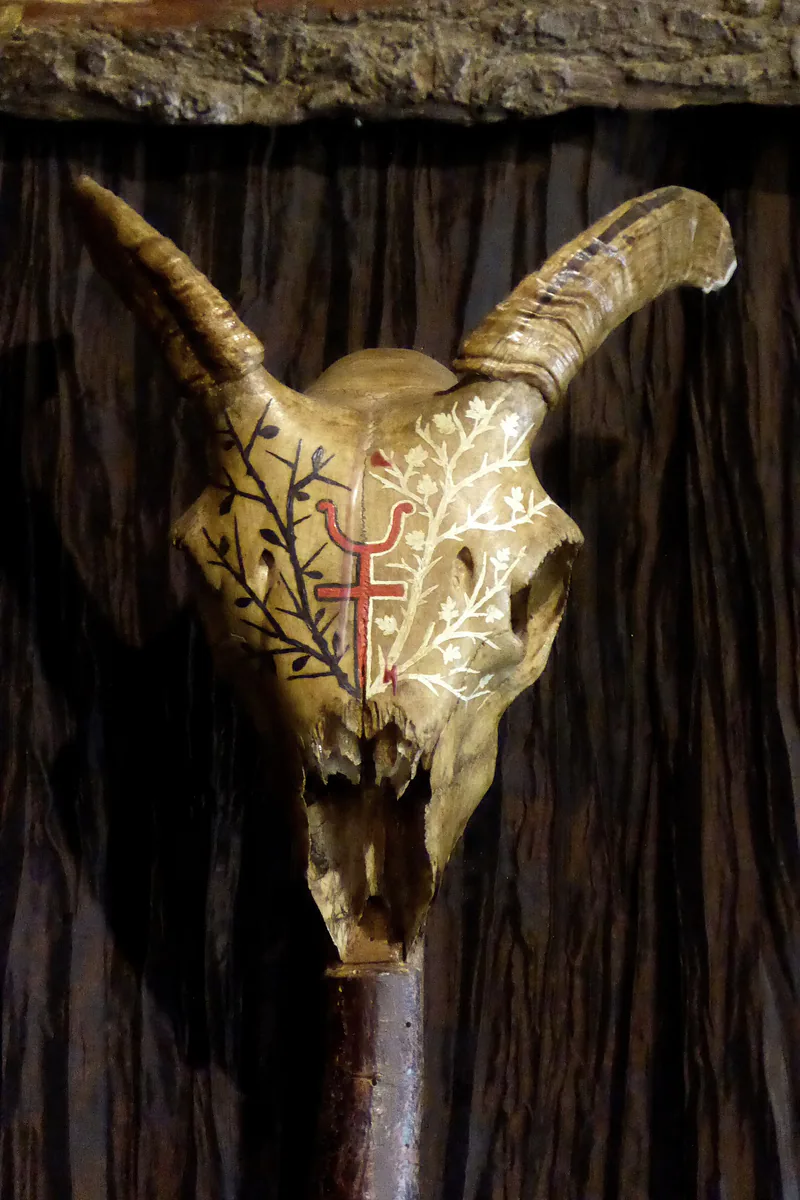
Cochrane's practice differed noticeably from Gardner's. Rites were often performed robed and outdoors, at night, in the landscape. Central symbols included the stang, the cauldron and the mill. His theology was mythic and poetic, featuring a horned god, a goddess who was sometimes threefold, and a concept of fate personified. He taught through riddles, symbols and allusive letters rather than a fixed Book of Shadows, insisting that the Craft was a mystery to be experienced rather than a set of rituals to be copied.
Cochrane died in 1966 at the age of 34 after taking a fatal combination of substances, an event widely understood as deliberate. His work was continued by Evan John Jones, who led the Clan of Tubal Cain and published Witchcraft: A Tradition Renewed (1990), and the group continues in a successor line today. Historians, including Hutton, accept that Cochrane drew on folklore and imaginative creation, and treat his claims of an ancient family tradition with caution, while recognising his considerable influence on later witchcraft.
The 1734 Tradition§
Cochrane corresponded in 1965–66 with Joseph Wilson, an American serving with the US Air Force in England. These letters, often called the "Cochrane letters", became the basis of what is known as the 1734 tradition in the United States. According to the letters, "1734" was not a date but a cryptogram, a numerical riddle concealing a name of the goddess or a teaching about the Craft. Cochrane deliberately left it unexplained.
Wilson and others, including Ann and Dave Finnin, who later formed the Roebuck tradition in California, developed a practice inspired by Cochrane's ideas, emphasising mystical experience, poetry and myth. The 1734 tradition remains a small but influential current in American witchcraft. Its practitioners vary on how strictly they claim descent from Cochrane, and scholars and members alike acknowledge that much of the tradition was built on interpretation of a limited body of correspondence.
Andrew Chumbley and the Sabbatic Craft§
A later and intellectually ambitious strand is associated with Andrew D. Chumbley (1967–2004), an English occultist and poet who led a group called the Cultus Sabbati. Chumbley described his tradition as the "Sabbatic Craft", a stream of initiatory magic combining dream, vision and the imagery of the witches' sabbat as an inner, visionary event rather than a literal gathering. He drew on grimoires, folk charms, the iconography of early modern demonology and Middle Eastern magical sources, and his writings show interest in the figure of the Devil as an initiator and the Witch-Father of folklore.
His major works include Azoëtia: A Grimoire of the Sabbatic Craft (1992), Qutub (1995) and One: The Grimoire of the Golden Toad (2000), issued in limited, finely produced editions through Xoanon Publishing. Chumbley also wrote on dream incubation and undertook graduate study in religion before his early death in 2004, following a severe asthma attack. His approach has been influential in the "Traditional Craft" publishing scene that emerged in the 2000s, alongside the work of Daniel Schulke, his successor in the Cultus Sabbati, and others.
Folk Magic Revival and Contemporary Practice§
Since the 1990s there has been considerable growth in practices described as traditional witchcraft, folk witchcraft or folk magic. Authors such as Nigel Pearson, Gemma Gary and Peter Paddon have written on regional and traditional practice, often drawing directly on historical sources such as charm books, court records and folklore collections. Practitioners in North America, Scandinavia and elsewhere have similarly turned to local folk traditions.
Typical practices include charm work and written amulets, the use of local herbs and plants, the veneration of ancestors and the dead, work with spirits of place, the use of bones, iron, salt and other traditional materials, and ritual at crossroads, churchyards or other liminal places. Many practitioners also observe seasonal festivals, though often not the eight-fold Wheel of the Year in its Wiccan form; some favour local feast days, agricultural milestones or the older quarter days alone.
How Traditional Witchcraft Differs from Wicca§
The differences between Wicca and traditional witchcraft are real but should not be overstated, as both emerged from the same mid-twentieth-century milieu and have influenced each other. Broad contrasts drawn by practitioners include:
| Aspect | Wicca (Gardnerian/Alexandrian) | Traditional witchcraft (typical) |
|---|---|---|
| Origins claimed | New Forest coven, 1939 | Hereditary or regional folk lineages |
| Deities | Goddess and God in balance | Often a horned god or Witch-Father, fate, spirits of place |
| Ritual dress | Often skyclad | Usually robed or everyday clothes |
| Key tools | Athame, pentacle, altar | Stang, cauldron, knife, local objects |
| Ethics | Wiccan Rede often central | Few formal codes; personal and communal honour |
| Text | Book of Shadows | Oral teaching, letters, grimoires |
The founding history of Wicca itself is covered in Wicca and Gerald Gardner.
Historians on the Claims of Old Craft§
As with Wicca, scholars have examined claims that traditional witchcraft preserves an unbroken pre-Christian or early modern religion. Ronald Hutton, in The Triumph of the Moon, found no documentary evidence of witch covens of the kind described surviving into the twentieth century, while acknowledging the real persistence of folk magic, charming and cunning craft into living memory. Owen Davies has shown that cunning folk were a genuine and widespread phenomenon but were not, in general, organised into covens or religious groups.
For many contemporary practitioners, these findings are not a threat. A growing number describe their practice as a modern reconstruction or reinterpretation of historical folk magic, valuing it for its connection to place and history rather than for claims of continuity. Others continue to affirm family or initiatory transmissions that cannot be independently verified, and the subject remains a matter on which scholarship and individual testimony are kept carefully distinct.
Frequently asked questions§
Is traditional witchcraft older than Wicca?§
Its organised forms, such as the Clan of Tubal Cain, date from the 1960s, a little after Gardner's Wicca. Traditional witchcraft draws on folk magic practices, such as those of the cunning folk, that are genuinely much older, but there is no evidence of witch covens surviving as an organised religion from earlier centuries.
Who were the cunning folk?§
Cunning folk were local magical specialists in Britain and elsewhere, active from the medieval period into the early twentieth century. They were paid to heal, find stolen goods, tell fortunes and counter witchcraft. Most considered themselves Christian and were regarded as opponents of witches rather than witches themselves.
What is a stang?§
A stang is a forked wooden staff, often of ash, used as a central ritual object in many traditional witchcraft groups, especially those influenced by Robert Cochrane. It can represent the horned god, the world tree or the meeting point of worlds, and it often serves as a portable altar planted in the ground.
What is the 1734 tradition?§
The 1734 tradition is an American form of traditional witchcraft based on letters Robert Cochrane wrote to Joseph Wilson in the mid-1960s. The number 1734 was described by Cochrane as a cryptic reference rather than a date. The tradition emphasises poetic, mystical experience over fixed ritual.
Sources and further reading§
- Popular Magic: Cunning-folk in English History — Owen Davies, 2007 (first published as Cunning-Folk, 2003)
- The Triumph of the Moon: A History of Modern Pagan Witchcraft — Ronald Hutton, 1999
- The Discoverie of Witchcraft — Reginald Scot, 1584
- The Robert Cochrane Letters — Robert Cochrane, Evan John Jones and Michael Howard, 2002
- Witchcraft: A Tradition Renewed — Evan John Jones with Doreen Valiente, 1990
- Azoëtia: A Grimoire of the Sabbatic Craft — Andrew D. Chumbley, 1992
- Children of Cain: A Study of Modern Traditional Witches — Michael Howard, 2011
- The Night Battles — Carlo Ginzburg, 1966 (English trans. 1983)