Liber XXVIII · Solomonic Magic · Chapter II: Demonology
Demonology: A History of Demons from Antiquity to the Grimoires
A history of demonology: demons in the Bible and Second Temple texts, the Church Fathers, scholastic theology, witch-hunt treatises and grimoire lists.

Demonology is the systematic study of demons: their origin, nature, names, ranks and powers, and the ways they may be resisted or, in magical texts, commanded. In the Western tradition it developed from Jewish and Christian scripture through the Church Fathers and scholastic theologians to the witch-hunting treatises of the early modern period, while a parallel magical demonology, beginning with the Testament of Solomon, catalogued demons so that magicians could bind them.
Demons in the Hebrew Bible and Second Temple Judaism§
The Hebrew Bible says relatively little about demons. It mentions shedim (Deuteronomy 32:17), goat-like seʿirim, the figure of Azazel in the Day of Atonement ritual (Leviticus 16), and, in Isaiah 34:14, a night creature called lilit, later developed into the demoness Lilith. The "satan" of Job and Zechariah is an accuser in the heavenly court rather than an independent prince of evil; see the history of Satan and the Devil.
During the Second Temple period (roughly the sixth century BCE to 70 CE), Jewish writers developed a rich demonology. The Book of the Watchers in 1 Enoch tells how angels descended, took human wives, taught forbidden arts such as metallurgy, cosmetics, sorcery and astrology, and fathered giants whose spirits became demons. The book of Tobit features the demon Asmodeus, driven off by the archangel Raphael. The Dead Sea Scrolls mention Belial and contain exorcistic songs, and Jubilees describes Mastema as chief of the evil spirits. Many of these ideas would shape Christian thought.
Demons in the New Testament and the Church Fathers§
The Gospels present Jesus as an exorcist who casts out unclean spirits and is accused of doing so by Beelzebul, "prince of demons". Paul speaks of principalities and powers, and Revelation depicts the dragon, "that old serpent", cast out of heaven with his angels.
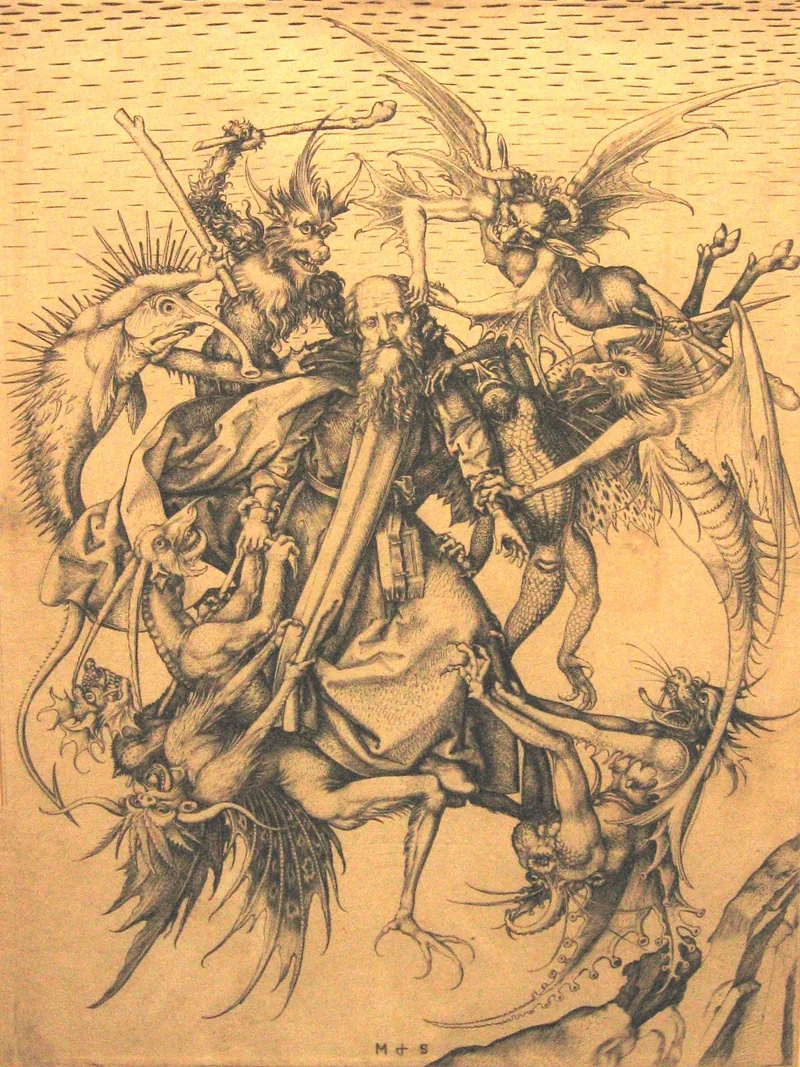
The Church Fathers systematised these hints. Justin Martyr, Tertullian, Origen and others identified demons with fallen angels and with the gods of Greek and Roman religion, who were said to deceive people through oracles and idols. Augustine of Hippo, in The City of God, argued that demons have bodies of air, possess sharp senses and long experience, and can deceive by illusions, but can do nothing without God's permission. In the desert monastic tradition, Evagrius Ponticus analysed the demons as tempters working through eight evil thoughts, a scheme that lies behind the later seven deadly sins.
Byzantine and scholastic demonology§
In the Byzantine world, a dialogue On the Operation of Daemons, long attributed to the eleventh-century scholar Michael Psellos but now generally regarded as pseudonymous, classified demons by the elements and regions they inhabit, from fiery spirits of the upper air to "light-hating" demons underground (On the Operation of Daemons). Richard Greenfield's study of late Byzantine demonology shows how learned and popular traditions intertwined.
In the Latin West, thirteenth-century scholastic theologians integrated demons into Aristotelian philosophy. Thomas Aquinas held that demons are angels who fell through pride, purely spiritual beings with great natural knowledge but no power to work true miracles. They could, however, move matter, influence the imagination and produce effects that seemed marvellous. Aquinas argued that the use of signs and characters in magic implied communication with demons, which made ritual magic in effect a tacit or explicit pact. This analysis became the foundation for later condemnations of magic.
Demonology and the witch trials§
From the fifteenth century demonology became bound up with fears of witchcraft. The Dominican Heinrich Kramer's Malleus Maleficarum (usually dated 1486, printed 1486–1487) presented witches as members of a diabolical conspiracy who made pacts with the Devil, and argued for their prosecution. A succession of learned treatises followed, among them Jean Bodin's De la démonomanie des sorciers (1580), Nicolas Rémy's Daemonolatreiae (1595), James VI of Scotland's Daemonologie (1597) and Martín del Río's Disquisitionum magicarum libri sex (1599–1600).

Not all demonologists supported the persecutions. The physician Johann Weyer, in De praestigiis daemonum (1563), accepted the reality of demons but argued that many accused witches were deluded, melancholic old women who deserved medical care rather than execution. Stuart Clark's Thinking with Demons (1997) shows that demonology was a sophisticated intellectual discipline connected to theology, natural philosophy and political thought. The wider story is told in the European witch trials.
Hierarchies and classifications of demons§
Demonologists repeatedly tried to rank the fallen angels. One common approach mirrored the nine angelic choirs of Pseudo-Dionysius, assigning fallen angels to each order. In 1589 the German bishop Peter Binsfeld linked seven princes of hell to the seven deadly sins: Lucifer with pride, Mammon with avarice, Asmodeus with lust, Satan with wrath, Beelzebub with gluttony, Leviathan with envy and Belphegor with sloth. The French inquisitor Sébastien Michaëlis described a hierarchy of demons revealed during a possession case in the early 1610s.
In the nineteenth century Jacques Collin de Plancy's Dictionnaire infernal (first published 1818) gathered demon lore into an encyclopedia; its 1863 edition, illustrated by Louis Le Breton, gave many demons the visual forms by which they are still known.
Magical demonology: catalogues of spirits§
Alongside theological demonology ran a magical tradition that catalogued demons in order to command them. The Testament of Solomon lists demons with their names, activities and the angels who thwart them. Medieval necromantic manuals, studied by Richard Kieckhefer and others, contain lists of spirits with their offices and appearances.
The most influential catalogue is the Pseudomonarchia daemonum, which Johann Weyer printed as an appendix to the 1577 edition of De praestigiis daemonum, explicitly to expose what he regarded as the folly of magicians (Pseudomonarchia Daemonum). It describes some sixty-nine demons (counts vary slightly between editions), their ranks as kings, dukes, marquises, presidents, earls and knights, their forms and the number of legions they command. A closely related list, with seals added, forms the 72 spirits of the Ars Goetia in the seventeenth-century Lemegeton. These catalogues, which present demons as a feudal court, influenced literature, art and later occultism; see What Is Solomonic Magic?.
Demons beyond Christianity§
Demonology is not only a Christian phenomenon. Islamic tradition developed an extensive lore of the jinn, beings of smokeless fire who may be believers or unbelievers, and of Iblis, who refused to bow to Adam. Jewish medieval and Kabbalistic texts elaborated on Lilith, Samael and the sitra aḥra, the "other side" of evil. Comparative scholars have also examined demonic figures in Zoroastrianism, Hinduism and Buddhism. Each tradition must be understood on its own terms rather than mapped directly onto Christian categories.
Frequently asked questions§
What is demonology?§
Demonology is the study or systematic description of demons, covering their origins, nature, hierarchy, names and activities. Historically it was a branch of theology, but it also appears in magical texts that catalogue demons for conjuration.
What is the Pseudomonarchia daemonum?§
It is a catalogue of about sixty-nine demons printed by Johann Weyer in 1577 as an appendix to his work on witchcraft and demonic illusions. Weyer published it to expose magic, but it became a key source for the Goetia of the Lemegeton.
Who were the seven princes of hell?§
In Peter Binsfeld's classification of 1589, the seven princes of hell were Lucifer (pride), Mammon (avarice), Asmodeus (lust), Satan (wrath), Beelzebub (gluttony), Leviathan (envy) and Belphegor (sloth). Other demonologists proposed different lists.
Did demonologists believe in witches?§
Most early modern demonologists did, and several treatises encouraged witch prosecutions. Some, notably Johann Weyer and later Reginald Scot, questioned whether accused witches truly had demonic powers.
Sources and further reading§
- Thinking with Demons: The Idea of Witchcraft in Early Modern Europe — Stuart Clark, 1997
- Traditions of Belief in Late Byzantine Demonology — Richard P. H. Greenfield, 1988
- Satan: The Early Christian Tradition — Jeffrey Burton Russell, 1981
- Forbidden Rites: A Necromancer's Manual of the Fifteenth Century — Richard Kieckhefer, 1997
- Daemonologie — James VI and I, 1597
- The Origin of Satan — Elaine Pagels, 1995