Liber XXVIII · Solomonic Magic · Chapter II: Demonology
Dictionnaire Infernal: Collin de Plancy and the Image of Demons
The Dictionnaire Infernal of Collin de Plancy (1818–1863): its encyclopedia of demons, Le Breton's engravings and the history of demon iconography.

The Dictionnaire infernal is an encyclopedia of demons, sorcerers, superstitions and the occult compiled by the French writer Jacques Collin de Plancy and first published in Paris in 1818. Its sixth edition of 1863, illustrated with engravings after the painter Louis Le Breton, gave definitive visual form to dozens of demons who had until then existed only as names and descriptions in grimoires and demonological treatises, and those images still shape how the spirits of the Goetia and of Christian demonology are pictured.
Collin de Plancy and the first edition§
Jacques Auguste Simon Collin de Plancy was born in 1793 at Plancy in Champagne and grew up in the world of post-revolutionary Paris, where he worked as a writer and publisher. His early books mocked credulity: a Dictionnaire critique des reliques et des images miraculeuses (1821–22) attacked the cult of relics, and the first Dictionnaire infernal, published in two volumes in 1818, presented the beliefs it described as errors to be dispelled by reason. Its full title promised an account of "beings, characters, books, deeds and causes" related to apparitions, magic, commerce with Hell, divination and the occult sciences.
In the late 1830s Collin de Plancy returned to the Catholic Church, and his later work changed direction. He produced devotional and legendary works and contributed a Dictionnaire des sciences occultes to the vast Encyclopédie théologique published by the Abbé Migne. Later editions of the Dictionnaire infernal were revised accordingly: the sceptical framing gave way to a Catholic one in which the reality of the Devil was affirmed, while the superstitions surrounding him were still criticised. The book's history thus mirrors the larger nineteenth-century movement between Enlightenment scepticism and religious revival described in French occultism from Lévi to Papus.
What the dictionary contains§
The Dictionnaire infernal is arranged alphabetically and mixes very different kinds of entry. There are articles on individual demons, drawn above all from Johann Weyer's Pseudomonarchia Daemonum and from the demonologists of the witch-hunt era such as Jean Bodin, Pierre de Lancre and Martín Del Rio. There are entries on famous sorcerers and trials — Urbain Grandier, Gilles de Rais, the possessions of Loudun — and on divinatory methods from aeromancy to tyromancy. There are entries on folklore, monsters and ghosts, on heresies and on secret societies, and on the grimoires themselves, including the Grand Grimoire and its Prime Minister of Hell, Lucifuge Rofocale.

Collin de Plancy also described an "infernal court" in which Beelzebub is supreme chief of the empire of Hell and other demons hold the offices of a modern state — ministers, ambassadors, a grand chamberlain. This hierarchy, which owes more to satire and to the administration of post-revolutionary France than to any medieval source, became widely quoted. The dictionary is a compilation of compilations; its value today lies in what it shows about nineteenth-century knowledge of and attitudes towards the occult, not in its reliability as a source for earlier periods.
Le Breton's engravings and the 1863 edition§
The edition that made the book famous was the sixth, published in Paris by Henri Plon in 1863. It contained some five hundred and fifty illustrations, and among them a series of full-figure portraits of demons drawn by Louis Le Breton (1818–1866), a marine painter who had sailed as an artist on Dumont d'Urville's voyage to the Antarctic, and engraved for the book.
Le Breton worked from the verbal descriptions in Weyer and the grimoires and turned them into precise, almost naturalistic figures. Among the best known are:
- Baal, with the heads of a cat, a man and a toad set on spider's legs, following Weyer's description of Bael;
- Buer, a lion's head surrounded by goat's legs arranged like the spokes of a wheel, on which he rolls;
- Asmodeus, with the heads of a bull, a man and a ram, a serpent's tail and goose's feet, riding a dragon;
- Belphegor, a horned, bearded figure seated on a throne that resembles a close-stool;
- Amduscias, whom Weyer describes as appearing like a unicorn; Abigor, an armed rider; Behemoth, an elephantine monster; and the minor fire-tending demon Ukobach.
The combination of exact detail and grotesque invention gave the images an authority that no earlier depictions of these spirits had possessed. Because most of the demons had never been illustrated before, Le Breton's versions effectively became their canonical appearance.
Demon iconography before the Dictionnaire§
Le Breton's engravings belong to a tradition of picturing demons almost as old as Christian art. Early Christian art rarely shows demons at all. From the Carolingian period small, dark, winged figures appear in manuscripts, emerging from the possessed or tempting saints. Romanesque sculptors of the eleventh and twelfth centuries created the first memorable demons: the gaunt, flame-haired devils weighing souls in the Last Judgement tympanum at Autun, carved by the sculptor known as Gislebertus around 1130, and the monstrous figures of the capitals at Vézelay and Saint-Benoît-sur-Loire. The thirteenth-century Bohemian Codex Gigas contains a famous full-page image of the Devil, horned and clawed.
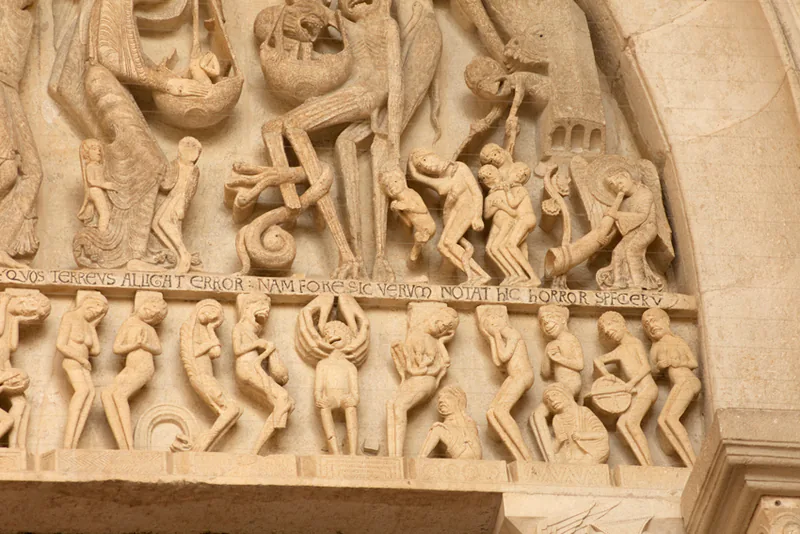
In the later Middle Ages demons acquired bat's wings, horns, tails, cloven hooves and faces on their bellies and joints, signs of a body that had lost its proper order. Giotto's Satan in the Arena Chapel at Padua (c. 1305) devours the damned; the Temptations of Saint Anthony by Martin Schongauer (engraving, c. 1470s) and Hieronymus Bosch fill the air with hybrid creatures; Michael Pacher's panel of Saint Wolfgang and the Devil shows the fiend as a green monster with a second face on its rump, forced to hold the saint's book. Luther Link has argued that this variety reflects the fact that the Devil had no fixed form: he was "a mask without a face", defined by what he did rather than by how he looked.
The early printed books added their own images: woodcuts of witches making pacts in Francesco Maria Guazzo's Compendium Maleficarum (1608 and 1626), of Faust and Mephistopheles on the title pages of Faust books, and of Lucifuge Rofocale in the Grand Grimoire. The longer history of the figure of Satan is told in the history of Satan and the Devil.
From Romantic Satan to the modern image of demons§
At almost the same moment as the 1863 Dictionnaire infernal, Gustave Doré was illustrating Dante's Inferno (1861) and Milton's Paradise Lost (1866), in which Satan appears as a fallen but majestic angel with immense bat-like wings. The two strands — the heroic Satan of Romantic art and the grotesque catalogue demons of Le Breton — have coexisted in popular culture ever since.
Le Breton's engravings, out of copyright and endlessly reproduced, passed into twentieth-century books on demonology and witchcraft, into editions and commentaries on the Ars Goetia, and from there into games, comics, album covers and the visual culture of the internet. Many people who have never heard of Collin de Plancy know his Baal and his Buer. For a wider survey of how occult themes entered art and literature, see occult literature and art, and for the theological background of the hierarchies he catalogued, demonology: a complete guide.
Frequently asked questions§
Who wrote the Dictionnaire infernal?§
Jacques Auguste Simon Collin de Plancy (1793–1881), a French writer and publisher. The first edition appeared in 1818; the much-reproduced illustrated edition is the sixth, of 1863.
Who drew the demons in the Dictionnaire infernal?§
The full-length demon portraits of the 1863 edition were drawn by Louis Le Breton, a French painter best known for marine scenes and for his work on Dumont d'Urville's voyage to the Antarctic, and were engraved for the book.
Are the Dictionnaire infernal's images of demons traditional?§
Mostly not. Le Breton based them on written descriptions in Weyer and other sources, but the specific images were new in 1863. Earlier Christian art had no fixed iconography for most of the named demons of the grimoires.
Is the Dictionnaire infernal a grimoire?§
No. It is an encyclopedia about demons, magic and superstition, not a book of rituals. Its author's attitude moved from mockery to Catholic disapproval, but at no stage did he write it as a practical manual.
Sources and further reading§
- Dictionnaire infernal — Jacques Collin de Plancy, 1818
- The Devil: A Mask Without a Face — Luther Link, 1995
- Lucifer: The Devil in the Middle Ages — Jeffrey Burton Russell, 1984
- Mephistopheles: The Devil in the Modern World — Jeffrey Burton Russell, 1986
- A History of the Devil: From the Middle Ages to the Present — Robert Muchembled, 2003
- De praestigiis daemonum — Johann Weyer, 1563
- Compendium Maleficarum — Francesco Maria Guazzo, 1608