Liber VI · Christianity · Chapter III: Catholicism
Roman Catholicism: History, Teaching and the Papacy
An introduction to Roman Catholicism: the papacy, the Catholic Church's history from Rome to Vatican II, its teaching, sacraments, orders and saints.

Roman Catholicism is the faith and life of the Catholic Church, the largest Christian body in the world, with about 1.4 billion members in communion with the bishop of Rome, the pope. Catholics believe that their Church is the one founded by Christ on the apostles, with the pope as successor of Saint Peter; its teaching is shaped by scripture and tradition, celebrated in seven sacraments, and expressed in a rich culture of saints, religious orders and devotion.
The Bishop of Rome and the Rise of the Papacy§
The Christian community in Rome was already significant when Paul wrote to it in the 50s, and the tradition that Peter and Paul were martyred there gave it unique prestige. Catholics read Jesus' words to Peter in Matthew 16 — "thou art Peter, and upon this rock I will build my church" — as the foundation of a lasting Petrine office. Early writers such as Irenaeus (c. 180) appealed to the Roman church's succession of bishops as a guarantee of true teaching.
The authority of the papacy grew gradually. Pope Leo I (440–461) articulated a strong theology of Petrine primacy, and Gregory the Great (590–604) combined pastoral care with practical leadership of Rome after the collapse of imperial government in the West. The coronation of Charlemagne as emperor by Pope Leo III in 800 bound the papacy to the new Western empire. The reforming popes of the eleventh century, above all Gregory VII (1073–1085), asserted the Church's freedom from lay control in the Investiture Controversy, and Innocent III (1198–1216) presided over a papacy at the height of its power, holding the Fourth Lateran Council in 1215.
Medieval Catholic Christendom§
The separation from the Eastern churches, conventionally dated to 1054, left the Latin Church as the dominant institution of Western Europe (see Eastern Orthodox Christianity). Monasteries, cathedral schools and, from the twelfth century, universities made it the guardian of learning. Scholastic theology reached its peak in Thomas Aquinas (c. 1225–1274), whose Summa Theologiae combined Christian doctrine with the philosophy of Aristotle and remains a reference point for Catholic thought.

The period also saw the founding of new religious orders — Cistercians, Franciscans and Dominicans among them — described in Christian Monasticism, the crusades, and the creation of inquisitorial tribunals to pursue heresy, notably against the dualist movements discussed in Cathars and Bogomils. The Avignon papacy (1309–1377) and the Great Western Schism (1378–1417), when two and then three rival popes claimed office, damaged the papacy's prestige and fuelled calls for reform that the Council of Constance resolved by electing Martin V in 1417.
Trent and the Catholic Reformation§
The Protestant Reformation, described in Protestantism and the Reformation, divided Western Christianity. The Catholic response, once called the Counter-Reformation and now often the Catholic Reformation, combined defence of doctrine with internal renewal. The Council of Trent, meeting in three periods between 1545 and 1563, reaffirmed the authority of scripture and tradition together, defined the canon of scripture, taught that justification involves both grace and human cooperation, confirmed seven sacraments and transubstantiation, and ordered seminaries for the training of priests. A Roman Catechism (1566) and a standard Roman Missal (1570) followed.
New orders carried the reform forward. The Society of Jesus, founded by Ignatius of Loyola and approved in 1540, became famous for its schools and its missions; Francis Xavier preached in India and Japan, and Jesuits later worked at the Chinese court. Teresa of Ávila and John of the Cross reformed the Carmelites, and Catholic missions spread to the Americas, Africa and Asia, often in the wake of Spanish and Portuguese colonial expansion, with complex and sometimes devastating consequences for the peoples concerned.
Vatican I, Vatican II and the Modern Church§
The nineteenth century brought conflict with liberal states and the loss of the Papal States. The First Vatican Council (1869–1870) defined papal infallibility: when the pope solemnly defines a doctrine of faith or morals ex cathedra, he is preserved from error. This power has been formally invoked rarely, the clearest example being the definition of the Assumption of Mary in 1950. Leo XIII's encyclical Rerum Novarum (1891), on capital and labour, founded modern Catholic social teaching.
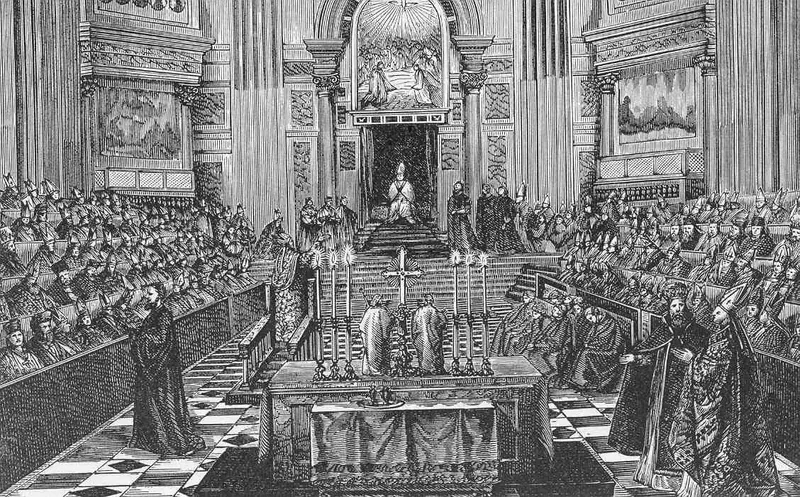
The Second Vatican Council (1962–1965), opened by John XXIII and concluded by Paul VI, brought the most significant changes in centuries. Its documents on the liturgy, the Church, revelation and the Church in the modern world led to Mass in local languages, a renewed role for the laity and for bishops acting together, and new relationships with other Christians and religions, notably in the declaration Nostra Aetate (1965) on non-Christian religions, which repudiated the charge that the Jewish people were collectively guilty of Christ's death. John Paul II (1978–2005), Benedict XVI (2005–2013) and Francis (2013–2025) interpreted the council in different emphases; in May 2025 the conclave elected Leo XIV, the first pope born in the United States. The Church has also been shaken since the 1990s by revelations of clerical sexual abuse and its concealment, which have prompted investigations and reforms in many countries.
Catholic Teaching and Practice§
Sources of authority§
Catholic doctrine is drawn from scripture and tradition, interpreted by the magisterium, the teaching authority of the pope and bishops. The Catechism of the Catholic Church, published in 1992, summarises official teaching, and the Code of Canon Law (1983 for the Latin Church) governs church life.
Sacraments and the Mass§
Catholics recognise seven sacraments: baptism, confirmation, the Eucharist, penance (confession), anointing of the sick, holy orders and matrimony. The Mass, in which Catholics believe the bread and wine become the body and blood of Christ, is the centre of worship; attendance on Sundays and holy days is an obligation. Most Latin-rite priests are celibate, while Eastern Catholic churches generally allow married priests. These rites are described in Christian Sacraments and Liturgy.
Saints, Mary and devotion§
Catholic piety honours the Virgin Mary and the saints as intercessors and examples, with feast days, pilgrimages, the rosary and devotions such as the Stations of the Cross. Formal canonisation procedures, Marian dogmas such as the Immaculate Conception (1854) and the Assumption (1950), and the veneration of relics are covered in Saints, Relics and the Virgin Mary.
The Global Catholic Church Today§
Catholicism today is a global communion whose demographic centre has moved to Latin America, Africa and Asia; Brazil, Mexico and the Philippines have among the largest Catholic populations. The Eastern Catholic churches — including the Ukrainian Greek Catholic, Maronite, Melkite, Chaldean and Syro-Malabar churches — keep their own liturgies and traditions while in communion with Rome. Catholic institutions run vast networks of schools, hospitals and charities. Debates over the role of women, clerical celibacy, the reception of divorced and remarried Catholics, sexuality and the legacy of Vatican II reflect the diversity of a church that spans almost every culture on earth.
Frequently asked questions§
What do Catholics believe about the pope?§
Catholics believe the pope is the successor of Saint Peter and the visible head of the Church on earth, with full and universal authority. Under strict conditions, when solemnly defining doctrine on faith or morals, he is believed to teach infallibly.
How is Catholicism different from Protestantism?§
Catholics recognise the authority of tradition and the magisterium alongside scripture, seven sacraments, the real and substantial presence of Christ in the Eucharist, and the intercession of Mary and the saints. Most Protestant churches hold scripture alone as the supreme authority and recognise two sacraments.
What was the Second Vatican Council?§
It was a council of the world's Catholic bishops held in Rome from 1962 to 1965. It reformed the liturgy, encouraged the use of local languages in the Mass, and opened new relationships with other Christians, Jews and other religions.
Are Eastern Catholics Catholic?§
Yes. Eastern Catholic churches are fully in communion with the pope but follow Eastern liturgical traditions, such as the Byzantine, Syriac, Armenian or Coptic rites, and have their own laws and customs.
Sources and further reading§
- Catechism of the Catholic Church — Catholic Church, 1992
- Saints and Sinners: A History of the Popes — Eamon Duffy, 1997
- Trent: What Happened at the Council — John W. O'Malley, 2013
- What Happened at Vatican II — John W. O'Malley, 2008
- Summa Theologiae — Thomas Aquinas, 1270
- A History of Christianity: The First Three Thousand Years — Diarmaid MacCulloch, 2009