Liber IX · Gnosticism · Chapter III: Christian Mystics
John of the Cross: The Dark Night of the Soul and Mystical Ascent
John of the Cross explained: the Carmelite poet-mystic, his Toledo imprisonment, the Dark Night of the Soul, Ascent of Mount Carmel and Spiritual Canticle.

John of the Cross (Juan de la Cruz, 1542–1591) was a Spanish Carmelite friar, poet and mystical theologian, the companion of Teresa of Ávila in the reform of the Carmelite order and the author of The Dark Night and The Ascent of Mount Carmel. His teaching describes the soul's journey to union with God through "nights" of purification in which the senses and the spirit are emptied of attachments, so that God may be known in pure faith and love. Canonised in 1726 and declared a Doctor of the Church in 1926, he is regarded as one of the greatest lyric poets in Spanish and a master of Christian contemplative theology.
Life of John of the Cross§
Juan de Yepes Álvarez was born in 1542 at Fontiveros, a small town in Old Castile. His father, from a family of silk merchants, had been disowned for marrying a poor weaver and died while Juan was small. His mother, Catalina Álvarez, moved with her sons in search of work, finally settling at Medina del Campo, where Juan attended a school for poor children, worked in a hospital and studied with the Jesuits.
In 1563 he entered the Carmelite friary at Medina, taking the name Juan de Santo Matía, and was sent to study at the University of Salamanca, then one of the great centres of learning in Europe. There he absorbed scholastic theology and the Bible, especially the Song of Songs, which shaped all his later writing. Drawn to a stricter, more contemplative life, he was considering joining the Carthusians, the strictest of the contemplative monastic orders, when, in 1567, he met Teresa of Ávila.
Teresa of Ávila and the Discalced Carmelite Reform§
Teresa (1515–1582), already in her fifties, was founding convents of nuns who would follow the primitive Carmelite rule in poverty, enclosure and prayer. These "Discalced" (barefoot) Carmelites, so called from the sandals they wore, sought to restore the eremitical spirit of the order's origins on Mount Carmel. Teresa wanted friars to join the reform and saw in the small, intense young man a suitable partner, calling him affectionately her "half a friar".
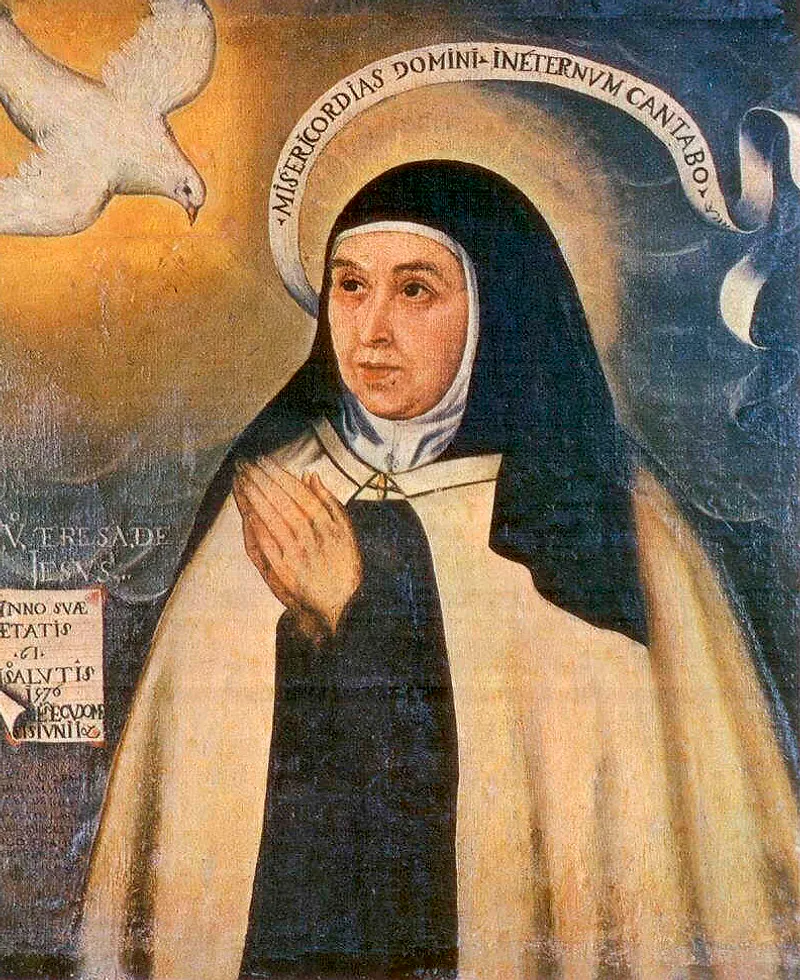
In November 1568 Juan and a few companions began the first house of Discalced friars at Duruelo, and he took the name Juan de la Cruz, "of the Cross". In 1572 Teresa had him appointed confessor to the large Convent of the Incarnation in Ávila, where she was prioress, and for five years the two worked closely together.
Imprisonment in Toledo and the Great Poems§
The reform provoked fierce opposition from the Calced (unreformed) Carmelites, amid disputes between papal and royal jurisdiction. On the night of 2–3 December 1577 John was seized in Ávila and taken to the Carmelite priory in Toledo, where he was confined for about nine months in a narrow cell with little light, regularly disciplined and pressed to abandon the reform.
In these conditions he composed some of the most celebrated poems in the Spanish language, including most of the Spiritual Canticle (Cántico espiritual), a dialogue between the soul as bride and Christ as bridegroom modelled on the Song of Songs. In August 1578 he escaped at night by lowering himself from a window on a rope made of strips of cloth, and found refuge with the Discalced nuns of Toledo. The famous poem En una noche oscura ("On a dark night"), which became the basis of the Ascent and the Dark Night, was probably written soon after, its imagery of a secret escape by night echoing his own experience.
The rest of his life was spent in the governance of the reform in Andalusia and Castile, as prior in Granada and Segovia and as vicar provincial. Most of his prose was written in the 1580s. In his last years he fell out with the reform's leadership under Nicolás Doria, was removed from office and sent to a remote house. He fell ill and died at Úbeda on 14 December 1591.
The Dark Night of the Soul: Nights of Sense and Spirit§
The phrase "dark night of the soul" has become a common expression for any period of spiritual or emotional desolation, but in John's writings it has a precise meaning. The "night" is the whole process by which the soul is purified of its attachments and brought to union with God. It is dark for three reasons, he explains: because the soul leaves behind its desire for things, because it travels by faith, which is dark to the intellect, and because God, its goal, is darkness to the soul in this life.
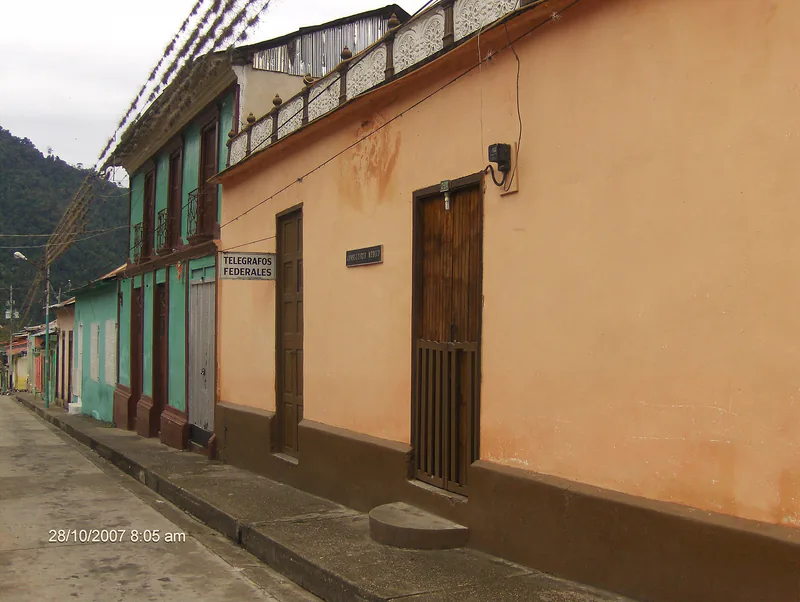
John distinguishes two nights. The night of sense purifies the soul of its dependence on the senses and on the sweetness of prayer; beginners who have relied on consolations find them withdrawn and feel dryness. The night of spirit, deeper and rarer, purifies the intellect, memory and will themselves, and can involve an intense sense of abandonment and of one's own poverty before God. Each night has an "active" side, in which the person cooperates through detachment, and a "passive" side, which is God's own work. The Dark Night treats chiefly the passive nights.
John was a careful director. He gives signs for discerning when dryness in prayer comes from God rather than from lukewarmness or from what he calls melancholy, and he warns spiritual directors not to confuse the two. Modern writers who use his language in pastoral care likewise stress that a spiritual dark night is not the same as clinical depression, and that persistent despair, exhaustion or loss of interest in life are reasons to seek medical and psychological help.
Ascent of Mount Carmel and the Way of Nada§
The Ascent of Mount Carmel, left unfinished, treats the active purification of the senses and faculties. Its emblem is a drawing John made for his nuns, the "Mount of Perfection", which shows several paths up the mountain. The path of seeking earthly goods and the path of seeking spiritual goods both stop short; only the narrow middle path, marked nada, nada, nada ("nothing"), reaches the summit, where "only the honour and glory of God dwells".
The sayings attached to this sketch summarise his teaching in paradoxes: to come to possess all, desire to possess nothing; to come to be all, desire to be nothing. Read in context, this is not contempt for creation but a teaching about freedom: whatever the soul clings to, even religious experiences, visions and favours, can stand between it and God. John is notably cautious towards visions and revelations, advising that they should neither be sought nor relied upon. Here he stands in the long apophatic tradition that runs from Pseudo-Dionysius and the Cloud of Unknowing, although he grounds it in the psychology of prayer rather than in metaphysics.
The Spiritual Canticle and the Living Flame of Love§
If the Ascent and the Dark Night describe the way, the Spiritual Canticle and the Living Flame of Love describe its goal. The Canticle, which exists in two redactions, follows the soul from its search for the hidden Beloved through the stages of betrothal to the "spiritual marriage", a transforming union in which the soul becomes God by participation while remaining a creature. The Living Flame, a commentary on a short poem written in Granada, speaks of the soul so penetrated by the Holy Spirit that it is like a log fully set ablaze, the fire and the wood become one flame.
These works belong to the bridal mysticism of the Song of Songs that runs from Origen and Bernard of Clairvaux through the Christian mystical tradition, but John fuses it with a rigorous scholastic account of the faculties. The poetry and the commentary illuminate each other, yet John insisted that the poems say more than any explanation can.
Influence: From Carmelite Doctor to Modern Psychology§
John's works were published posthumously, beginning in 1618, and were examined closely during the controversies over Quietism, in which some of his phrases were invoked by both sides. His canonisation in 1726 and his recognition as Doctor of the Church in 1926 confirmed his standing in Roman Catholic teaching. Thérèse of Lisieux and Edith Stein, both Carmelites, were among his most devoted readers; Stein's last work, The Science of the Cross, was a study of his thought.
Beyond the Church, John has been admired by poets, philosophers and psychologists. His poems are anthologised as masterpieces of Spanish Renaissance verse; his small drawing of Christ crucified, seen from above, inspired a well-known twentieth-century painting; and the "dark night of the soul" has entered common speech. The popular phrase often loses his framework of faith, love and union, but its spread shows how deeply his account has spoken to modern experience.
Frequently asked questions§
What is the dark night of the soul according to John of the Cross?§
It is the process of purification by which God frees the soul from attachments to the senses and to its own ideas and feelings, so that it may be united to God in faith and love. John describes a night of sense and a deeper night of spirit, each painful but ultimately leading to peace and union.
What did John of the Cross write?§
His major prose works are The Ascent of Mount Carmel, The Dark Night, The Spiritual Canticle and The Living Flame of Love, each a commentary on one of his poems. He also left shorter poems, letters, counsels and the "Sayings of Light and Love".
How were John of the Cross and Teresa of Ávila connected?§
Teresa recruited John in 1567 to help extend her Discalced Carmelite reform to the friars. He founded the first house of Discalced friars in 1568 and served as confessor at Teresa's convent in Ávila from 1572 to 1577; both are now Doctors of the Church.
Is the dark night of the soul the same as depression?§
No. John himself distinguished spiritual dryness from melancholy, and modern pastoral writers do the same. Someone experiencing lasting low mood, hopelessness or exhaustion should seek medical or psychological help rather than assume a spiritual explanation.
Sources and further reading§
- The Collected Works of St. John of the Cross — Kieran Kavanaugh and Otilio Rodriguez (trans.), 1964
- The Complete Works of Saint John of the Cross — E. Allison Peers (trans.), 1934
- St John of the Cross: His Life and Poetry — Gerald Brenan, 1973
- St John of the Cross: Songs in the Night — Colin P. Thompson, 2002
- The Science of the Cross — Edith Stein, 1960
- The Impact of God: Soundings from St John of the Cross — Iain Matthew, 1995
- The Darkness of God: Negativity in Christian Mysticism — Denys Turner, 1995