Liber IX · Gnosticism · Chapter III: Christian Mystics
Meister Eckhart: Detachment, the Ground and the Birth of God
Meister Eckhart (c. 1260–1328): the Dominican mystic's life, German sermons, teaching on detachment and the ground of the soul, his heresy trial and legacy.

Meister Eckhart (c. 1260–c. 1328) was a German Dominican friar, university master and preacher whose sermons on detachment, the "ground" of the soul and the birth of God in the soul made him the most influential and most controversial mystical theologian of the Middle Ages. Shortly after his death, Pope John XXII condemned twenty-eight propositions drawn from his writings. Rediscovered in the nineteenth century, he has since been read by philosophers, Zen Buddhists and contemplatives as one of the great voices of Western mysticism.
Life of Meister Eckhart: Friar, Master and Preacher§
Eckhart was born around 1260, probably at Tambach near Gotha in Thuringia. He entered the Dominican Order, the Order of Preachers, as a young man at Erfurt and studied at Cologne, where the great Dominican scholar Albert the Great had taught. In 1293–94 he lectured on the Sentences of Peter Lombard at Paris, and in 1302–03 he held the Dominican chair of theology there as magister, the title from which "Meister" comes.
His career combined scholarship and administration. He was prior of Erfurt and vicar of Thuringia, and in 1303 became the first provincial of the new Dominican province of Saxonia, stretching from the Netherlands to Livonia. In 1311–13 he returned to Paris for a second regency, a rare distinction. From about 1314 he worked in Strasbourg as vicar for the order's master general, with responsibility for the spiritual care of the many communities of Dominican nuns and beguines in the Rhineland. It was in this pastoral setting that many of his German sermons were preached. Around 1323 he moved to Cologne, probably to direct the order's house of studies.
His Talks of Instruction (Reden der Unterweisung), given to young friars at Erfurt, and the Book of Divine Consolation, possibly written for Queen Agnes of Hungary, are among his best-known German works. His Latin writings include parts of an ambitious Opus tripartitum ("Three-Part Work"), with commentaries on Genesis, Exodus, Wisdom and John.
Detachment and Letting-Be§
The virtue Eckhart praised above all others was detachment (abegescheidenheit), a state of inner freedom in which the soul clings to nothing created, including its own will, its images of God and even its spiritual practices. In a short treatise on the subject he ranked it above love and humility, since love compels the soul to love God, but detachment compels God to come into the soul.
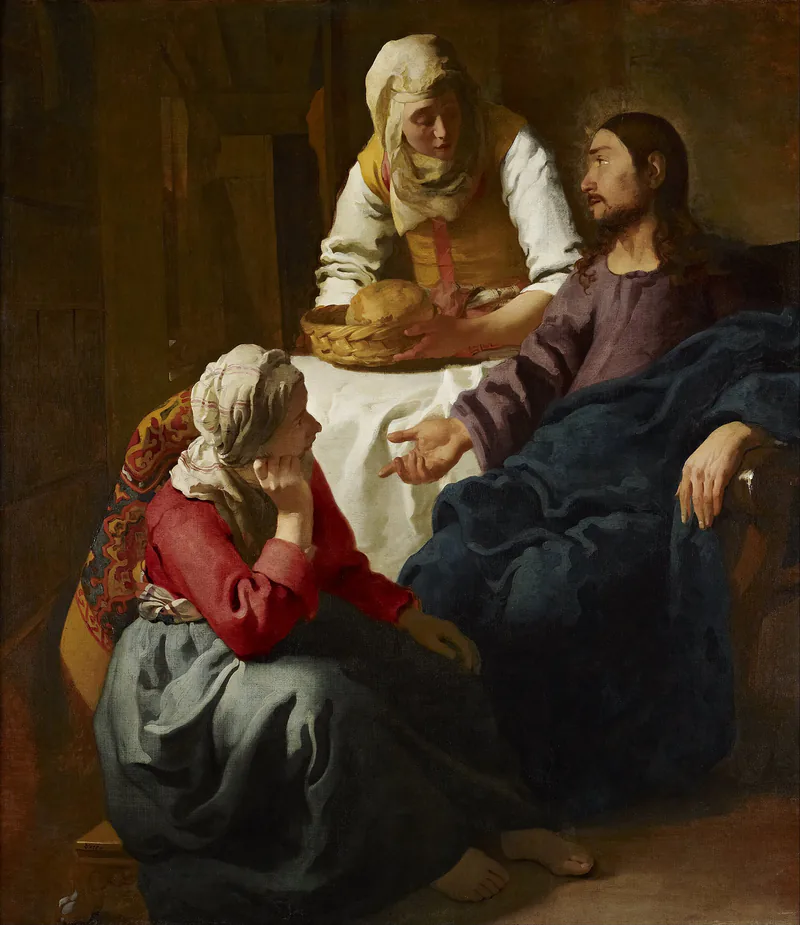
Closely related is gelâzenheit, often translated "releasement" or "letting-be": the attitude of leaving things as they are and leaving oneself to God. Eckhart insisted that this was not withdrawal from active life. In a famous sermon on Mary and Martha he reversed the usual reading, praising Martha as the more mature soul because she could work in the world without being hindered by it. One should seek God, he said, as readily in the kitchen as in church.
This teaching made Eckhart a spiritual guide of unusual directness. He criticised those who practise devotions in order to gain something, comparing them to merchants who bargain with God, and urged a love of God "without a why".
The Ground of the Soul and the Birth of the Word§
Eckhart's most characteristic idea is that at the deepest level of the soul there is a "ground" (grunt) where God and the soul are one. He also called it a little spark (vünkelîn), a castle, a light or a power in the soul that is uncreated and uncreatable, a phrase that later caused him trouble.
In this ground the eternal Father gives birth to his Son, the Word, just as he does in eternity. Christmas, for Eckhart, is not only a historical event but something that must happen in every soul: what good is it, he asked, that the Son was born of Mary long ago if he is not born in me now? The soul that is detached and empty becomes the place of this birth, and in it the person becomes by grace what Christ is by nature.
These themes connect Eckhart with a long tradition of Christian Platonism. Augustine, the Neoplatonists and above all Pseudo-Dionysius provided him with the language of the One, of emanation and return, and of a God beyond all names.
God and the Godhead: Eckhart's Apophatic Theology§
Eckhart pushed the negative or apophatic theology of Dionysius to an extreme. God, he taught, is beyond every name and concept; to say "God is good" is in a sense less true than to deny it, since God is beyond goodness. In some German sermons he distinguished between "God" (got), the God of the Trinity who acts and is known as creator, and the "Godhead" (gotheit), the silent, undifferentiated desert beyond all distinction where nothing is done.
From this distinction comes one of his most quoted sayings, from the sermon on the poor in spirit (Beati pauperes spiritu): he prays God to rid him of "God", meaning the God of human concepts, so that he may reach the true ground. True poverty, he argued in that sermon, is to want nothing, to know nothing and to have nothing, not even a place in oneself where God could act.
His Latin works approach the same questions more technically, beginning the Opus tripartitum with the proposition that "existence is God" (esse est deus) and discussing the analogy of being between creator and creatures. Scholars such as Bernard McGinn have emphasised that the scholastic and the vernacular Eckhart are one thinker, and that his boldest German formulations rest on careful metaphysics.
Trial, Condemnation and Defence§
In 1326 Henry of Virneburg, archbishop of Cologne, opened proceedings against Eckhart on the basis of lists of suspect propositions drawn from his works and sermons. The context was tense: the archbishop was hostile to the beguines and to unregulated lay spirituality, and the Dominicans were divided. Eckhart defended himself vigorously, arguing that his statements had been misunderstood or taken out of context and that he could be in error but not a heretic, since heresy is a matter of the will. In February 1327 he made a public declaration in the Dominican church at Cologne that he rejected anything in his works that might be found erroneous.
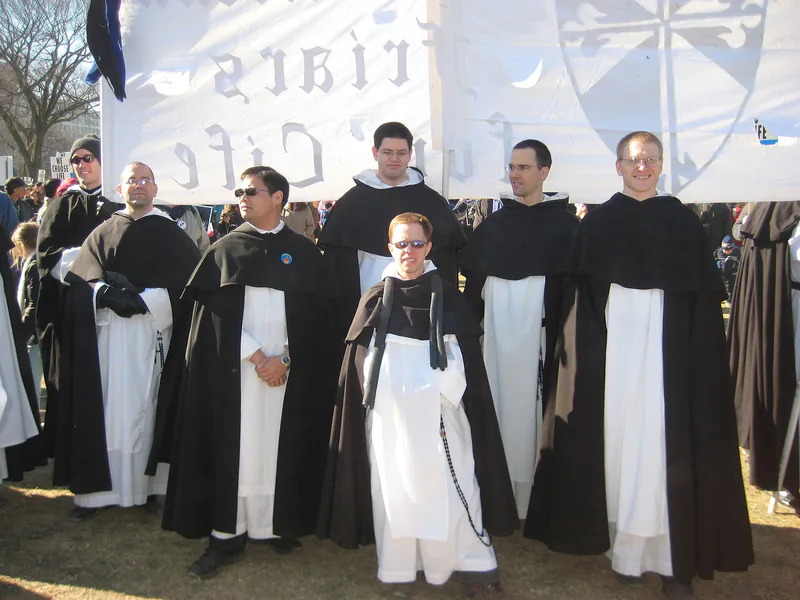
He appealed to Pope John XXII at Avignon and travelled there to defend himself, but died before 30 April 1328, the date of a papal letter that speaks of him as dead. On 27 March 1329 the bull In agro dominico ("In the field of the Lord") condemned twenty-eight articles, seventeen as heretical and eleven as ill-sounding and rash but capable of an orthodox reading with explanation. The bull stated that Eckhart had recanted before his death, so he was not condemned personally as a heretic. In the late twentieth century members of the Dominican Order sought a formal reassessment of his standing, and his orthodoxy remains a subject of theological discussion.
Tauler, Suso and the Legacy of Meister Eckhart§
Eckhart's influence passed first through his Dominican disciples. Johannes Tauler (c. 1300–1361), a preacher at Strasbourg, adapted his teaching on the ground of the soul in a more pastoral and practical form. Henry Suso (c. 1295–1366) defended his master in the Little Book of Truth and wrote the widely read Little Book of Eternal Wisdom. The anonymous Theologia Germanica, later published by Martin Luther, carried similar ideas into the Reformation era. Eckhartian themes also reached the circle of the Friends of God and the Flemish mystic Jan van Ruusbroec, who was nonetheless critical of some readings of Eckhart. Comparison with the contemporary English author of The Cloud of Unknowing shows how widely the Dionysian tradition flourished in the fourteenth century.
Later readers rediscovered him in quite different ways. Nicholas of Cusa owned and annotated his Latin works. German Romantics and idealists, including Franz von Baader and Hegel, admired him, and Jacob Boehme's language of the Ungrund has been compared, though without direct dependence, with Eckhart's ground. Arthur Schopenhauer compared him with the Buddha, and Martin Heidegger took up Gelassenheit as a philosophical term. In the twentieth century D. T. Suzuki and Rudolf Otto set him beside Zen and Vedanta respectively, and the critical edition of his German and Latin works, begun in 1936, finally made reliable texts available. Today he is read both as a Catholic theologian and as a universal mystic, two images that scholars continue to reconcile. For his place among the wider tradition, see our guide to Christian mystics.
Frequently asked questions§
Why is he called "Meister" Eckhart?§
"Meister" translates the Latin magister, the title of a master of theology at a medieval university. Eckhart earned it at Paris in 1302, and the title stayed with him as a mark of his learning.
Was Meister Eckhart a heretic?§
The bull In agro dominico of 1329 condemned twenty-eight propositions drawn from his works, but noted that he had recanted any errors before his death. He was therefore never personally declared a heretic, and many theologians argue that his teaching is orthodox when read in context.
What does Eckhart mean by detachment?§
Detachment is the inner freedom of a soul that clings to nothing created, not even its own will or images of God. For Eckhart it is the condition in which God is born in the soul, and it is compatible with an active life in the world.
What is the difference between God and the Godhead in Eckhart?§
In some German sermons Eckhart uses "God" for the Trinity as known and active in creation, and "Godhead" for the hidden, silent ground of the divine beyond all distinction. The contrast expresses his conviction that God transcends every concept.
Sources and further reading§
- Meister Eckhart: The Essential Sermons, Commentaries, Treatises, and Defense — Edmund Colledge and Bernard McGinn (trans.), 1981
- The Mystical Thought of Meister Eckhart: The Man from Whom God Hid Nothing — Bernard McGinn, 2001
- Meister Eckhart: Selected Writings — Oliver Davies (trans.), 1994
- The Complete Mystical Works of Meister Eckhart — Maurice O'C. Walshe (trans.), 2009
- Mysticism East and West — Rudolf Otto, 1932
- The Darkness of God: Negativity in Christian Mysticism — Denys Turner, 1995