Liber IX · Gnosticism · Chapter I: Apophatic Theology
Pseudo-Dionysius the Areopagite and Christian Mystical Theology
Pseudo-Dionysius the Areopagite explained: his writings, apophatic theology, the nine choirs of angels, and his influence on Eriugena, Eckhart and Hesychasm.

Pseudo-Dionysius the Areopagite is the name scholars give to the anonymous author, probably a Syrian Christian of the late fifth or early sixth century, who wrote a body of Greek treatises under the name of Dionysius, the Athenian converted by Paul in Acts 17:34. His works introduced apophatic, or negative, theology into the heart of Christian mysticism, described the angels in nine choirs arranged in three hierarchies, and shaped Christian contemplative thought from Eriugena and the Cloud of Unknowing to Meister Eckhart and Eastern Orthodox Hesychasm.
Who Was Pseudo-Dionysius the Areopagite?§
Acts 17 describes Paul preaching to the Athenian council of the Areopagus; a few listeners believed, among them "Dionysius the Areopagite". The author of the treatises presents himself as this disciple of Paul, addresses his works to a fellow presbyter named Timothy, claims to have witnessed the solar eclipse at the crucifixion, and writes a letter to the apostle John on Patmos. These literary devices place the works in the apostolic age.
The real author is unknown. The writings first appear in the historical record in the early sixth century: they are cited by Severus of Antioch, a leading Miaphysite theologian, in works dated around 518–528, and their authority was debated at a meeting between Chalcedonian and Miaphysite bishops in Constantinople in 532, where the Chalcedonian Hypatius of Ephesus questioned their authenticity. Internal evidence shows a close knowledge of the Athenian Neoplatonist Proclus (412–485) and of the liturgy of the Syrian churches, including the recitation of the creed during the eucharist, a practice introduced at Antioch in the 470s. Most scholars therefore date the corpus to around 485–525 and locate the author in Syria. Proposed identifications, including Peter the Fuller, Severus himself and the Syrian monk Stephen bar Sudaili, have not won consensus.
The pseudonym was remarkably successful. Endorsed by the scholia of John of Scythopolis and by Maximus the Confessor in the seventh century, the corpus was treated in both East and West as an authority second only to scripture. In the fifteenth century Lorenzo Valla doubted that the Areopagite had written it, and Erasmus repeated the doubt. In 1895 Hugo Koch and Josef Stiglmayr independently demonstrated that the treatise On the Divine Names paraphrases Proclus's On the Existence of Evils, settling the question for modern scholarship.
The Dionysian Corpus: Four Treatises and Ten Letters§
The surviving writings are:
- The Divine Names (De divinis nominibus), the longest treatise, which examines the names applied to God in scripture, such as Good, Light, Beautiful, Love, Being, Life, Wisdom, Power and One, and how they can and cannot be said of the transcendent.
- The Mystical Theology (De mystica theologia), a short treatise in five chapters on the ascent of the mind into the "divine darkness" beyond knowledge.
- The Celestial Hierarchy (De coelesti hierarchia), on the orders of angels and how scripture's symbolic language represents them.
- The Ecclesiastical Hierarchy (De ecclesiastica hierarchia), on the sacraments of the church (baptism, the eucharist and the consecration of oil) and the orders of clergy, monks and laity.
- Ten letters to various correspondents, which develop themes from the treatises.
The author also refers to other works, such as The Theological Outlines and The Symbolic Theology. These are not known to survive and may never have existed, serving instead to suggest a larger body of teaching.
Apophatic Theology and the Divine Darkness§
At the centre of Dionysian thought is a distinction between two ways of speaking about God. Cataphatic (affirmative) theology names God from his effects: because God is the cause of all goodness, being and life, he may be called Good, Being and Life. Apophatic (negative) theology denies these names, because God is not good, existent or living in the way created things are; he is beyond all of them. Dionysius uses a distinctive vocabulary of "hyper-" terms: God is hyperousios, beyond being, and hypertheos, beyond divinity.
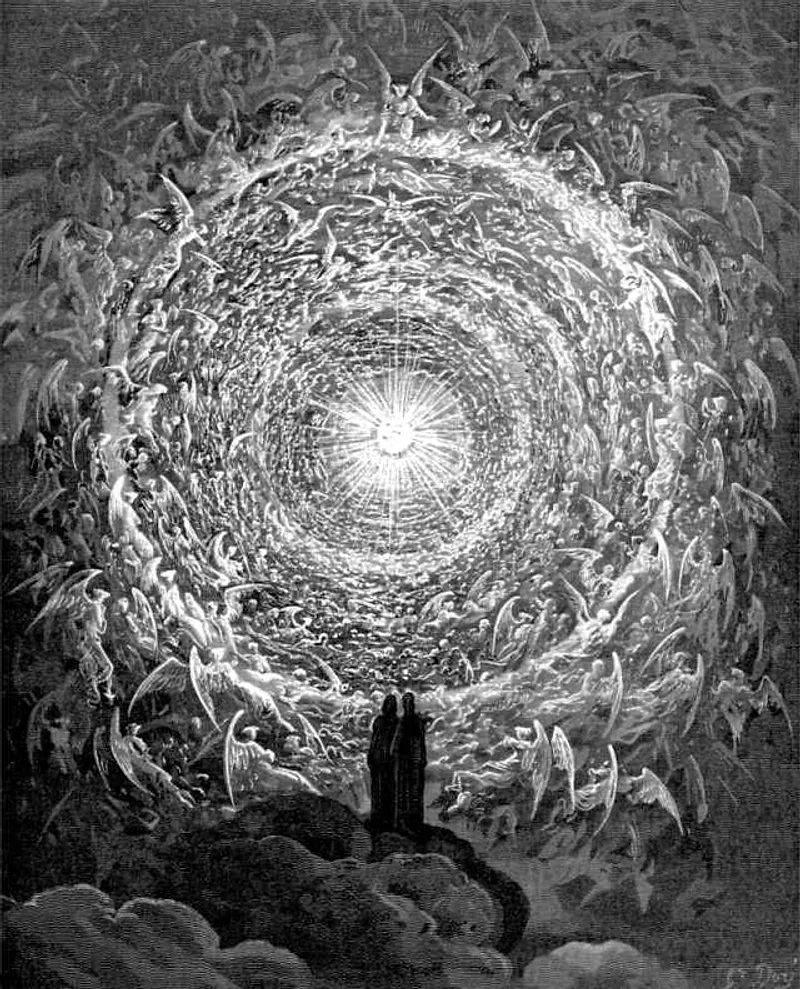
The Mystical Theology takes the argument to its limit. It ends with a long series of denials, saying that the cause of all is neither soul nor mind, neither number nor order, neither one nor oneness, neither divinity nor goodness, neither being nor non-being, and finally that it is beyond both assertion and denial. The goal of contemplation is union with God in a "darkness" that is not ignorance but the excess of light. Dionysius takes as his model Moses entering the cloud on Mount Sinai, an image already used by Gregory of Nyssa in his Life of Moses.
This negative theology has deep roots in Platonism, especially in the commentary tradition on Plato's Parmenides, where the One is denied every predicate. Similar language appears in the transcendent God of Sethian Gnosticism, whose invisible Spirit is described almost entirely through negations. The parallels reflect a shared philosophical heritage; Dionysius himself is firmly committed to the goodness of creation and to the church's sacramental life.
The Celestial Hierarchy and the Nine Choirs of Angels§
The word "hierarchy" seems to have been coined by Dionysius. He defines it as a sacred order, knowledge and activity that is assimilated as far as possible to the divine. Each hierarchy receives divine illumination from above and passes it on to those below, through three activities: purification, illumination and perfection.
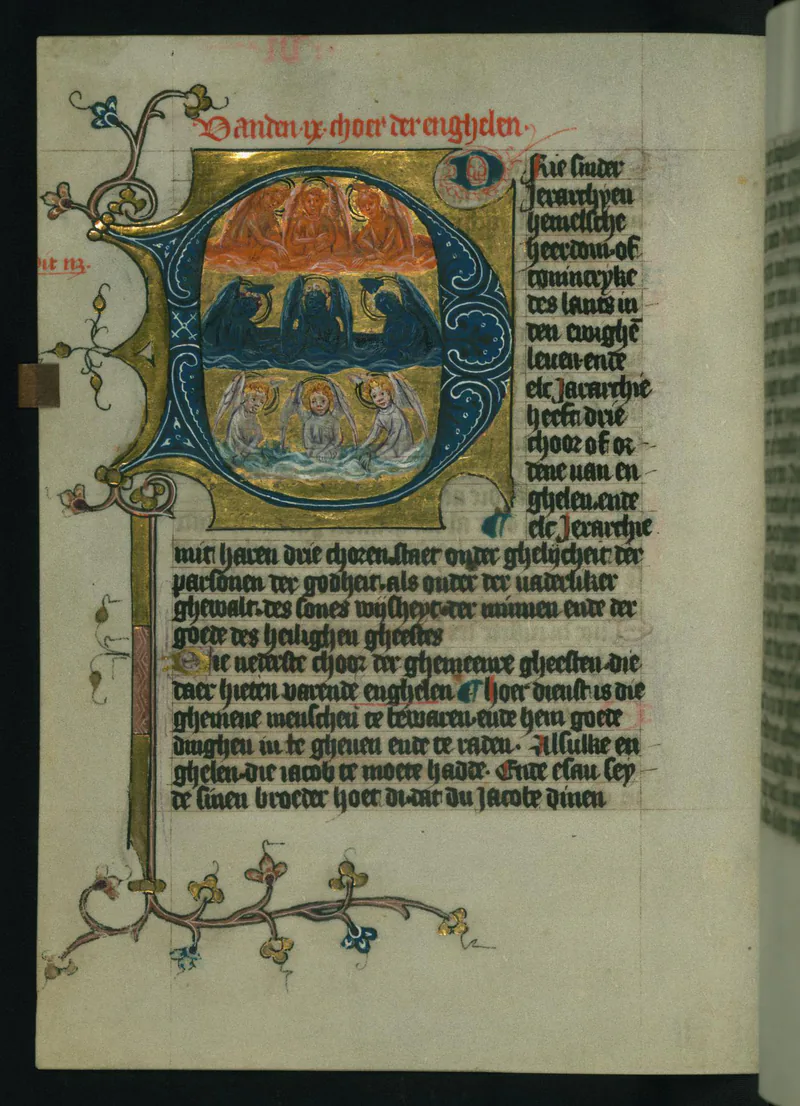
The Celestial Hierarchy arranges the angelic names found in scripture into nine orders in three triads:
- First hierarchy: Seraphim, Cherubim and Thrones, closest to God and contemplating him directly.
- Second hierarchy: Dominions, Powers and Authorities.
- Third hierarchy: Principalities, Archangels and Angels, the last of whom deal directly with human beings.
The names derive from Isaiah, Ezekiel, Genesis and the letters of Paul (Colossians 1:16 and Ephesians 1:21). Gregory the Great gave a slightly different order, but the Dionysian scheme became standard. Thomas Aquinas discusses it at length, and Dante adopts it in the Paradiso (canto 28), having Beatrice note that Gregory, on reaching heaven, laughed at his own error. The Ecclesiastical Hierarchy mirrors the celestial one on earth, with the sacraments, the clergy (hierarchs, priests and deacons) and those they serve (monks, the holy people and those being purified). Interest in angelic orders also has parallels in Jewish visionary traditions, discussed in our article on Merkavah and Hekhalot mysticism.
Dionysius in the Latin West: Eriugena, the Victorines and Aquinas§
The corpus reached the Latin West dramatically. In 827 the Byzantine emperor Michael II sent a Greek manuscript to the Frankish emperor Louis the Pious; it is still preserved in Paris. Abbot Hilduin of Saint-Denis translated it and helped to identify Dionysius the Areopagite with Saint Denis, the martyred first bishop of Paris and patron of the abbey, which greatly increased the prestige of the writings in France.
A far better translation was made around 860–862 by the Irish scholar John Scottus Eriugena at the court of Charles the Bald. Eriugena also translated Maximus the Confessor and Gregory of Nyssa, and his own great work, the Periphyseon (On the Division of Nature), is a bold synthesis of Dionysian and Greek patristic thought, describing the procession of all things from God and their return. Parts of it were later condemned, in 1225, because of its alleged pantheism.
In the twelfth century Hugh of Saint Victor wrote a commentary on the Celestial Hierarchy, and Abbot Suger rebuilt the church of Saint-Denis, which art historians often connect with the Dionysian theology of light, though how much Suger drew on Dionysius has been questioned. Thomas Gallus, a Victorine canon at Vercelli, produced influential paraphrases in the thirteenth century that emphasised love rather than intellect as the means of union. Thomas Aquinas cites Dionysius some 1,700 times and wrote a commentary on The Divine Names.
The Cloud of Unknowing and Meister Eckhart§
The Dionysian tradition flowered in the late medieval mystics. The Cloud of Unknowing is an anonymous Middle English guide to contemplative prayer, written in the second half of the fourteenth century, probably by an English priest or Carthusian monk. The same author produced Deonise Hid Divinite, an English version of the Mystical Theology, largely based on the Latin paraphrases of Thomas Gallus. The Cloud teaches the contemplative to place all created things beneath a "cloud of forgetting" and to reach toward God, hidden in a "cloud of unknowing", with a "naked intent" of love, sometimes focused in a single short word such as "God" or "love". It is a descriptive account of a prayer method, emphasising humility and the need for proper spiritual guidance.
Meister Eckhart (c. 1260–1328), a Dominican theologian and preacher, drew on Dionysius, Augustine and the Neoplatonic Book of Causes. His German sermons speak of the "desert of the Godhead", a ground of God beyond the Trinity of persons, and of the birth of the Word in the soul. He urged detachment (Abgeschiedenheit) and a radical letting-go (Gelassenheit). Some propositions from his works were condemned by Pope John XXII in the bull In agro dominico in 1329, after his death. His successors Johannes Tauler and Henry Suso, and later the Theologia Germanica, transmitted Dionysian and Eckhartian themes to Martin Luther and to the Protestant mystic Jacob Boehme. Nicholas of Cusa's On Learned Ignorance (1440) is another major Dionysian work.
Dionysius in the Christian East: Maximus, Palamas and the Philokalia§
In the Byzantine world, Dionysius was read primarily through Maximus the Confessor (c. 580–662), whose Ambigua and Mystagogy integrated Dionysian hierarchy and apophaticism into a christocentric theology of deification (theosis). Dionysian vocabulary of light, darkness and union became part of the common language of Orthodox spirituality.
In the fourteenth century the Hesychast controversy turned on these themes. Hesychasm (from hesychia, "stillness") was a tradition of monastic prayer on Mount Athos centred on the continual repetition of the Jesus Prayer, sometimes combined with attention to breathing and posture. Practitioners reported visions of the divine light, identified with the light of Christ's transfiguration on Mount Tabor. The Calabrian monk Barlaam criticised these claims; Gregory Palamas (1296–1359) defended them, distinguishing between God's unknowable essence and his uncreated energies, in which human beings can truly participate. Both sides appealed to Dionysius. Councils in Constantinople in 1341, 1347 and 1351 upheld Palamas's position.
The Philokalia, an anthology of Greek texts on prayer and watchfulness from the fourth to the fifteenth centuries, was compiled by Nikodimos of the Holy Mountain and Makarios of Corinth and published in Venice in 1782. Translated into Slavonic by Paisius Velichkovsky in 1793 and later into Russian, it spread Hesychast practice widely and remains a central text of Orthodox spirituality. Traditional teachers stress that such breath-linked prayer should be practised under the guidance of an experienced spiritual father, a caution relevant to any intensive contemplative method. Comparable themes of annihilation and union in Islamic mysticism are discussed in our article on Sufism.
Frequently asked questions§
Why is he called Pseudo-Dionysius?§
The author wrote under the name of Dionysius the Areopagite, a first-century convert of Paul mentioned in Acts 17:34. Since the works depend on fifth-century Neoplatonism, scholars add "Pseudo-" to signal that the attribution is a literary fiction. His real identity is unknown.
What is apophatic theology?§
Apophatic or negative theology approaches God by denying that any human concept adequately describes him, since God transcends all created categories. It is paired with cataphatic theology, which affirms names drawn from scripture and creation. Dionysius taught that God lies beyond both affirmation and negation.
What are the nine choirs of angels?§
According to the Celestial Hierarchy, the angels form three triads: Seraphim, Cherubim and Thrones; Dominions, Powers and Authorities; and Principalities, Archangels and Angels. This order became standard in medieval theology and art and appears in Aquinas and Dante.
Was Pseudo-Dionysius a Gnostic?§
No. He wrote within the mainstream church, affirmed the goodness of creation and devoted a whole treatise to the sacraments and clergy. He does share with some Gnostic texts a Platonist vocabulary of divine transcendence and negative description of God, reflecting their common philosophical background.
Sources and further reading§
- Pseudo-Dionysius: The Complete Works — Colm Luibheid and Paul Rorem (trans.), 1987
- Corpus Dionysiacum — Beate Regina Suchla, Günter Heil and Adolf Martin Ritter (eds.), 1990–1991
- Pseudo-Dionysius: A Commentary on the Texts and an Introduction to Their Influence — Paul Rorem, 1993
- Denys the Areopagite — Andrew Louth, 1989
- The Origins of the Christian Mystical Tradition: From Plato to Denys — Andrew Louth, 1981
- The Cloud of Unknowing — anonymous, late 14th century
- Periphyseon — John Scottus Eriugena, c. 860s
- The Philokalia — Nikodimos of the Holy Mountain and Makarios of Corinth (comp.), 1782
- The Foundations of Mysticism (The Presence of God, vol. 1) — Bernard McGinn, 1991