Liber VI · Christianity · Chapter IV: Creeds, Councils & Doctrine
The Trinity: History of the Christian Doctrine of God
The Trinity explained: how Christians came to confess one God in Father, Son and Holy Spirit, from the New Testament and Nicaea to Augustine and its critics.

The Trinity is the central Christian teaching that the one God exists eternally as three persons — Father, Son and Holy Spirit — who are distinct from one another yet share a single divine nature. The word does not appear in the Bible; the doctrine was worked out over four centuries of reflection on scripture and worship, and was defined at the councils of Nicaea (325) and Constantinople (381).
What Christians Mean by the Trinity§
In mainstream Catholic, Orthodox and Protestant teaching, the Trinity is not three gods, nor one God wearing three masks, nor a God divided into three parts. The classical formula is "one essence (Greek ousia, Latin substantia) in three persons (hypostaseis, personae)." Each person is wholly God; the persons are distinguished only by their relations of origin: the Father is unbegotten, the Son is eternally begotten of the Father, and the Spirit eternally proceeds.
Theologians speak of the "economic" Trinity — God as revealed in the history of salvation, where the Father sends the Son and the Spirit — and the "immanent" Trinity, God as he is in himself. Christians generally hold that the Trinity is a mystery, in the technical sense of a truth revealed by God that reason can explore but not fully comprehend.
Biblical Roots and Early Christian Worship§
The Hebrew Bible insists that God is one (Deuteronomy 6:4), and the first Christians, as Jews, did not abandon that conviction. Yet they addressed prayers and hymns to Jesus, called him Kyrios ("Lord," the word used for God's name in the Greek scriptures), and spoke of the Spirit as God's own presence among them.
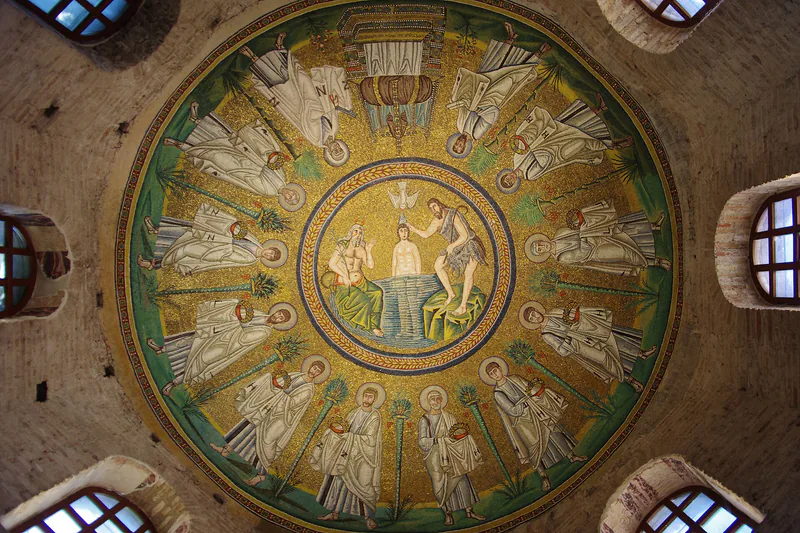
The New Testament contains no doctrine of the Trinity as later defined, but several passages place Father, Son and Spirit side by side. The risen Jesus sends his disciples to baptise "in the name of the Father, and of the Son, and of the Holy Ghost" (Matthew 28:19), and Paul closes 2 Corinthians with a blessing invoking the grace of Christ, the love of God and the fellowship of the Spirit. The prologue of John's Gospel declares that the Word (Logos) was with God and was God, and became flesh (John 1).
One famous verse is a later addition. The King James Version of 1 John 5:7 speaks of "three that bear record in heaven," but this so-called Johannine Comma is absent from the Greek manuscripts before the late Middle Ages; it entered the printed Greek text through Erasmus's third edition of 1522 and is omitted by modern translations.
Logos Theology, Monarchianism and Origen§
Second-century apologists such as Justin Martyr explained Christ as the divine Logos, God's reason and word, through whom the world was made — a concept that also allowed dialogue with Greek philosophy. Theophilus of Antioch, around 180, is the first known writer to use the Greek word trias for God, his Word and his Wisdom.
Others feared that this compromised God's unity. So-called Monarchians defended the "single rule" (monarchia) of God in two ways. Adoptionists taught that Jesus was a man adopted as God's Son. Modalists, associated with Noetus, Praxeas and Sabellius, taught that Father, Son and Spirit were successive modes or names of one divine person. In his treatise Against Praxeas (around 213), Tertullian of Carthage answered with the Latin vocabulary that the West would keep: one substantia and three personae, a trinitas.
In Alexandria, Origen (c. 185–c. 253) taught that the Son is eternally generated by the Father, so that there was never a time when the Father was without the Son. Yet he also ranked the Son and Spirit below the Father in a hierarchy that resembled Middle Platonist and later Neoplatonic schemes of descending divine principles, like the One, Intellect and Soul of Plotinus. Origen's legacy fed both sides of the coming controversy.
Nicaea, the Cappadocians and the Creed of 381§
Around 318 the Alexandrian priest Arius taught that the Son, though exalted above all creatures, was himself created: "there was when he was not." The emperor Constantine summoned the Council of Nicaea in 325, which declared the Son "of one substance" (homoousios) with the Father and condemned Arius. The story of this and later councils is told in Christian Creeds and Ecumenical Councils.
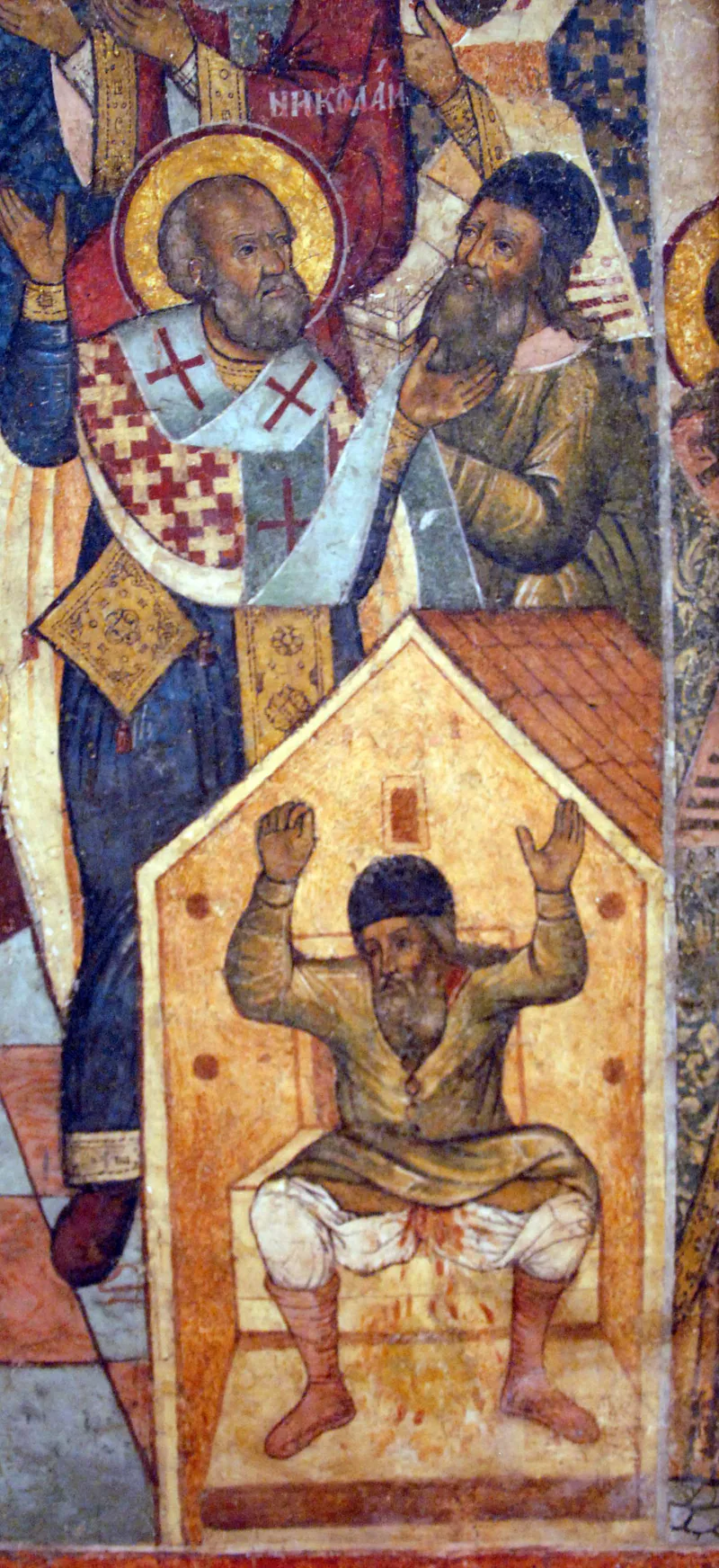
Nicaea did not end the dispute. For half a century bishops and emperors favoured compromise formulas — that the Son was "like" the Father, or "of like substance" (homoiousios) — and Athanasius of Alexandria was exiled five times for defending the Nicene term. Historians such as R. P. C. Hanson and Lewis Ayres stress that this was less a fight between two fixed parties than a long search for adequate language.
The decisive clarification came from three theologians of Cappadocia: Basil of Caesarea, his brother Gregory of Nyssa and their friend Gregory of Nazianzus. They distinguished ousia, the one shared divine being, from hypostasis, the distinct existence of each person, and argued in works such as Basil's On the Holy Spirit that the Spirit is worshipped and glorified together with the Father and the Son. The Council of Constantinople in 381 reaffirmed Nicaea and expanded the creed's article on the Spirit, "the Lord and Giver of life." This Niceno-Constantinopolitan Creed is still recited in most churches today.
Augustine, the West and the Filioque§
In the West, Augustine of Hippo wrote the most influential Latin treatise on the subject, The Trinity (De Trinitate), composed over some two decades and completed around 420. Beginning from the unity of God, he sought analogies for the Trinity in the human mind made in God's image — above all memory, understanding and will, three powers of one mind — while insisting that every analogy falls short. He also described the Spirit as the mutual love of Father and Son, proceeding from both.
This led to the Filioque ("and from the Son"), added to the creed in Spain at the Third Council of Toledo (589) and later adopted across the Latin West, though only accepted into the creed at Rome in the early eleventh century. Greek theologians objected both to the unilateral change of an ecumenical creed and to what they saw as a confusion of the persons, since for them the Father is the single source of the Godhead. The dispute became one of the doctrinal causes of the schism described in Eastern Orthodox Christianity.
The so-called Athanasian Creed (Quicunque vult), a Latin text probably composed in southern Gaul in the late fifth or sixth century and not by Athanasius, set out the Western doctrine in rhythmic formulas. Medieval scholastics, above all Thomas Aquinas, refined the idea of the persons as "subsisting relations," while in the East Gregory Palamas distinguished God's unknowable essence from his uncreated energies, as described in Hesychasm and the Jesus Prayer.
Symbols and Images of the Trinity§
Because the doctrine is abstract, Christians developed a rich visual language for it. The triangle, three interlocking circles and the triquetra knot all served as emblems. A diagram known as the Shield of the Trinity (Scutum Fidei), attested from the early thirteenth century, links the words Father, Son and Holy Spirit to a central "God" with the Latin est ("is") and the three persons to each other with non est ("is not"). The legend that Saint Patrick explained the Trinity with a shamrock is popular but first recorded many centuries after his death.
In the East the most celebrated image is Andrei Rublev's icon of the Trinity, painted in the early fifteenth century, which depicts the three angels who visited Abraham at Mamre (Genesis 18) as a figure of the Godhead. Western art developed the "Throne of Mercy," with the Father holding the crucified Son and the dove of the Spirit between them, famously in Masaccio's fresco in Santa Maria Novella, Florence (around 1427). Such imagery overlaps with the triadic symbols surveyed in Religious Symbols.
Dissent and Modern Trinitarian Theology§
The doctrine has always had critics. Jewish thinkers have generally regarded it as incompatible with strict monotheism, and the Qur'an explicitly warns Christians against saying "three" (Surah 4, Surah 5). Within Christianity, the Spanish physician Michael Servetus attacked the doctrine and was burned in Calvin's Geneva in 1553; the Socinians of Poland and later Unitarians in Britain and America rejected it on biblical and rational grounds; Isaac Newton privately held anti-Trinitarian views. Today Jehovah's Witnesses, Christadelphians and Oneness Pentecostals reject the classical formulation, and the Latter-day Saints teach a Godhead of three distinct beings.
In the twentieth century the Trinity returned to the centre of theology. Karl Barth made it the starting point of his Church Dogmatics; the Catholic Karl Rahner argued that "the economic Trinity is the immanent Trinity"; and Orthodox and Protestant "social" Trinitarians such as John Zizioulas and Jürgen Moltmann presented the communion of the three persons as a model for human community. Mystics from Meister Eckhart to Jacob Boehme also explored the Trinity as an inner dynamic of the divine life, which links the doctrine to the wider history of Christian mysticism.
Frequently asked questions§
Is the word Trinity in the Bible?§
No. The word was coined by later Christian writers; the Greek trias appears around 180 and the Latin trinitas in Tertullian around 200. Christians who accept the doctrine hold that the reality it names is taught in scripture, especially in passages that join Father, Son and Spirit.
What is the difference between the Trinity and modalism?§
Trinitarian doctrine holds that Father, Son and Spirit are three eternally distinct persons sharing one divine nature. Modalism, rejected as a heresy in the third century, taught that they are only three successive roles or manifestations of a single divine person.
Do all Christians believe in the Trinity?§
The great majority of Catholic, Orthodox, Oriental and Protestant churches confess the Trinity as defined in the Nicene Creed. A minority of groups, including Unitarians, Jehovah's Witnesses, Oneness Pentecostals and the Latter-day Saints, hold other views of God.
Sources and further reading§
- The Trinity — Augustine of Hippo, c. 420
- On the Holy Spirit — Basil of Caesarea, c. 375
- Early Christian Doctrines — J. N. D. Kelly, 1958
- The Search for the Christian Doctrine of God: The Arian Controversy 318–381 — R. P. C. Hanson, 1988
- Nicaea and Its Legacy: An Approach to Fourth-Century Trinitarian Theology — Lewis Ayres, 2004
- The Trinity — Karl Rahner, 1967