Liber VI · Christianity · Chapter V: Eastern Orthodoxy
Eastern Orthodox Christianity: History, Icons and Theology
Eastern Orthodox Christianity explained: its Byzantine history, the schism of 1054, the autocephalous churches, icons, the Divine Liturgy and theosis.

Eastern Orthodox Christianity is the communion of self-governing churches — Greek, Russian, Serbian, Romanian, Georgian and others — that trace their faith in unbroken continuity to the apostles and the Christian Roman Empire of Byzantium. With an estimated 220 to 260 million members, it is the second-largest Christian communion, known for its icons, its richly sung Divine Liturgy, its monastic spirituality and its teaching that salvation is theosis, union with God.
The Byzantine Origins of Orthodoxy§
When Constantine refounded the Greek city of Byzantium as Constantinople in 330, he created a new imperial capital in the East. The eastern half of the Roman Empire, which historians call the Byzantine Empire, survived until the Ottoman conquest of 1453, and for more than a thousand years Christian worship, art and theology developed there in Greek. The great Eastern Fathers — Athanasius, the Cappadocians, John Chrysostom, Cyril of Alexandria, Maximus the Confessor and John of Damascus — gave Orthodox theology its classic shape, and the seven councils described in Christian Creeds and Councils were all held in the East.
The church of Hagia Sophia, completed by Justinian in 537, embodied the Byzantine vision of worship as heaven on earth. A well-known story in the Russian Primary Chronicle tells how envoys of Prince Vladimir of Kiev, attending the liturgy there, did not know whether they were in heaven or on earth; Vladimir's baptism around 988 brought Christianity to the Rus'. Earlier, in the 860s, the brothers Cyril and Methodius, missionaries from Thessalonica, had translated the liturgy and scriptures into Slavonic, creating the alphabet tradition from which Cyrillic developed.
The Great Schism Between East and West§
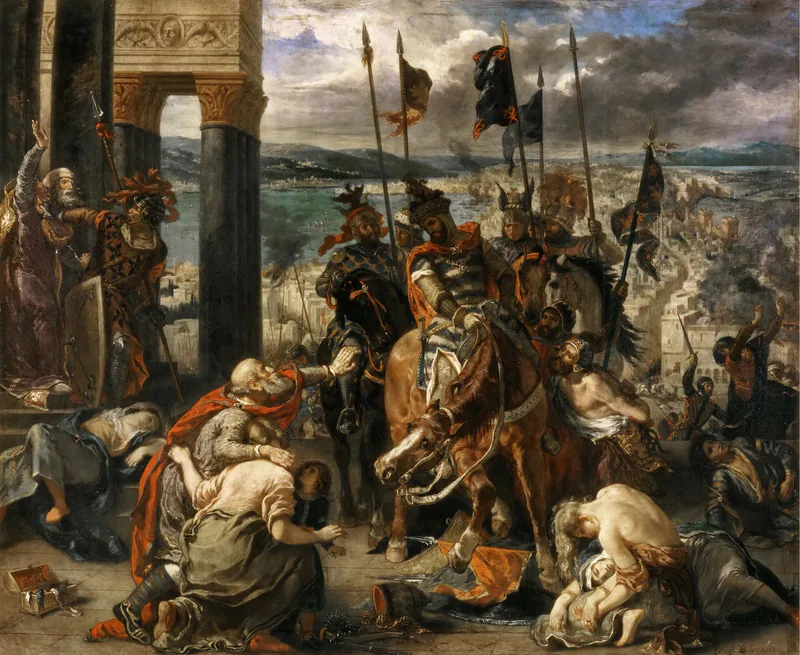
The Greek East and Latin West drifted apart over centuries, divided by language, politics and differing views on the authority of the pope and the addition of the filioque to the creed. In 1054 papal legates led by Cardinal Humbert and Patriarch Michael Cerularius of Constantinople exchanged excommunications. This date is conventionally given for the "Great Schism," though at the time it was one quarrel among many. Far more damaging was the Fourth Crusade, which sacked Constantinople in 1204 and installed a Latin patriarch. Attempts at reunion at the Councils of Lyon (1274) and Florence (1439) were rejected by most Orthodox clergy and faithful. The excommunications of 1054 were formally lifted by Pope Paul VI and Patriarch Athenagoras in 1965, and theological dialogue continues.
After 1453 most Orthodox lived under Ottoman rule, while Russia, with its own patriarchate from 1589, became the largest Orthodox state. In the nineteenth and twentieth centuries national churches gained independence in Greece, Serbia, Romania and Bulgaria, and the communist period brought severe persecution in Russia and Eastern Europe, followed by revival after 1989–1991.
The Structure of the Orthodox Church§
The Orthodox Church has no single head on earth. It is a communion of autocephalous churches that share the same faith and sacraments. By tradition the ancient patriarchates come first: Constantinople, Alexandria, Antioch and Jerusalem, followed by Moscow and the churches of Serbia, Romania, Bulgaria, Georgia, Cyprus, Greece, Poland, Albania and the Czech Lands and Slovakia. The Ecumenical Patriarch of Constantinople, based in Istanbul, is regarded as "first among equals," with a primacy of honour rather than of jurisdiction.
The status of some churches is disputed. The Orthodox Church in America received autocephaly from Moscow in 1970, but not all churches recognise it; Constantinople's decision in 2018 to grant autocephaly to a new Orthodox Church of Ukraine, formalised in January 2019, led the Russian Orthodox Church to break communion with the Ecumenical Patriarchate. The Orthodox should also be distinguished from the Oriental Orthodox churches (Coptic, Ethiopian, Armenian, Syriac and others), which did not accept the Council of Chalcedon, and from the Eastern Catholic churches, which follow Byzantine rites in communion with Rome.
Icons and Orthodox Worship§
The theology of the icon§
Icons, painted images of Christ, the Virgin, the saints and biblical scenes, are among the most recognisable features of Orthodoxy. In the eighth and ninth centuries Byzantine emperors banned and destroyed images in the crisis known as iconoclasm (roughly 726–787 and 815–843). Defenders such as John of Damascus argued that because God became visible in Christ, he could be depicted; the honour paid to an icon passes to the person it represents. The Second Council of Nicaea (787) endorsed this view, and the final restoration of icons in 843 is still celebrated as the "Triumph of Orthodoxy" on the first Sunday of Lent. Icon painting follows established patterns and is often described by the Orthodox as "writing" theology in colour.
The Divine Liturgy§
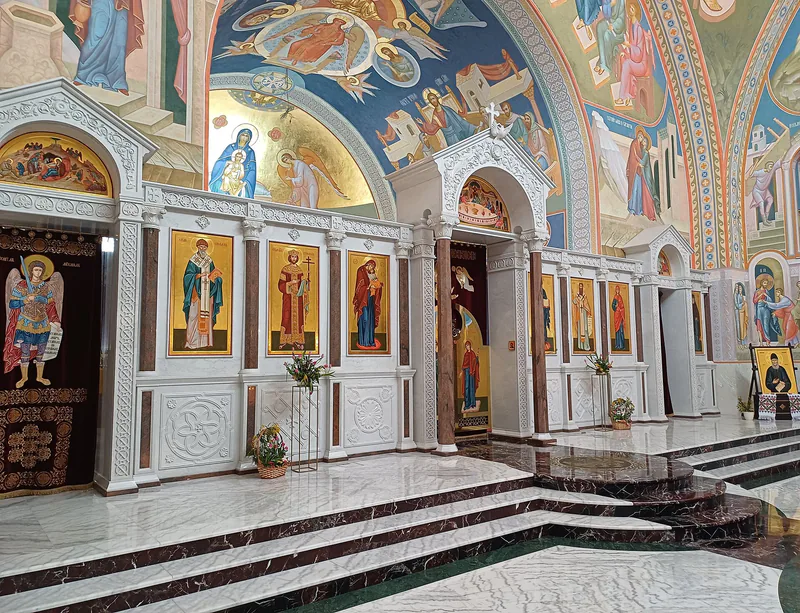
The main Sunday service is the Divine Liturgy, most often in the form attributed to John Chrysostom, with the longer Liturgy of Saint Basil used on certain days. The altar is separated from the nave by the iconostasis, a screen covered with icons, and the service is sung throughout. Orthodox Christians recognise sacraments, called "holy mysteries," including baptism by triple immersion, chrismation immediately afterwards and communion given to infants. The calendar is marked by long fasts, especially Great Lent before Pascha (Easter), the greatest feast of the year. Many Orthodox churches still follow the Julian calendar for some or all feasts, so that Pascha usually falls later than the Western Easter. The forms of Christian worship are compared in Christian Sacraments and Liturgy.
Theosis, Hesychasm and the Orthodox Spiritual Tradition§
The goal of Christian life in Orthodox teaching is theosis or deification: humans, created in God's image, are called to share by grace in the divine life. The idea is often summarised in a saying of Athanasius, that God became human so that humans might become divine. Orthodox theology emphasises the mystery of God beyond concepts, an apophatic approach indebted to Pseudo-Dionysius.
Monasticism is the heart of this spirituality, and the monastic republic of Mount Athos in northern Greece, home to monasteries since the tenth century, is its spiritual centre (see Christian Monasticism). There, from the late thirteenth century, monks practised Hesychasm ("stillness"), repeating the Jesus Prayer and seeking a vision of the uncreated light of the Transfiguration. Gregory Palamas (1296–1359) defended this practice by distinguishing God's unknowable essence from his energies, in which humans truly participate; councils at Constantinople in the 1340s and 1351 upheld his teaching. The Philokalia, an anthology of texts on prayer published in Venice in 1782, spread these teachings across the Orthodox world, and the anonymous nineteenth-century Way of a Pilgrim introduced the Jesus Prayer to readers far beyond Russia. These figures are also discussed among the Christian mystics.
Orthodoxy in the Modern World§
Russian Orthodoxy experienced its own internal division in the seventeenth century, when Patriarch Nikon's liturgical reforms led to the schism of the Old Believers, who kept older rites. In the nineteenth century Russian thinkers such as Aleksei Khomiakov, and the elders (startsy) of Optina Monastery who influenced Dostoevsky, renewed Orthodox thought. After 1917 émigré theologians in Paris and New York — among them Vladimir Lossky, Georges Florovsky, John Meyendorff and Alexander Schmemann — introduced Orthodox theology to the West. Today Orthodox communities exist across Western Europe, the Americas and Australia, and Orthodoxy faces questions of nationalism, church unity and its relationship with modern states.
Frequently asked questions§
What is the difference between Orthodox and Catholic Christianity?§
Both share the sacraments, the early councils and apostolic succession. They differ chiefly over the authority of the pope, which the Orthodox do not accept as universal jurisdiction, the filioque clause in the creed, and various practices such as leavened bread in the Eucharist, married parish clergy and the Julian calendar.
Why do Orthodox Christians celebrate Easter on a different date?§
Most Orthodox churches calculate Pascha using the Julian calendar and the rules established in the early Church, while Western churches use the Gregorian calendar introduced in 1582. The two dates sometimes coincide but are often one to five weeks apart.
Who leads the Orthodox Church?§
No single person does. Each autocephalous church is led by its own patriarch, archbishop or metropolitan with a synod of bishops. The Ecumenical Patriarch of Constantinople is honoured as first among equals.
What is an iconostasis?§
It is the screen of icons that separates the sanctuary, where the altar stands, from the nave in an Orthodox church. It typically bears icons of Christ, the Virgin Mary, John the Baptist, the church's patron saint and the great feasts.
Sources and further reading§
- The Orthodox Church — Timothy Ware, 1963
- The Mystical Theology of the Eastern Church — Vladimir Lossky, 1944
- Byzantine Theology: Historical Trends and Doctrinal Themes — John Meyendorff, 1974
- The Byzantine Commonwealth: Eastern Europe, 500–1453 — Dimitri Obolensky, 1971
- The Philokalia — Nikodimos of the Holy Mountain & Makarios of Corinth (comp.), 1782