Liber VI · Christianity · Chapter X: Sacraments & Liturgy
Christian Sacraments and Liturgy: Baptism, Eucharist, Worship
Christian sacraments and liturgy explained: baptism, the Eucharist and the seven sacraments, the Mass and Divine Liturgy, and the Christian liturgical year.

Christian sacraments are rites believed to convey or signify God's grace through visible signs, above all baptism with water and the Eucharist or Lord's Supper with bread and wine. Liturgy is the Church's public, ordered worship in which these rites are celebrated. Catholic and Orthodox Christians recognise seven sacraments or holy mysteries, most Protestants recognise two, and all organise their worship around Sunday and a yearly cycle of feasts centred on Easter.
What Is a Sacrament?§
The Latin sacramentum, originally an oath, translated the Greek mysterion, "mystery," used in the Eastern churches to this day. Augustine of Hippo described a sacrament as a visible sign of an invisible, sacred reality, and medieval theologians refined this into the idea of an outward sign instituted by Christ that gives grace. For much of the first millennium the word was used loosely of many holy rites and objects. The twelfth-century theologian Peter Lombard listed seven sacraments in his Sentences, and the list was confirmed by the Council of Florence (1439) and the Council of Trent.
Catholic theology also speaks of sacramentals — blessings, holy water, medals, candles and other objects and gestures that prepare people to receive grace. In popular religion these sacramentals often took on protective or healing functions, a meeting point with the practices discussed in Folk Christianity.
Baptism and Christian Initiation§
Baptism is the rite of entry into the Church. The Gospels record Jesus' baptism by John, and Matthew ends with the command to baptise "in the name of the Father, and of the Son, and of the Holy Ghost" (Matthew 28). The Didache, an early church manual usually dated to the late first or early second century, prefers baptism in "living" (running) water but allows pouring when this is not available.
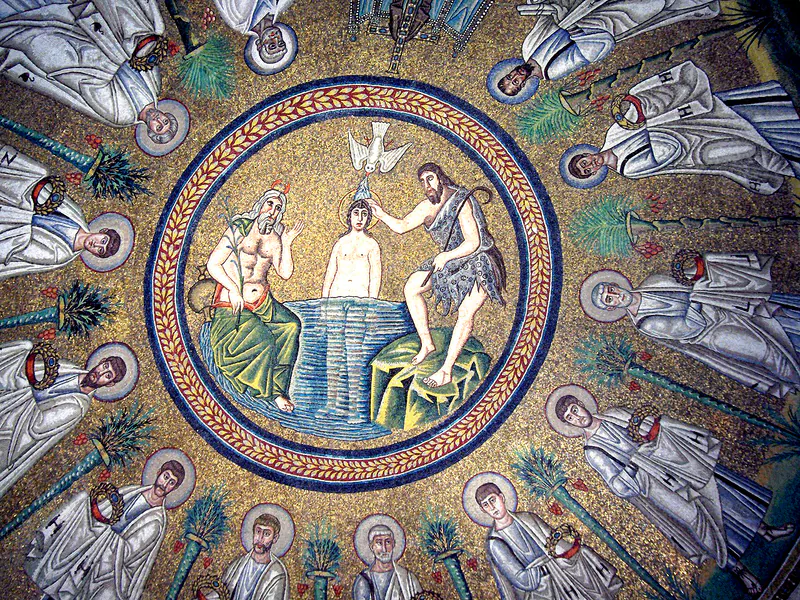
By the third and fourth centuries adult converts passed through a long catechumenate of instruction and exorcisms, renouncing Satan before being baptised at the Easter Vigil, anointed and admitted to the Eucharist. Infant baptism, already practised by the third century, became the norm as Christianity became the religion of whole societies. In the West the anointing by the bishop became a separate rite, confirmation, given later in childhood; Orthodox churches continue to give baptism, chrismation (anointing with holy oil) and first communion together, even to infants.
The Anabaptists and later Baptists insisted on believers' baptism, given only to those who confess faith for themselves, usually by full immersion. Most other Protestant churches baptise infants. The Salvation Army and the Quakers (Religious Society of Friends) do not practise outward sacraments at all, emphasising inward spiritual experience.
The Eucharist, Mass and Lord's Supper§
Origins§
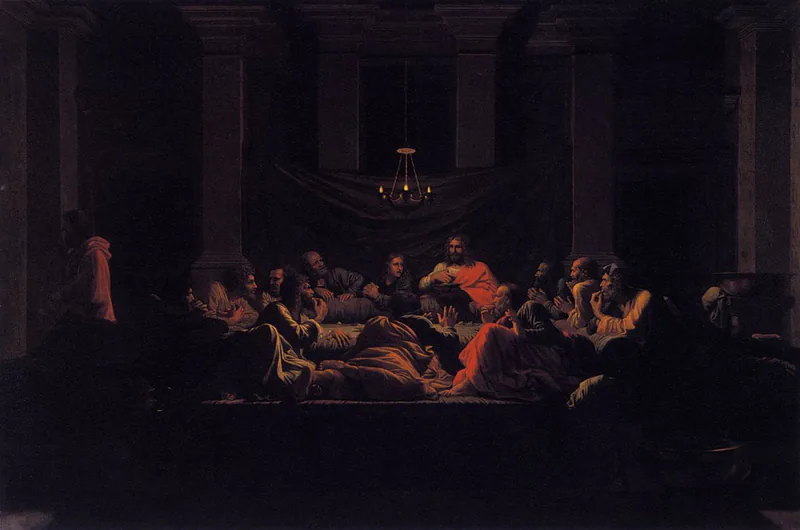
The Eucharist (from Greek eucharistia, "thanksgiving") recalls Jesus' last meal with his disciples. Paul's account in 1 Corinthians 11, written in the 50s, is the earliest record of the words Jesus spoke over the bread and the cup, identifying them with his body and with a new covenant in his blood. Around 155 Justin Martyr described a Sunday gathering in Rome with readings from the "memoirs of the apostles" and the prophets, a sermon, prayers, and the offering of bread and wine mixed with water, which deacons then carried to the absent.
Eucharistic theologies§
Christians have long debated how Christ is present in the sacrament.
- Catholic teaching, using the term defined at the Fourth Lateran Council (1215) and developed by Thomas Aquinas, holds that the substance of bread and wine becomes the body and blood of Christ — transubstantiation — while the appearances remain.
- Orthodox Christians affirm a real change but prefer to speak of a mystery without philosophical definition.
- Lutherans affirm that Christ's body and blood are truly present "in, with and under" the bread and wine.
- Reformed churches, following Calvin, teach a real but spiritual presence received by faith.
- Many Baptists and other evangelicals, following Zwingli, regard the Lord's Supper as a memorial and sign of faith.
These disagreements divided Protestants from Catholics and from one another; Luther and Zwingli's failure to agree at Marburg in 1529 is described in Protestantism and the Reformation.
The Seven Sacraments in Catholic and Orthodox Practice§
Catholic and Orthodox churches recognise seven sacraments:
- Baptism — entry into the Church and cleansing from sin.
- Confirmation or chrismation — the gift of the Holy Spirit, sealed with anointing.
- The Eucharist — the central act of worship.
- Penance or confession — forgiveness of sins after baptism through a priest's absolution.
- Anointing of the sick — prayer and oil for the seriously ill, based on James 5; in the medieval West it was mainly given to the dying as "extreme unction."
- Holy orders — ordination of bishops, priests and deacons.
- Marriage — the union of a man and woman blessed by the Church.
The Orthodox have been less concerned to fix the number at seven and sometimes include other rites, such as monastic tonsure or the blessing of waters, among the mysteries. Anglicans speak of two sacraments "of the Gospel" and five "commonly called sacraments." These rites are discussed in their institutional setting in Roman Catholicism and Eastern Orthodox Christianity.
Christian Liturgies East and West§
Early worship varied by region, and several great liturgical families emerged: the Roman, the Byzantine, the Alexandrian (Coptic and Ethiopian), the West Syrian, the East Syrian and the Armenian, along with Western rites such as the Ambrosian rite of Milan and the Mozarabic rite of Spain. Liturgical languages included Latin, Greek, Syriac, Coptic, Ge'ez, Armenian and Church Slavonic.
In the West, the Council of Trent led to the Roman Missal of 1570, which standardised the Latin Mass for four centuries. After the Second Vatican Council the Missal of Paul VI (1969–1970) introduced Mass in local languages and a revised order, while the older form continues in some communities under restrictions that recent popes have alternately eased and tightened. Byzantine churches celebrate the Divine Liturgy of John Chrysostom, sung throughout and centred on the procession of the gifts. Protestant worship ranges from the Lutheran Mass and the Anglican Book of Common Prayer (1549) to the plain services of the Reformed churches, the silence of Quaker meetings and the spontaneous praise of Pentecostal worship. Church music, from Gregorian chant and Byzantine chant to Bach's cantatas and the hymns of Charles Wesley, grew from these liturgies.
The Liturgical Year§
Christian time is organised around Easter, the feast of the resurrection, whose date was debated in the early Church and is calculated from the first full moon after the spring equinox. The Western and most Orthodox churches compute it differently because they use the Gregorian and Julian calendars respectively. The main seasons are:
- Advent — four weeks of preparation for Christmas.
- Christmas and Epiphany — the birth of Christ (25 December) and his manifestation to the nations (6 January).
- Lent — forty days of fasting and penitence, beginning on Ash Wednesday in the West.
- Holy Week and Easter — Palm Sunday, Maundy Thursday, Good Friday and the Easter Vigil.
- Pentecost — fifty days after Easter, celebrating the gift of the Holy Spirit.
The calendar is filled with feasts of the saints and of the Virgin Mary, and most churches observe Sunday as the weekly feast of the resurrection.
Frequently asked questions§
What are the seven sacraments?§
They are baptism, confirmation (chrismation), the Eucharist, penance (confession), anointing of the sick, holy orders and marriage. Catholic and Orthodox Christians recognise all seven, while most Protestants regard only baptism and the Lord's Supper as sacraments instituted by Christ.
What is transubstantiation?§
It is the Catholic teaching that during the Mass the substance of the bread and wine is changed into the body and blood of Christ, while their appearances remain. The term was used by the Fourth Lateran Council in 1215 and defended by the Council of Trent.
Why do some churches baptise babies and others only adults?§
Churches that baptise infants see baptism as God's gift of grace, received by the child within the faith of the family and Church. Baptist and many evangelical churches hold that baptism should follow a personal confession of faith, as in the New Testament examples of adult converts.
Sources and further reading§
- The Shape of the Liturgy — Gregory Dix, 1945
- The Search for the Origins of Christian Worship — Paul F. Bradshaw, 1992
- For the Life of the World — Alexander Schmemann, 1963
- Catechism of the Catholic Church — Catholic Church, 1992
- Institutes of the Christian Religion — John Calvin, 1536