Liber VI · Christianity · Chapter X: Sacraments & Liturgy
Easter and Holy Week: History, Dating and Traditions
Easter and Holy Week explained: the Christian feast of the resurrection, its Passover roots, how its date is calculated, its liturgies and its folk customs.

Easter is the oldest and most important feast of the Christian year, celebrating the resurrection of Jesus Christ on the third day after his crucifixion. It falls on a Sunday between late March and late April, is preceded by the forty days of Lent and the solemn rites of Holy Week, and grew out of the Jewish Passover, which is why most languages call it by a form of the word Pascha.
The Meaning of Easter in Christian Belief§
For Christians, Easter proclaims that Jesus, crucified under Pontius Pilate, was raised bodily from the dead and so overcame sin and death. The Gospels tell how women disciples found the tomb empty on the first day of the week and how the risen Christ then appeared to his followers (Matthew 28). Paul calls the resurrection the foundation of faith, and in 1 Corinthians 5 he writes: "Christ our passover is sacrificed for us."
Every Sunday is a weekly commemoration of the resurrection, but the annual Easter feast is its high point. Theologically it is inseparable from Good Friday: together they form the "paschal mystery" of Christ's passage through death to life, which believers enter through baptism. For this reason Easter has always been the preferred time for baptisms, as explained in Christian Sacraments and Liturgy.
Passover, Pascha and the Earliest Easter§
According to the Gospels, Jesus was crucified at the time of Passover, the Jewish festival commemorating the exodus from Egypt (Exodus 12), described in Jewish Festivals and the Sabbath. The Synoptic Gospels present the Last Supper as a Passover meal, while John places the crucifixion on the afternoon when the Passover lambs were sacrificed. The earliest Christians, most of them Jews, naturally interpreted Jesus' death through the Passover story of the lamb whose blood saved Israel.

The Greek and Latin name Pascha simply transliterates the Aramaic form of Pesach, and most European languages still use it: Pâques in French, Pascua in Spanish, Pasqua in Italian, Paskha in Russian. Early writers also linked it, by a false etymology, with the Greek paschein, "to suffer."
The oldest surviving Easter sermon, On Pascha, was composed by Melito, bishop of Sardis in Asia Minor, around 160–170. A poetic meditation read on the night of Passover, it presents the slaughter of the lamb in Egypt as a foreshadowing of Christ. It also contains bitter accusations against the Jewish people that later contributed to Christian anti-Judaism.
Dating Easter: Quartodecimans, Nicaea and the Computus§
Early Christians disagreed about when to keep the feast. Churches in the Roman province of Asia, the "Quartodecimans" (from Latin for "fourteenth"), ended their fast on 14 Nisan, the date of Passover, whatever the day of the week. Rome and most other churches always celebrated on the following Sunday. Around 155 Polycarp of Smyrna and Bishop Anicetus of Rome agreed to differ, but around 190 Bishop Victor of Rome threatened to excommunicate the Asian churches, and Irenaeus of Lyon intervened to urge peace.
The Council of Nicaea in 325 decided that all Christians should celebrate Easter on the same Sunday, calculated independently of the Jewish calendar. No canon on the subject survives; the decision is known from the emperor Constantine's letter to the churches. The rule that emerged, refined in Alexandria, sets Easter on the first Sunday after the first full moon on or after the spring equinox, fixed for this purpose at 21 March. The "full moon" is an ecclesiastical one, calculated from tables based on the nineteen-year lunar cycle, not observed in the sky. In Western usage Easter therefore falls between 22 March and 25 April.
Calculating the date, known as the computus, was a central science of the early medieval Church. In 525 the monk Dionysius Exiguus produced Easter tables that also introduced the system of counting years from the birth of Christ. In Britain, Irish and Roman methods of reckoning clashed until the Synod of Whitby (664) adopted the Roman one, and Bede's The Reckoning of Time (725) became the standard textbook.
When Pope Gregory XIII reformed the calendar in 1582, the Western churches adopted the new reckoning, while most Orthodox churches kept the older Julian calendar for Easter. The two dates coincide in some years — as in 2025 — but often differ by one or more weeks; in 2026 Western Easter fell on 5 April and Orthodox Easter on 12 April. Proposals for a common date were discussed again around the 1,700th anniversary of Nicaea in 2025. Real new and full moons can be compared in the moon calendar.
Holy Week from Palm Sunday to the Easter Vigil§
The shape of Holy Week owes much to the church of Jerusalem in the fourth century. The pilgrim Egeria, probably from Spain or Gaul, visited the holy places around 381–384 and described how the Christians there followed the last days of Jesus in the places where they occurred: a procession with palm branches from the Mount of Olives, the veneration of the relic of the cross on Good Friday, and a night vigil awaiting the resurrection.
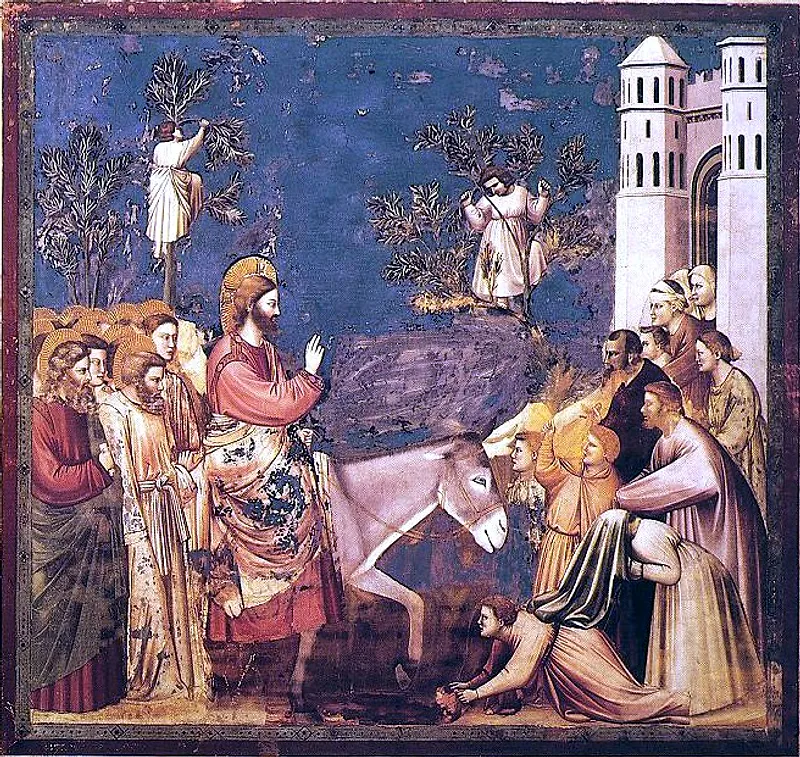
- Palm Sunday recalls Jesus' entry into Jerusalem, with the blessing of palms (or local substitutes such as willow or box) and the reading of the Passion.
- Maundy Thursday (from Latin mandatum, "commandment") commemorates the Last Supper; in many churches the priest or bishop washes the feet of members of the congregation, following John 13, and afterwards the altar is stripped bare.
- Good Friday is a day of fasting and mourning. The Western liturgy includes the reading of the Passion, solemn prayers, the veneration of the cross and Communion from elements consecrated the day before; the devotion of the Stations of the Cross, fixed at fourteen stations in the eighteenth century, is widely practised.
- Holy Saturday is a day of silence before the tomb.
- The Easter Vigil, celebrated after nightfall, begins with the lighting of a new fire and the Paschal candle, which is carried into the dark church while the ancient hymn known as the Exsultet is sung. Readings from the Old Testament, baptisms and the first Eucharist of Easter follow.
Many Protestant churches simplified these rites at the Reformation, though many have since revived them.
Eastern Orthodox Pascha§
In the Orthodox churches Pascha is the "feast of feasts," preceded by the strict fast of Great Lent and the services of Holy Week, which include long vigils with Gospel readings and lamentations at the symbolic tomb of Christ on Good Friday. Shortly before midnight on Holy Saturday the church is darkened; the priest emerges with a lit candle, and the flame is passed from hand to hand as the congregation processes outside. At midnight the priest proclaims "Christ is risen!" and the people answer "Truly he is risen!" — a greeting repeated for forty days.
In Jerusalem, the ceremony of the Holy Fire at the Church of the Holy Sepulchre, recorded by a Western pilgrim named Bernard as early as the ninth century, draws vast crowds each year. Easter tables are laden with foods forbidden during the fast: red-dyed eggs, the tall sweet bread kulich and the cheese dessert paskha in Russia, lamb in Greece. More on Orthodox worship can be found in Eastern Orthodox Christianity.
Eggs, Hares and Folk Customs of Easter§
Around the liturgy grew a rich folk culture, much of it described in Folk Christianity. Eggs, forbidden during the Lenten fast in many medieval regions, accumulated by Easter and were blessed, dyed and given as gifts; red eggs were linked to the blood of Christ, and the egg's hidden life became a symbol of the tomb and resurrection. Egg rolling and egg tapping are among the games that developed.
The Easter hare, ancestor of the Easter bunny, appears in German sources from the seventeenth century, with one of the earliest references in a 1682 medical treatise on Easter eggs by Georg Franck von Franckenau; German emigrants carried the custom to America. Other customs include Easter fires on hilltops in northern Germany, Holy Week processions of hooded brotherhoods in Seville and across Spain, and passion plays, of which the most famous is that of Oberammergau in Bavaria, first performed in 1634 in fulfilment of a vow made during an epidemic of plague. Popular belief gave special powers to Easter water, Good Friday bread and blessed palms, as described in European Superstitions and Folk Beliefs.
The Name "Easter" and the Eostre Debate§
English and German are unusual in not using Pascha. The English word "Easter" and German Ostern go back to an old Germanic name for the season. The only early source for its origin is Bede, who wrote in The Reckoning of Time that the Anglo-Saxon month Eosturmonath, roughly April, was named after a goddess called Eostre, whose festivals had once been held then.
No other ancient source mentions Eostre, and scholars have long debated whether Bede was recording genuine tradition or guessing from the month's name. Some connect the name with the dawn and the east and accept a real deity; others remain sceptical. The goddess "Ostara" of popular modern books is largely a reconstruction by Jacob Grimm in 1835, and claims that Easter eggs and hares descend from her worship lack ancient evidence. Modern Pagans have adopted Ostara as the name of their spring equinox festival, described in The Wheel of the Year, while Christian historians stress that the feast itself plainly derives from Passover.
Frequently asked questions§
Why does the date of Easter change every year?§
Easter is tied to the lunar Passover. Since the fourth century it has been kept on the first Sunday after the first ecclesiastical full moon on or after 21 March, so it moves within a range of about five weeks, between 22 March and 25 April in the Western calendar.
Why do Orthodox Christians celebrate Easter on a different date?§
Most Orthodox churches calculate Easter using the Julian calendar and older lunar tables, while Catholic and Protestant churches use the Gregorian calendar introduced in 1582. The two methods sometimes give the same Sunday but often differ by one to five weeks.
Is Easter named after a pagan goddess?§
Only the English and German names may be. Bede claimed that the Anglo-Saxon month of Easter was named after a goddess Eostre, but there is little other evidence. Most languages call the feast by a form of Pascha, from the Hebrew word for Passover.
Sources and further reading§
- On Pascha — Melito of Sardis, c. 170
- Egeria's Travels — John Wilkinson, 1971
- The Reckoning of Time — Bede, 725
- The Origins of the Liturgical Year — Thomas J. Talley, 1986
- The Origins of Feasts, Fasts and Seasons in Early Christianity — Paul F. Bradshaw and Maxwell E. Johnson, 2011
- The Stations of the Sun: A History of the Ritual Year in Britain — Ronald Hutton, 1996