Liber XIX · Judaism · Chapter II: Festivals & the Sabbath
The Sabbath and Jewish Festivals: From Passover to Hanukkah
A guide to the Jewish Sabbath and festivals: the Hebrew calendar, Rosh Hashanah and Yom Kippur, Passover, Shavuot, Sukkot, Hanukkah, Purim and the fast days.

The Sabbath (Shabbat) is the weekly Jewish day of rest, kept from sunset on Friday until nightfall on Saturday in memory of God's rest after creation and of the exodus from Egypt. Around it turns a yearly cycle of festivals set by the Hebrew lunar calendar: the solemn High Holy Days of Rosh Hashanah and Yom Kippur, the three biblical pilgrimage festivals of Passover, Shavuot and Sukkot, and later celebrations such as Hanukkah and Purim. Together they give Jewish time its rhythm of work and rest, memory and hope.
The Jewish Calendar§
Jewish days begin at sunset, following the refrain of Genesis 1, "And the evening and the morning were the first day". Months begin with the new moon (Rosh Chodesh) and last twenty-nine or thirty days. Because twelve lunar months fall about eleven days short of the solar year, an extra month, Adar II, is added in seven years of every nineteen, so that Passover always falls in spring. In antiquity the new month was proclaimed by a rabbinic court on the testimony of witnesses who had seen the crescent moon; a fixed, calculated calendar was later adopted, traditionally credited to the patriarch Hillel II in the fourth century CE. Years are numbered from the traditional date of creation, so that the year beginning in autumn 2026 is 5787.
Because communities outside the Land of Israel could not always learn in time which day the court had proclaimed, they added a second day to most biblical festivals, a custom still kept by Orthodox and many Conservative Jews in the diaspora.
The Sabbath: A Day of Rest and Holiness§
The Torah commands the Sabbath in the Ten Commandments, giving two reasons: in Exodus, because God rested on the seventh day of creation (Exodus 20:8–11); in Deuteronomy, in memory of liberation from slavery in Egypt. The rabbis defined the prohibited "work" (melakhah) as thirty-nine categories of creative activity — among them sowing, baking, writing, building, lighting and extinguishing fire, and carrying between private and public domains — derived from the labours used to build the Tabernacle in the wilderness. The detailed laws are part of halakha.

The Sabbath is also a day of joy and holiness. Before sunset on Friday candles are lit, traditionally by the woman of the household. The Friday evening service welcomes the Sabbath as a bride and queen, and at home the meal begins with Kiddush, the sanctification over wine, and a blessing over two loaves of challah, recalling the double portion of manna in the wilderness. Saturday brings the morning service with its Torah reading, further festive meals, rest and study. As the Sabbath ends, the Havdalah ceremony separates holy time from ordinary time with wine, fragrant spices and a braided candle. The twentieth-century theologian Abraham Joshua Heschel famously described the Sabbath as a "palace in time", a sanctuary built not in space but in time.
The High Holy Days: Rosh Hashanah and Yom Kippur§
The autumn month of Tishri opens with Rosh Hashanah, the New Year, on the first and second of the month. The Mishnah calls it the day on which all creatures pass in judgement before God, and its central ritual is the sounding of the shofar, a ram's horn, whose blasts are understood as a call to repentance. It is customary to eat apples dipped in honey for a sweet year, and many communities perform tashlikh, symbolically casting sins into flowing water.
The ten days that follow, the Days of Awe, culminate in Yom Kippur, the Day of Atonement, on the tenth of Tishri. In the Temple this was the day the high priest entered the Holy of Holies (Leviticus 16); today it is a twenty-five-hour fast from food and drink, spent largely in the synagogue in confession and prayer. It begins with the solemn Kol Nidre and ends with the closing service of Ne'ilah and a final long blast of the shofar. Jewish teaching holds that Yom Kippur atones for sins against God, but wrongs against other people require first seeking their forgiveness.
The Pilgrimage Festivals: Passover, Shavuot and Sukkot§
Leviticus 23 lists three festivals on which, in Temple times, Israelites went up to Jerusalem (see ancient Israel and the Temple).
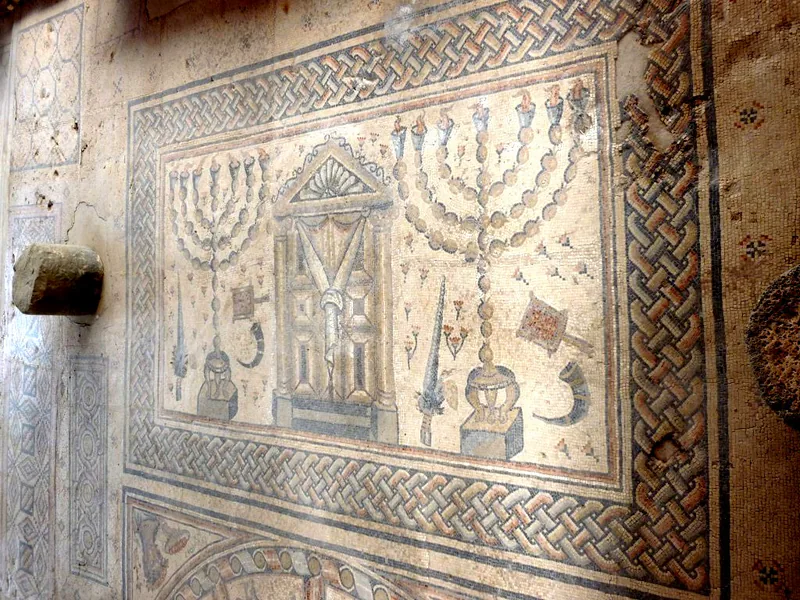
Passover (Pesach) begins on the fifteenth of Nisan in spring and lasts seven days in Israel, eight in the diaspora. It commemorates the exodus from Egypt (Exodus 12). Leavened food (chametz) is removed from the home and unleavened bread (matzah) eaten instead. On the first night (and in the diaspora the second) families hold the seder, a ritual meal at which the story of the exodus is retold from the Haggadah, with symbolic foods such as bitter herbs and four cups of wine, and the youngest child asks the Four Questions.
From the second day of Passover Jews count forty-nine days, the Omer, to Shavuot ("Weeks"), originally the wheat-harvest festival, which rabbinic tradition identifies as the anniversary of the giving of the Torah at Sinai. The Book of Ruth is read, dairy foods are customary, and many stay up all night studying, a custom popularised by the kabbalists of sixteenth-century Safed.
Sukkot ("Booths"), beginning on the fifteenth of Tishri, recalls the Israelites' dwelling in temporary shelters in the wilderness and celebrates the autumn harvest. Families build a sukkah, a hut roofed with branches, and eat their meals in it; in the synagogue worshippers wave the "four species" — a palm branch (lulav), citron (etrog), myrtle and willow. Sukkot is followed by Shemini Atzeret and Simchat Torah, the "rejoicing of the Torah", when the annual cycle of Torah readings ends and begins again amid dancing with the scrolls.
Hanukkah, Purim and the Later Festivals§
Hanukkah, the eight-day "Dedication" beginning on the twenty-fifth of Kislev in early winter, commemorates the rededication of the Temple by the Maccabees in 164 BCE after its desecration by the Seleucid king Antiochus IV. The Talmud adds the story that a single day's supply of pure oil burned for eight days; the books of Maccabees, which tell the military story, do not mention it. Jews light an eight-branched lamp (hanukkiah), adding one light each night, and eat foods fried in oil.
Purim, on the fourteenth of Adar, celebrates the rescue of the Jews of Persia from the plot of Haman, as told in the Book of Esther. The scroll of Esther is read aloud, with noise-making at Haman's name, and the day is marked by gifts of food to friends, gifts to the poor, a festive meal and costumes. Its carnival spirit makes it the most boisterous day of the Jewish year.
Other days include Tu Bishvat, the "new year of the trees", which the kabbalists of Safed turned into a mystical seder of fruits; and Lag ba-Omer, a joyful break in the Omer period, associated with Rabbi Shimon bar Yochai, the sage to whom the Zohar is attributed, when crowds gather at his tomb at Meron in Galilee.
Fasts, Mysticism and Modern Commemorations§
The calendar also contains days of mourning. Tisha B'Av, the ninth of Av, is a full fast recalling the destruction of both Temples and later catastrophes, when the Book of Lamentations is chanted by dim light. Lesser fasts mark other stages of the fall of Jerusalem, and the Fast of Esther precedes Purim.
Kabbalists layered mystical meanings over the calendar, understanding the Sabbath as the union of the divine Bride and King and each festival as a flow of particular divine energies; their liturgical creations are described in Jewish prayer and the synagogue. In modern times new commemorations have entered the calendar: Yom HaShoah, Holocaust Remembrance Day, and in Israel Yom HaZikaron for fallen soldiers and Yom HaAtzmaut, Independence Day, observed with varying religious significance by different communities.
Frequently asked questions§
Why does the Sabbath start on Friday evening?§
In the Jewish calendar each day begins at sunset, following the order of evening and morning in the creation story of Genesis. The seventh day, Saturday, therefore begins at sunset on Friday and ends at nightfall on Saturday.
What is the holiest day of the Jewish year?§
Yom Kippur, the Day of Atonement, is generally considered the holiest day, a day of fasting, repentance and prayer. In Jewish law the Sabbath is also of the highest sanctity, and Yom Kippur is called the "Sabbath of Sabbaths".
Why do Jewish holidays fall on different dates each year?§
They follow the Hebrew lunisolar calendar, whose months are tied to the moon. Their dates are fixed in the Hebrew calendar but move in relation to the Gregorian calendar, usually within a range of about a month.
Is Hanukkah a major Jewish holiday?§
Religiously it is a minor festival, as it is not commanded in the Torah and work is permitted. Its popularity has grown in modern times, especially in countries where it falls near Christmas.
Sources and further reading§
- The Sabbath: Its Meaning for Modern Man — Abraham Joshua Heschel, 1951
- The Jewish Festivals: From Their Beginnings to Our Own Day — Hayyim Schauss, 1938
- The Jewish Holidays: A Guide and Commentary — Michael Strassfeld, 1985
- The Jewish Way: Living the Holidays — Irving Greenberg, 1988
- Seasons of Our Joy: A Handbook of Jewish Festivals — Arthur Waskow, 1982