Liber XIX · Judaism · Chapter I: Ancient Israel & the Temple
Ancient Israel and the Temple: From the Kings to 70 CE
The religion of ancient Israel and the Jerusalem Temple: the kingdoms of Israel and Judah, Solomon's Temple, exile, the Second Temple and its fall in 70 CE.

Ancient Israel was the people of the kingdoms of Israel and Judah in the southern Levant during the first millennium BCE, whose worship of the god YHWH became the root of Judaism. For roughly a thousand years the centre of that worship was the Temple in Jerusalem: the First Temple, traditionally built by King Solomon and destroyed by the Babylonians in 586 BCE, and the Second Temple, rebuilt after the exile and destroyed by Rome in 70 CE. The loss of the Temple reshaped Judaism into the rabbinic religion that survives today.
The Origins of Ancient Israel: Texts and Archaeology§
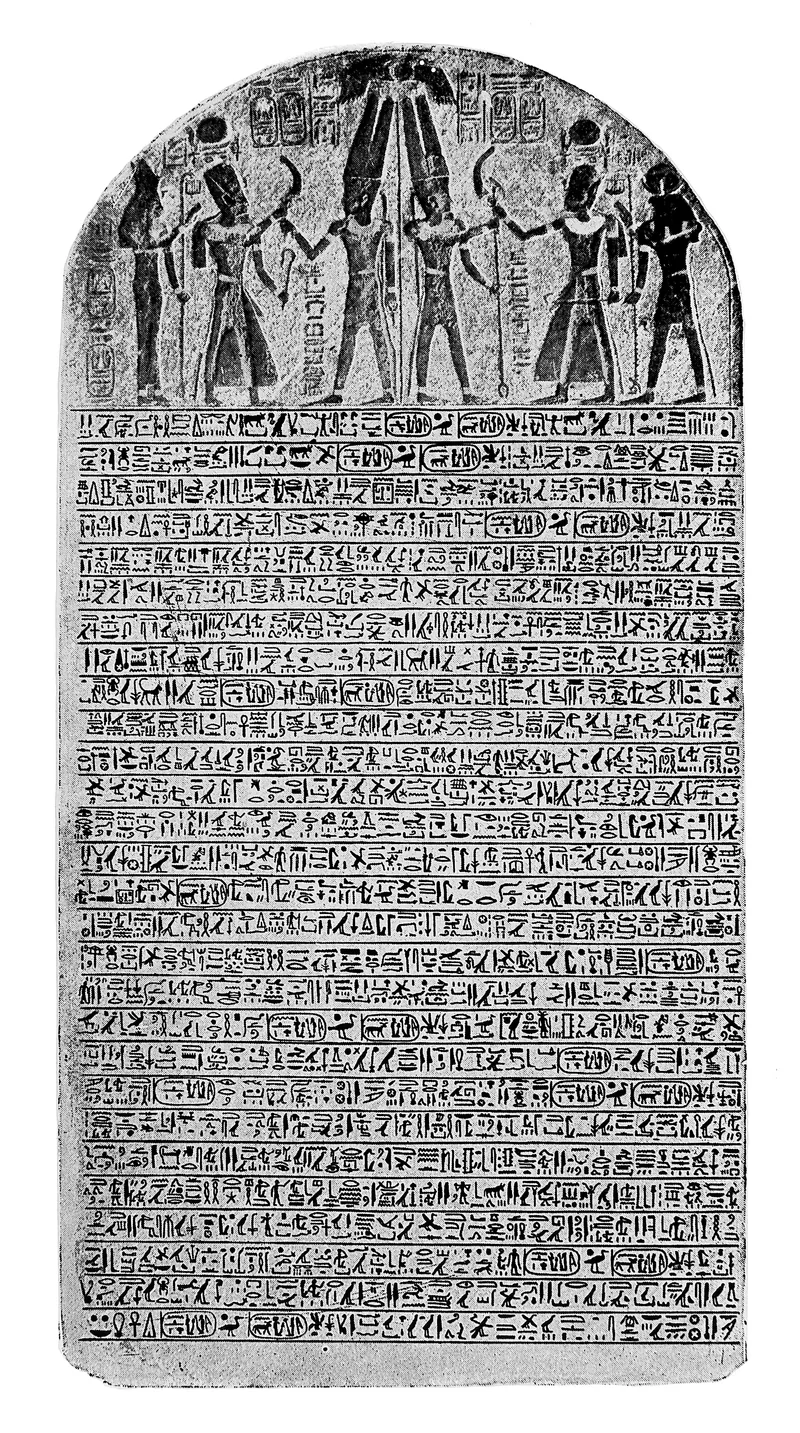
The Hebrew Bible tells Israel's early story through the patriarchs, the exodus from Egypt, the conquest of Canaan under Joshua and the period of the judges (see the Hebrew Bible). Historians and archaeologists read this account alongside the material evidence, and the two do not always match. The earliest external reference to Israel is the victory stele of Pharaoh Merneptah, about 1208 BCE, which names Israel as a people in Canaan. In the following centuries, during the early Iron Age, hundreds of small farming villages appeared in the central highlands; many archaeologists, notably Israel Finkelstein, interpret them as the settlements of early Israelites who emerged largely from within the population of Canaan rather than arriving as a conquering army.
The Bible's united monarchy of Saul, David and Solomon is usually placed in the tenth century BCE. Its size and splendour are strongly debated: some scholars see a modest chiefdom centred on Jerusalem, others a more substantial state. An Aramaic inscription from Tel Dan, from the ninth century BCE, refers to the "House of David", the earliest extra-biblical mention of David's dynasty. After Solomon the realm divided into two kingdoms: Israel in the north, with its capital eventually at Samaria, and Judah in the south, ruled from Jerusalem by the Davidic line.
Kings, Prophets and the Religion of YHWH§
The national god of both kingdoms was YHWH. Inscriptions and archaeology suggest that early Israelite religion was more varied than the biblical writers approved: inscriptions of around 800 BCE from Kuntillet Ajrud in the Sinai mention "YHWH and his Asherah", household shrines and figurines were common, and sanctuaries existed at Bethel, Dan, Arad and elsewhere. Scholars such as Mark S. Smith describe a gradual development from the worship of YHWH among other deities, through the insistence that Israel should worship YHWH alone, to the explicit monotheism of texts written during the exile, such as the later chapters of Isaiah.
The prophets were central to this development. Amos and Hosea in the northern kingdom, and Isaiah and Micah in Judah, denounced the worship of other gods and condemned injustice to the poor, insisting that ritual without righteousness was worthless. The northern kingdom fell to Assyria around 720 BCE and much of its population was deported. Judah survived; its kings Hezekiah and Josiah carried out religious reforms, and Josiah's reform of about 622 BCE centralised worship in Jerusalem and suppressed rural shrines.
Solomon's Temple and the Worship of the First Temple Period§
According to 1 Kings 6–8, Solomon built the Temple on the hill north of David's city, the site Jewish tradition identifies with Mount Moriah (1 Kings 6). No remains of this building have been securely identified, because the Temple Mount cannot be excavated, but its plan — a porch, a main hall and an innermost chamber — resembles other temples of the Iron Age Levant. The innermost room, the Holy of Holies, held the Ark of the Covenant beneath the wings of two great carved cherubim, and was understood as the earthly throne of the invisible God. In the courtyard stood the altar of burnt offering and a huge bronze basin, the "molten sea".
Worship consisted above all of sacrifice, conducted by hereditary priests descended, according to the Torah, from Aaron, and assisted by the Levites. Leviticus describes several kinds of offering: the burnt offering wholly consumed on the altar, the shared well-being offering eaten by the worshippers, and purification and reparation offerings for sin and impurity, along with daily offerings morning and evening, incense and grain offerings. On the Day of Atonement the high priest entered the Holy of Holies to purge the sanctuary (Leviticus 16). The three pilgrimage festivals — Passover, Shavuot and Sukkot — brought crowds to Jerusalem; their later forms are described in the Sabbath and Jewish festivals.
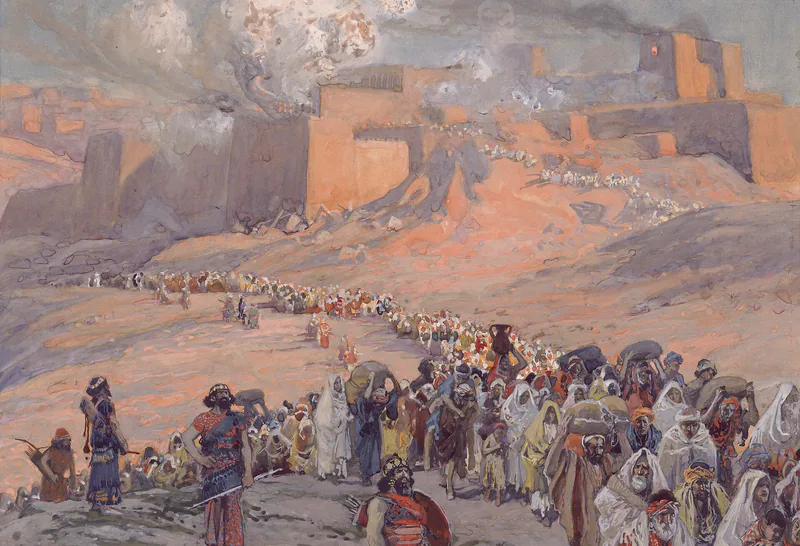
In 587 or 586 BCE the Babylonian king Nebuchadnezzar II captured Jerusalem, burned the Temple and deported much of Judah's elite to Babylonia. The Ark disappears from history at this point, and its fate has inspired legends ever since.
Exile in Babylon and the Second Temple§
The exile was a turning point. Cut off from Temple and land, Judeans in Babylonia preserved their identity through observance of the Sabbath, circumcision and dietary law, and through the collection and editing of their sacred writings. In 539 BCE the Persian king Cyrus the Great conquered Babylon; the Bible credits him with allowing the exiles to return and rebuild the Temple (Ezra 1), and Isaiah even calls him God's "anointed". Iranian religion may have influenced Jewish ideas in this period, a question discussed in our article on Zoroastrianism.
The Second Temple was completed, according to Ezra, in the sixth year of Darius I, about 516–515 BCE. In the following century the scribe Ezra and the governor Nehemiah promoted public reading of the Torah and strict observance. Judah, now the Persian province of Yehud, was a small temple community governed in practice by its high priests. Not all Jews returned: communities remained in Babylonia, and papyri from Elephantine in Egypt reveal a Jewish military colony with its own temple to YHW in the fifth century BCE.
Hellenism, the Maccabees and Herod's Temple§
Alexander the Great's conquest in 332 BCE brought Judea under Greek rule, first of the Ptolemies of Egypt and then of the Seleucids of Syria. Greek culture attracted some Jews and alarmed others. In 167 BCE the Seleucid king Antiochus IV outlawed Jewish practices and set up a pagan altar in the Temple. A revolt led by the priest Mattathias and his son Judah Maccabee recaptured Jerusalem, and the Temple was purified and rededicated in 164 BCE — the origin of Hanukkah. The Maccabees' descendants, the Hasmoneans, ruled as high priests and kings until the Roman general Pompey took Jerusalem in 63 BCE.
The late Second Temple period was one of great religious variety. The historian Josephus describes the Pharisees, who taught ancestral traditions beyond the written law and believed in resurrection; the Sadducees, linked to the priestly aristocracy, who rejected those traditions; and the Essenes, a strict communal movement. The Dead Sea Scrolls, probably the library of a sectarian group related to the Essenes, reveal intense interest in purity, angels, calendars and the end of days — interests that also fed into the early visionary traditions described in Merkavah and Hekhalot mysticism. Christianity too emerged from this world.
Herod the Great, king of Judea under Rome from 37 to 4 BCE, began rebuilding the Temple on a magnificent scale around 20 BCE, enlarging the Temple Mount with massive retaining walls; the Western Wall in Jerusalem is a surviving section of them.
The Destruction of the Temple in 70 CE and Its Legacy§
Tension with Roman governors led to the great revolt of 66 CE. In 70 CE the future emperor Titus besieged Jerusalem and destroyed the Temple; Jewish tradition dates both destructions to the ninth of Av, mourned on the fast of Tisha B'Av. The Arch of Titus in Rome still shows soldiers carrying the Temple's seven-branched menorah in triumph. A second revolt under Simon bar Kosiba (Bar Kokhba) in 132–135 CE ended with Jerusalem refounded as the Roman colony Aelia Capitolina, from which Jews were barred.
Without a Temple, the sages known as rabbis reorganised Jewish life around prayer, study and the commandments, teaching that deeds of loving-kindness atone as sacrifice once did. Their work is described in rabbinic Judaism and the Talmud. Yet the Temple remained central to Jewish memory: the daily prayers ask for its restoration, the synagogue faces Jerusalem, and the rabbis preserved in detail the laws of a service no one could perform.
Frequently asked questions§
When was the First Temple built and destroyed?§
The Bible attributes it to Solomon, usually dated to the tenth century BCE, though archaeological confirmation is lacking. It was destroyed by the Babylonians in 587 or 586 BCE.
What was in the Holy of Holies?§
In the First Temple it held the Ark of the Covenant, the chest believed to contain the tablets of the law, beneath two carved cherubim. In the Second Temple, according to the Mishnah, the chamber was empty except for a stone on which the high priest placed incense on the Day of Atonement.
Who destroyed the Second Temple?§
The Roman army under Titus destroyed it in 70 CE at the end of the first Jewish revolt against Rome. The Western Wall in Jerusalem is part of the retaining wall of the platform on which it stood.
Was ancient Israel always monotheistic?§
Most historians think not. Inscriptions and the biblical prophets' own complaints suggest that many Israelites worshipped other deities alongside YHWH, and that strict monotheism became dominant around the time of the Babylonian exile.
Sources and further reading§
- The Bible Unearthed: Archaeology's New Vision of Ancient Israel and the Origin of Its Sacred Texts — Israel Finkelstein & Neil Asher Silberman, 2001
- The Early History of God: Yahweh and the Other Deities in Ancient Israel — Mark S. Smith, 1990
- Ancient Israel: Its Life and Institutions — Roland de Vaux, 1961
- From the Maccabees to the Mishnah — Shaye J. D. Cohen, 1987
- Judaism: Practice and Belief, 63 BCE–66 CE — E. P. Sanders, 1992
- Jerusalem: The Biography — Simon Sebag Montefiore, 2011