Liber XIX · Kabbalah · Chapter X: The Zohar
The Zohar: Origins, Authorship and Teachings Explained
The Zohar explained: Moses de León in 13th-century Castile, the attribution to Shimon bar Yochai, structure, Aramaic style, themes and printing history.
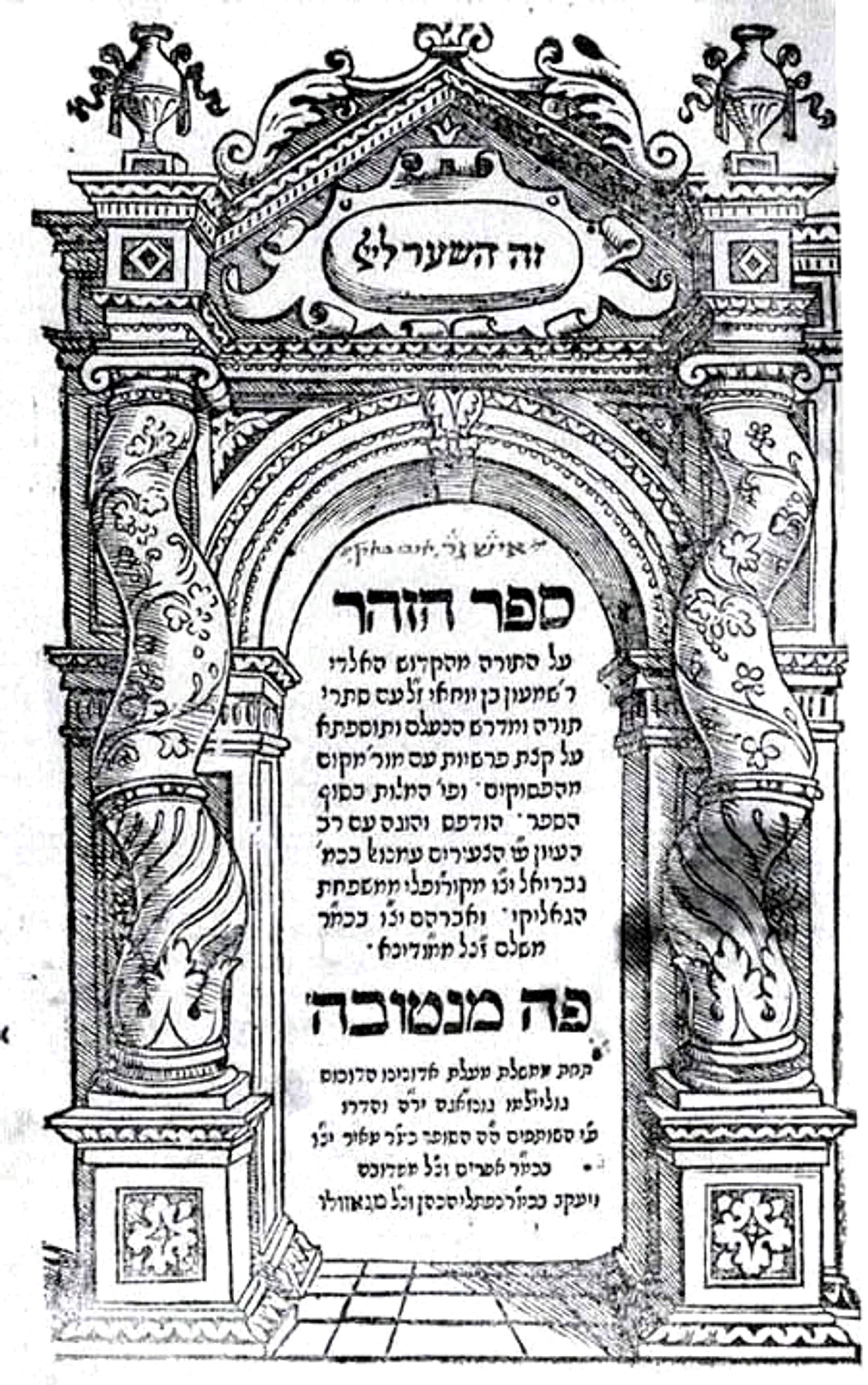
The Zohar ("Radiance" or "Splendour") is the central work of Jewish Kabbalah: a vast mystical commentary on the Torah, written mostly in Aramaic, that presents itself as the teachings of the second-century sage Rabbi Shimon bar Yochai and his companions. Modern scholarship generally holds that it was composed in late-thirteenth-century Castile, largely by Moses de León and possibly a circle of associates. Printed in Italy in 1558–1560, it became for many Jewish communities a sacred text second only to the Bible and Talmud.
The Appearance of the Zohar in Thirteenth-Century Castile§
In the last decades of the thirteenth century, booklets in a strange, archaic-sounding Aramaic began to circulate among kabbalists in Castile. They contained conversations between Rabbi Shimon bar Yochai, his son Eleazar and a group of companions (havrayya) as they wandered through the hills of the Galilee, expounding the hidden meanings of Scripture. The main distributor of these texts was Moses ben Shem Tov de León, a kabbalist who lived in Guadalajara and later Ávila and who also wrote Hebrew works such as Sefer ha-Rimmon (1287) and Ha-Nefesh ha-Hakhamah (1290).
The testimony of Isaac of Acre§
A famous account is preserved in Sefer Yuhasin, a sixteenth-century chronicle by Abraham Zacuto, which cites a now-partly lost diary of the kabbalist Isaac ben Samuel of Acre. Isaac, having arrived in Spain after the fall of Acre in 1291, heard about the Zohar and sought out Moses de León, who swore that he possessed an ancient manuscript. After de León died in 1305, Isaac is said to have learned of a report attributed to his widow, that her husband had written the work himself. The report is suggestive, but it is secondhand, partly fragmentary, and preserved only in a later chronicle, so historians treat it with caution.
Who Wrote the Zohar? Authorship Debates§
Traditional Jewish belief, still held in many communities, attributes the Zohar to Shimon bar Yochai, whose teachings were supposedly hidden and later revealed. Some traditional views allow that later disciples recorded and edited them.
Modern critical study began with figures such as Jacob Emden, who in the eighteenth century argued in Mitpahat Sefarim that parts of the Zohar were late, and Heinrich Graetz, who in the nineteenth century called it a forgery of Moses de León. Gershom Scholem, after initially hoping to prove the antiquity of the work, concluded in Major Trends in Jewish Mysticism (1941) that the main body was the work of a single author, Moses de León, writing between about 1280 and 1286, with the Midrash ha-Ne'lam somewhat earlier. He based this on its language, which reflects medieval Hebrew and Spanish rather than ancient Aramaic; its errors in Galilean geography; its knowledge of medieval philosophy and kabbalistic doctrine; and its close parallels with de León's Hebrew writings.
Later scholars modified Scholem's single-author thesis. Yehuda Liebes argued that the Zohar was the product of a group of kabbalists, including Joseph Gikatilla and others, whose fellowship mirrors the circle of companions in the text itself. Daniel Abrams and Boaz Huss have gone further, arguing that "the Zohar" as a single book was largely constructed by later editors and printers who gathered disparate texts under one title. Most scholars today speak of a core composed in Castile in the late thirteenth century, with additional layers and editorial shaping over the following centuries.
Structure of the Zohar§
The Zohar is not a single continuous book but a corpus of interrelated texts. The printed editions arrange most of it as a commentary on the weekly Torah portions, beginning with Genesis, but embedded within and alongside this are distinct units:
- The main body (guf ha-Zohar) — homilies on the Torah portions, often framed as discussions during journeys.
- Sifra di-Tseni'uta ("The Book of Concealment") — a terse, enigmatic text on the emanation of the divine countenances.
- Idra Rabba ("The Great Assembly") and Idra Zuta ("The Lesser Assembly") — dramatic gatherings in which Shimon bar Yochai and his companions expound the features of the divine "faces"; the Idra Zuta describes Shimon's death.
- Midrash ha-Ne'lam ("The Hidden Midrash") — partly in Hebrew, probably among the earliest layers.
- Raya Mehemna ("The Faithful Shepherd") and Tikkunei ha-Zohar — later compositions focusing on the commandments and on seventy interpretations of the first word of Genesis, generally considered by scholars to be by a different author writing in the early fourteenth century.
- Other sections, such as Sitrei Torah, Matnitin and Hekhalot passages, describing secret teachings and the palaces of holiness.
The Zohar Hadash ("New Zohar") gathers material found later in manuscripts and printed separately in the 1590s.
Language and Literary Style§
The Zohar's Aramaic is unique: an artificial literary language that draws on the Aramaic of the Babylonian Talmud and the Targum Onkelos but shows medieval Hebrew syntax, invented words and Spanish influence. Its style is poetic and allusive, rich in images of light, kings, queens, gardens, rivers and seeds. Stories punctuate the homilies: the companions meet a donkey-driver who turns out to be a hidden sage, or a child who reveals astonishing secrets, reflecting a recurring theme that wisdom appears in unexpected places.
The work's narrative frame is itself important. The fellowship of Shimon bar Yochai's circle is presented as an ideal mystical community whose exegesis both reveals and affects divine reality. Scholars such as Melila Hellner-Eshed, in A River Flows from Eden (2009), have explored the Zohar as a description of living mystical experience as well as doctrine.
Major Themes of the Zohar§
The sefirot and the symbolic reading of Torah§
The Zohar reads the Torah as a garment over hidden meanings. Its characters, events and laws correspond to the ten sefirot, the divine powers described in the Tree of Life article. A well-known parable compares the Torah to a beloved maiden in a palace who reveals herself gradually to her lover, from outer narrative to inner mystery. Another passage warns that those who see only the stories of the Torah see only its clothing.
The Shekhinah and sacred union§
The feminine Shekhinah, identified with Malkhut, is a central figure. She is the Queen, the Sabbath Bride, the moon, the community of Israel and the "lower mother". Her union with the masculine Tiferet, the Holy One blessed be He, is the goal of Jewish devotion, and exile is understood as their separation. The Zohar's erotic and gendered imagery has been studied extensively by Elliot Wolfson and others.
The Other Side and evil§
The Zohar develops a detailed demonology and theory of evil as the sitra ahra, "the other side", a realm of impurity arising from separated judgment. Figures such as Samael and Lilith appear, and the husks (kelippot) surround holiness as a shell surrounds a nut.
The soul and the commandments§
The Zohar teaches a three-part soul (nefesh, ruah, neshamah) and explains each commandment as affecting the upper worlds. Prayer, Sabbath observance and Torah study at midnight are invested with cosmic significance. It also discusses reincarnation (gilgul), a theme later developed systematically in Lurianic Kabbalah.
Printing, Canonisation and Influence§
The Zohar was first printed in two rival editions in Italy: in Mantua (three volumes, 1558–1560) and in Cremona (one volume, 1559–1560). Their publication was contested, with some rabbis objecting to the printing of esoteric teaching, but it went ahead in a climate of growing kabbalistic influence, only a few years after the burning of the Talmud in Italy in 1553. The pagination of the Mantua edition remains the standard reference system.
After the expulsion from Spain and the flourishing of Safed, the Zohar rose to canonical authority. Cordovero and Luria built their systems on it, and its readings shaped prayer customs such as Kabbalat Shabbat and the recitation of Berikh Shemeh before the Torah reading. Sabbatean, Hasidic (see Hasidism and the Baal Shem Tov) and Sephardic communities all treated it as sacred, and recitation of the Zohar, even without full understanding, came to be regarded by some as spiritually effective. Jewish critics of Kabbalah, such as Leon Modena in Ari Nohem (written around 1639), challenged its antiquity.
Christian Cabalists translated portions into Latin; Knorr von Rosenroth's Kabbala Denudata included the Sifra di-Tseni'uta and the Idrot, which Mathers later rendered into English in The Kabbalah Unveiled (1887). For a general survey of how this transmission shaped the Western occult picture of Kabbalah, see What Is Kabbalah?.
Translations and Modern Study§
The full Zohar is enormous, and for most of history it was studied in the original or through Hebrew paraphrases such as Yehuda Ashlag's Sulam ("Ladder") commentary. The Soncino translation by Harry Sperling and Maurice Simon (1931–1934) offered an incomplete English rendering. Isaiah Tishby's anthology Mishnat ha-Zohar (The Wisdom of the Zohar), with Fischel Lachower, organised key passages by theme with extensive introductions. Daniel C. Matt's The Zohar: Pritzker Edition (12 volumes, 2004–2017, with later volumes by Nathan Wolski and Joel Hecker) provides a critical Aramaic text and an annotated English translation, and has become the standard reference.
Frequently asked questions§
What does the word Zohar mean?§
Zohar means "radiance" or "splendour". The title comes from Daniel 12:3, which says the wise "shall shine as the brightness of the firmament" (KJV). The verse is interpreted at the start of several Zohar passages.
Did Shimon bar Yochai write the Zohar?§
Tradition attributes it to him. Most modern scholars conclude that it was written in thirteenth-century Castile, chiefly by Moses de León and possibly a group of associates, with later additions. The evidence includes its medieval Aramaic, its knowledge of medieval thought and its parallels with de León's own Hebrew works.
Why is the Zohar written in Aramaic?§
Aramaic was the language of the Talmud and of Jewish life in late antique Palestine and Babylonia, so writing in Aramaic lent the text an aura of antiquity consistent with its second-century setting. Its Aramaic is nevertheless distinctive and contains many medieval features.
Is there a reliable English translation of the Zohar?§
The most complete and scholarly English translation is The Zohar: Pritzker Edition, begun by Daniel C. Matt, which includes a critically established Aramaic text and detailed commentary. Isaiah Tishby's The Wisdom of the Zohar is a valuable thematic anthology.
Sources and further reading§
- The Zohar: Pritzker Edition — Daniel C. Matt (trans.), 2004–2017, with Nathan Wolski and Joel Hecker
- The Wisdom of the Zohar: An Anthology of Texts — Isaiah Tishby and Fischel Lachower, 1989 (English translation)
- Major Trends in Jewish Mysticism — Gershom Scholem, 1941
- Studies in the Zohar — Yehuda Liebes, 1993
- A River Flows from Eden: The Language of Mystical Experience in the Zohar — Melila Hellner-Eshed, 2009
- The Zohar: Reception and Impact — Boaz Huss, 2016 (English translation)
- Zohar: The Book of Enlightenment — Daniel C. Matt, 1983