Liber XX · Kabbalah · Chapter IX: The Sefirot
The Ten Sefirot and the Kabbalistic Tree of Life Explained
The ten sefirot and the Kabbalistic Tree of Life: meaning of each sefirah, the three pillars, the 22 paths, diagram history and its use in Hermetic Qabalah.

The Tree of Life (Etz Hayyim) in Kabbalah is a diagram of the ten sefirot, the powers or attributes through which the infinite God (Ein Sof) becomes manifest, connected by twenty-two channels and arranged in three vertical columns. In Jewish Kabbalah it serves as a symbolic map of divine life and of the meaning of the Torah and commandments. In later Christian Cabala and Hermetic Qabalah it became a universal map of the cosmos and of the stages of spiritual ascent.
From Numbers to Divine Attributes§
The word sefirot first appears in the Sefer Yetzirah, where it seems to mean "numbers" or "countings": ten abstract dimensions of a created universe. The kabbalists of twelfth-century Provence transformed this idea. In the Sefer ha-Bahir and in the teaching of Isaac the Blind, the sefirot became ten aspects of God's own being, linked to biblical names, attributes and images. The thirteenth-century Gerona school and then the Zohar gave them full symbolic development.
The sefirot are not separate gods. Kabbalists repeatedly insisted on divine unity and compared the sefirot to flames from a single coal, to colours in a light, or to water poured into vessels of different colours. They argued over whether the sefirot are God's essence (atzmut) or tools (kelim) through which God acts. Moses Cordovero, in Pardes Rimonim (1548), proposed that they are both: the divine light within them is essence, while their structure is vessel.
The image of a tree is ancient. The Bahir speaks of God planting a tree whose roots are above, and the sefirotic system is often described as an inverted tree, nourished from Ein Sof. Other images include a human figure (the "primordial man", Adam Kadmon), a set of concentric circles, and a pattern of lights.
The Ten Sefirot, One by One§
The following descriptions summarise common associations in classical Jewish Kabbalah. Each sefirah gathers many symbols, and different schools vary in emphasis.
Keter — Crown§
The highest sefirah, sometimes called Ayin ("Nothingness") because it is beyond all comprehension. It is the primordial divine will, so close to Ein Sof that some kabbalists did not count it among the ten, substituting Da'at.
Hokhmah — Wisdom§
The first flash of divine thought, a point of potential containing everything in undifferentiated form. It is associated with the "father" and with the letter Yod of the divine name.
Binah — Understanding§
The "mother" or "palace" in which the point of wisdom expands and differentiates. Binah is linked to repentance (teshuvah), to the jubilee, and to the upper He of the divine name. From her the seven lower sefirot are "born".
Da'at — Knowledge§
Not a full sefirah in most systems, Da'at is the hidden point of union between Hokhmah and Binah. It became especially important in Lurianic Kabbalah and in Habad Hasidism.
Hesed — Loving-kindness§
Also called Gedulah ("Greatness"), it is the outflowing of unrestrained divine love, linked with Abraham, the right arm and the colour white.
Gevurah — Strength or Judgment§
Also called Din ("Judgment") or Pahad ("Fear"), it restrains and limits. It is linked with Isaac, the left arm and the colour red. When Gevurah becomes cut off from Hesed, the Zohar teaches, it becomes the source of evil.
Tiferet — Beauty§
Also called Rahamim ("Compassion"), Tiferet harmonises love and judgment. It is the central sefirah, identified with Jacob, the written Torah, the sun and "the Holy One, blessed be He". It corresponds to the Vav of the divine name.
Netzah — Eternity or Victory§
Netzah represents enduring persistence, linked with Moses and the right leg; it is often paired with Hod as a source of prophecy.
Hod — Splendour or Majesty§
Hod is paired with Netzah and linked with Aaron and the left leg. Together these two channel the flow downward.
Yesod — Foundation§
The channel through which all the upper powers flow into Malkhut. Yesod is linked to the tzaddik ("righteous one"), to Joseph, and to the procreative organ, interpreting Proverbs 10:25: "the righteous is an everlasting foundation" (KJV).
Malkhut — Kingship§
The final sefirah, identified with the Shekhinah, the feminine divine presence, the Sabbath, the moon, the Oral Torah, King David and the community of Israel. It receives from all the others and governs the world below. It corresponds to the final He of the divine name.
The Three Pillars and the Structure of the Tree§
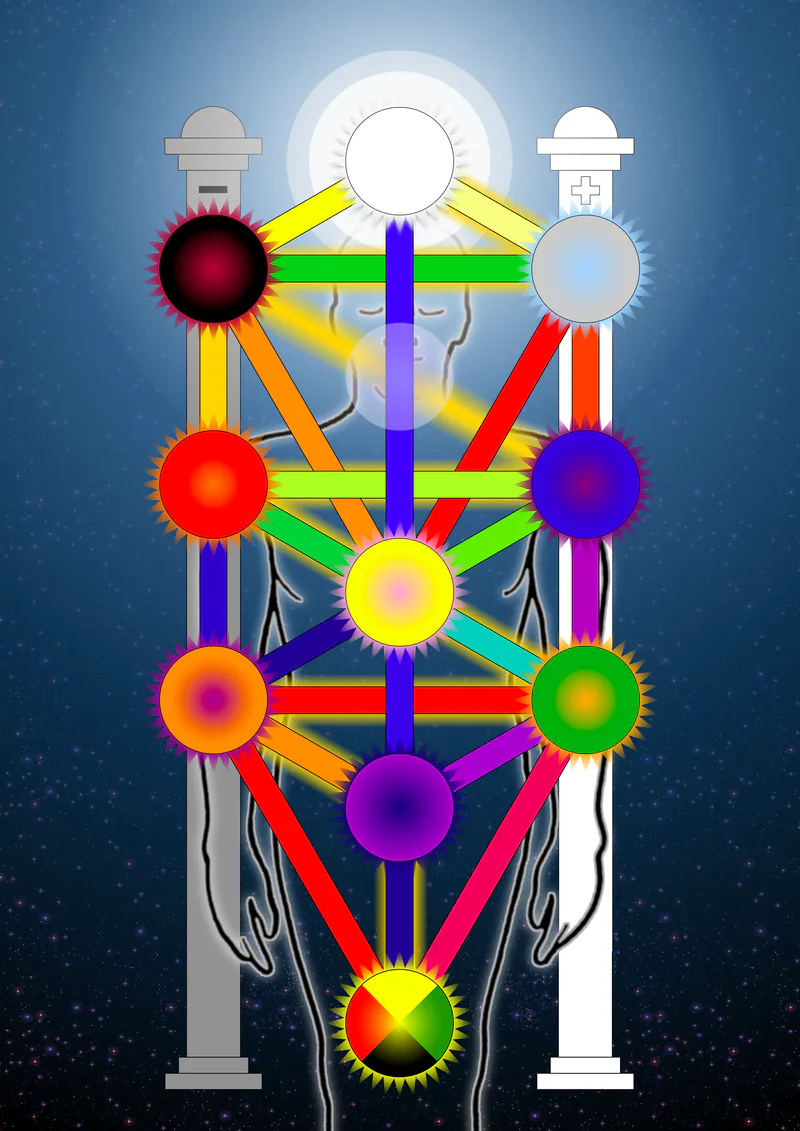
Kabbalists described the sefirot as arranged in three lines (kavim). On the right, the line of mercy runs through Hokhmah, Hesed and Netzah. On the left, the line of judgment runs through Binah, Gevurah and Hod. In the centre, the line of balance runs from Keter through Tiferet and Yesod to Malkhut. This central column was sometimes identified with the patriarch Jacob, who unites Abraham's love and Isaac's fear.
The sefirot are also grouped in triads: an upper triad of intellect (Keter, Hokhmah, Binah), a middle triad of emotion (Hesed, Gevurah, Tiferet) and a lower triad of action (Netzah, Hod, Yesod), with Malkhut receiving all. The seven lower sefirot correspond to the seven days of creation. Grouped by the four letters of the divine name YHVH, they also map onto the Lurianic "faces" described in Lurianic Kabbalah.
In Hermetic usage these columns are called the Pillar of Mercy, the Pillar of Severity and the Middle Pillar, and the Golden Dawn associated the outer two with the pillars Jachin and Boaz of Solomon's Temple. The term "Middle Pillar" was later given to a meditation exercise in the writings of Israel Regardie.
The Twenty-Two Paths§
Since the Sefer Yetzirah speaks of thirty-two paths of wisdom, made up of ten sefirot and twenty-two letters, kabbalists linked the twenty-two Hebrew letters to channels (tzinorot) connecting the sefirot. There was no single fixed arrangement. Different medieval and early modern diagrams connect the sefirot in different ways and assign the letters differently.
In the arrangement associated with the Vilna Gaon, the three "mother" letters of the Sefer Yetzirah occupy the three horizontal paths, the seven "doubles" the vertical paths, and the twelve "simples" the diagonals. The tree used in Hermetic Qabalah, derived from Kircher, instead assigns the letters in alphabetical order from the top downward, beginning with Aleph on the path from Keter to Hokhmah, and numbers the paths from 11 to 32 after the ten sefirot. The separate medieval text known as "The Thirty-Two Paths of Wisdom", which gives each path a name such as "Admirable Intelligence" or "Illuminating Intelligence", was printed with the Sefer Yetzirah and translated into English by Westcott; Hermetic writers relied heavily on it.
A Short History of Tree of Life Diagrams§
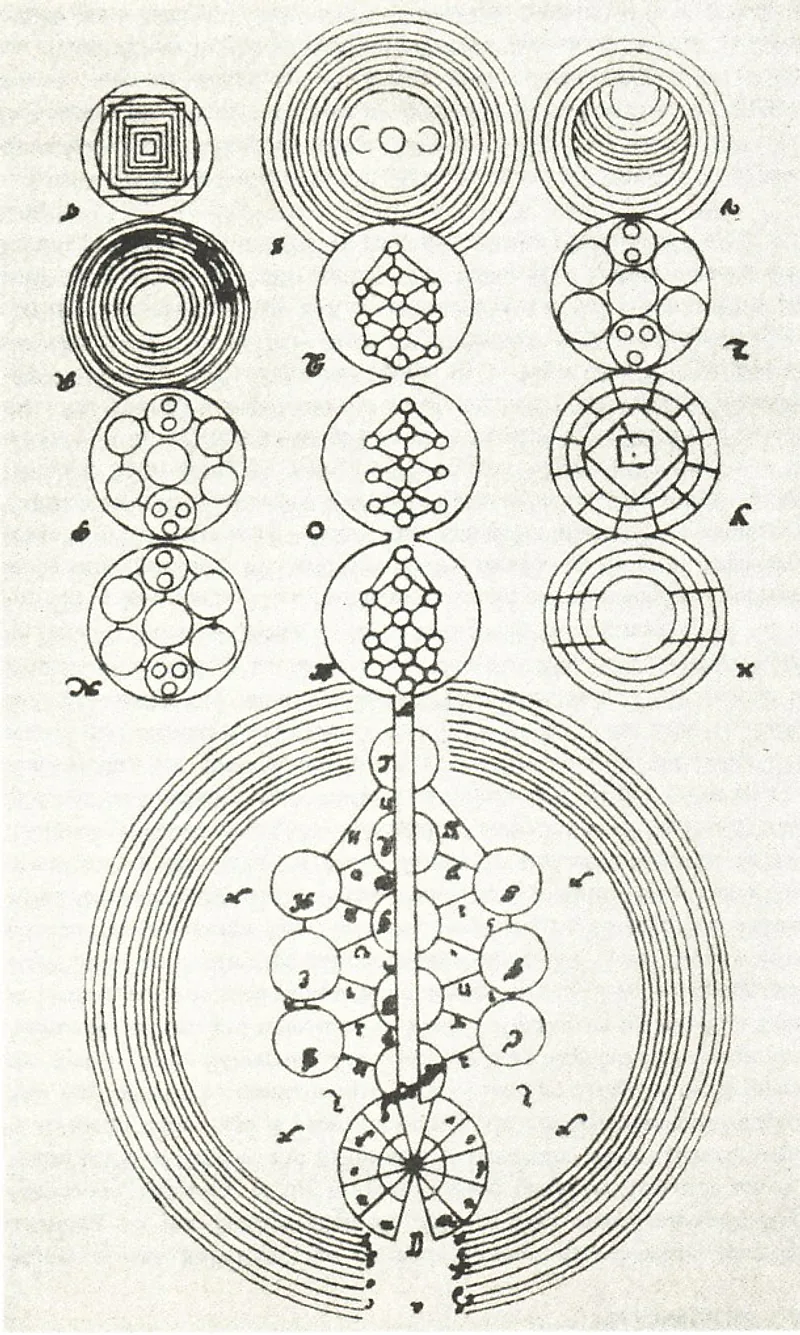
Diagrams of the sefirot appear in manuscripts from the thirteenth century onward and take many forms: circles, concentric rings, human figures, menorahs and branching trees. There was no canonical picture.
Moses Cordovero's Pardes Rimonim discusses various arrangements of channels. Within Lurianic Kabbalah, the arrangement described in Hayyim Vital's Etz Hayyim became standard in Jewish practice, with a different set of connecting lines; the Vilna Gaon's school preferred yet another variant. Printed Jewish works such as Joseph Gikatilla's Sha'arei Orah (first printed in Latin translation in 1516) and Christian publications circulated sefirotic diagrams widely.
The layout most familiar today owes much to Christian scholars. Athanasius Kircher, a Jesuit polymath, published an influential Tree of Life diagram in Oedipus Aegyptiacus (1652–1654), drawing on earlier Christian Cabalistic sources, with numbered sefirot and twenty-two lettered paths. A similar arrangement appears in Knorr von Rosenroth's Kabbala Denudata (1677–1684). The Golden Dawn adopted a version of this "Kircher tree" with its own letter-assignments, and it has dominated popular and occult representations ever since. The Lurianic diagram, by contrast, is the one usually found in traditional Jewish kabbalistic works.
The Tree of Life in Hermetic Qabalah§
From the nineteenth century the Tree of Life became the backbone of Western ceremonial magic. Following Éliphas Lévi, the Hermetic Order of the Golden Dawn attached each of the twenty-two Major Arcana of the tarot to a path, assigned planets to the sefirot (Saturn to Binah, Jupiter to Hesed, Mars to Gevurah, the Sun to Tiferet, Venus to Netzah, Mercury to Hod, the Moon to Yesod, and the sphere of the elements to Malkhut), and organised its initiatory grades from Malkuth upward. Practitioners used "pathworking", guided imaginative journeys along the paths. Aleister Crowley's 777 and Dion Fortune's The Mystical Qabalah (1935) expanded the correspondences to gods, colours, perfumes and stones, and Fortune popularised the image of the Tree as a ladder of consciousness.
This is a distinct tradition with its own history. In Jewish Kabbalah, the sefirot are aspects of God revealed in Scripture and activated through prayer and commandments; Hermetic Qabalah treats the Tree as a general, syncretic system of correspondence open to practitioners of any religion and often detached from Hebrew language and Jewish law. Neither can be fully understood by projecting the other onto it, as What Is Kabbalah? explains in more detail.
Frequently asked questions§
What are the ten sefirot in order?§
The traditional order is Keter (Crown), Hokhmah (Wisdom), Binah (Understanding), Hesed (Loving-kindness), Gevurah (Strength/Judgment), Tiferet (Beauty), Netzah (Eternity), Hod (Splendour), Yesod (Foundation) and Malkhut (Kingship). Some systems replace Keter with Da'at (Knowledge) when counting the ten.
What are the three pillars of the Tree of Life?§
The right pillar of mercy contains Hokhmah, Hesed and Netzah; the left pillar of judgment contains Binah, Gevurah and Hod; the middle pillar of balance contains Keter, Tiferet, Yesod and Malkhut. Hermetic writers call them the Pillars of Mercy, Severity and Mildness (or the Middle Pillar).
Is the Tree of Life the same in Jewish Kabbalah and Hermetic Qabalah?§
Not exactly. Both use ten sefirot and twenty-two paths, but the diagrams and letter assignments differ, and Hermetic Qabalah adds tarot, astrology and magical correspondences. Jewish Kabbalah typically uses the Lurianic diagram and understands the sefirot as divine attributes within a framework of Torah and commandments.
What is Da'at?§
Da'at, "Knowledge", is a hidden point between Hokhmah and Binah. In some systems it substitutes for Keter as one of the ten, especially in Lurianic Kabbalah and Habad Hasidism. Modern occultists sometimes describe it as an "eleventh" or invisible sefirah, a later interpretation.
Sources and further reading§
- Pardes Rimonim — Moses Cordovero, completed 1548
- Sha'arei Orah (Gates of Light) — Joseph Gikatilla, trans. Avi Weinstein, 1994
- On the Mystical Shape of the Godhead — Gershom Scholem, 1991 (English translation)
- The Wisdom of the Zohar — Isaiah Tishby, 1989 (English translation)
- Kabbalah: New Perspectives — Moshe Idel, 1988
- Oedipus Aegyptiacus — Athanasius Kircher, 1652–1654
- The Mystical Qabalah — Dion Fortune, 1935
- Kabbalah: A Very Short Introduction — Joseph Dan, 2006