Liber XXII · Occultism · Chapter VII: Occult Philosophy
Athanasius Kircher: Hieroglyphs, Magnetism and Occult Learning
Athanasius Kircher (1602–1680), the Jesuit polymath of Rome whose Oedipus Aegyptiacus, magnetic cosmos and Mundus subterraneus shaped later occultism.

Athanasius Kircher (1602–1680) was a German Jesuit scholar who spent most of his career at the Collegio Romano in Rome and wrote some forty large books on Egyptian hieroglyphs, magnetism, music, optics, geology, China and the art of combination. In works such as the Oedipus Aegyptiacus (1652–54) he tried to show that the wisdom of Hermes Trismegistus, the Kabbalah and the Greek philosophers formed a single ancient theology that pointed toward Christianity. He was the last great representative of Renaissance occult philosophy, and his engravings and diagrams, above all his Tree of the Sefirot, passed directly into the occult revival of the nineteenth century.
A Jesuit Polymath from Fulda to the Collegio Romano§
Kircher was born in 1602 at Geisa, near Fulda in central Germany, and educated at the Jesuit college in Fulda before entering the Society of Jesus in 1618. His training took him through the colleges of the German Rhineland, where he studied philosophy, mathematics and languages, including Hebrew. The Thirty Years' War repeatedly disrupted his career: in 1631, as Swedish forces advanced on Würzburg where he was teaching, he fled to France and spent two years in Avignon. There he met the antiquarian Nicolas-Claude Fabri de Peiresc, who encouraged his interest in Egyptian antiquities.
In 1633 Kircher was assigned to Vienna as court mathematician, but on his way he was diverted to Rome, where he would remain for the rest of his life. He taught mathematics, physics and Oriental languages at the Collegio Romano, the Jesuits' leading college, and then, freed from teaching, devoted himself to writing and correspondence. Supported by popes, cardinals and the Habsburg emperors, and in contact with Jesuit missionaries from China to the Americas, he became a clearing house for curiosities and information from across the world. He died in Rome in 1680.
Egypt, Hermes and the Oedipus Aegyptiacus§
Kircher's lifelong project was the recovery of Egyptian wisdom. In the Prodromus Coptus (1636) and Lingua Aegyptiaca restituta (1643) he published grammars and word lists of Coptic, arguing correctly that it was the late form of the language of the pharaohs. This was a genuine contribution, and the Coptic studies he helped found later aided Champollion's decipherment of hieroglyphs in 1822.
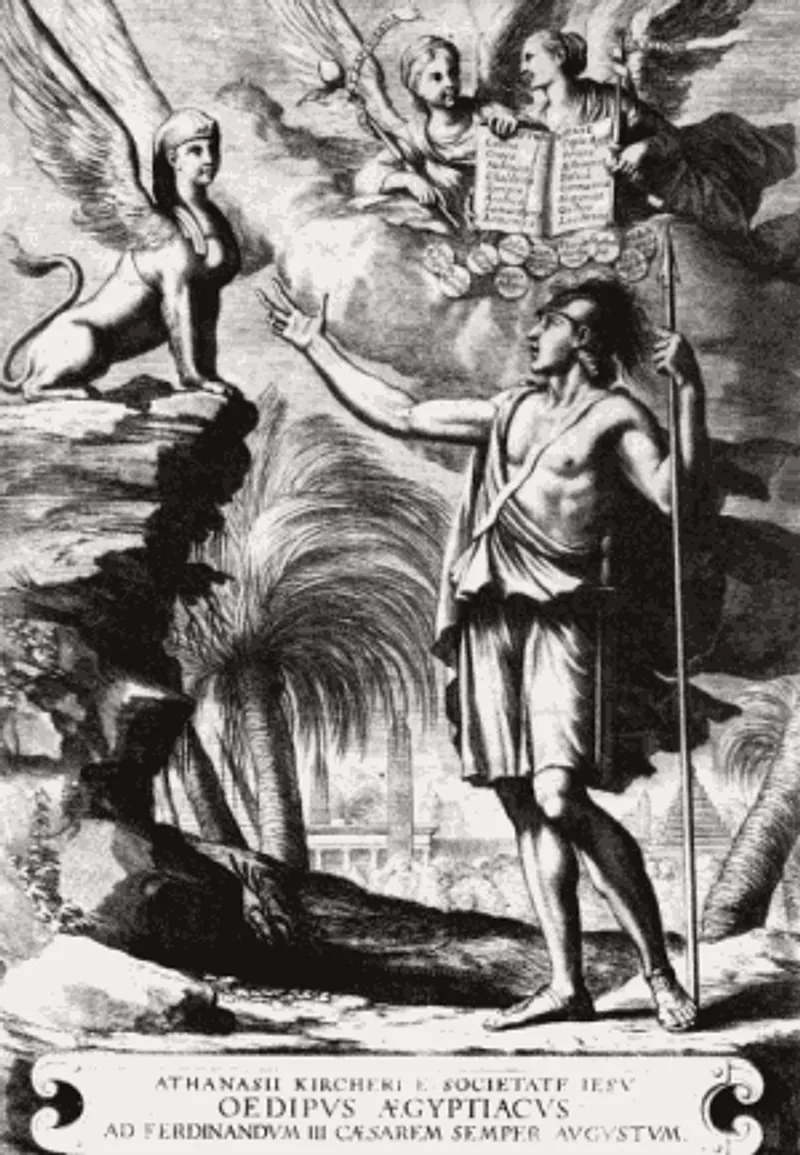
His interpretation of the hieroglyphs themselves followed a different tradition. Since the rediscovery of the late antique Hieroglyphica of Horapollo in the fifteenth century, Renaissance scholars had believed that hieroglyphs were not a script for sounds but a symbolic language, in which each sign expressed a philosophical or theological idea. Kircher accepted this and combined it with the Renaissance belief in a prisca theologia, the ancient theology passed from Hermes and Moses to Orpheus, Pythagoras and Plato. He continued to treat Hermes Trismegistus as an ancient Egyptian sage, even though Isaac Casaubon had shown in 1614 that the Greek Hermetic writings were composed in the Christian era.
The result was the Oedipus Aegyptiacus (Rome, 1652–54), a work in several folio volumes that offered translations of obelisks as statements of a mystical theology of God, the world-soul and the hierarchy of spirits. Around these "translations" Kircher built an encyclopedia of what he called the hieroglyphic wisdom of the nations: the theology of the Chaldaeans, Greek mysteries, Pythagorean number, Arab astrology and magic, alchemy, and Hebrew Kabbalah. Related works on the obelisks of Rome, the Obeliscus Pamphilius (1650) and the Obeliscus Aegyptiacus (1666), applied the same method to monuments the popes were re-erecting in their piazzas.
Kircher's Kabbalah and the Tree of the Sefirot§
The Oedipus contains one of the fullest Christian treatments of Kabbalah in the seventeenth century, drawing on Reuchlin and the Christian Cabala tradition described in Christian and Hermetic Qabalah; the section is summarised in our catalogue entry on Kircher's Cabala of the Hebrews. It includes an engraving of the ten sefirot joined by twenty-two paths, each labelled with a Hebrew letter. This arrangement, which differs from those common in Jewish Lurianic manuscripts, closely resembles the Tree later used by the Hermetic Order of the Golden Dawn, and Kircher's diagram became one of the most reproduced images in Western occultism. The Oedipus also discusses amulets, magical seals and talismans, including material on John Dee's angelic seal (see Kircher on the Sigillum Dei Aemeth), though Kircher presented such things as superstitions to be understood rather than practised.
Magnetism and the Chain of Sympathy§
The second great theme of Kircher's work was magnetism. In Magnes sive de arte magnetica (1641) and the later Magneticum naturae regnum (1667) he treated the attraction of the lodestone as one instance of a universal power by which all things draw and repel each other. The sunflower turning toward the sun, the tides following the moon, the bond between music and the passions, and even love between persons were for him forms of a cosmic magnetism, ultimately grounded in God as the central magnet of creation.
This vision grew out of the older doctrine of sympathy and antipathy that underpinned natural magic. Kircher's books combined it with genuine experiment and measurement, such as tables of magnetic declination gathered from Jesuit travellers, and with long discussions of which reported magnetic marvels were credible. Like his English contemporary Robert Fludd, Kircher saw the universe as a web of hidden correspondences, but he insisted that these be explained as natural powers created by God rather than as the work of spirits. The later theory of animal magnetism owed something to this tradition of a cosmic magnetic fluid.
Mundus Subterraneus, Alchemy and the Hidden Earth§
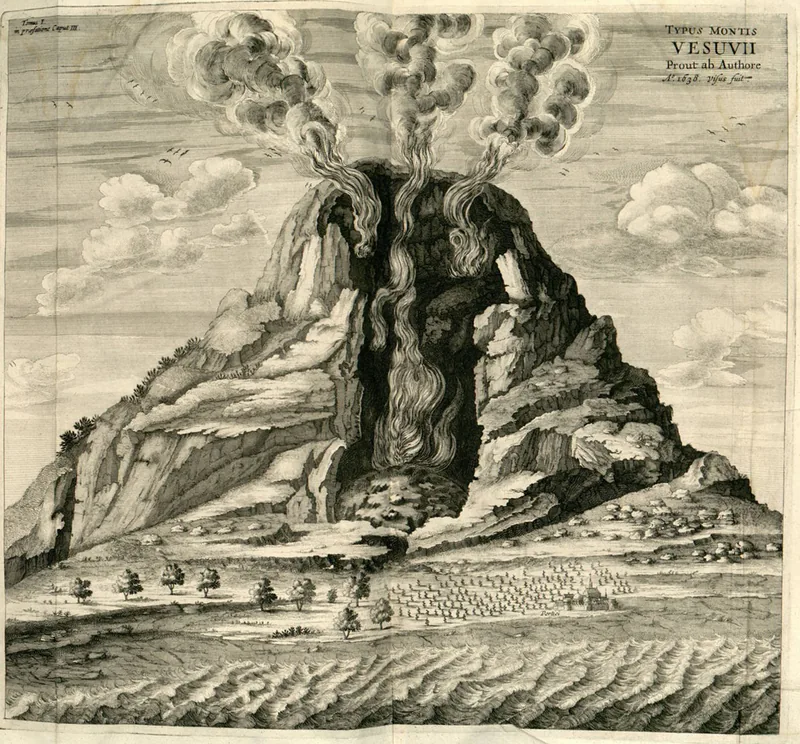
In 1638, while travelling in southern Italy, Kircher had himself lowered into the crater of Vesuvius to observe its fires. The experience shaped Mundus subterraneus (1664–65), a vast study of the earth's interior. Kircher imagined the globe as a body threaded with channels of fire and water, linked to volcanoes, hot springs and the circulation of the oceans, and he discussed minerals, fossils, giants' bones and the generation of metals.
One book of the Mundus subterraneus deals with alchemy. Kircher accepted that metals grow in the earth and that the chemistry of the laboratory could imitate natural processes, but he attacked the claims of alchemists to make gold, which he regarded as deceptions that ruined their patrons. The section provoked angry replies from defenders of transmutation, and it shows how a learned Jesuit could share the language of Western alchemy while rejecting its most famous promise.
Machines, Music and the Kircherian Museum§
Kircher's reputation rested as much on spectacle as on doctrine. Ars magna lucis et umbrae (1646) dealt with light, shadow, mirrors and projection, and its second edition (1671) described a projecting lantern of the kind later called the magic lantern. Musurgia universalis (1650) presented music as a mirror of cosmic harmony and included designs for automatic organs and a mechanical composing device. The Ars magna sciendi (1669) revived the combinatorial method of Ramon Llull, and the Polygraphia nova (1663) proposed a universal writing.
From 1651 Kircher curated a museum at the Collegio Romano, the Musaeum Kircherianum, which displayed antiquities, obelisks in miniature, scientific instruments, speaking tubes and magnetic devices to visiting princes and scholars. It was one of the most celebrated cabinets of curiosities of the age, and its illustrated catalogue (1678) spread his fame further.
Kircher's Legacy in Occultism and Scholarship§
By the time of his death, Kircher's methods were going out of date. Critics mocked his hieroglyphic translations, and the new experimental science of the Royal Society had little use for magnetic sympathies. After Champollion, his reading of Egyptian became a byword for learned fantasy.
Yet his books remained in libraries, and their engravings proved far more durable than their arguments. Occultists of the nineteenth century, from Éliphas Lévi to the founders of the Golden Dawn, drew on Kircher's diagrams, his Egyptian theology and his synthesis of Kabbalah with Hermetic wisdom; the theme recurs in our catalogue entries on Kircher's Isis and Zoroaster's Egg. Modern historians, notably Joscelyn Godwin, Paula Findlen and Daniel Stolzenberg, have rehabilitated him as a key figure in the history of knowledge, at once a scientific collector and a late heir of the occult philosophy of Ficino and Agrippa.
Frequently asked questions§
Did Athanasius Kircher decipher Egyptian hieroglyphs?§
No. He believed hieroglyphs were symbolic signs of hidden doctrine and produced elaborate but mistaken "translations". His real achievement was to show that Coptic descended from ancient Egyptian, a fact that later helped Champollion decipher the script in 1822.
Was Kircher an occultist?§
He was a Catholic priest who rejected demonic magic and alchemical gold-making, but he wrote extensively about Kabbalah, astrology, amulets, magnetic sympathy and Egyptian mysteries. Historians usually describe him as a late representative of Renaissance occult philosophy rather than as a practising magician.
Why is Kircher's Tree of Life important?§
His 1652 engraving of the ten sefirot and twenty-two lettered paths closely matches the arrangement adopted by the Golden Dawn and later Hermetic Qabalah. Through reproductions in occult books, it became one of the standard images of the Tree of Life in the West.
Sources and further reading§
- Oedipus Aegyptiacus — Athanasius Kircher, 1652
- Athanasius Kircher: A Renaissance Man and the Quest for Lost Knowledge — Joscelyn Godwin, 1979
- Athanasius Kircher's Theatre of the World — Joscelyn Godwin, 2009
- Athanasius Kircher: The Last Man Who Knew Everything — Paula Findlen (ed.), 2004
- Egyptian Oedipus: Athanasius Kircher and the Secrets of Antiquity — Daniel Stolzenberg, 2013
- The Myth of Egypt and Its Hieroglyphs in European Tradition — Erik Iversen, 1961
- The Search for the Perfect Language — Umberto Eco, 1995