Liber XXII · Occultism · Chapter VII: Occult Philosophy
Pietro Pomponazzi's De incantationibus: Marvels Without Demons
Pietro Pomponazzi's De incantationibus (1520) explained marvels, cures and charms by nature, imagination and the stars rather than by demons or angels.

Pietro Pomponazzi (1462–1525) was an Italian Aristotelian philosopher who taught at Padua and Bologna and wrote De naturalium effectuum causis sive de incantationibus ("On the causes of natural effects, or on incantations"), finished in 1520 and printed in Basel in 1556. In it he argued that cures, charms, prodigies and other apparent marvels could all be explained by natural causes, such as the hidden properties of things, the power of the imagination and the influence of the heavens, without appeal to demons or angels. The book made him a central and controversial figure in the history of occult philosophy and of Renaissance naturalism.
Pomponazzi's Life at Padua and Bologna§
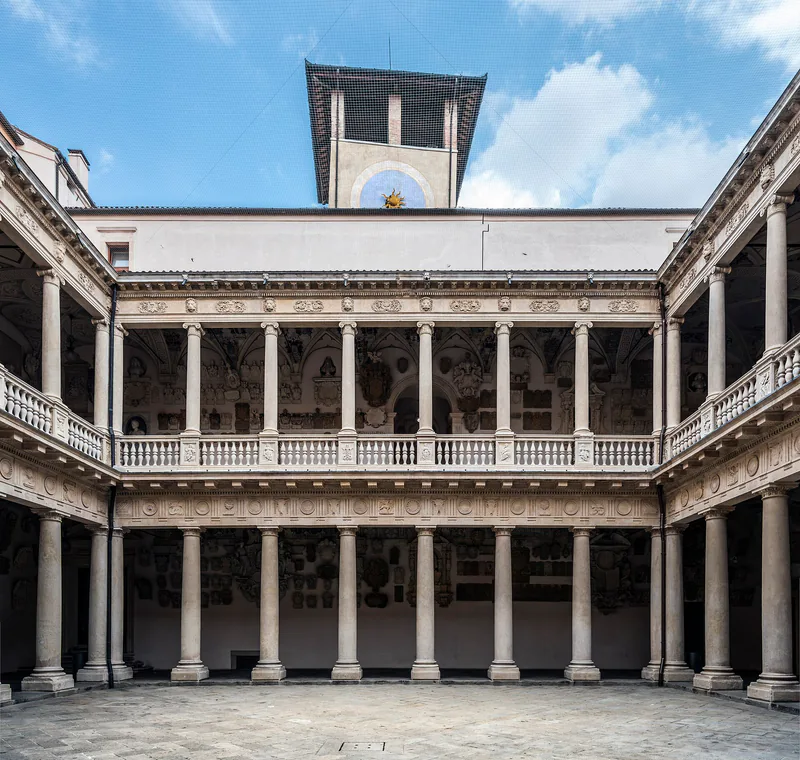
Pietro Pomponazzi was born in Mantua in 1462 and studied philosophy and medicine at the University of Padua, then the most important centre of Aristotelian learning in Europe. He took his degree in arts in 1487 and taught at Padua for much of the following two decades, working within a tradition that read Aristotle with the help of medieval Arabic and Latin commentators, above all Averroes and Alexander of Aphrodisias. When war closed the university after 1509 he moved briefly to Ferrara and then, from about 1511, to Bologna, where he taught until his death in 1525.
He was a lecturer before he was an author. Most of his teaching survives in students' notes, and his printed treatises are few but sharp. They share a method: Pomponazzi asked what could be shown "according to natural principles", setting aside what the Church taught by faith, and he followed Aristotle's arguments wherever they led. That method placed him at a distance from the Platonic and Hermetic enthusiasm of Marsilio Ficino and his Florentine circle, even though he addressed many of the same questions about spirits, stars and hidden powers.
The Immortality Controversy of 1516§
Pomponazzi's first famous work, the Tractatus de immortalitate animae (Bologna, 1516), argued that Aristotle's philosophy, rightly understood, made the human soul the form of the body and therefore mortal. Natural reason could not demonstrate that the individual soul survived death; Christians held that it did on the authority of revelation. The Fifth Lateran Council had decreed in 1513 that philosophers must defend the soul's immortality, so the book caused an uproar. It was burned publicly in Venice, attacked by the Venetian patrician Gasparo Contarini and the philosopher Agostino Nifo, and defended by its author in an Apologia (1518) and a Defensorium (1519). Powerful friends, among them the humanist Pietro Bembo, helped to protect him from formal condemnation.
The controversy matters for his writing on magic because it fixed his procedure. Pomponazzi distinguished sharply between what a philosopher could establish from nature and what a believer accepted on faith. Critics accused him of teaching a "double truth"; admirers, then and since, have seen in this distinction a way of making room for a strictly natural philosophy inside a Christian society.
De incantationibus: A Natural History of Marvels§
De incantationibus was written in 1520 in reply to a question from a physician acquaintance. People spoke of wounds healed by spoken charms, of fevers cured by herbs gathered with words and ceremonies, of apparitions, possession and strange prodigies, and the common learned explanation, from the scholastics to the witch-hunting treatises of the age, was that demons or angels were at work behind them. The physician asked whether a philosopher must accept this.
Pomponazzi's answer was that he need not. Aristotle's natural philosophy, he argued, gave no grounds for believing that incorporeal spirits act directly on bodies, since every natural effect must have a natural, bodily cause and nothing in experience shows a demon at work. As a Christian he accepted the existence of angels and demons because Scripture and the Church taught it, but as a philosopher he would look for causes in nature first and would treat spirits as a last, not a first, explanation.
What the book contains§
The treatise is long and loosely organised, moving through numerous reported cases, many drawn from earlier authors and from stories current in Italy. Its interest lies less in the cases than in the explanatory toolkit applied to them, and in the boldness with which the toolkit is extended from healing charms to prophecy, oracles and miracles. It belongs alongside Pomponazzi's De fato (also written around 1520), which treats fate, free will and predestination with the same independence.
Imagination, Occult Properties and the Stars§
Pomponazzi did not deny that marvels happened. He accepted many of the reported facts and instead redistributed their causes among three natural sources, each borrowed from the existing learned tradition.

The first was the hidden or occult properties of things. Medieval and Renaissance natural philosophy already recognised that the magnet draws iron and that some stones and herbs act in ways their visible qualities do not explain, the domain explored in our guide to natural magic. Pomponazzi argued that many cures attributed to charms were really effects of the herbs, stones or substances used with them, whose powers were simply unknown to the observer.
The second was the imagination. Following Avicenna and a medical tradition that connected mind, vital spirits and body, he held that a strong imagination and confident belief could alter the body of the person who held them, and perhaps, through subtle vapours and spirits, act on others nearby. This was the same framework used to explain fascination and the evil eye. A patient who trusted a healer or a formula could therefore recover through the force of his own expectation, and the words of a charm worked not as commands to spirits but as instruments of that trust.
The third was the heavens. Like nearly all his contemporaries, Pomponazzi accepted that the celestial bodies govern changes in the world below, as set out in our overview of astrology. Rare and wonderful events could therefore be ascribed to rare configurations of the stars and planets, and certain persons might be born with unusual powers because of the heavens at their birth.
Miracles, Relics and the Horoscope of Religions§
What made the book dangerous was that Pomponazzi did not stop at folk charms. He applied the same causes to events that the Church treated as miracles. In a passage that became notorious, he suggested that cures at the shrines of saints could come about through the faith and imagination of the sick, so that the same effect would follow even if the venerated bones were not a saint's at all. On this reasoning the efficacy of relics lay in the believer rather than in the object.
He went further still. Drawing on a medieval astrological doctrine of great conjunctions, he argued that religions and laws themselves rise, flourish and decline according to celestial cycles, and that the wonders accompanying the founding of a new religion, including the miracles of its prophets, belong to the natural order of those cycles. Every religion, including Christianity, would on this account have its season under the heavens. Pomponazzi ended the book by declaring that he submitted everything he had written to the judgement of the Church and believed what it believed, but readers have argued ever since about how sincere that closing submission was.
Reception: Censorship, Libertines and Modern Readings§
De incantationibus circulated in manuscript during Pomponazzi's lifetime and was first printed in Basel in 1556 by the physician and editor Guglielmo Gratarolo, a Protestant exile, and a Basel edition that added De fato followed in 1567. Its arguments soon drew Catholic censure, and the work appeared on later indexes of prohibited books.
The book was read in two very different ways. Opponents of magic and many theologians saw it as an attack on the reality of spiritual beings and on the miraculous; the debates about this boundary are surveyed in how theologians judged demonic magic. At the same time, defenders of a purely natural magic found in Pomponazzi an ally, since he showed how much could be explained by hidden natural powers. Later Italian thinkers such as Tommaso Campanella and the radical Giulio Cesare Vanini, executed at Toulouse in 1619, took up his themes, and French libertine writers of the seventeenth century treated him as a forerunner of free thought.
Historians now place him within the wider story told in occult philosophy. D. P. Walker read him as a key witness to the theory of spiritual magic, in which imagination and spirit, not demons, carried magical effects; Paul Oskar Kristeller and Martin Pine stressed his Aristotelian rigour; and recent historians of science see in him an early, if still very un-modern, programme of naturalising the marvellous. His explanations relied on occult properties and astrology, which later science rejected, yet the decision to look for natural causes first was a step on the long road discussed in occultism and science.
Frequently asked questions§
Did Pomponazzi believe in magic?§
He believed that many reported marvels and cures really happened, but he denied that a philosopher must attribute them to demons or angels. He explained them through hidden natural properties, the imagination and the influence of the stars, which in his day were regarded as respectable natural causes.
When was De incantationibus published?§
Pomponazzi finished the treatise in 1520, but it was not printed during his lifetime. The first edition appeared in Basel in 1556, edited by Guglielmo Gratarolo, more than thirty years after the author's death.
Was Pomponazzi condemned as a heretic?§
He was never formally condemned in his lifetime, despite the furore over his book on the soul and the burning of copies in Venice. Influential patrons protected him, and he consistently stated that he submitted to the Church. His posthumously printed works were later censured.
Why is Pomponazzi important for the history of the occult?§
He showed how the whole repertoire of occult phenomena could be redescribed as natural, which helped shape the idea of natural magic and the later debates over miracles. His treatise is a turning point between medieval demonology and early modern naturalism.
Sources and further reading§
- De naturalium effectuum causis sive de incantationibus — Pietro Pomponazzi, 1556
- The Renaissance Philosophy of Man — Ernst Cassirer, Paul Oskar Kristeller and John Herman Randall Jr. (eds.), 1948
- Eight Philosophers of the Italian Renaissance — Paul Oskar Kristeller, 1964
- Pietro Pomponazzi: Radical Philosopher of the Renaissance — Martin L. Pine, 1986
- Spiritual and Demonic Magic from Ficino to Campanella — D. P. Walker, 1958
- A History of Magic and Experimental Science — Lynn Thorndike, 1923–1958
- Magic in Western Culture: From Antiquity to the Enlightenment — Brian P. Copenhaver, 2015