Liber XXII · Occultism · Chapter VIII: The Occult Revival
The Hermetic Brotherhood of Luxor: Practical Occultism, 1884
The Hermetic Brotherhood of Luxor (from 1884): Max Théon, Peter Davidson, Thomas Burgoyne, P. B. Randolph's legacy and its quarrel with Theosophy.

The Hermetic Brotherhood of Luxor (H. B. of L.) was a small occult order that appeared in Britain in 1884 and offered, by correspondence, a course of "practical occultism" as an alternative to the Theosophical Society. Its public organisers were the Scottish occultist Peter Davidson and the secretary Thomas H. Burgoyne, under the authority of a shadowy Grand Master later identified as Max Théon. Drawing on the teachings of the American spiritualist Paschal Beverly Randolph, it was one of the first Western orders to teach a spiritual use of sexuality, and historians now regard it as an important link between nineteenth-century spiritualism and twentieth-century magical orders.
Origins: A Western Answer to Theosophy§
By 1884 the Theosophical Society had attracted many British spiritualists and occultists with the promise of contact with hidden Masters. But it disappointed some of them. Its Masters were Tibetan and Indian, its teachings were increasingly Buddhist and Hindu in flavour, and it offered little practical instruction. In 1884 the society was also shaken by accusations of fraud against Helena Blavatsky, which the Society for Psychical Research investigated the following year.
Into this situation came a new order. Late in 1884 an advertisement appeared, inserted in a reprint of the Divine Pymander edited by Hargrave Jennings, inviting suitable "Neophytes" to apply for instruction from an ancient brotherhood. The order called itself the Hermetic Brotherhood of Luxor, and it claimed to descend from an ancient circle of initiates whose "Exterior Circle" was now opening to the West. Its members were promised real training in occult development rather than speculation.
Leaders: Théon, Davidson and Burgoyne§
The H. B. of L. presented three levels of leadership. Its external organiser was Peter Davidson (c. 1837–1916), a Scottish violin maker, amateur botanist and long-time occultist living at Forres in Morayshire, who styled himself Provincial Grand Master of the North. The practical work of correspondence was done by the secretary, Thomas Henry Burgoyne (c. 1855–1894), a young man of considerable literary ability who wrote many of the order's instructional papers.
Above them stood the Grand Master of the Exterior Circle, identified in the order's papers by a monogram and later known to be Max Théon. Théon, whose original name is usually given as Louis-Maximilian Bimstein and who was born in Poland around 1848, was a Jewish occultist and healer of uncertain early history who later settled at Tlemcen in Algeria. There, with his English wife Mary Ware, known as Alma, he taught a system called the Cosmic Philosophy or Cosmic Movement. Among those who studied with the couple at Tlemcen in the early 1900s was Mirra Alfassa, later known as "the Mother" of the Sri Aurobindo Ashram. Théon's exact role in the H. B. of L. remains debated; he seems to have been more a source of authority than an active organiser.
Teachings: Practical Occultism and the Randolph Legacy§
The H. B. of L. offered a graded correspondence course rather than a lodge system, and members were expected to work largely alone under the guidance of the secretary. Its papers drew on a wide range of sources, including Hermetic philosophy, astrology, Kabbalah, the writings of Emma Hardinge Britten and above all the works of Paschal Beverly Randolph.
Paschal Beverly Randolph§
Randolph (1825–1875) was an African American spiritualist medium, physician, novelist and occult teacher, one of the most original figures of American esotericism. Rising from poverty in New York, he became a celebrated trance speaker, travelled in Europe and the Near East, and founded his own Rosicrucian circles. In books such as Eulis! (1874) and in privately circulated papers he taught that sexual love, approached as a sacrament with prayer and concentrated will, was a source of spiritual and magical power, and that magic mirrors could be used for clairvoyant vision. He described the faculties the student had to train under coined names such as "volantia", a calm and steady concentration, and "decretism", the power of will. The H. B. of L. adapted much of this material, often without acknowledgment, and its inner papers on sexual mysticism are among the earliest systematic Western texts on the subject. The wider history is outlined in our guide to sex magick.
Against reincarnation and passive mediumship§
Two doctrines set the H. B. of L. apart from Theosophy. First, it rejected the idea that human souls are reborn on earth in successive lives, a doctrine that Blavatsky had begun to teach after Isis Unveiled; the H. B. of L. taught that reincarnation occurs only in exceptional cases. Second, it criticised passive mediumship, in which spirits use an entranced medium, and promoted instead the active, controlled development of the initiate's own faculties of vision and will. In this it shared the ambitions of the later Hermetic Order of the Golden Dawn.
Members and Influence in Britain, France and America§
At its height the order counted perhaps a few hundred members. In Britain they included the clergyman William Alexander Ayton, later a member of the Golden Dawn, and other occultists who passed between the H. B. of L., Theosophy and the Golden Dawn. The order was particularly influential in France, where its representative F.-Ch. Barlet belonged to the circle around Papus and the Martinists, and in the United States, where it appealed to spiritualists dissatisfied with the séance room. Its associated journal, The Occult Magazine, was published in Glasgow in 1885–1886.
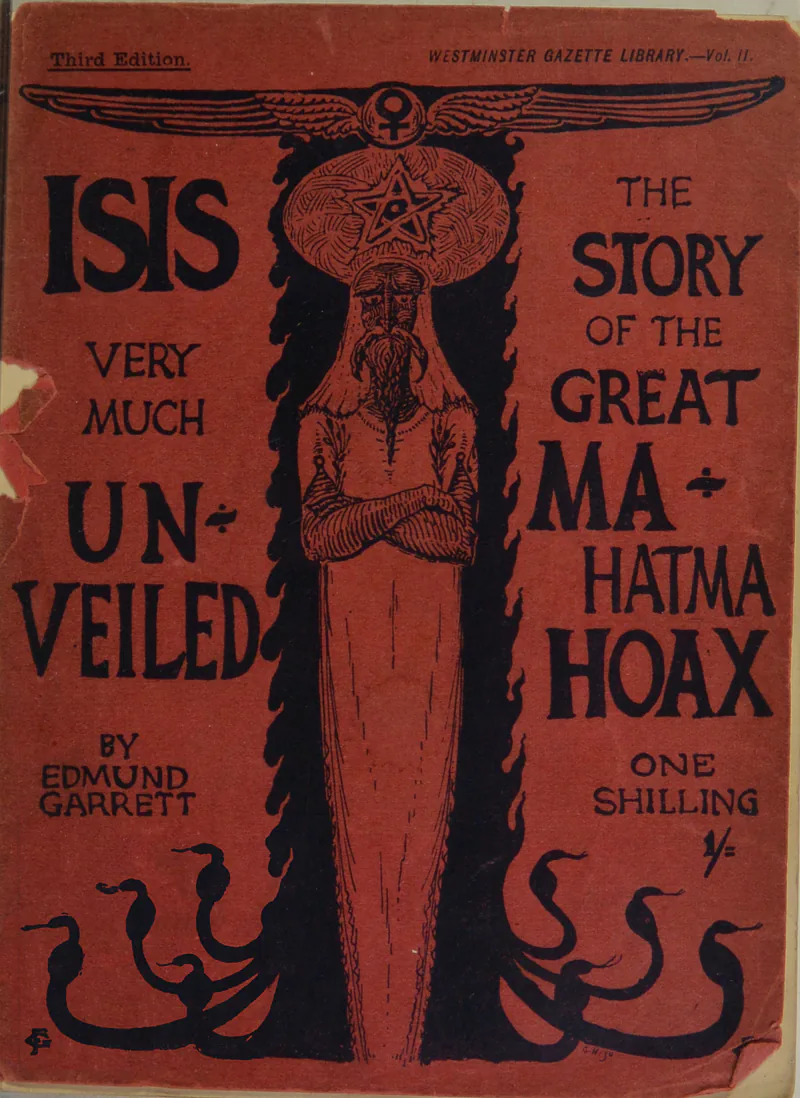
Theosophists reacted with hostility. Blavatsky and her followers regarded the H. B. of L. as a rival that drew away members, and the order's leaders attacked Theosophy in turn. The conflict illustrates the intense competition within the occult revival of the 1880s, in which small groups offered rival claims to the true secret wisdom.
Scandal, Emigration and Decline§
In 1886 Theosophists discovered and publicised that Burgoyne, under his original name Thomas Henry Dalton, had been convicted of fraud in Leeds and had served a prison sentence. The revelation discredited the order in Britain. Davidson and Burgoyne both moved to the United States, where Davidson settled at Loudsville in Georgia and founded a small colony and a series of related orders, and Burgoyne published The Light of Egypt; or, the Science of the Soul and the Stars (1889), which presented much of the H. B. of L.'s teaching on astrology, the soul and occult evolution to the public. The book remained in print for decades and influenced American astrology and esotericism.
After Burgoyne's death in the mid-1890s the order's activity faded, though Davidson continued to teach until his death in 1916, and several later American groups claimed its heritage.
Legacy and Rediscovery§
For most of the twentieth century the H. B. of L. was a footnote, mentioned chiefly by Theosophists as a fraudulent rival. In 1995 Joscelyn Godwin, Christian Chanel and John Patrick Deveney published its surviving documents with a detailed history, and Deveney's biography of Randolph (1997) restored the importance of its chief source. Their work showed that the order played a significant role in the transmission of practical occultism.
Historians have argued in particular that Randolph's teachings, passed through the H. B. of L. and its French and German contacts, contributed to the sexual mysticism of later orders, including the Ordo Templi Orientis, whose founders emerged in the 1900s; the exact lines of transmission are still debated. The H. B. of L. also anticipated the twentieth-century pattern of correspondence courses in occultism, later followed by groups such as the Rosicrucian orders. Its history is surveyed alongside other groups in magical orders and Thelemic orders.
Frequently asked questions§
What was the Hermetic Brotherhood of Luxor?§
It was an occult order founded around 1884 that taught practical occultism by correspondence in Britain, France and America. Its leaders were Peter Davidson, Thomas H. Burgoyne and, as Grand Master, Max Théon.
Was the H. B. of L. connected with Egypt?§
Despite its name, there is no evidence of any Egyptian origin. "Luxor" functioned as a symbol of ancient wisdom, and the order's claims of descent from ancient initiates cannot be verified.
What was the relationship between the H. B. of L. and Theosophy?§
The two were rivals. The H. B. of L. presented itself as a Western and practical alternative to the Theosophical Society, rejected its doctrine of reincarnation, and was in turn attacked by Theosophists, who publicised Burgoyne's criminal record in 1886.
Who was Paschal Beverly Randolph?§
Randolph (1825–1875) was an African American spiritualist, physician and occult writer who taught sexual mysticism and the use of magic mirrors. The H. B. of L. adapted much of his teaching, and historians regard him as a key figure in American esotericism.
Sources and further reading§
- The Light of Egypt; or, the Science of the Soul and the Stars — Thomas H. Burgoyne, 1889
- Eulis! The History of Love — Paschal Beverly Randolph, 1874
- The Hermetic Brotherhood of Luxor: Initiatic and Historical Documents of an Order of Practical Occultism — Joscelyn Godwin, Christian Chanel and John Patrick Deveney, 1995
- Paschal Beverly Randolph: A Nineteenth-Century Black American Spiritualist, Rosicrucian, and Sex Magician — John Patrick Deveney, 1997
- The Theosophical Enlightenment — Joscelyn Godwin, 1994