Liber XIII · High Magick · Chapter VI: Magical Orders
Magical Orders: The Golden Dawn, A∴A∴, O.T.O. and Their Heirs
A guide to magical orders: Masonic and Rosicrucian roots, the Golden Dawn and its grades, its schism and successors, the A∴A∴, the O.T.O. and others.

Magical orders are initiatory societies, mostly founded from the late nineteenth century onward, that teach ceremonial magic through a ladder of grades, secret rituals and graded study. The model was the Hermetic Order of the Golden Dawn, founded in London in 1888, which borrowed its structure from Freemasonry and Rosicrucian fraternities; its schisms and successors, along with Aleister Crowley's A∴A∴ and the Ordo Templi Orientis, shaped almost every later group.
Masonic and Rosicrucian roots§
Modern magical orders grew out of the world of Freemasonry. From the eighteenth century, Masonic lodges developed "higher degrees" with chivalric, Templar, Rosicrucian and Hermetic themes. The German Order of the Gold- und Rosenkreuz (active from the 1750s to the 1780s) organised alchemical study through a series of grades, and the Rosicrucian name, taken from the manifestos of 1614–1616, came to signify hidden esoteric wisdom.
In England, the Societas Rosicruciana in Anglia (SRIA), founded in 1867 and open only to Master Masons, offered a nine-grade system for the study of Rosicrucian and Hermetic lore. Its grade names, such as Zelator, Theoricus, Practicus and Philosophus, were adapted from the Gold- und Rosenkreuz. Several founders of the Golden Dawn were members. In France, Joséphin Péladan and Stanislas de Guaita founded the Ordre Kabbalistique de la Rose-Croix in 1888, and Papus organised the Martinist Order around 1891, drawing on the eighteenth-century teachings of Martinès de Pasqually and Louis-Claude de Saint-Martin.
The Golden Dawn and its grades§
The Hermetic Order of the Golden Dawn was founded in 1888 by William Wynn Westcott, S. L. MacGregor Mathers and William Robert Woodman, on the authority of a cipher manuscript of ritual outlines and of a claimed German adept, "Fräulein Sprengel", whose existence historians doubt. Its first temple, Isis-Urania, opened in London; unlike the SRIA it admitted women from the start.
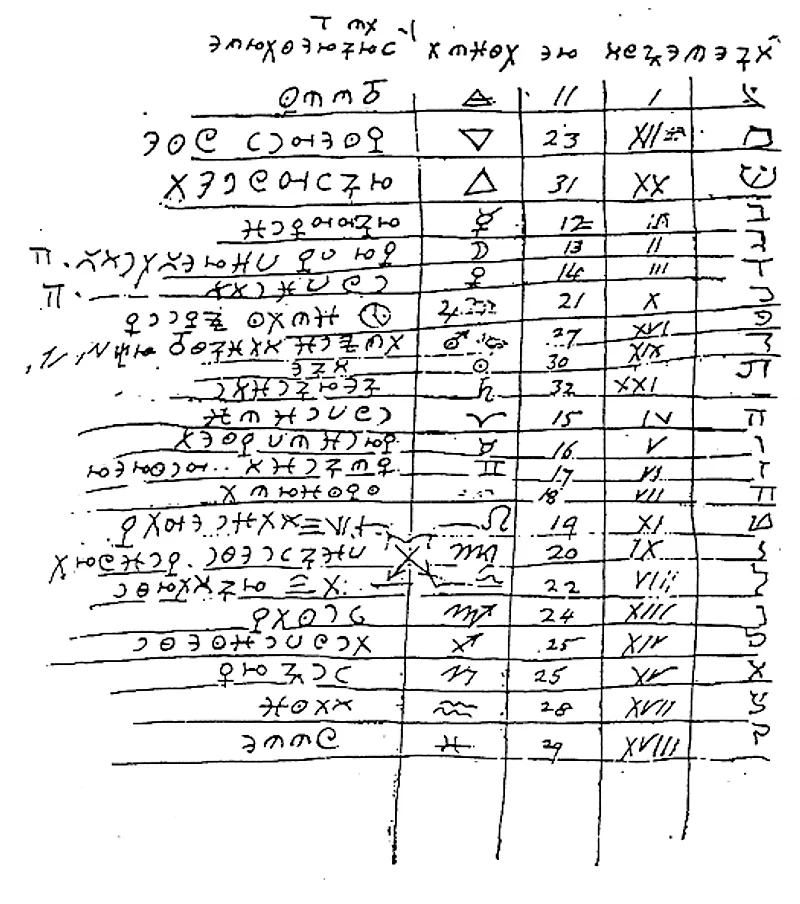
The order's grades were mapped onto the ten sefirot of the Tree of Life, each written as a pair of numbers:
- Neophyte (0=0) — the entrance grade.
- Zelator (1=10), Theoricus (2=9), Practicus (3=8) and Philosophus (4=7) — the elemental grades of the Outer Order, associated with earth, air, water and fire.
- Adeptus Minor (5=6) — the first grade of the Second Order, the Rosae Rubeae et Aureae Crucis (R.R. et A.C.), founded by Mathers around 1891–1892, where practical magic was taught.
- Higher grades, Adeptus Major and Adeptus Exemptus, and a Third Order of "Secret Chiefs" believed to exist on a non-physical plane.
The Outer Order taught Kabbalah, astrology, tarot, alchemy and correspondences; the Second Order taught ritual magic, talismans, scrying, Enochian magic and the consecration of tools. Its symbolism is explored in ritual and symbolism.
Schism and the successor orders§
The Golden Dawn did not hold together. Tensions between Mathers, then living in Paris, and the London adepts came to a head in 1900, when Mathers claimed the cipher manuscripts had been forged by Westcott and attempted to assert his authority, partly through his young protégé Aleister Crowley. The London members expelled Mathers, and over the following years the order fragmented:
- Alpha et Omega — Mathers' loyal branch, continued after his death in 1918 by his wife, Moina Mathers.
- Stella Matutina — formed around 1903 by members including R. W. Felkin; Israel Regardie was later a member and published its rituals in 1937–1940.
- Independent and Rectified Rite — led by A. E. Waite from 1903, emphasising Christian mysticism rather than practical magic; Waite later founded the Fellowship of the Rosy Cross (1915).
Ellic Howe's The Magicians of the Golden Dawn (1972) remains the classic documentary history of these quarrels.
Crowley's A∴A∴ and the Ordo Templi Orientis§
After leaving Mathers, Crowley developed his own religion of Thelema based on the Book of the Law (1904); see Thelema and the Book of the Law. In 1907 he and George Cecil Jones founded the A∴A∴, a teaching order that kept a modified version of the Golden Dawn grade structure but emphasised individual work under a single supervisor rather than group ritual. Its official journal, The Equinox (from 1909), published many former Golden Dawn documents.

The Ordo Templi Orientis (O.T.O.) arose in Germany in the early twentieth century, associated with Carl Kellner and Theodor Reuss, as a Masonic-style order with a secret teaching on sexual magic. Crowley joined around 1910, led its British section and, after Reuss's death in 1923, became its head in the following years, reorganising it around Thelema. The O.T.O. today works a series of initiatory degrees and celebrates Crowley's Gnostic Mass through its ecclesiastical arm.
Other twentieth-century magical orders§
Many later groups took the Golden Dawn as a model:
- Fraternity of the Inner Light — founded by Dion Fortune (Violet Firth) in the 1920s after her time in the Alpha et Omega, combining ceremonial magic, Christian mysticism and psychology.
- Builders of the Adytum (B.O.T.A.) — founded in Los Angeles in the 1920s by Paul Foster Case, a former Alpha et Omega member, teaching tarot and Kabbalah by correspondence.
- Fraternitas Saturni — a German order founded in 1928 by Eugen Grosche, with a Saturnian and Thelemic emphasis.
- Hermetic Brotherhood of Luxor — an earlier, mainly correspondence-based order (active from 1884) that taught practical occultism, including sexual teachings, and influenced the O.T.O.
From the 1970s, after Regardie's publications made the rituals widely available, numerous revived Golden Dawn orders appeared, often in competition with one another. Wicca also borrowed the degree system and many ritual elements; see Wicca and Gerald Gardner.
Grades, initiation and secrecy§
Initiation in these orders is a ritual drama in which the candidate, often blindfolded, is led through symbolic stages, swears an oath of secrecy and receives signs, words and teaching. Grades are earned through study, examinations and, in some groups, practical work. The structure serves both pedagogical and spiritual purposes: each grade presents a stage of inner development symbolised by a position on the Tree of Life.
Secrecy protected members' reputations and reinforced the sense of a privileged path, but it also led to disputes over authority and lineage, since claims to legitimacy often rested on charters, manuscripts or contact with hidden masters. Historians such as Alex Owen and Henrik Bogdan have studied how these orders reflected Victorian and modern concerns about selfhood, gender and religion; the wider context is set out in What Is Ceremonial Magic?.
Frequently asked questions§
What are the grades of the Golden Dawn?§
The Outer Order grades were Neophyte (0=0), Zelator (1=10), Theoricus (2=9), Practicus (3=8) and Philosophus (4=7). The Second Order began with Adeptus Minor (5=6), followed by Adeptus Major (6=5) and Adeptus Exemptus (7=4), with a notional Third Order above.
What were the Stella Matutina and the Alpha et Omega?§
They were successor orders formed after the Golden Dawn split around 1900–1903. The Alpha et Omega followed Mathers, while the Stella Matutina, associated with R. W. Felkin, continued the London tradition and was the source of the rituals Regardie later published.
Are magical orders the same as Freemasonry?§
No, but they borrowed heavily from it. Many founders were Freemasons, and the lodge structure, degree rituals, oaths and symbolism derive from Masonic models, but magical orders teach practical magic and usually admit women.
Sources and further reading§
- The Magicians of the Golden Dawn — Ellic Howe, 1972
- The Golden Dawn — Israel Regardie, 1937
- The Place of Enchantment: British Occultism and the Culture of the Modern — Alex Owen, 2004
- Western Esotericism and Rituals of Initiation — Henrik Bogdan, 2007
- Yeats's Golden Dawn — George Mills Harper, 1974
- The Hermetic Brotherhood of Luxor — Joscelyn Godwin, Christian Chanel & John P. Deveney, 1995