Liber XXV · Secret Societies · Chapter IV: Rosicrucianism
Rosicrucianism: The Manifestos, the Legend and Modern Orders
Rosicrucianism explained: the Fama, Confessio and Chymical Wedding, Christian Rosenkreutz, the Tübingen circle, the Rosicrucian furore and the modern orders.

Rosicrucianism is the esoteric movement inspired by three anonymous German texts of 1614–1616, which announced a secret Brotherhood of the Rose Cross, founded by the legendary Christian Rosenkreutz, devoted to the reform of knowledge, religion and society through hidden wisdom drawn from alchemy, Hermeticism and Kabbalah. Whether such a brotherhood ever existed is doubtful, but the manifestos provoked a European sensation and inspired centuries of real orders claiming the Rosicrucian name, several of which remain active today.
The Rosicrucian Manifestos, 1614–1616§
The Fama Fraternitatis, or Discovery of the Fraternity of the Most Laudable Order of the Rosy Cross was printed in Kassel in 1614, although manuscript copies had circulated for several years before. It told how a German nobleman, known by the initials C. R. and later named Christian Rosenkreutz, travelled as a young man to the East, learned the secrets of nature from sages in "Damcar" in Arabia and in Fez, and on returning to Germany founded a small brotherhood of eight members. The brothers bound themselves to heal the sick without payment, wear the clothes of the country where they lived, meet once a year, and keep the fraternity secret for a hundred years.
The Fama then described the discovery, around 1604, of Rosenkreutz's hidden seven-sided tomb, lit by an artificial sun and filled with books and symbolic objects, with his body uncorrupted. This discovery, the text announced, signalled the time for a general reformation, and it invited learned men to make themselves known to the brotherhood.
The Latin Confessio Fraternitatis (1615) elaborated the brotherhood's aims, with a strongly anti-papal tone and apocalyptic expectations. The third work, the Chymical Wedding of Christian Rosenkreutz, Anno 1459 (Chymische Hochzeit), published in Strasbourg in 1616, is an allegorical romance over seven days in which the aged Rosenkreutz attends a royal wedding in a castle, witnesses the death and resurrection of a king and queen, and takes part in alchemical operations. It is one of the most remarkable literary works of the alchemical tradition (see the history of Western alchemy).
Christian Rosenkreutz: Legend and Symbol§
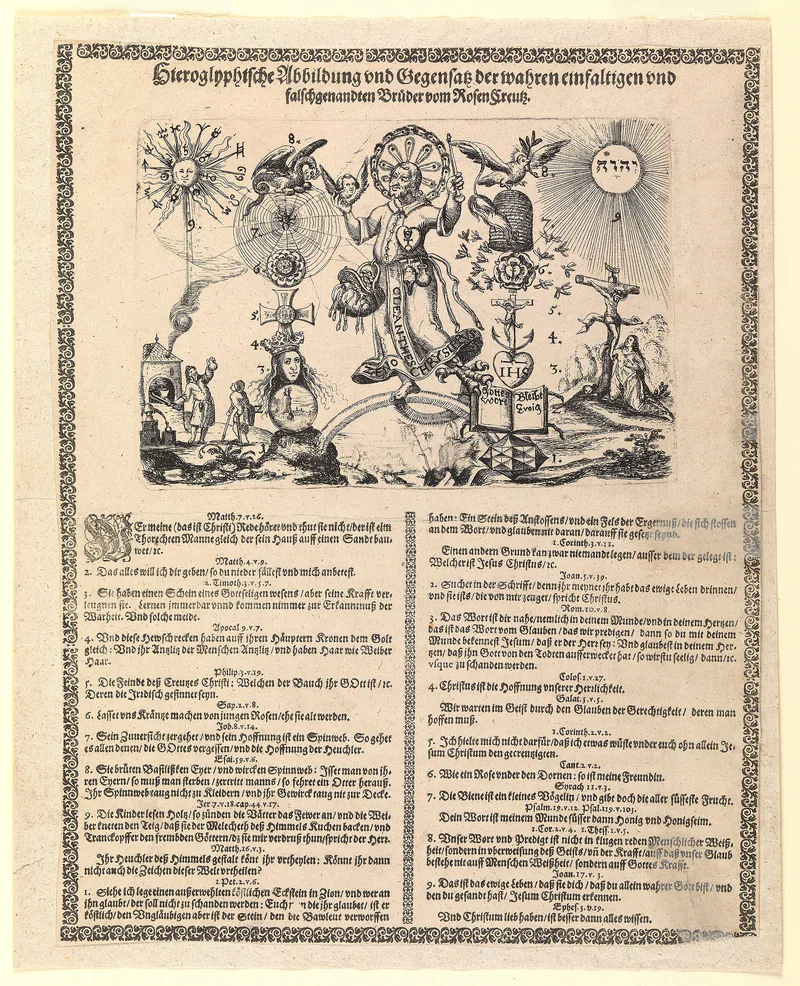
According to the Confessio, Rosenkreutz was born in 1378 and lived to the age of 106, dying in 1484; his tomb was opened 120 years later. These dates, the eastern journey and the incorrupt body all function symbolically, and historians do not regard Rosenkreutz as a historical person. His name joins two potent symbols: the rose, associated with the Virgin Mary, love and secrecy, and the cross of Christ. Luther's own seal showed a cross within a heart set on a rose, and the image would have resonated with Lutheran readers.
Who Wrote the Manifestos? The Tübingen Circle§
The authorship of the manifestos has been debated since they appeared. The strongest evidence points to a circle of Lutheran scholars in Tübingen influenced by the reformer Johann Arndt, Paracelsian medicine and millenarian hopes. Johann Valentin Andreae (1586–1654), later a respected Lutheran theologian, admitted in his autobiography to having written the Chymical Wedding as a youth, and he later dismissed the Rosicrucian affair as a ludibrium, a jest or play. Scholars such as Carlos Gilly and Roland Edighoffer have argued that the Fama was largely the work of the circle around Andreae and his friend Tobias Hess (1568–1614), a physician with apocalyptic interests, with Christoph Besold also sometimes named.
In The Rosicrucian Enlightenment (1972), Frances Yates connected the movement with the court of Frederick V, Elector Palatine, and his English wife Elizabeth Stuart, whose short reign as King and Queen of Bohemia ended in defeat in 1620. Her thesis was influential but is now considered overstated by many historians.
The Rosicrucian Furore in Europe§
The manifestos produced hundreds of responses within a few years. Some readers addressed open letters to the brotherhood asking to be admitted; others denounced it as heresy or fraud. The English physician Robert Fludd published defences of the fraternity in 1616 and 1617, and the German alchemist Michael Maier, physician to Emperor Rudolf II, wrote Silentium post clamores (1617) and Themis Aurea (1618), presenting the Rosicrucians as true philosophers. In Paris in 1623 placards announced that the "invisible" brothers were present in the city, provoking a brief panic and pamphlets against them. The philosopher René Descartes, then a young man in Germany, was later rumoured to have sought them out.
No member of the brotherhood ever came forward, and the Thirty Years' War soon overshadowed the affair. Yet the ideal of an invisible college of enlightened reformers persisted, and some historians have seen echoes of it in the circles that later formed the Royal Society in London. In 1652 the Welsh alchemist Thomas Vaughan published an English translation of the Fama and Confessio.
Rosicrucianism and Freemasonry§
In the eighteenth century Rosicrucian symbolism entered Freemasonry. The "Rose Croix" degree appeared in French higher-degree rites by the 1760s and survives as the eighteenth degree of the Ancient and Accepted Scottish Rite. In Germany the Order of the Golden and Rosy Cross (Gold- und Rosenkreuz), active from around the 1750s and organised into a system of nine grades by the 1770s, combined alchemy, Christian theosophy and Masonic structure; its members included the future King Frederick William II of Prussia. The richly illustrated Secret Symbols of the Rosicrucians (Geheime Figuren der Rosenkreuzer), published at Altona in 1785–1788, belongs to this milieu.
Modern Rosicrucian Orders§
The nineteenth-century occult revival produced new orders. In England the Societas Rosicruciana in Anglia (1866), open to Master Masons, gave rise to the Hermetic Order of the Golden Dawn, whose inner order was called the Rosae Rubeae et Aureae Crucis. In France Stanislas de Guaita and Papus founded the Ordre Kabbalistique de la Rose-Croix in 1888, and Joséphin Péladan led a Catholic Rose-Croix and its Salons de la Rose+Croix art exhibitions in the 1890s.
In the twentieth century three large organisations emerged. The Rosicrucian Fellowship was founded by Max Heindel in 1909 and is based in Oceanside, California, with teachings close to Theosophy and Steiner. The Ancient and Mystical Order Rosae Crucis (AMORC) was founded by H. Spencer Lewis in New York in 1915 and later based in San Jose, California, where it runs a well-known Egyptian museum. The Lectorium Rosicrucianum was founded in Haarlem in the Netherlands by Jan van Rijckenborgh and Catharose de Petri, with roots in the 1920s and 1930s, and teaches a gnostic Christianity. None of these can demonstrate a historical link to the seventeenth-century brotherhood, and most present their lineage in spiritual rather than strictly historical terms. More on these groups appears in our guide to initiatory orders.
Frequently asked questions§
Did the original Rosicrucian brotherhood exist?§
There is no evidence that the brotherhood described in the manifestos existed as an organisation. Most historians regard the manifestos as a literary and religious programme by a Tübingen circle, using the fiction of a secret order to call for reform.
What does the rose cross symbolise?§
The rose cross combines the cross of Christ with the rose, a symbol of the Virgin Mary, divine love, secrecy and unfolding spiritual life. Later Rosicrucian and Masonic writers read it as the union of spirit and matter or of suffering and resurrection.
Is AMORC the same as the original Rosicrucians?§
No. AMORC was founded in 1915 by H. Spencer Lewis and presents itself as the modern expression of a long Rosicrucian tradition, but it has no documented connection to the brotherhood announced in 1614.
Sources and further reading§
- Fama Fraternitatis — Anonymous, 1614
- Confessio Fraternitatis — Anonymous, 1615
- The Chymical Wedding of Christian Rosenkreutz — Johann Valentin Andreae, 1616
- The Fame and Confession of the Fraternity of R: C: — Thomas Vaughan (trans.), 1652
- The Real History of the Rosicrucians — Arthur Edward Waite, 1887
- The Rosicrucian Enlightenment — Frances A. Yates, 1972
- The Rose Cross and the Age of Reason — Christopher McIntosh, 1992
- Rose Cross over the Baltic — Susanna Åkerman, 1998
- The Invisible History of the Rosicrucians — Tobias Churton, 2009