What Are Secret Societies? A History of Esoteric Brotherhoods
What are secret societies? A historian's guide to initiatory brotherhoods, from the ancient mysteries to Rosicrucians, Freemasons and occult orders.

A secret society is an organisation whose rituals, teachings or membership are kept partly hidden from outsiders, and which typically admits new members through initiation and binds them by oaths. In the history of Western esotericism, the most important examples are the Rosicrucian brotherhood announced in 1614, Freemasonry, which took its modern form in the early eighteenth century, and the occult orders it inspired. Historians distinguish the documented history of these societies from the legends and conspiracy theories that have grown up around them.
Defining a Secret Society§
The term is looser than it sounds. Most "secret societies" are not secret in the sense that their existence is unknown: Masonic halls stand on main streets, and their members are often public figures. What is secret is the content of their rituals, their modes of recognition and certain teachings. The German sociologist Georg Simmel, in a classic essay published in English in 1906, argued that shared secrets create strong bonds of trust, mark a boundary between insiders and outsiders, and give members a sense of exclusivity. Secrecy, in his view, is a social form rather than evidence of a hidden agenda.
Historians of esotericism add a further element: initiation. Esoteric secret societies typically arrange their knowledge in a sequence of degrees or grades, each conferred through a ritual of symbolic death and rebirth, and each revealing further symbols and teachings. The historian Henrik Bogdan has shown how this initiatory pattern, largely taken from Freemasonry, became the backbone of modern Western esoteric organisations.
Ancient Mysteries and Medieval Brotherhoods§
The mystery cults of the ancient Mediterranean were the classic initiatory religions. The Eleusinian Mysteries of Demeter and Persephone, celebrated near Athens for perhaps a thousand years, were so well guarded that their central rite is still not known with certainty. The cults of Isis and of Mithras also initiated members in stages, and the Pythagorean brotherhood of southern Italy was remembered as a community bound by silence. Later esotericists repeatedly appealed to these "mysteries" as the ancestors of their own orders, though there is no historical line of descent.

The Middle Ages had confraternities, craft guilds with their own secrets of trade, and military religious orders such as the Knights Templar, whose dramatic fall in 1307–1314 later fed a rich body of Templar legends. None of these was an esoteric society in the modern sense, but each would be reimagined as one.
The Rosicrucian Manifestos and the Invisible Brotherhood§
The modern idea of an esoteric secret society begins with three anonymous German publications: the Fama Fraternitatis (1614), the Confessio Fraternitatis (1615) and the Chymical Wedding of Christian Rosenkreutz (1616). They announced a brotherhood founded by a medieval sage, Christian Rosenkreutz, which possessed secret knowledge of nature and sought a general reformation of learning. Readers across Europe tried to contact the order, and some, like Robert Fludd and Michael Maier, defended it in print, but no Rosicrucian brother ever publicly stepped forward. Most historians now trace the manifestos to a circle of Lutheran scholars around Johann Valentin Andreae in Tübingen. The story is told in our guide to Rosicrucianism.
Freemasonry and the Eighteenth-Century Lodge§
Freemasonry grew out of the lodges of working stonemasons, especially in Scotland, which began admitting gentlemen who were not masons in the seventeenth century; the antiquary Elias Ashmole recorded his own admission in 1646. In 1717 four London lodges formed a Grand Lodge, and James Anderson's Constitutions (1723) gave the new "speculative" Freemasonry its charter. With its allegorical rituals based on the building of Solomon's Temple and its ideals of brotherhood, charity and tolerance, Freemasonry spread rapidly through Europe and its colonies. See our guide to Freemasonry.
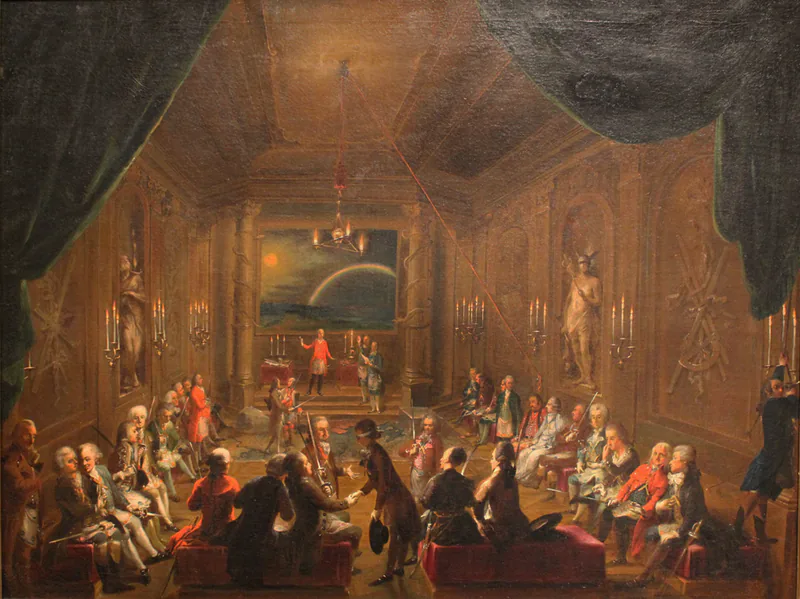
Eighteenth-century Freemasonry also spawned "higher degrees" and new rites, many of them steeped in alchemy, Kabbalah and chivalric legend: the Templar-themed Strict Observance in Germany, the theurgic Élus Coëns of Martinez de Pasqually in France, the Gold- und Rosenkreuz order, and Cagliostro's Egyptian Rite.
The Bavarian Illuminati§
The Order of the Illuminati was founded on 1 May 1776 by Adam Weishaupt, a professor of canon law at Ingolstadt, as a secret society to promote Enlightenment reason against clerical influence. It recruited through Masonic lodges and reached perhaps two thousand members before the Bavarian government banned secret societies in 1784–1785 and published its seized papers. The order did not survive, but its name became the centre of enduring conspiracy myths.
Occult Orders of the Nineteenth and Twentieth Centuries§
In the nineteenth century the Masonic model was adapted for openly occult purposes. The Societas Rosicruciana in Anglia (1866) admitted Master Masons to the study of Rosicrucian and Hermetic lore, and three of its members founded the Hermetic Order of the Golden Dawn in 1888, the most influential magical order of modern times. In France, Martinist and Rosicrucian orders flourished around Papus and Joséphin Péladan. In the early twentieth century came the Ordo Templi Orientis, later led by Aleister Crowley, and organisations such as AMORC and the Rosicrucian Fellowship, which made initiation available by correspondence. These are discussed in our guide to initiatory orders.
Secrecy, Suspicion and the Historian's Task§
Secret societies have always attracted suspicion. The papacy condemned Freemasonry in 1738; the French Revolution was blamed on Masons and Illuminati; and in the 1820s the disappearance of William Morgan in New York, after he threatened to publish Masonic rituals, produced an Anti-Masonic political party. Totalitarian regimes of the twentieth century persecuted Freemasons. Because secrecy invites speculation, the historian's task is to separate what documents show from what legend, rivalry and fear have added: to explain, for example, that Freemasonry's claimed descent from the Templars is an eighteenth-century invention, and that the "Illuminati" of modern conspiracy theory bear no relation to Weishaupt's short-lived order.
Fraternal societies and student clubs§
Not every secret society is esoteric. The eighteenth and nineteenth centuries also produced political secret societies, such as the Italian Carbonari, which plotted for constitutional government and national unity, and a great many fraternal and benefit societies, such as the Odd Fellows and the Knights of Pythias, which borrowed Masonic forms of ritual to bind members together for mutual aid. American college societies such as Yale's Skull and Bones, founded in 1832, belong to the same broad family. Their rituals are sometimes theatrical, but their purposes are social, charitable or political rather than spiritual, and historians treat them separately from orders that teach esoteric doctrine.
Frequently asked questions§
Do secret societies still exist?§
Yes, many fraternal and initiatory organisations exist today, including Freemasonry, Rosicrucian orders, Martinist orders and magical orders descended from the Golden Dawn. Most are legally registered, publish information about themselves and keep only their rituals and modes of recognition private.
Are the Illuminati real?§
The Bavarian Illuminati were a real Enlightenment society founded in 1776 and suppressed by 1785. There is no credible evidence that the order survived, and modern claims that an "Illuminati" secretly controls world events are conspiracy theories without historical foundation.
What is the oldest secret society?§
The ancient mystery cults, such as the Eleusinian Mysteries, were among the oldest initiatory religions with secret rites. Among modern organisations, Freemasonry has the longest continuous documented history, with records of Scottish lodges from around 1600.
Sources and further reading§
- Fama Fraternitatis — Anonymous, 1614
- The Constitutions of the Free-Masons — James Anderson, 1723
- The Sociology of Secrecy and of Secret Societies — Georg Simmel, 1906
- The Mythology of the Secret Societies — J. M. Roberts, 1972
- The Rosicrucian Enlightenment — Frances A. Yates, 1972
- The Origins of Freemasonry: Scotland's Century, 1590–1710 — David Stevenson, 1988
- Living the Enlightenment: Freemasonry and Politics in Eighteenth-Century Europe — Margaret C. Jacob, 1991
- Western Esotericism and Rituals of Initiation — Henrik Bogdan, 2007
- The Rose Cross and the Age of Reason — Christopher McIntosh, 1992