Liber XXV · Secret Societies · Chapter I: Conspiracy Myths
Secret Society Conspiracy Myths: Illuminati, Masons, Protocols
A historian's guide to secret society conspiracy myths: Barruel and the Illuminati scare, the forged Protocols, the Taxil hoax and New World Order theories.

Conspiracy myths about secret societies are claims that hidden organisations, usually Freemasons, the "Illuminati" or, in their most dangerous form, Jews, secretly plan revolutions and control world events. Historians trace them to the reaction against the French Revolution in the 1790s, when writers such as Augustin Barruel and John Robison blamed it on a plot by Masons and the Bavarian Illuminati. These ideas were later fused with antisemitism in the forged Protocols of the Elders of Zion, with catastrophic consequences. None of these grand conspiracy claims is supported by historical evidence.
The Real Bavarian Illuminati§
The starting point of the most famous myth was a real organisation. On 1 May 1776 Adam Weishaupt, a professor of canon law at the University of Ingolstadt, founded the Order of Perfectibilists, soon called the Illuminati. Its aim was to spread Enlightenment values of reason and moral improvement and to counter the influence of the clergy, especially the Jesuits, in Bavarian public life. After the Hanoverian nobleman Adolph Knigge joined in 1780, the order recruited actively through Masonic lodges and reached perhaps two thousand members, mostly officials, professors and nobles.
In 1784 and 1785 the Elector of Bavaria, Karl Theodor, issued edicts banning secret societies. The Illuminati collapsed, Weishaupt fled to Gotha, and in 1787 the government published seized documents to expose the order's aims. The evidence shows a reforming society with grandiose plans but limited influence, which ceased to function as an organisation in the mid-1780s. Everything later attributed to "the Illuminati" depends on the claim, never supported by evidence, that it secretly survived.
Barruel, Robison and the Myth of the Revolution§
The French Revolution shocked Europe, and some conservatives explained it not as the result of social and political crisis but as the work of a plot. Earlier pamphlets had blamed Freemasons, but the decisive works appeared in 1797. The French Jesuit Augustin Barruel published his Memoirs Illustrating the History of Jacobinism (1797–1798), which argued that the Revolution was the outcome of a threefold conspiracy of philosophers, Freemasons and Illuminati against throne and altar. In the same year the Scottish physicist John Robison, professor of natural philosophy at Edinburgh, published Proofs of a Conspiracy, reaching similar conclusions independently. Another French writer, Cadet de Gassicourt, claimed in 1796 that the Revolution was the Templars' revenge (see Templar legends).
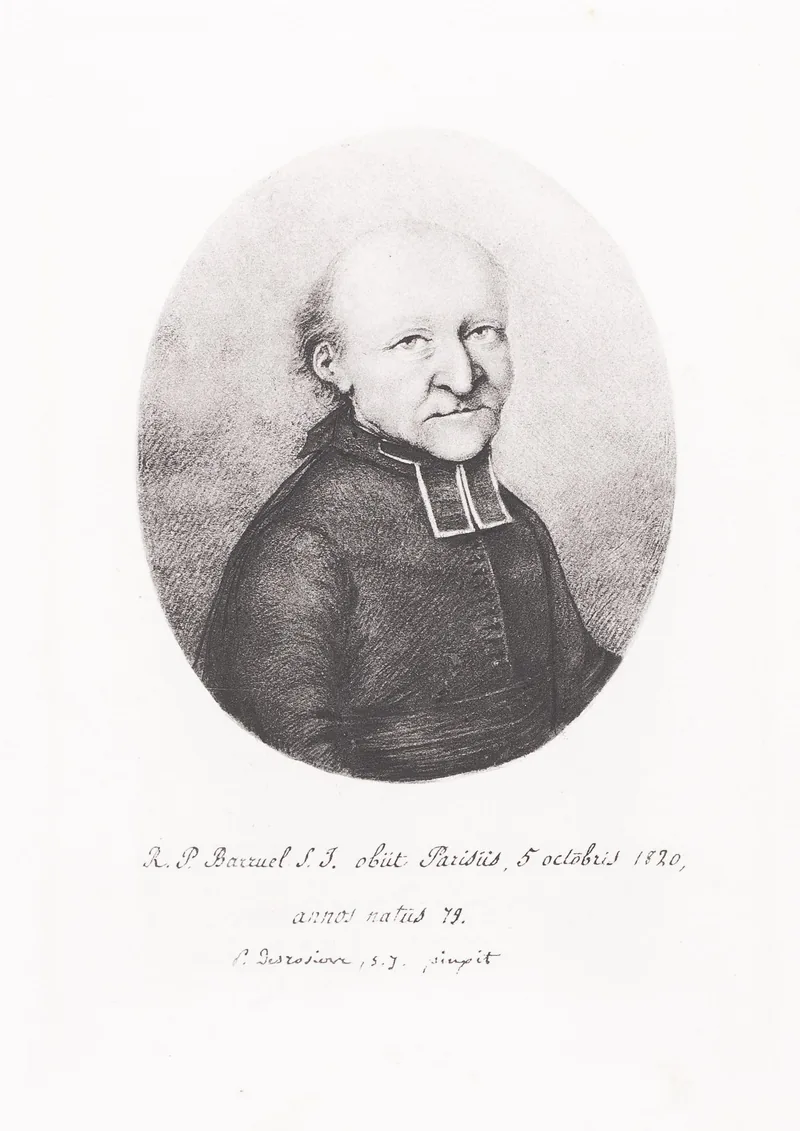
Historians, including J. M. Roberts in The Mythology of the Secret Societies (1972), have shown that these works misread the evidence. The Illuminati had been dissolved years before 1789, and while many revolutionaries had been Masons, so had many royalists and aristocrats; lodges did not act as a coordinated political force.
The Illuminati scare in America§
Robison's book reached the United States quickly. In 1798 the Boston minister Jedidiah Morse preached sermons warning of Illuminati agents, and for a time New England Federalists associated the Jeffersonian opposition with the conspiracy. George Washington, himself a Freemason, wrote in 1798 that he did not doubt the doctrines of the Illuminati had spread to the United States but did not believe American lodges were involved. The scare faded within a few years, but it set a pattern.
From Masonic Plot to Antisemitic Myth§
Barruel's version did not originally blame Jews. In 1806 he received a letter from a supposed army officer, J. B. Simonini, claiming that Jews stood behind the Masons and Illuminati. Barruel did not publish it, but the letter circulated, and over the nineteenth century, especially in France, Catholic and nationalist writers developed the idea of a "Judeo-Masonic" conspiracy. This fusion turned a myth about secret societies into a vehicle for antisemitism.
The Taxil Hoax and Palladism§
In 1885 the French anticlerical writer Gabriel Jogand-Pagès, known as Léo Taxil, announced his conversion to Catholicism and began publishing sensational exposés of Freemasonry. With collaborators, he invented "Palladism", a supposed inner cult of Lucifer-worshipping Masons, said to be directed by the American Masonic leader Albert Pike, and a repentant priestess, "Diana Vaughan", who did not exist. The books were widely believed in Catholic circles. On 19 April 1897, at a public meeting in Paris, Taxil confessed that the whole affair had been a hoax intended to show the credulity of his opponents.
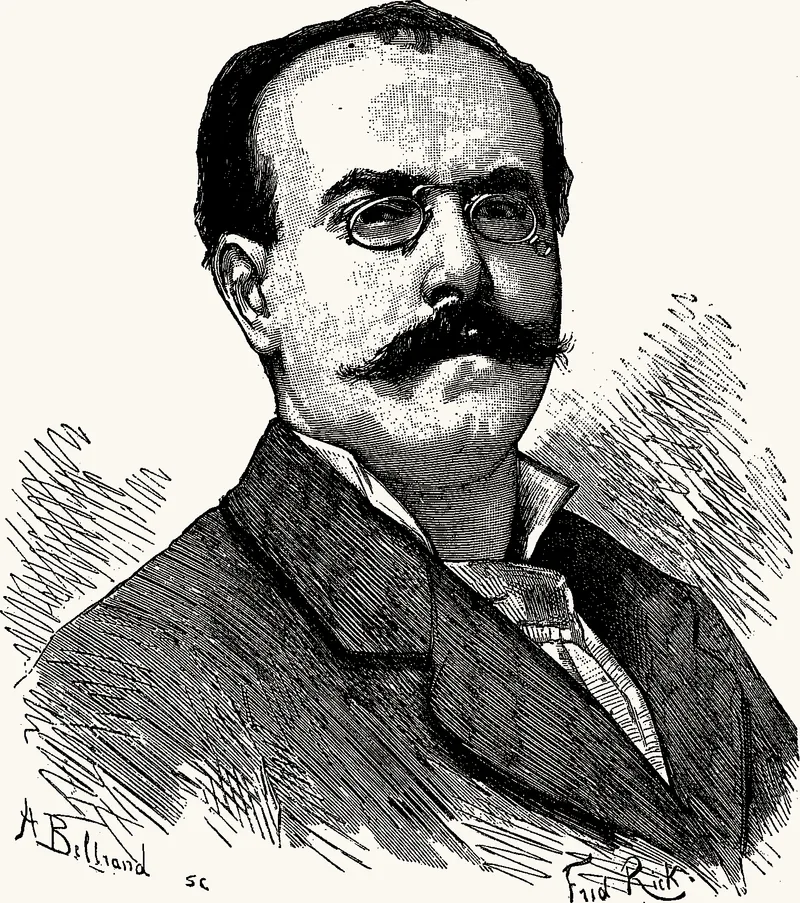
Despite the confession, material from the hoax, including a fabricated statement attributed to Pike about Luciferian doctrine, continues to be quoted as genuine in anti-Masonic and "satanic conspiracy" literature, contributing to later episodes such as the Satanic Panic.
The Protocols of the Elders of Zion: A Forgery and Its Uses§
The Protocols of the Elders of Zion purports to be the minutes of secret meetings of Jewish leaders plotting world domination through control of finance, the press and revolutionary movements, using Freemasons as tools. It is a forgery. It was first published in serial form in the Russian newspaper Znamya in 1903 and became widely known through an edition by the religious writer Sergei Nilus in 1905. Scholars believe it was produced by circles connected with the Russian secret police and right-wing groups, though the exact authors remain uncertain.
In August 1921 the journalist Philip Graves showed in The Times of London that large parts of the text were plagiarised from Maurice Joly's Dialogue in Hell Between Machiavelli and Montesquieu (1864), a satire against Napoleon III that had nothing to do with Jews. Other passages derive from a scene in Hermann Goedsche's novel Biarritz (1868). In 1935 a court in Bern, Switzerland, ruled after expert testimony that the Protocols were forgeries; a 1937 appeal overturned the verdict on a narrow legal point without affirming their authenticity.
Exposure did not stop their spread. In the United States Henry Ford's newspaper, the Dearborn Independent, promoted the Protocols in a series published as The International Jew (1920–1922). In Germany the Nazis made them part of their propaganda, and the historian Norman Cohn called the document a "warrant for genocide". The Protocols remain in circulation today and are recognised by historians as one of the most harmful forgeries ever produced. Francoist Spain and other authoritarian regimes also persecuted Freemasons as part of a supposed Judeo-Masonic plot.
Modern Versions: New World Order, Reptilians and Beyond§
In the twentieth century the British writer Nesta Webster revived Barruel's thesis in World Revolution (1921) and Secret Societies and Subversive Movements (1924), and Cold War groups such as the John Birch Society, founded in 1958, warned of hidden "Insiders" behind communism and world government. Pat Robertson's The New World Order (1991) brought Illuminati and Masonic theories to a large evangelical audience.
From the 1990s the British writer David Icke combined these themes with New Age ideas, claiming that shape-shifting reptilian beings rule humanity; critics, including the scholar Michael Barkun, note that his work treated the Protocols as authentic while relabelling their subject. Some modern writers have also reread the gnostic archons as hidden controllers, an interpretation foreign to the ancient texts. The satirical Illuminatus! trilogy (1975) by Robert Shea and Robert Anton Wilson, and Umberto Eco's novels Foucault's Pendulum (1988) and The Prague Cemetery (2010), dissect these myths in fiction. Online movements such as QAnon, which emerged in 2017, recycle the same structure of an all-powerful secret cabal. Overlaps between New Age wellness culture and conspiracy theories are sometimes called "conspirituality".
Why these myths persist§
Barkun describes "superconspiracy" theories as systems that link many conspiracies into a single hierarchy of evil, and that treat lack of evidence as proof of the plotters' power. Historians note that such myths offer simple explanations for complex events, flatter believers as possessors of hidden knowledge, and almost always single out a scapegoat, very often Jews. Studying their history is the most effective way to see how they were constructed.
Frequently asked questions§
Do the Illuminati still exist?§
The Bavarian Illuminati were dissolved in the 1780s. Some modern groups have adopted the name, but there is no evidence of any continuous organisation, and claims that an Illuminati secretly controls governments, banks or entertainment are unfounded conspiracy theories.
Are the Protocols of the Elders of Zion real?§
No. The Protocols are a forgery first published in Russia in 1903, shown in 1921 to be plagiarised largely from a French satire of 1864 that had nothing to do with Jews. They were used to justify antisemitic persecution, including by the Nazis.
What was the Taxil hoax?§
Between 1885 and 1897 Léo Taxil published invented exposés claiming that Freemasons secretly worshipped Lucifer. In 1897 he publicly confessed it was a hoax, but fabricated quotations from it still circulate as genuine.
Sources and further reading§
- Memoirs Illustrating the History of Jacobinism — Augustin Barruel, 1797
- Proofs of a Conspiracy — John Robison, 1797
- Warrant for Genocide: The Myth of the Jewish World-Conspiracy and the Protocols of the Elders of Zion — Norman Cohn, 1967
- The Mythology of the Secret Societies — J. M. Roberts, 1972
- The Paranoid Style in American Politics — Richard Hofstadter, 1965
- A Culture of Conspiracy: Apocalyptic Visions in Contemporary America — Michael Barkun, 2003
- The Paranoid Apocalypse: A Hundred-Year Retrospective on The Protocols of the Elders of Zion — Richard Landes and Steven T. Katz (eds.), 2012
- The Plot: The Secret Story of the Protocols of the Elders of Zion — Will Eisner, 2005