Liber XXV · Secret Societies · Chapter I: Conspiracy Myths
The Protocols of the Elders of Zion: How a Forgery Was Made
The Protocols of the Elders of Zion explained: a Russian forgery of 1903, plagiarised from Maurice Joly, exposed in 1921 and used to justify persecution.

The Protocols of the Elders of Zion is a forged text, first printed in Russia in 1903, that pretends to be the minutes of a secret meeting at which Jewish leaders plan to dominate the world through finance, the press, liberalism and Freemasonry. It was exposed as a plagiarism of a French political satire in 1921, condemned as a forgery by a Swiss court in 1935, and is regarded by historians as one of the most consequential frauds of the twentieth century, used to justify pogroms and Nazi persecution.
What the Protocols of the Elders of Zion Claim§
The text consists of twenty-four short "protocols", lectures supposedly delivered by an unnamed leader of the "Elders of Zion" to an inner circle. The speaker explains, in the first person, a long-term plan to destroy Christian civilisation and install a Jewish world ruler of the Davidic line. The methods are listed with cynical candour: spreading liberal ideas and the slogan "liberty, equality, fraternity" in order to dissolve traditional authority; controlling gold, credit and the stock exchange; buying the press so that public opinion becomes a tool; encouraging economic crises, strikes and wars; corrupting youth through education; and using the lodges of Freemasonry as a screen and recruiting ground for agents who do not know whom they serve.
None of these accusations was new. What was new was the form: a supposed confession by the conspirators themselves, which turns every modern development the compiler disliked into evidence of a single hidden will.
Joly, Goedsche and the Sources of the Forgery§
The decisive evidence against the Protocols is textual. In 1864 the French lawyer Maurice Joly published anonymously in Brussels the Dialogue aux enfers entre Machiavel et Montesquieu (Dialogue in Hell between Machiavelli and Montesquieu). In it, the shade of Machiavelli explains to Montesquieu how a modern despot can rule through a façade of liberal institutions: by manipulating the press, packing the courts, using plebiscites and dazzling the people with public works. The target was Napoleon III, and Joly was imprisoned for the book. It contains no reference to Jews at all.
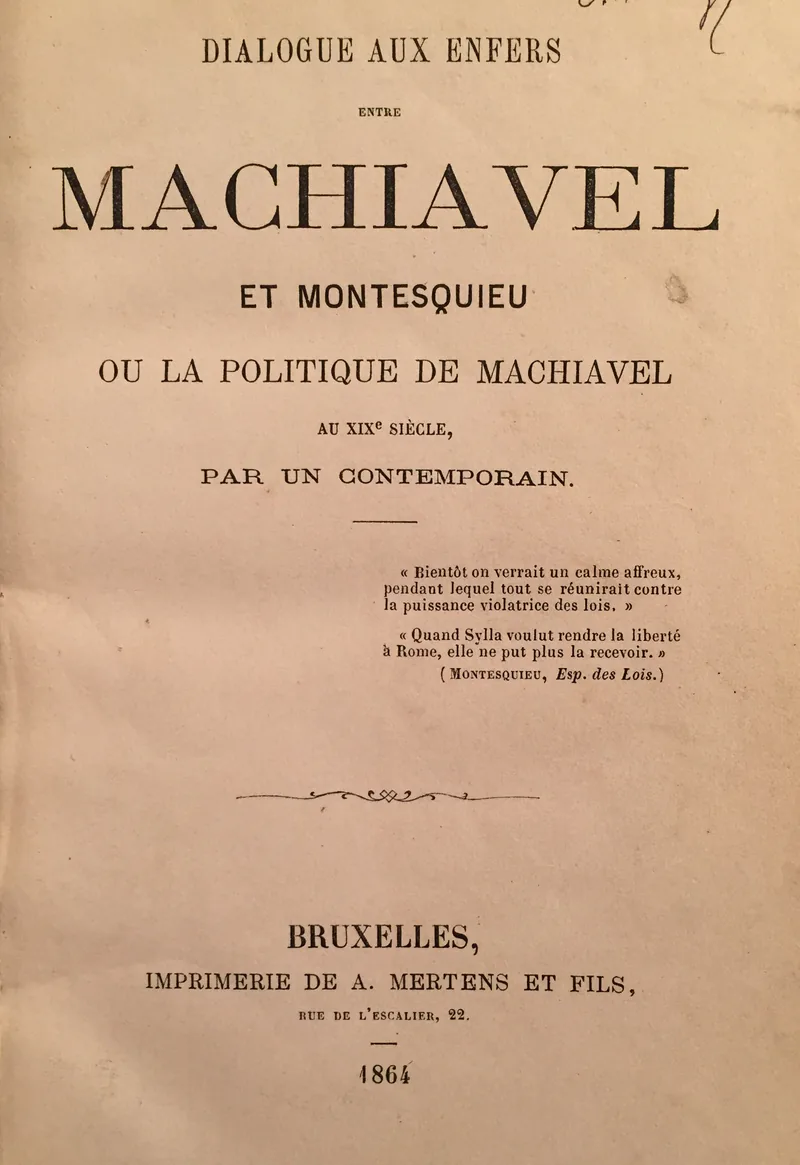
Whoever compiled the Protocols took Machiavelli's speeches, rearranged them and put them in the mouth of the Elders. Scholars have counted dozens of passages, amounting to a large share of the whole text, that follow Joly closely, sometimes almost word for word, with the despot's plans transferred to a Jewish conspiracy.
A second source was a work of fiction. In 1868 the German writer Hermann Goedsche, under the pen name "Sir John Retcliffe", published the novel Biarritz, which contains a chapter in which representatives of the twelve tribes of Israel meet at night in the Jewish cemetery of Prague to report to the devil on their progress towards world domination. The chapter was later reprinted in Russia and France as if it were a real rabbi's speech.
Behind both lay a third tradition: the conspiracy theories that followed the French Revolution. Augustin Barruel and John Robison had blamed the Revolution on Freemasons and the Bavarian Illuminati in 1797, and in 1806 a letter attributed to one J. B. Simonini urged Barruel to recognise the Jews as the hidden power behind the lodges. Counter-revolutionary writers steadily recast the "Masonic plot" as a "Judeo-Masonic" one. The Protocols gave that synthesis its most notorious form (see Barruel and the Jacobin conspiracy myth).
Russian Origins and First Publication§
The first known printing appeared in instalments in August and September 1903 in Znamya (The Banner), a St Petersburg newspaper edited by Pavel Krushevan, an antisemitic journalist who had helped stir up the Kishinev pogrom earlier that year. In 1905 the religious writer Sergei Nilus included a fuller version in the second edition of his book The Great in the Small, an apocalyptic work about the coming of Antichrist; another edition was issued by Georgy Butmi in the same period. Nilus's 1917 edition became the basis of most later translations.
Who actually compiled the text, and where, is still debated. A long-standing account holds that it was produced in Paris in the late 1890s or around 1900 in circles connected with the foreign branch of the Russian political police, the Okhrana, whose Paris chief Pyotr Rachkovsky ran propaganda campaigns; in 1999 the Russian researcher Mikhail Lepekhin argued for the authorship of the journalist Mathieu Golovinski. Other scholars, notably Cesare G. De Michelis and Michael Hagemeister, have questioned the Paris and Okhrana story and argue that the text was most probably put together in Russia shortly before 1903, perhaps within the circle of the far-right press. The textual borrowing from Joly is not in doubt; the precise authorship is. Nilus gave contradictory accounts of how he obtained it, and no original "minutes" have ever been produced. Before 1917 the text had only modest success in Russia.
From Russian Pamphlet to Global Myth, 1917–1945§
The Russian Revolution transformed the fortunes of the Protocols. White Russian officers and émigrés presented Bolshevism as the fulfilment of the Elders' plan and carried the text west. A German translation edited by Ludwig Müller von Hausen appeared in 1920, an English version entitled The Jewish Peril was published in London the same year, and translations into French, Polish, Italian and other languages followed. On 8 May 1920 The Times itself published a leader that treated the document as disturbing and called for an inquiry.
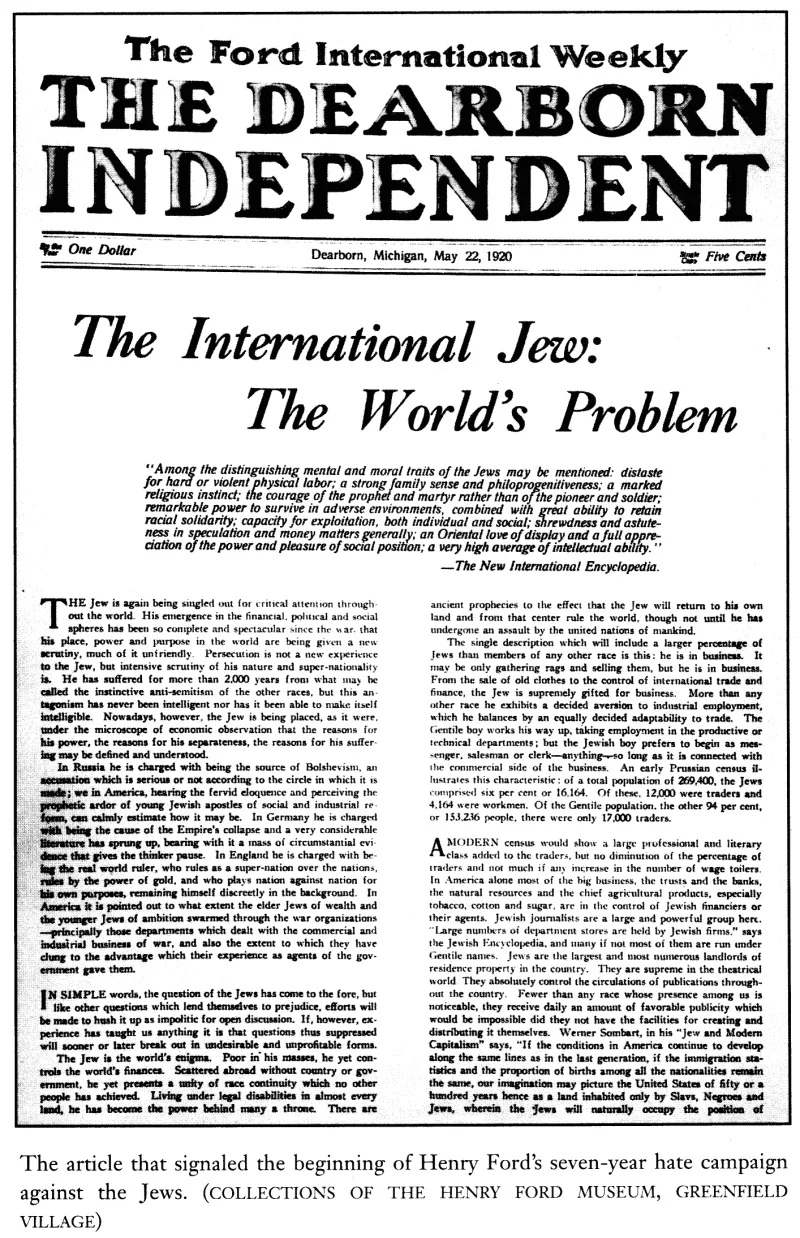
In the United States the industrialist Henry Ford's newspaper, the Dearborn Independent, ran a long series based on the Protocols from 1920, later collected as The International Jew and distributed in hundreds of thousands of copies. Ford issued a public apology in 1927 after a libel suit, but the reprints continued abroad.
In Germany the Protocols became part of the ideological arsenal of the radical right. Hitler referred to them in Mein Kampf, arguing that the very denials of the press proved their authenticity, and after 1933 the text was reprinted many times and used in schooling. Historians do not make a single book the cause of the Holocaust, but Norman Cohn's phrase "warrant for genocide" captures how the myth supplied a rationale for destruction.
How the Forgery Was Exposed§
Philip Graves and The Times, 1921§
In August 1921 The Times, which had treated the text seriously the year before, published three articles by its Constantinople correspondent Philip Graves. A Russian émigré had shown him a copy of Joly's Dialogue, and Graves printed parallel passages that left no room for doubt. In the same year the American journalist Herman Bernstein published his own exposure, and in 1924 the German-Jewish scholar Binjamin Segel produced a detailed critical study.
The Bern trial, 1933–1935§
In Switzerland, Jewish organisations sued local Nazi sympathisers for distributing the Protocols under a law against indecent literature. The Bern court heard expert witnesses and Russian émigrés on the text's origins, and in May 1935 judge Walter Meyer ruled that the Protocols were forgeries and "trash literature". An appeal court overturned the conviction in 1937 on the narrow ground that political propaganda did not fall under that law, without reversing the finding of forgery. A United States Senate committee report of 1964 reached the same conclusion.
The Protocols After 1945 and Their Persistence§
Defeat of Nazism discredited the Protocols in Western Europe, but the text did not disappear. It has been reprinted widely in the Middle East since the 1950s, quoted in the 1988 charter of Hamas, and adapted for television, notably in an Egyptian serial of 2002 that drew international protest. It circulates in far-right and some esoteric or "alternative" milieus in Europe and the Americas, often with the word "Jewish" replaced by "Zionist", "globalist", "Illuminati" or "bankers", a substitution that keeps the structure of the original accusation intact (see conspiracy myths).
Why the myth persists§
The Protocols is short, vague and adaptable: almost any war, crash or social change can be read as "fulfilling" a passage, and its claim to be a secret document makes every exposure look like part of the plot. It also draws on a much older language of secret societies, hidden masters and initiatory degrees, the same language that had earlier been turned against Freemasons and Illuminati and that anti-Masonic writers such as Léo Taxil exploited. For the historian of esotericism the Protocols is a case study in how the imagery of secret brotherhoods can be weaponised against a real minority, with lethal results.
Frequently asked questions§
Are the Protocols of the Elders of Zion real?§
No. The Protocols is a forgery. Large parts are copied from Maurice Joly's 1864 satire against Napoleon III, as The Times demonstrated in 1921, and no meeting of "Elders of Zion" ever took place. Courts and official inquiries, as well as every serious historian of the subject, have reached the same conclusion.
Who wrote the Protocols of the Elders of Zion?§
The compiler is unknown. One theory places its origin in Paris around 1900 among agents of the Russian political police, possibly the journalist Mathieu Golovinski; other scholars think it was assembled in Russia shortly before its first printing in 1903. Sergei Nilus published the best-known edition but did not write it.
What do the Protocols have to do with Freemasonry?§
The forgery presents Freemasonry as a tool of the Elders, a front through which unwitting Masons serve a Jewish plan. This reflects the nineteenth-century merging of anti-Masonic conspiracy theories, which blamed the lodges for the French Revolution, with antisemitism.
Why are the Protocols still circulated?§
Because the text is vague enough to be applied to new events and claims to reveal a secret, believers treat denials as further proof. It is still reprinted in several countries and online, often with the word "Jewish" swapped for code words, which is why historians and educators continue to document its origins.
Sources and further reading§
- Warrant for Genocide: The Myth of the Jewish World-Conspiracy and the Protocols of the Elders of Zion — Norman Cohn, 1967
- Dialogue aux enfers entre Machiavel et Montesquieu — Maurice Joly, 1864
- The Truth about "The Protocols of Zion": A Complete Exposure — Herman Bernstein, 1935
- A Lie and a Libel: The History of the Protocols of the Elders of Zion — Binjamin W. Segel, 1995
- The Non-Existent Manuscript: A Study of the Protocols of the Sages of Zion — Cesare G. De Michelis, 2004
- The Lie That Wouldn't Die: The Protocols of the Elders of Zion — Hadassa Ben-Itto, 2005
- The Global Impact of the Protocols of the Elders of Zion: A Century-Old Myth — Esther Webman, 2011