Liber XXV · Secret Societies · Chapter I: Conspiracy Myths
Barruel, Robison and the Jacobin Conspiracy Myth of 1797
How Augustin Barruel and John Robison blamed the French Revolution on Freemasons and Illuminati in 1797, and what historians make of the Jacobin myth.

The Jacobin conspiracy myth is the claim, set out in 1797 by the French Jesuit Augustin Barruel and the Scottish scientist John Robison, that the French Revolution was not a popular upheaval but the planned work of philosophers, Freemasons and the Bavarian Illuminati. Their books were bestsellers across Europe and America and became the founding texts of modern secret-society conspiracy theory, although historians have long shown that the lodges and the Illuminati did not plan or direct the Revolution.
Before Barruel: The First Plot Theories of the Revolution§
The idea that the Revolution had been engineered appeared almost as soon as the Revolution itself. Royalists and clergy who lost everything after 1789 struggled to explain how an ancient monarchy and Church could fall so quickly, and a hidden plan offered an answer. In 1791 the Eudist priest Jacques-François Lefranc published Le Voile levé pour les curieux (The Veil Lifted for the Curious), which traced revolutionary principles to Masonic rituals of equality and fraternity. Lefranc was killed in the September Massacres of 1792, which lent his warning a grim prestige among émigrés.
In 1796 the writer Charles-Louis Cadet de Gassicourt added a legendary dimension in Le Tombeau de Jacques Molai (The Tomb of Jacques de Molay). He argued that the Knights Templar, suppressed in 1307–1314, had survived in secret, passed their hatred of kings and popes to the higher degrees of Freemasonry, and taken revenge at last by imprisoning Louis XVI in the Paris Temple, the old Templar headquarters (see the Templar survival legend). In Germany, conservative journals such as Eudämonia had meanwhile been warning since the suppression of the Bavarian Illuminati in 1784–1785 that the order lived on underground.
Augustin Barruel and the Memoirs of Jacobinism§
Augustin Barruel (1741–1820) entered the Society of Jesus as a young man and remained a Jesuit in spirit after the order's suppression in 1773. He made his name as a polemicist against the Enlightenment with Les Helviennes (1781), a series of letters attacking the philosophes. Refusing the oath required of clergy under the Civil Constitution, he fled to London in 1792, where he wrote his great work.
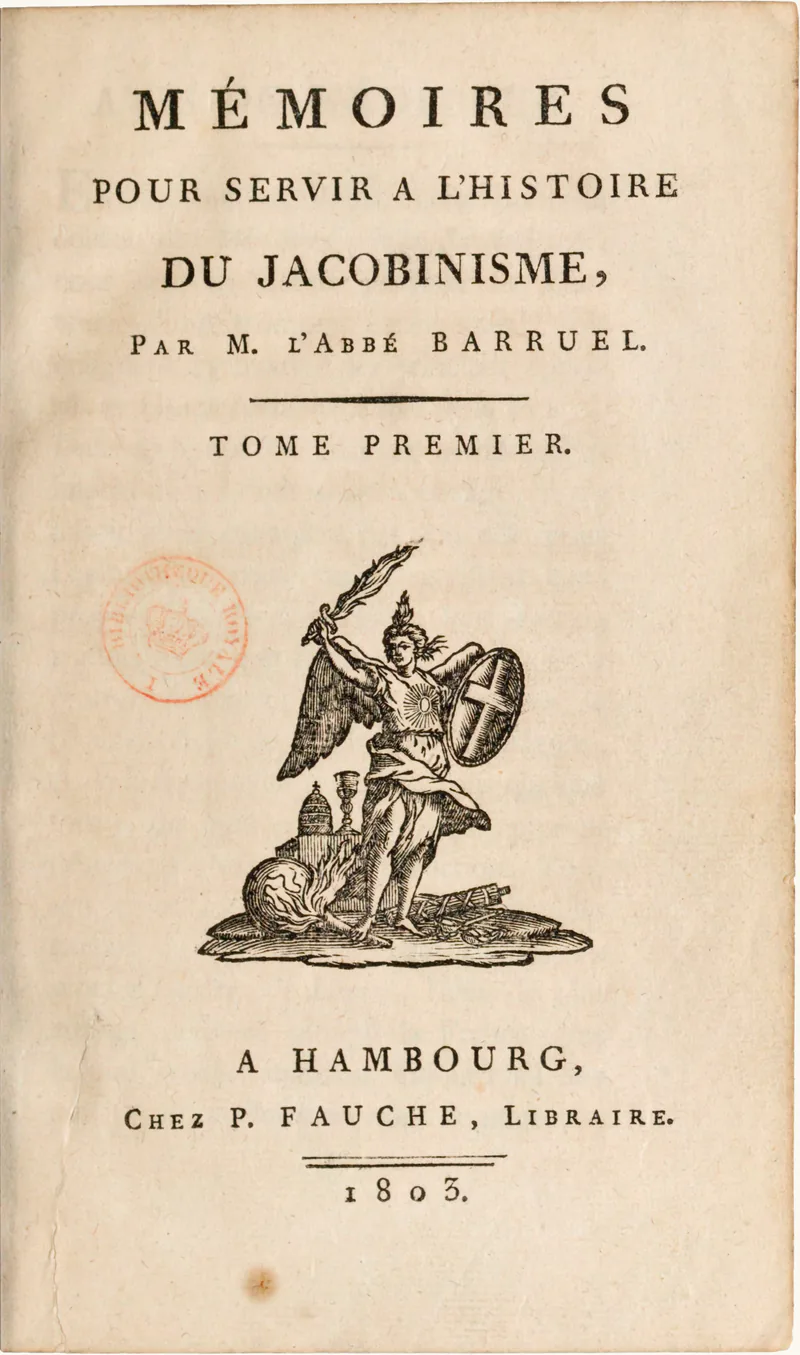
The Mémoires pour servir à l'histoire du Jacobinisme appeared in four volumes in 1797–1798 and was translated into English by Robert Clifford almost at once as Memoirs Illustrating the History of Jacobinism. An abridgement followed, and the book was soon available in German, Italian, Spanish, Polish, Russian and other languages.
The threefold conspiracy§
Barruel's argument was architectural. He described three conspiracies that converged in the Jacobin club:
- the "sophists of impiety", Voltaire, d'Alembert, Diderot and Frederick II of Prussia, who plotted to destroy Christianity;
- the "sophists of rebellion" in the Masonic lodges, whose secret degrees taught that liberty and equality meant the overthrow of kings;
- the "sophists of anarchy", the Illuminati of Adam Weishaupt, who wished to abolish property, religion and every government.
The Illuminati, Barruel claimed, had penetrated French Masonry in the 1780s, and their merger with the lodges produced the Jacobins. He drew heavily on the papers seized from the Bavarian order and published by the Bavarian government in 1787, quoting Weishaupt's frankest letters at length, and he made much of a visit to Paris in 1787 by the Illuminatus Johann Joachim Christoph Bode, which he presented as the moment of contagion.
Barruel's tone was learned and confident, his footnotes numerous. That apparatus was much of his power: readers found an argument that seemed documented, and the sheer volume of quotation disguised the gap between showing that the Illuminati had radical ideas and showing that they had caused events in France.
John Robison and the Proofs of a Conspiracy§
Barruel's British counterpart came from a very different world. John Robison (1739–1805) was professor of natural philosophy at the University of Edinburgh, general secretary of the Royal Society of Edinburgh and a friend of James Watt. He had been initiated into Freemasonry on the Continent and had visited lodges in several countries.
In 1797, the same year as Barruel's first volumes, he published Proofs of a Conspiracy against All the Religions and Governments of Europe, carried on in the Secret Meetings of Free Masons, Illuminati, and Reading Societies. Robison argued that French and German Masonry had been corrupted by fanciful higher degrees and then captured by the Illuminati, who spread revolutionary ideas through lodges and reading clubs. Unlike Barruel, he exonerated the British lodges, which he considered harmless convivial societies. He knew less German than his subject required, and Barruel, who read the Proofs while finishing his own work, noted errors in it while welcoming its support.
The appearance of two such books in one year, by a Catholic priest and a Protestant scientist, seemed to many readers like independent confirmation. In reality they drew on the same small body of German anti-Illuminati literature.
The Illuminati Scare in America, 1798–1799§
The books arrived in the United States during the Quasi-War with France, when Federalists feared French influence and Jeffersonian Republicans admired the Revolution. On 9 May 1798, a national fast day, the Congregationalist minister Jedidiah Morse preached a sermon at Charlestown, Massachusetts, warning on the authority of Robison that the Illuminati were at work in America. Timothy Dwight, president of Yale, preached in similar terms, and for about two years New England pulpits and newspapers debated whether Illuminist societies were hidden among the Democratic-Republican clubs.
George Washington, himself a Freemason, wrote in 1798 that he had heard much of the Illuminati but did not believe that the American lodges were contaminated by them. Thomas Jefferson read Barruel and, in a letter of 1800, dismissed the work as "the ravings of a Bedlamite", while suggesting that Weishaupt was a well-meaning enthusiast. Morse never produced convincing evidence, and the scare faded by 1800, although it prepared the ground for the larger wave of anti-Masonry that followed the Morgan affair in 1826. Vernon Stauffer's study of 1918 remains the classic account.
What Historians Say About the Masonic Plot Thesis§
Modern historians agree that the conspiracy thesis does not survive contact with the evidence. The Bavarian Illuminati had ceased to function by 1785, four years before the Revolution, and there is no record of an organised Illuminati presence in France. French Freemasonry was socially mixed and politically divided: its lodges included nobles, clergy, officers and royal officials, and the Grand Master of the Grand Orient, the Duke of Orléans, renounced Masonry in 1793. During the Terror the lodges largely ceased to meet, and many Masons were imprisoned or executed. A movement that devoured its supposed authors makes an unlikely conspiracy.
J. M. Roberts, in The Mythology of the Secret Societies (1972), traced how the myth answered real anxieties about change, and Darrin McMahon has placed Barruel within a broad Catholic Counter-Enlightenment that predated 1789.
A grain of social history§
Historians have nevertheless taken seriously a more modest point. In the early twentieth century Augustin Cochin argued that the Revolution grew out of sociétés de pensée, voluntary associations such as lodges, academies and reading societies, in which people practised debate, voting and equality among members. François Furet revived this analysis in the 1970s, and studies of lodges by Ran Halévi and Margaret Jacob have shown how Masonic sociability helped spread new political habits. This is a story of shared culture and unintended consequences, not of a hidden directorate, and it is precisely the distinction that Barruel's model erased.
The Legacy of Barruel: Template for Modern Conspiracy Theory§
Barruel's book outlived its moment because it supplied a reusable pattern: a small, secret, highly organised group; a long-range plan concealed behind innocent institutions; graded initiations that keep lower members ignorant of the true aim; and the interpretation of every disaster as part of the design. In 1806 he received a letter signed by one J. B. Simonini that claimed the Jews were the real power behind the Masons and Illuminati. Barruel did not publish it, but the letter was printed later in the century and helped turn the Masonic plot into a "Judeo-Masonic" one, the line that led to the forged Protocols of the Elders of Zion.
Nineteenth-century Catholic writers on Masonry, the twentieth-century English author Nesta Webster in World Revolution (1921) and Secret Societies and Subversive Movements (1924), and many later writers on the "New World Order" all reproduce Barruel's structure, often without knowing its source. For an overview of the whole family of these ideas see secret society conspiracy myths.
Frequently asked questions§
Did the Freemasons cause the French Revolution?§
No. Many revolutionaries were Masons, but so were many royalists, aristocrats and clergy, and the lodges did not act as a political organisation. Historians explain the Revolution through fiscal crisis, social tensions, political ideas and events, not a Masonic plan. The most they grant is that lodges, like other clubs, spread habits of discussion and equality.
Were the Illuminati behind the French Revolution?§
There is no evidence that they were. The Bavarian Illuminati were suppressed in 1784–1785 and had effectively dissolved before 1789. Barruel and Robison inferred their role from the order's radical writings, not from documents showing activity in France.
What was Barruel's Memoirs of Jacobinism?§
It was a four-volume history published in 1797–1798 by the exiled Jesuit Augustin Barruel, arguing that philosophers, Freemasons and Illuminati together produced the Revolution. It became one of the most widely translated books of its age and the model for later secret-society conspiracy literature.
Who was John Robison?§
John Robison (1739–1805) was an Edinburgh professor of natural philosophy who published Proofs of a Conspiracy in 1797. He blamed corrupted Continental Freemasonry and the Illuminati for revolutionary unrest while defending British lodges.
Sources and further reading§
- Memoirs Illustrating the History of Jacobinism — Augustin Barruel, 1797
- Proofs of a Conspiracy Against All the Religions and Governments of Europe — John Robison, 1797
- The Mythology of the Secret Societies — J. M. Roberts, 1972
- The Bavarian Illuminati in America: The New England Conspiracy Scare, 1798 — Vernon Stauffer, 1918
- Enemies of the Enlightenment: The French Counter-Enlightenment and the Making of Modernity — Darrin M. McMahon, 2001
- Interpreting the French Revolution — François Furet, 1981
- Living the Enlightenment: Freemasonry and Politics in Eighteenth-Century Europe — Margaret C. Jacob, 1991