Liber V · Chaos Magick · Chapter II: Contemporary Occultism
Robert Anton Wilson: Reality Tunnels, Illuminatus! and Magick
Robert Anton Wilson (1932–2007): Illuminatus!, Cosmic Trigger, reality tunnels, model agnosticism, the eight-circuit model and his influence on chaos magick.

Robert Anton Wilson (1932–2007) was an American novelist, essayist and self-described "guerrilla ontologist" whose books, from the Illuminatus! trilogy (1975, with Robert Shea) to Cosmic Trigger (1977) and Prometheus Rising (1983), taught a generation of readers to treat every belief system as a provisional "reality tunnel". His blend of Discordian humour, Crowleyan magick, general semantics and Timothy Leary's psychology made him one of the most important intellectual influences on chaos magick and late twentieth-century occult culture.
Early Life, Playboy and the Discordians§
Wilson was born in Brooklyn, New York, on 18 January 1932, into an Irish-American Catholic family, and later described his rejection of Catholic schooling as his first experience of leaving one reality tunnel for another. He studied engineering and mathematics in New York, worked in a variety of jobs and wrote for small radical and libertarian magazines in the 1950s and early 1960s. In 1958 he married the writer Arlen Riley, his partner until her death in 1999.
From 1965 to 1971 he was an associate editor at Playboy, responsible among other things for its "Forum" pages of readers' letters. During the 1960s he became friends with Kerry Thornley and Greg Hill, the founders of the parody religion Discordianism, and joined their circle under the name "Mordecai the Foul". Discordianism's worship of Eris, goddess of chaos, and its insistence that humour can be a spiritual discipline would remain central to his work.
Illuminatus! and the Comedy of Conspiracy§
At Playboy, Wilson and his colleague Robert Shea noticed how many letters claimed to have uncovered secret plots, often attributed to the Bavarian Illuminati, the Enlightenment society suppressed in 1785. With Discordian mischief in mind they began a novel that would take every conspiracy theory seriously at once. The result, The Illuminatus! Trilogy, was published by Dell in 1975 in three volumes: The Eye in the Pyramid, The Golden Apple and Leviathan.

The trilogy combines thriller, science fiction, sex comedy and occult lore, with rival secret societies, a talking dolphin, H. P. Lovecraft's entities and lengthy digressions on history and philosophy. Its purpose was partly satirical and partly pedagogical: by piling conspiracy upon conspiracy until the reader could no longer tell fiction from fact, it aimed to make the reader question how any belief is formed. The Discordian "Operation Mindfuck", a campaign of pranks and deliberate disinformation, was the novel's real-world counterpart. In 1976 the British director Ken Campbell staged a long adaptation in Liverpool, which was revived in 1977 at the National Theatre in London.
Ironically, the novel later fed the very conspiracy culture it mocked, as images and names from its pages migrated into sincere claims about secret rulers. The broader history of such ideas is discussed in Conspiracy Myths.
Cosmic Trigger and Chapel Perilous§
Cosmic Trigger: Final Secret of the Illuminati (1977) is Wilson's most personal and most influential book for occultists. It recounts a period beginning around 1971 in which he experimented intensively with the magical exercises of Aleister Crowley, with meditation and yoga, and with psychedelic drugs, then a widespread practice in the counterculture. During 1973 and 1974 he experienced a series of synchronicities, apparent communications and visions that seemed to centre on the star Sirius, and he recorded them alongside the strikingly similar reports of other writers of the time.
Wilson did not ask readers to believe that he had been contacted by extraterrestrial or magical intelligences. Instead he offered several competing explanations, from genuine contact to a by-product of his own nervous system, and declined to choose between them. He named the disorienting state in which such questions cannot be settled "Chapel Perilous", after the perilous chapel of Arthurian romance, and argued that a person might emerge from it either paranoid or agnostic. The book is equally concerned with grief: in 1976 his fifteen-year-old daughter, Luna, was killed during a robbery, and the later chapters address loss with notable restraint.
Reality Tunnels, Model Agnosticism and Maybe Logic§
Wilson's core philosophical idea is the "reality tunnel", a term he took from Timothy Leary. Every person, he argued, perceives the world through a tunnel shaped by genetics, upbringing, language, culture and personal experience. A reality tunnel is not a delusion; it is the necessary condition of any perception at all. But it becomes a trap when a person mistakes it for reality itself and assumes that those who see differently are stupid or wicked.
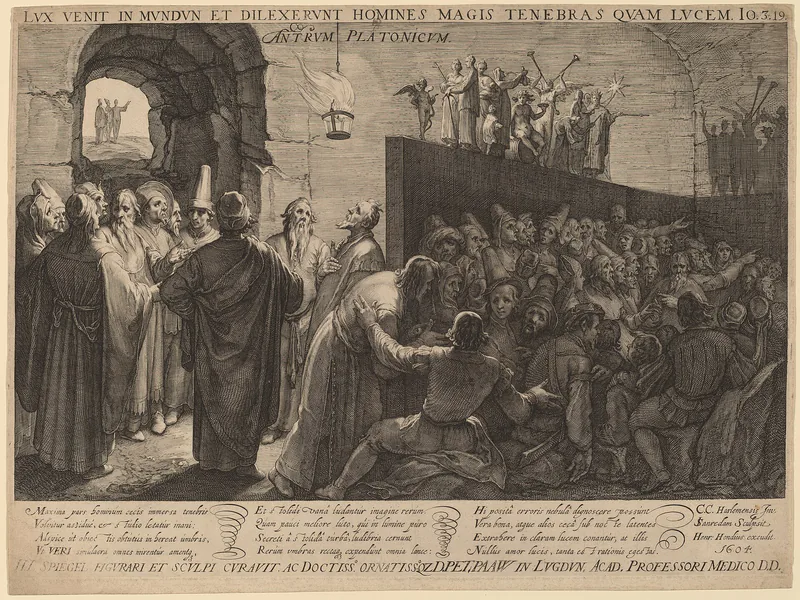
To loosen that trap he drew on Alfred Korzybski's general semantics, with its maxim that "the map is not the territory", and on E-Prime, a form of English that avoids the verb "to be" so as to make the observer's role in every judgement explicit. He called his own stance "model agnosticism": treating every theory, whether scientific, religious or magical, as a model to be used while it is useful, without claiming final truth for any of them. Later he spoke of "maybe logic", a habit of replacing "true" and "false" with degrees of probability.
Against fundamentalism of every kind§
Wilson applied this scepticism even-handedly. In The New Inquisition (1986) he attacked what he called fundamentalist materialism among organised sceptics, while in other books he was equally hostile to religious dogmatism and political authoritarianism. Critics found the approach slippery or evasive; admirers saw it as a practical training in intellectual humility. Quantum Psychology (1990) presents many of these ideas as exercises for readers.
The Eight-Circuit Model with Timothy Leary§
In the 1970s Wilson collaborated with Timothy Leary, the former Harvard psychologist, and became the chief popular interpreter of Leary's "eight-circuit model" of consciousness. In this scheme the human nervous system develops through a series of circuits: four concerned with ordinary life (bodily survival, emotional and territorial status, language and reasoning, and social and sexual roles) and four "higher" circuits that Leary associated with ecstatic, mystical and visionary states, some of which he linked with his psychedelic research.
Wilson's Prometheus Rising (1983) turned the model into a practical guide to "reprogramming" one's habitual reactions, borrowing techniques from yoga, ritual magic, hypnosis and psychotherapy. The model has no standing in neuroscience and was presented by both authors as a speculative map rather than a finding. Its importance is historical: it offered occultists a quasi-scientific vocabulary in which magical and mystical practices could be discussed as forms of self-programming, an approach that runs through much chaos magick.
Influence on Chaos Magick and Contemporary Occultism§
Wilson never founded an order and never called himself a chaos magician, but his influence on the movement was profound. His deliberately provisional attitude to belief closely parallels the chaos principle of paradigm shifting, and his popularisation of Discordianism brought Eris, the Sacred Chao and the Law of Fives into chaos practice. The slogan "nothing is true, everything is permitted", attributed in occult legend to Hassan-i Sabbah, circulated through Illuminatus! as well as through William S. Burroughs. Peter J. Carroll and many early members of the Illuminates of Thanateros read Wilson, and chaos writers from Phil Hine to Grant Morrison cited him.
Wilson lived in Ireland from 1982 to 1988 and later in California, where he taught online courses through the Maybe Logic Academy. He died in Capitola, California, on 11 January 2007. Interest in his work has continued through new editions, the 2003 documentary Maybe Logic and a stage adaptation of Cosmic Trigger in 2014 by Daisy Eris Campbell, Ken Campbell's daughter. Scholars of contemporary esotericism, including Erik Davis in High Weirdness (2019), treat him as a central figure in the meeting of counterculture, psychedelia and occultism described in Contemporary Occultism.
Frequently asked questions§
What is a reality tunnel?§
A reality tunnel is Robert Anton Wilson's term, borrowed from Timothy Leary, for the framework of assumptions through which each person perceives the world. Wilson argued that everyone has one, and that wisdom lies in recognising one's own as a map rather than reality itself.
Was Robert Anton Wilson a chaos magician?§
He did not use the label, but chaos magicians regard him as a major influence. His model agnosticism, his Discordian humour and his experiments with Crowleyan magick, described in Cosmic Trigger, anticipated many chaos magick attitudes.
What is Chapel Perilous?§
Chapel Perilous is Wilson's name, taken from Arthurian legend, for a state of mind in which a person cannot tell whether strange experiences are real, coincidental or self-generated. In Cosmic Trigger he describes passing through it during 1973 and 1974.
Is Illuminatus! a true story?§
No. The Illuminatus! Trilogy is a satirical novel that weaves together real history and invented conspiracies to show how easily beliefs are formed. The historical Bavarian Illuminati existed from 1776 to 1785, but the novel's world-controlling plots are fiction.
Sources and further reading§
- The Illuminatus! Trilogy — Robert Shea and Robert Anton Wilson, 1975
- Cosmic Trigger I: Final Secret of the Illuminati — Robert Anton Wilson, 1977
- Prometheus Rising — Robert Anton Wilson, 1983
- The New Inquisition: Irrational Rationalism and the Citadel of Science — Robert Anton Wilson, 1986
- Quantum Psychology — Robert Anton Wilson, 1990
- Principia Discordia — Malaclypse the Younger (Gregory Hill), 1970
- High Weirdness: Drugs, Esoterica, and Visionary Experience in the Seventies — Erik Davis, 2019