Liber V · Chaos Magick · Chapter II: Contemporary Occultism
Discordianism: Eris, the Principia Discordia and Chaos
Discordianism explained: Greg Hill and Kerry Thornley, the Principia Discordia, Eris and the Sacred Chao, Illuminatus!, and its influence on chaos magick.

Discordianism is a modern religion, or parody of religion, centred on Eris, the Greek goddess of strife, whom its followers honour as the goddess of chaos. It was founded in California around 1958–59 by Greg Hill and Kerry Thornley, set out in their satirical scripture the Principia Discordia, and popularised by Robert Shea and Robert Anton Wilson's Illuminatus! trilogy (1975); it became a major influence on chaos magick.
Origins: Greg Hill, Kerry Thornley and the Vision of Eris§
Gregory Hill (1941–2000) and Kerry Wendell Thornley (1938–1998) were school friends in southern California. According to the story they later told, in the late 1950s, during a late night in a bowling alley, the two experienced a revelation: chaos is the underlying reality of the world, and the goddess of that chaos is Eris, called Discordia by the Romans. They resolved to found a religion in her honour, and over the following years they and a small circle of friends developed a body of doctrine, jokes, saints, holy days and mock-ecclesiastical titles. Hill took the name Malaclypse the Younger; Thornley became Omar Khayyam Ravenhurst.
Thornley's later life became entangled with one of the great events of the period. He had served in the US Marine Corps alongside Lee Harvey Oswald and had written a novel partly based on him before the assassination of President Kennedy in 1963. In the late 1960s he was drawn into New Orleans district attorney Jim Garrison's investigation of the assassination, and he spent much of his later life preoccupied with conspiracy theories, some of them of his own making. The overlap between Discordian mischief and the American culture of conspiracy, discussed in Conspiracy Myths, became a lasting feature of the movement.
Eris, the Golden Apple and the Sacred Chao§
In Greek myth Eris was the goddess of strife. The best-known story about her tells how she was left off the guest list at the wedding of Peleus and Thetis and took revenge by throwing among the guests a golden apple inscribed kallisti, "for the fairest". Hera, Athena and Aphrodite each claimed it; the Trojan prince Paris was asked to judge; and the chain of events that followed led to the Trojan War.

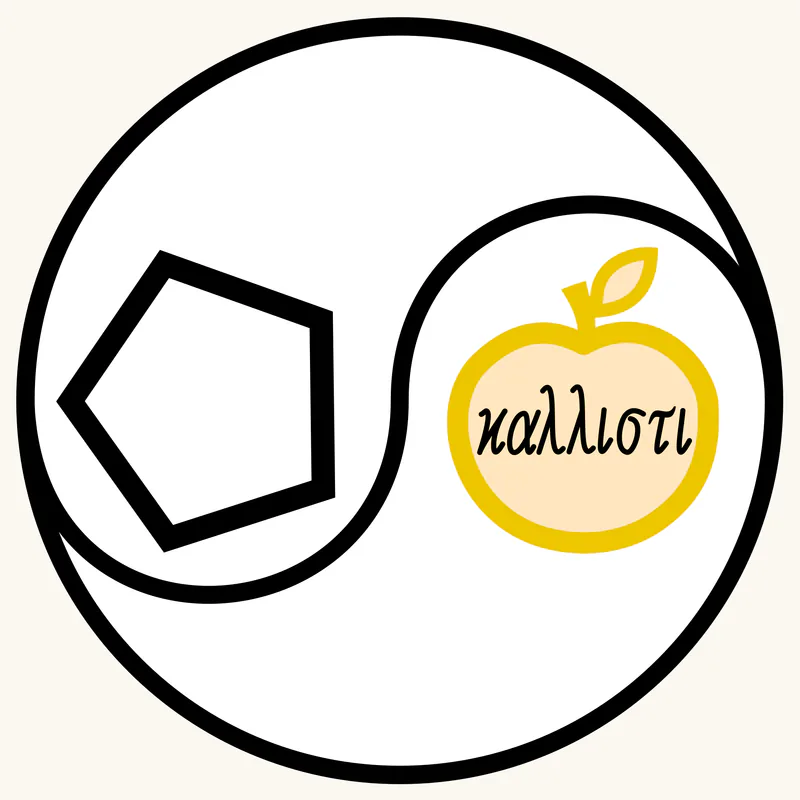
Discordians retell this story as "the Original Snub" and make the golden apple, with its word kallisti, their chief emblem. Their Eris is not a malicious goddess of quarrels but a playful embodiment of the creative disorder from which everything arises. The trouble in the world, according to Discordian teaching, comes not from chaos but from human attempts to impose rigid order on it.
The movement's main symbol is the Sacred Chao, a deliberate parody of the Chinese yin–yang (taijitu). A circle is divided by a curving line into two halves, named Hodge and Podge; one bears a golden apple and the other a pentagon. Where the Chinese symbol represents the complementary balance of yin and yang, the Sacred Chao represents the "Eristic" principle of disorder and the "Aneristic" principle of order, which Discordians regard as two equally arbitrary ways of slicing up a reality that is in itself neither orderly nor disorderly.
The Principia Discordia§
The Principia Discordia is the scripture of Discordianism, a collage of short texts, mock sermons, rubber-stamp slogans, borrowed clip-art and hand-lettered pages. Discordian tradition holds that its first edition of 1963 consisted of only five copies, produced, so the story goes, on an office copier belonging to Jim Garrison; like many Discordian claims, this is told with a wink and should be treated with caution. Further editions followed, and the fourth edition of 1970 became the standard text, reprinted many times since. Hill released it with the notice "Ⓚ All Rites Reversed – reprint what you like", an early example of anti-copyright culture.
The book's tone is consistently comic, but its jokes carry a serious point. It mocks the solemnity of organised religion, the bureaucratic mind and the belief that any system of ideas can capture reality. A recurring villain is Greyface, a mythical man of 1166 BC who taught that life is serious and play is sinful, laying a "Curse of Greyface" on humanity. The Discordian calendar counts years from that date, so that the Year of Our Lady of Discord (YOLD) is the conventional year plus 1166.
Discordian Doctrines: The Law of Fives, the Calendar and the Pentabarf§
The Law of Fives§
The Law of Fives holds that all things happen in fives, or are divisible by or are multiples of five, or are somehow directly or indirectly related to five; and that the law is never wrong, since a person who looks hard enough will always find it confirmed. The doctrine is a gentle satire on numerology and on the human habit of finding patterns everywhere, and at the same time an exercise in noticing how belief shapes perception, a theme central to What Is Chaos Magick?.
The calendar and the Pentabarf§
The Discordian calendar divides the year into five seasons of 73 days, named Chaos, Discord, Confusion, Bureaucracy and The Aftermath, with a five-day week (Sweetmorn, Boomtime, Pungenday, Prickle-Prickle and Setting Orange) and an extra day, St. Tib's Day, inserted every fourth year outside the ordinary count. The Pentabarf, the five commandments of Discordianism, include the instruction to use the official Discordian document numbering system and the warning that "A Discordian is Prohibited of Believing What he Reads".
Every Discordian is also declared a pope, entitled to issue pope cards, excommunicate anyone, and found a sect, or "cabal". Hill's own sect was the Paratheo-Anametamystikhood of Eris Esoteric (POEE). The point of universal papacy is to dissolve religious authority by distributing it to everyone.
Robert Anton Wilson, Illuminatus! and Operation Mindfuck§
Discordianism might have remained a private joke among friends had it not been taken up by Robert Anton Wilson (1932–2007) and Robert Shea (1933–1994), two editors at Playboy magazine in the late 1960s. Wilson, who met Thornley through the countercultural press, became an enthusiastic Discordian. With Shea he wrote Illuminatus!, a sprawling satirical novel about secret societies, assassinations and rival conspiracies, published in three volumes in 1975 (The Eye in the Pyramid, The Golden Apple and Leviathan). The novel mixed the legend of the Bavarian Illuminati with Discordian theology, Lovecraftian horror, sex, anarchist politics and parody, and gave the world the word "fnord".
Wilson and his friends also conducted what they called Operation Mindfuck, a loose campaign of hoaxes, contradictory letters to the press and planted rumours, intended to jolt people out of fixed belief systems by making them unsure what to believe. In later books, especially Cosmic Trigger (1977), Wilson described his own experiments with altered states and synchronicity, including a fascination with the number 23 that he took from William S. Burroughs. His concepts of "reality tunnels" and "model agnosticism", the view that every belief system is a map rather than the territory, became fundamental to the chaos magick attitude.
Discordianism and Chaos Magick§
The overlap between Discordianism and chaos magick is close. Both arose in the 1960s and 1970s, both identify "chaos" as the ultimate reality, both treat belief as something to be adopted and discarded playfully, and both use humour and absurdity to undermine fixed ideas. Many chaos magicians adopted Eris as a patron, used the golden apple and Sacred Chao in ritual, and borrowed Discordian slogans; the IOT's very name, with its echo of the Illuminati, shares the ironic spirit of Illuminatus! (see The Illuminates of Thanateros). The eight-arrowed emblem of chaos magick, discussed in The Chaos Star, is often combined with Discordian imagery.
Discordianism also offered an early example of practising religion with an invented or half-invented deity, a method later developed as pop-culture magic. For many practitioners its greatest gift was a tone: the conviction that magic and spirituality can be taken seriously without being taken solemnly.
Religion or Joke? Scholarly Views§
Whether Discordianism is a religion disguised as a joke or a joke disguised as a religion is a question Discordians themselves enjoy leaving open. Scholars have increasingly treated it as a genuine, if unusual, religious phenomenon. Carole M. Cusack, in Invented Religions (2010), places it alongside the Church of All Worlds and Jediism as a religion that openly draws on fiction and play, and argues that its humour does not prevent adherents from finding in it real meaning, community and a philosophy of life. Others classify it among parody religions such as the Church of the SubGenius, founded around 1979, which owes much to Discordian example.
Discordianism has no central organisation, membership figures or official doctrine, which makes it difficult to study sociologically. It survives through reprints of the Principia, through internet communities and through its pervasive influence on counterculture, conspiracy satire and contemporary magic.
Frequently asked questions§
What do Discordians believe?§
Discordians honour Eris, goddess of chaos, and hold that order and disorder are both human ideas imposed on an underlying chaos. They use humour, paradox and absurdity to loosen fixed beliefs, and many treat the religion as both a joke and a serious philosophy.
Who wrote the Principia Discordia?§
The Principia Discordia was written chiefly by Greg Hill under the name Malaclypse the Younger, with contributions from Kerry Thornley as Omar Khayyam Ravenhurst and other friends. Its best-known version is the fourth edition of 1970.
What is the Law of Fives?§
The Law of Fives is the Discordian doctrine that everything is connected with the number five, and that this law is always confirmed if you look hard enough. It satirises numerology while illustrating how belief shapes what we notice.
How is Discordianism connected to chaos magick?§
Both movements treat chaos as the fundamental reality and belief as a tool. Chaos magicians adopted Eris, the golden apple and Discordian humour, and Robert Anton Wilson's model agnosticism became central to chaos magick philosophy.
Sources and further reading§
- Principia Discordia — Malaclypse the Younger (Gregory Hill), 1970
- The Illuminatus! Trilogy — Robert Shea and Robert Anton Wilson, 1975
- Cosmic Trigger I: Final Secret of the Illuminati — Robert Anton Wilson, 1977
- The Prankster and the Conspiracy: The Story of Kerry Thornley and How He Met Oswald and Inspired the Counterculture — Adam Gorightly, 2003
- Historia Discordia: The Origins of the Discordian Society — Adam Gorightly, 2014
- Invented Religions: Imagination, Fiction and Faith — Carole M. Cusack, 2010