Liber V · Chaos Magick · Chapter III: Magic & Culture
The Chaos Star: Moorcock's Symbol of Chaos and the Chaosphere
The chaos star or symbol of chaos: its origin in Michael Moorcock's fantasy fiction, its adoption as the chaosphere of chaos magick, and its meanings today.

The chaos star, also called the symbol of chaos or the arms of chaos, is an emblem of eight arrows radiating from a common centre. It was created in the early 1960s by the British fantasy writer Michael Moorcock for his stories of the cosmic struggle between Law and Chaos, and from around 1980 it was adopted, often in the three-dimensional form called the chaosphere, as the principal symbol of chaos magick.
What the Chaos Star Looks Like§
In its standard form the chaos star consists of eight straight arrows, spaced evenly around a central point and pointing outward, like the points of a compass rose turned into weapons. A small circle often marks the centre. The four cardinal arrows are sometimes drawn longer than the four diagonal ones, and many versions place the arrows on a disc or a sphere. In Moorcock's fiction it has a counterpart: the symbol of Law, a single upward-pointing arrow.
The contrast is the key to the symbol's meaning. Law points in one direction, towards order, fixity and a single truth. Chaos points in every direction at once, representing limitless possibility, change and the refusal of any single path. This made it an obvious emblem for a magical movement whose central principle is that no belief system is final.
Eight-Pointed Stars Before Moorcock§
Eight-pointed figures are ancient and widespread, and it is sometimes claimed that the chaos star is an old occult sign. It is not, although its form resembles older symbols. In Mesopotamia an eight-pointed star represented the goddess Inanna, or Ishtar, associated with the planet Venus, and appears on boundary stones and seals of the second millennium BC. The octagram, formed by two overlapping squares, appears in Islamic geometric art (where one form is called the Rub el Hizb), in Christian architecture and in Western magical diagrams. The compass rose of medieval and early modern charts divided the horizon into eight principal winds.
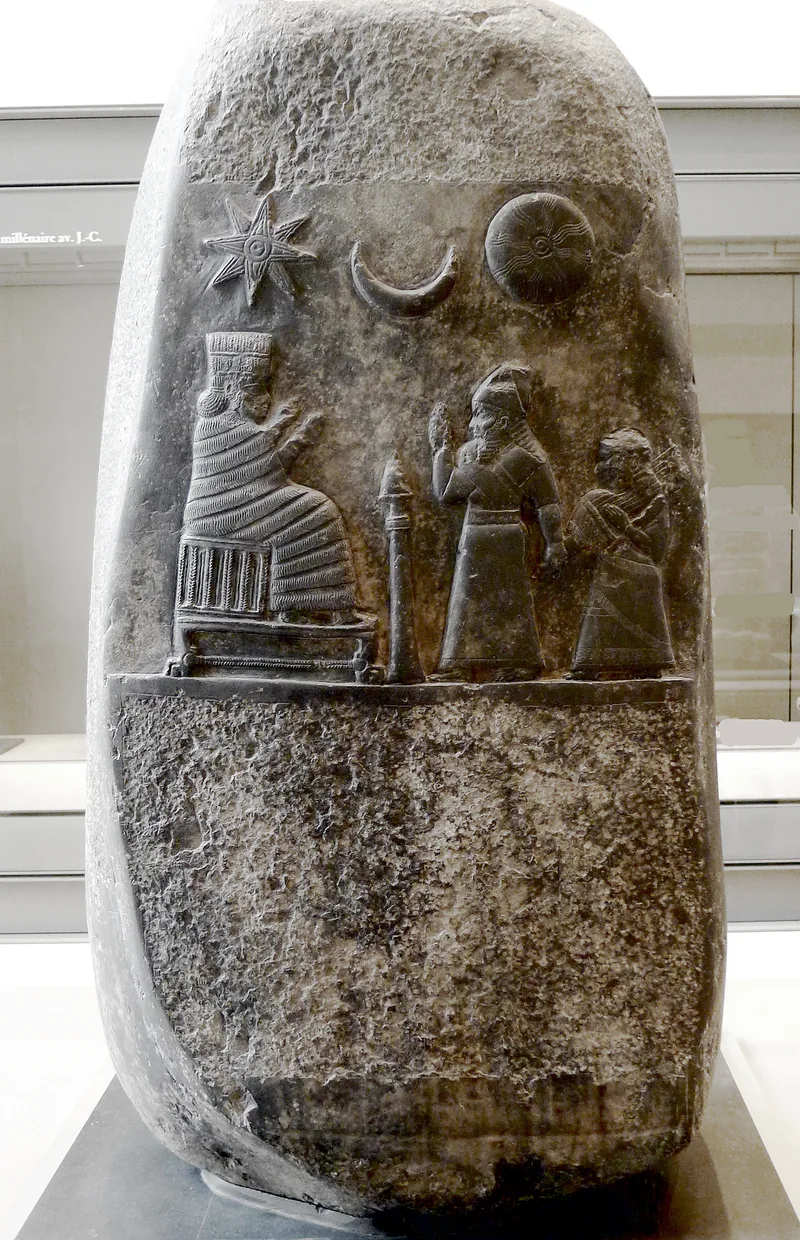
None of these symbols uses arrows, and none stands for chaos. Moorcock's design was an original invention for a work of fiction, and its later life as a magical emblem is a characteristically modern story of a symbol moving from popular culture into practice. Readers interested in older emblems can compare the entries in Occult Symbols.
The word "chaos" itself is ancient. In Hesiod's Theogony (around 700 BC), Chaos is the first thing to come into being, a yawning void from which the other primordial powers emerge. Later Greek and Roman writers came to understand it as a formless mass of mixed elements, the raw material that the ordering power of the gods shaped into a cosmos. Moorcock's Chaos and the chaos magicians' Chaos both inherit something of this sense of a creative, formless origin.
Michael Moorcock, Law and Chaos§
Michael Moorcock (born 1939) began publishing the stories of Elric of Melniboné, an albino sorcerer-emperor bound to a soul-drinking sword, in the British magazine Science Fantasy in 1961. Elric was the first of many incarnations of what Moorcock called the Eternal Champion, a hero reborn across a "multiverse" of worlds in which the cosmic powers of Law and Chaos struggle, each restrained by a third principle, the Cosmic Balance.
Moorcock deliberately rejected the moral simplicity of much earlier fantasy. In his stories neither Law nor Chaos is simply good or evil: Law, unchecked, produces sterile tyranny, while Chaos, unchecked, dissolves everything into meaningless flux. Moorcock has said that he devised the eight-arrowed symbol himself while working on these early stories, and it became attached to the Lords of Chaos in his fiction and in the illustrations and covers of his books. His framework was also an influence on the "Law versus Chaos" alignments of early role-playing games, which drew on Moorcock alongside Poul Anderson's Three Hearts and Three Lions (1961).
For a generation of readers in the 1960s and 1970s, many of them involved in the counterculture, rock music and occult experiment, Moorcock's Chaos was an attractive myth: a force of freedom and transformation against rigid order. Moorcock himself worked with the space-rock band Hawkwind, and his imagery circulated well beyond the readers of fantasy fiction.
From Fiction to Magic: The Chaosphere of Chaos Magick§
When British magicians around Peter J. Carroll and Ray Sherwin began calling their approach "chaos magic" in the late 1970s, the borrowing of Moorcock's symbol was almost inevitable. By the early 1980s the eight-arrowed star had become their emblem. The Illuminates of Thanateros used it in the form of the chaosphere, a sphere from which eight arrows radiate in three dimensions, and the design appeared on book covers, ritual objects and members' jewellery.

The adoption expressed several ideas at once. Carroll's Liber Null identified "Chaos" as the unknowable creative source of the universe, and the star became its visual sign. Using a symbol from a fantasy novel also announced one of the movement's principles: that a symbol's power lies in how it is used, not in its antiquity. Chaos magicians would later extend the same logic to deities and spirits drawn from fiction, a practice discussed in Pop-Culture Magic.
Practitioners use the chaos star in several ways: as a focus for meditation, as a central image in group rituals, as a sign of affiliation, and as a component of sigils and talismans. Some draw it with a circle of arrows on the floor of a ritual space, in a manner loosely modelled on the magic circles of the grimoires.
The Eight Arrows and the Eight Colours of Magic§
In Liber Kaos (1992) Carroll divided magic into eight "colours", each associated with a type of goal, and these are often mapped onto the eight arrows of the star. The scheme assigns octarine to "pure" magic, black to death, blue to wealth, red to war, yellow to the ego, green to love, orange to thinking and purple to sex. Octarine, a colour visible only to wizards, was borrowed from Terry Pratchett's The Colour of Magic (1983), a further instance of chaos magick's playful use of fiction.
A coloured chaos star, with each arrow painted its own colour, has become one of the most recognisable images of the movement. The eight colours function rather like the planetary correspondences of Renaissance magic: they classify desires and suggest appropriate symbols, moods and techniques. Carroll and later writers present them as a convenient modern framework rather than an ancient or exclusive system.
Some practitioners also interpret the eight arrows in other ways: as directions in space, as the eight phases of a cycle, or as the many possible paths open to a magician who has refused the single arrow of Law. The Discordians, whose goddess Eris presides over chaos, sometimes combine the star with their golden apple.
The Chaos Star in Games, Music and Popular Culture§
The chaos star's career in popular culture has been at least as significant as its use in magic. From the 1980s the British company Games Workshop made an eight-pointed star of Chaos central to its Warhammer fantasy and science-fiction settings, which in turn influenced many video games. The symbol appears widely in heavy metal and other music scenes, in tattoos, and in comics. In the twenty-first century it has also been used, in various forms, as a general emblem of anarchy, disorder or nonconformity, often by people with no knowledge of its origin.
This wide diffusion means that the chaos star carries different meanings in different settings: fictional villainy in a war game, the creative void in a chaos magick ritual, a statement of personal freedom on a tattoo. That range is fitting for a symbol designed to point in all directions. The broader relationship between occult imagery and popular culture is traced in Magic and Culture.
Frequently asked questions§
What does the chaos star mean?§
The chaos star represents chaos as limitless possibility: eight arrows pointing in all directions, in contrast to the single arrow of Law. In chaos magick it symbolises the creative, unknowable source of things and the freedom to adopt any belief or method.
Who created the chaos star?§
The fantasy writer Michael Moorcock devised the eight-arrowed symbol of Chaos for his Eternal Champion stories, which began with the Elric tales of the early 1960s. Chaos magicians adopted it from his fiction around 1980.
Is the chaos star an ancient symbol?§
No. Although eight-pointed stars are ancient, such as the Mesopotamian star of Ishtar, the arrowed chaos star is a twentieth-century invention. Its use in magic dates from the late 1970s and early 1980s.
What is the chaosphere?§
The chaosphere is a three-dimensional version of the chaos star, a sphere from which eight arrows radiate. It became the emblem of the Illuminates of Thanateros and is widely used by chaos magicians as a focus for ritual and meditation.
Sources and further reading§
- Elric of Melniboné — Michael Moorcock, 1972
- Liber Null & Psychonaut — Peter J. Carroll, 1987
- Liber Kaos — Peter J. Carroll, 1992
- The Colour of Magic — Terry Pratchett, 1983
- Theogony and Works and Days — Hesiod (trans. M. L. West), 1988
- Condensed Chaos: An Introduction to Chaos Magic — Phil Hine, 1995
- The History of British Magick After Crowley — Dave Evans, 2007