Liber V · Chaos Magick · Chapter III: Magic & Culture
Magic and Culture: Occultism in Art, Music, Comics and Film
How magic shaped modern culture: occultism in Symbolist and abstract art, rock and industrial music, comics by Alan Moore and Grant Morrison, and horror film.

Magic and culture have been intertwined throughout the modern period: occult ideas shaped Symbolist poetry, early abstract painting, Surrealism, rock and industrial music, comics, horror cinema and video games, while popular culture in turn supplied magicians with new symbols, deities and methods. Scholars describe this two-way traffic with terms such as "occulture" and the "re-enchantment" of the West.
Occultism and the Arts at the Fin de Siècle§
The occult revival of the late nineteenth century coincided with a remarkable flowering of esoteric art. In Paris, the novelist and critic Joséphin Péladan organised the Salons de la Rose+Croix (1892–1897), exhibitions of idealist and Symbolist painting intended to restore a spiritual mission to art. Writers including Joris-Karl Huysmans, whose novel Là-bas (1891) dramatised Satanism in Paris, explored the borders of mysticism and decadence.
In Britain, the poet W. B. Yeats was a dedicated member of the Hermetic Order of the Golden Dawn, and his poetry and later system in A Vision (1925) are steeped in magical symbolism. Arthur Machen and Algernon Blackwood, both connected with the order, wrote supernatural fiction that shaped modern horror. Pamela Colman Smith, an artist in the same milieu, designed the images of the Rider-Waite-Smith tarot (1909), the most influential deck of the twentieth century, as described in The History of Tarot.
Theosophy and the Birth of Abstract Art§
Theosophy, founded in 1875, had an unexpectedly large influence on modern painting. Wassily Kandinsky's Concerning the Spiritual in Art (1911) cited Theosophical ideas about colour, vibration and spiritual evolution, and Annie Besant and Charles Leadbeater's Thought-Forms (1901), with its coloured illustrations of thoughts and emotions, circulated among artists. Piet Mondrian joined the Theosophical Society in 1909, and his later grids were meant to express universal harmony.
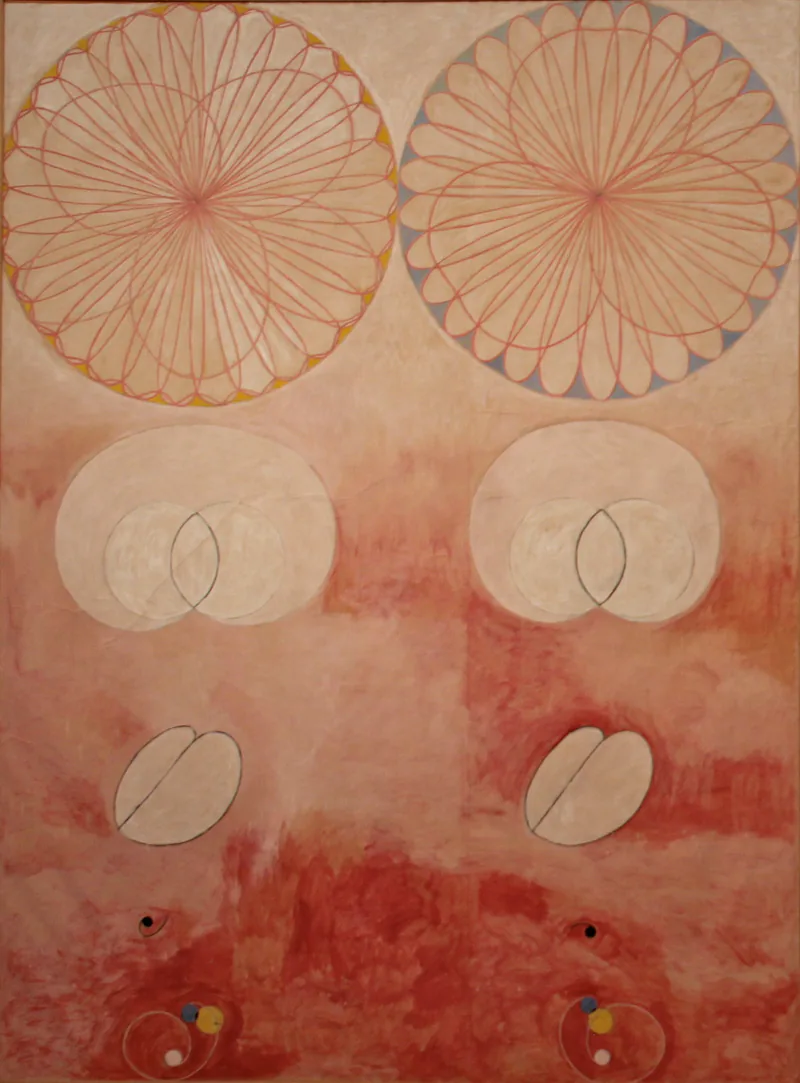
The Swedish painter Hilma af Klint, who took part in séances with a group of women known as "The Five", produced large abstract canvases from 1906 onward, including her Paintings for the Temple, which she believed were guided by higher beings. Exhibitions since the 1980s, and especially the major retrospectives of the 2010s, have prompted art historians to reconsider the occult roots of abstraction.
Surrealism, the Artist-Magician and Austin Spare§
The Surrealists, led by André Breton, valued automatism, dreams and the marvellous, and many were fascinated by alchemy, tarot and magic. Breton's Arcane 17 (1945) takes its title from a tarot trump, and painters such as Leonora Carrington, Remedios Varo and Kurt Seligmann, author of The Mirror of Magic (1948), drew heavily on esoteric imagery.
Austin Osman Spare (1886–1956) embodied the artist as magician. A gifted draughtsman who exhibited at the Royal Academy as a teenager, he fused drawing and magical practice in his "automatic" art and his method of sigils, explained in Sigils. Largely forgotten at his death, he was rediscovered in the 1970s and became the patron figure of chaos magic, as described in Chaos Magick.
Crowley, Rock Music and the Counterculture§
Aleister Crowley enjoyed a remarkable posthumous career in popular music. His face appears among the crowd on the cover of the Beatles' Sgt. Pepper's Lonely Hearts Club Band (1967). David Bowie named him in the song "Quicksand" (1971). Jimmy Page of Led Zeppelin collected Crowley's books and manuscripts and bought Boleskine House, Crowley's former home on Loch Ness, in the early 1970s. The filmmaker Kenneth Anger, a devoted Thelemite, created ritual films such as Inauguration of the Pleasure Dome (1954) and Lucifer Rising (completed 1980), which linked avant-garde cinema, rock music and magic.

Black Sabbath's dark imagery from 1970 inaugurated heavy metal's long flirtation with the occult, which deepened in later decades with black metal in Scandinavia. In Britain, Genesis P-Orridge's bands Throbbing Gristle and Psychic TV, and the associated network Thee Temple ov Psychick Youth (1981), made sigil magic part of industrial and experimental music culture. Not all musicians who used occult imagery practised magic; many used it as provocation or aesthetics, a fact often lost in the Satanic Panic of the 1980s.
Comics, Fiction and "Pop Magic"§
Two British comics writers made the link between magic and fiction explicit. Alan Moore announced in 1993 that he had become a magician, and works such as From Hell (1989–1996) and Promethea (1999–2005) explore Kabbalah, tarot and the theory that art and magic are the same activity, the manipulation of symbols to change consciousness. Grant Morrison's The Invisibles (1994–2000) was conceived, its author said, as a "hypersigil", a long-running work of fiction designed to act magically on the author's life. Morrison's essay "Pop Magic!" (2003) encouraged readers to use pop culture icons as gods and sigils.
Fiction has also provided magicians with material. H. P. Lovecraft's invented gods were taken up by Kenneth Grant and others, and several grimoires titled Necronomicon, presenting Lovecraft's fictional book as real, appeared from the 1970s. Practitioners of chaos magic and "pop culture magic" deliberately work with fictional characters, a practice discussed in What Is Chaos Magick?
Horror Film and the Public Image of Magic§
For most people, images of magic come from film and television. Dennis Wheatley's novels, such as The Devil Rides Out (1934), and their film adaptations shaped British fears of Satanism. Rosemary's Baby (1968), The Exorcist (1973) and The Wicker Man (1973) brought diabolism, possession and paganism into mainstream cinema, while later films such as The Craft (1996) helped inspire a generation of young witches. Children's fantasy, from Tolkien to Harry Potter, popularised a fantasy idea of magic that is quite different from historical practice, and sometimes provoked religious objections.
Video games, role-playing games and the "witch aesthetic" of social media continue the process. Scholars note that such representations both distort and spread occult ideas, sometimes drawing new practitioners into the movements described in Contemporary Occultism. Tools that began as parlour games, such as the Ouija board, show how easily objects move between entertainment, religion and fear.
Frequently asked questions§
Which famous artists were influenced by the occult?§
W. B. Yeats, Wassily Kandinsky, Piet Mondrian, Hilma af Klint, Leonora Carrington and Austin Osman Spare are among the best-known examples. Many Symbolist and Surrealist artists drew on esoteric symbolism, and several belonged to occult or Theosophical organisations.
Why is Aleister Crowley on the Sgt. Pepper cover?§
The Beatles' cover gathered figures the band admired or found interesting, and Crowley was chosen as an icon of rebellion and the counterculture. His inclusion reflected his growing status as a symbol rather than any formal involvement of the band with Thelema.
What is a hypersigil?§
"Hypersigil" is Grant Morrison's term for an extended work of art, such as a comic series or novel, created as a magical act intended to influence the creator's life. It expands the chaos magic idea of the sigil into narrative form.
Did heavy metal bands practise Satanism?§
Most did not. Many used occult and Satanic imagery for shock or aesthetic effect. A minority of musicians, especially in parts of the black metal scene, did hold Satanic or left-hand path views.
Sources and further reading§
- The Re-Enchantment of the West — Christopher Partridge, 2004–2005
- Concerning the Spiritual in Art — Wassily Kandinsky, 1911
- Thought-Forms — Annie Besant and C. W. Leadbeater, 1901
- The Mirror of Magic — Kurt Seligmann, 1948
- The Place of Enchantment: British Occultism and the Culture of the Modern — Alex Owen, 2004
- Lords of Chaos: The Bloody Rise of the Satanic Metal Underground — Michael Moynihan and Didrik Søderlind, 1998
- Book of Lies: The Disinformation Guide to Magick and the Occult — Richard Metzger (ed.), 2003
- Supergods — Grant Morrison, 2011
- Zos Speaks! Encounters with Austin Osman Spare — Kenneth Grant and Steffi Grant, 1998
- Occultism in a Global Perspective — Henrik Bogdan and Gordan Djurdjevic (eds), 2013