Liber VII · Divination · Chapter XIII: Tarot History
History of Tarot: From Italian Card Game to Occult Oracle
The history of tarot: 15th-century Italian tarocchi, Visconti-Sforza decks, Marseille cards, Court de Gébelin, Etteilla, Lévi, Rider-Waite-Smith and Thoth.

Tarot began in fifteenth-century northern Italy as a pack of playing cards, the carte da trionfi or tarocchi, used for a trick-taking game, and was not associated with divination or occult symbolism until the late eighteenth century. The idea that tarot preserves ancient Egyptian wisdom was launched in Paris in 1781; it was elaborated by French occultists such as Etteilla and Éliphas Lévi, systematised by the Hermetic Order of the Golden Dawn, and gave rise to the Rider-Waite-Smith (1909) and Thoth decks that shape modern tarot.
Origins in fifteenth-century Italy§
Ordinary playing cards with four suits reached Europe from the Islamic world, probably via Mamluk Egypt, in the 1370s. Italian decks used the suits of cups, swords, coins and batons, which survive in tarot as the four suits of the minor arcana. Around the 1430s–1440s, in the courts of northern Italy, someone added a fifth series of picture cards that functioned as permanent trumps, together with an unnumbered card, the Fool, which acted as an "excuse." The new pack was called carte da trionfi, "cards of the triumphs"; the word tarocchi appears only in the early sixteenth century, and its etymology is unknown.
Documentary references to trionfi cards appear in Ferrara in 1442, and the earliest surviving cards come from Milan. The game played with them was a trick-taking game, the ancestor of a family of games still played in France (jeu de tarot), Austria, Italy and elsewhere. The images on the trumps drew on familiar late medieval themes: virtues such as Justice, Fortitude and Temperance; the Wheel of Fortune; Death; the Pope and Emperor; the celestial bodies; and the Last Judgement. Their ordering echoed the Petrarchan theme of "triumphs," processions in which each figure is overcome by a greater one.
The Visconti-Sforza decks§
The most famous early tarot cards are the hand-painted decks associated with the Visconti and Sforza dukes of Milan, especially Filippo Maria Visconti (d. 1447) and his son-in-law Francesco Sforza. Painted in tempera on card with gold and silver leaf, they were luxury objects. No single deck survives complete; cards are scattered among collections, notably the Pierpont Morgan Library and Accademia Carrara set (often called the Colleoni or Pierpont Morgan–Bergamo deck), the Cary-Yale deck at Yale, and the Brera-Brambilla deck in Milan. Several cards are attributed to the painter Bonifacio Bembo, though attribution is debated.
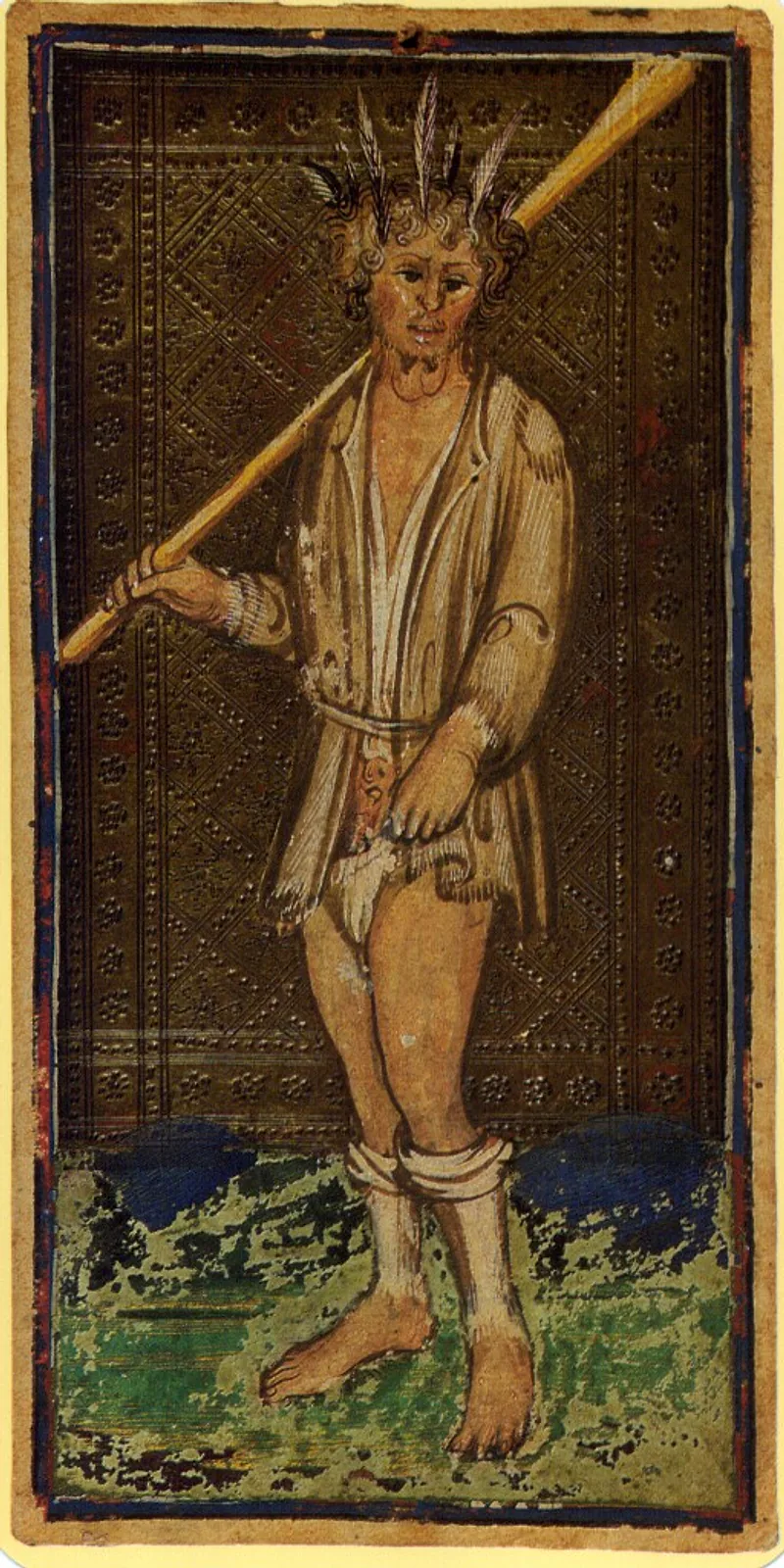
These decks show courtly dress, heraldic devices of the Visconti and Sforza, and trumps without numbers or titles. Their imagery is unmistakably that of the Christian Renaissance court, which is one reason historians reject theories of an exotic or secret origin.
The Tarot de Marseille and the spread of the game§
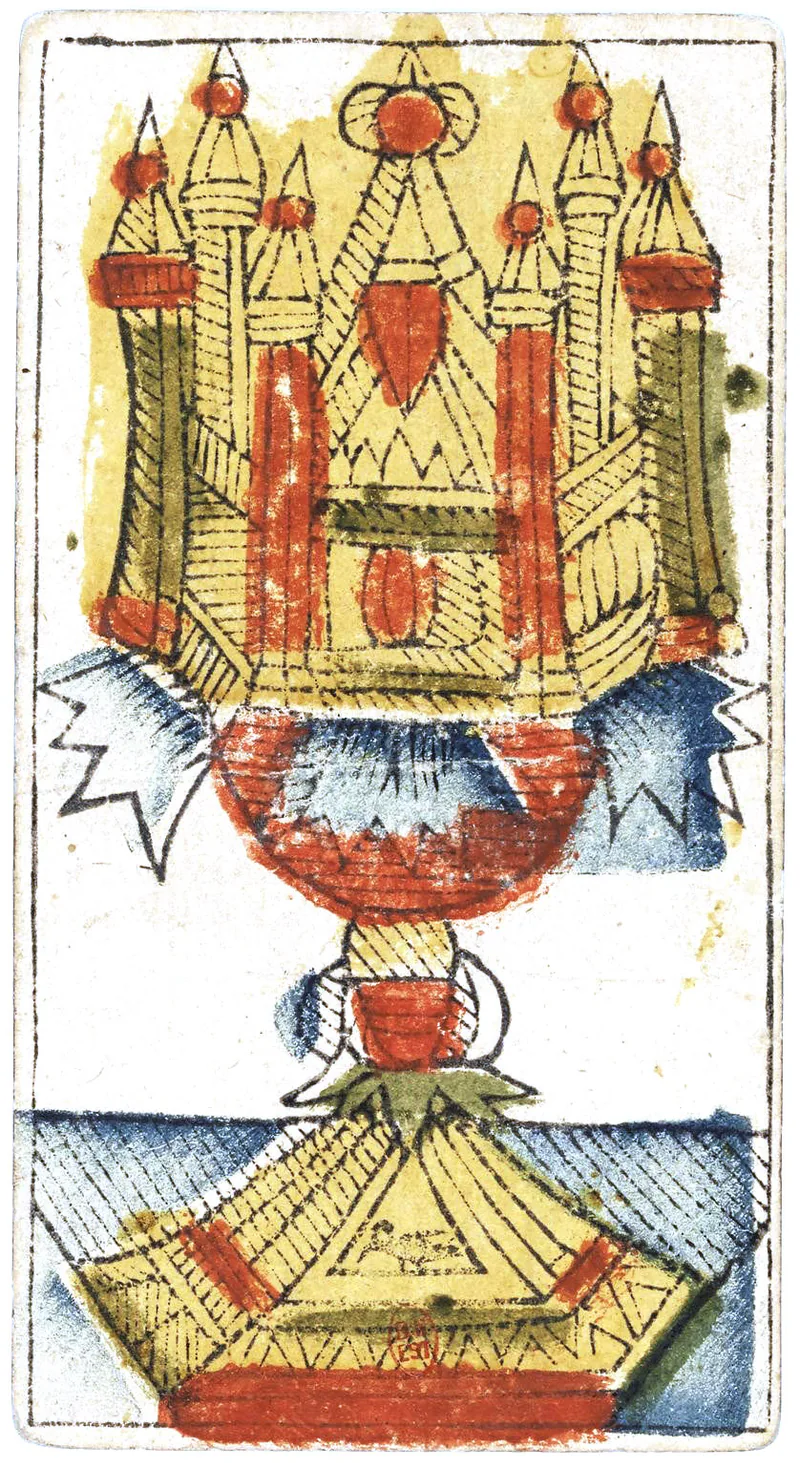
As the game spread, cheaper woodcut decks appeared. From the sixteenth and seventeenth centuries a standardised design developed that collectors in the twentieth century came to call the Tarot de Marseille, after the city where many were printed in the eighteenth century, though similar patterns were produced elsewhere in France and Switzerland. The Marseille pattern fixed many conventions: the numbering of the trumps in Roman numerals, French titles such as Le Bateleur (the Magician), La Papesse (the High Priestess) and La Maison Dieu (the Tower), and the order with Justice at VIII and Strength at XI. Notable surviving Marseille decks include those of Jean Noblet (mid-seventeenth century), Jean Dodal (early eighteenth) and Nicolas Conver (1760).
Court de Gébelin and the Egyptian theory of 1781§
The transformation of tarot into an occult object happened suddenly. In 1781 the Protestant pastor and scholar Antoine Court de Gébelin (1725–1784) published, in the eighth volume of his encyclopedic Le Monde primitif, an essay claiming that the tarot was a surviving book of ancient Egyptian wisdom, the "Book of Thoth," disguised as a game to escape destruction. The volume also included an essay by the Comte de Mellet, who connected the 22 trumps to the 22 letters of the Hebrew alphabet and proposed their use in divination.
Court de Gébelin had no evidence beyond his own interpretation of the images, and Egyptian hieroglyphs were not deciphered until Champollion's work in 1822, which revealed nothing of the kind. Yet the claim proved extraordinarily durable, and the "Egyptian tarot" remains part of popular belief.
Etteilla and the first divinatory tarot§
Building directly on Court de Gébelin, the Parisian cartomancer Jean-Baptiste Alliette, who wrote under the reversed name Etteilla (1738–1791), published works on using tarot for fortune-telling from 1783. He produced around 1789 what is generally regarded as the first deck designed specifically for divination, with redesigned cards, assigned meanings for upright and reversed positions, and astrological attributions. He also founded a society devoted to the study of the "Book of Thoth." Earlier cartomancy with ordinary playing cards existed, but Etteilla established tarot as the cartomancer's tool.
Éliphas Lévi and the Kabbalistic tarot§
In the mid-nineteenth century, Éliphas Lévi (Alphonse-Louis Constant, 1810–1875) reinterpreted the tarot within his synthesis of magic, Kabbalah and Catholic mysticism. In Dogme et rituel de la haute magie (1854–56) he linked the 22 trumps to the 22 Hebrew letters in a different arrangement from de Mellet's, treated the tarot as a universal key to occult science and connected the four suits to the letters of the divine name. Lévi dismissed Etteilla as a vulgariser. His followers in the French occult revival, including Papus (Gérard Encausse), whose Le Tarot des Bohémiens appeared in 1889, and Oswald Wirth, who designed a deck in 1889, carried this approach forward.
The Golden Dawn, Rider-Waite-Smith and the Thoth deck§
The Golden Dawn system§
The Hermetic Order of the Golden Dawn, founded in London in 1888, integrated tarot into a comprehensive system of correspondences. It assigned the trumps to the Hebrew letters and to the 22 paths on the Tree of Life, switched the positions of Strength and Justice to fit astrological attributions, connected the numbered cards to the ten sefirot and the court cards to the elements, and used tarot for meditation and visionary "scrying." The order's teachings circulated in manuscript to initiates.
Rider-Waite-Smith (1909)§
In 1909 the Golden Dawn member Arthur Edward Waite (1857–1942) commissioned the artist Pamela Colman Smith (1878–1951) to design a new deck, published in London by William Rider & Son. Its most influential innovation was Smith's illustration of all 56 minor arcana cards with scenes of people and actions, rather than simple arrangements of pips, partly inspired by the Sola Busca tarot (c. 1490), photographs of which Smith is thought to have seen at the British Museum. Waite's The Pictorial Key to the Tarot (1910) accompanied the deck. Long called the "Rider-Waite" deck, it is now often named Rider-Waite-Smith to acknowledge Smith, who received little credit or money during her lifetime. It became the most widely used tarot of the twentieth century and the model for countless later decks.
The Thoth tarot§
Aleister Crowley designed the Thoth deck with the painter Lady Frieda Harris between 1938 and 1943. It reworks the Golden Dawn system in the light of Crowley's Thelemic teachings, renaming several trumps (Lust, Art, the Aeon) and making dense use of astrological, alchemical and Kabbalistic symbolism. Crowley's The Book of Thoth appeared in 1944; the deck itself was not published until 1969, after both creators had died.
Michael Dummett and the scholarly history of tarot§
The modern understanding of tarot history owes most to Sir Michael Dummett (1925–2011), the Oxford philosopher of logic, who turned his expertise to card history. In The Game of Tarot (1980) and, with Ronald Decker and Thierry Depaulis, A Wicked Pack of Cards (1996) and A History of the Occult Tarot, 1870–1970 (2002), he documented tarot's origin as a game and traced the invention of the occult tarot from 1781 onward. Scholars such as Helen Farley have built on this work. Their conclusion is now the consensus: tarot is a Renaissance Italian invention, its occult meanings a later and fascinating chapter in the history of Western esotericism. Practitioners today often accept this history while continuing to find tarot valuable as a tool for reflection and divination.
Frequently asked questions§
Did tarot come from ancient Egypt?§
No. The Egyptian origin was proposed by Antoine Court de Gébelin in 1781 without evidence. Surviving cards and documents show that tarot was invented in northern Italy in the fifteenth century as a deck for a card game.
When did tarot start being used for divination?§
Tarot was linked to divination in the 1780s, after Court de Gébelin's essay. Etteilla published methods of tarot cartomancy from 1783 and produced the first deck specifically designed for fortune-telling around 1789.
Who drew the Rider-Waite tarot?§
The cards were drawn by Pamela Colman Smith under the direction of Arthur Edward Waite and published by Rider in 1909. Because her role was long underplayed, many now call it the Rider-Waite-Smith deck.
What is the oldest surviving tarot deck?§
The oldest surviving tarot cards are the hand-painted Visconti and Visconti-Sforza decks from Milan, made around the 1440s and 1450s. None survives complete; their cards are divided among several museums and libraries.
Sources and further reading§
- The Game of Tarot: From Ferrara to Salt Lake City — Michael Dummett, 1980
- A Wicked Pack of Cards: The Origins of the Occult Tarot — Ronald Decker, Thierry Depaulis and Michael Dummett, 1996
- A History of the Occult Tarot, 1870–1970 — Ronald Decker and Michael Dummett, 2002
- A Cultural History of Tarot — Helen Farley, 2009
- The Pictorial Key to the Tarot — A. E. Waite, 1910
- The Book of Thoth — Aleister Crowley, 1944
- Le Monde primitif, vol. 8 — Antoine Court de Gébelin, 1781
- Dogme et rituel de la haute magie — Éliphas Lévi, 1854–56