Liber VII · Divination · Chapter IX: Numerology
Abjad Numerology: Arabic Letter Numbers in Islamic Tradition
Abjad numerology explained: Arabic letter values, chronograms, 786 for the basmala, name divination, the Hurufis, the Babi 19 and Islamic views of it.

Abjad numerology is the use of the numerical values of the Arabic letters, in the order known as abjad, to calculate the value of words and names. Called ḥisāb al-jummal ("calculation of totals") in Arabic, it was used across the Islamic world for dating by chronogram, for poetry and inscriptions, for the lettrist "science of letters", and for popular divination about names, marriages and contests. It is the Arabic counterpart of Hebrew gematria and Greek isopsephy.
The Abjad System and Its Letter Values§
The Arabic alphabet as it is now taught is arranged by the shape of the letters. The older abjad order, which takes its name from its first four letters (alif, ba, jim, dal), follows the sequence of the Northwest Semitic alphabet shared with Hebrew, Aramaic and Phoenician. The six letters that Arabic has and Hebrew lacks were added at the end. Each letter has a value, by units, tens and hundreds, as in the Hebrew and Greek alphabetic numerals:
| Units | Tens | Hundreds | Thousand |
|---|---|---|---|
| alif 1, ba 2, jim 3, dal 4, ha 5, waw 6, zay 7, ḥa 8, ṭa 9 | ya 10, kaf 20, lam 30, mim 40, nun 50, sin 60, ʿayn 70, fa 80, ṣad 90 | qaf 100, ra 200, shin 300, ta 400, tha 500, kha 600, dhal 700, ḍad 800, ẓa 900 | ghayn 1000 |
Students memorised the sequence with eight nonsense words: abjad, hawwaz, ḥuṭṭī, kalaman, saʿfaṣ, qarashat, thakhadh, ḍaẓagh. The North African (Maghribi) tradition uses a slightly different order and assigns different values to six letters (ṣād, ḍād, sīn, shīn, ẓāʾ and ghayn), so the same word can have two values depending on region.
Before Indian ("Arabic") numerals spread in the Islamic world from about the ninth century, abjad letters served as ordinary numerals in astronomy and administration, and they remained in use in astronomical tables for centuries. A few examples of word values often cited in devotional literature: Allāh = 66 (1 + 30 + 30 + 5), Muḥammad = 92 (40 + 8 + 40 + 4) and ʿAlī = 110 (70 + 30 + 10).
Chronograms: Writing Dates in Words§
The most admired literary use of abjad was the chronogram (Persian māddah-yi tārīkh, Ottoman Turkish tarih), a phrase or line of verse whose letters add up to the year of the event it commemorates in the Islamic hijri calendar. Poets composed chronograms for births, accessions, victories, deaths and the completion of buildings, and they were carved on mosques, fountains, tombstones and gates from the Balkans to India. A skilful chronogram had to make sense as poetry, refer aptly to the event, and add up correctly, often signalled by a phrase such as "its date is" placed before the counted words.
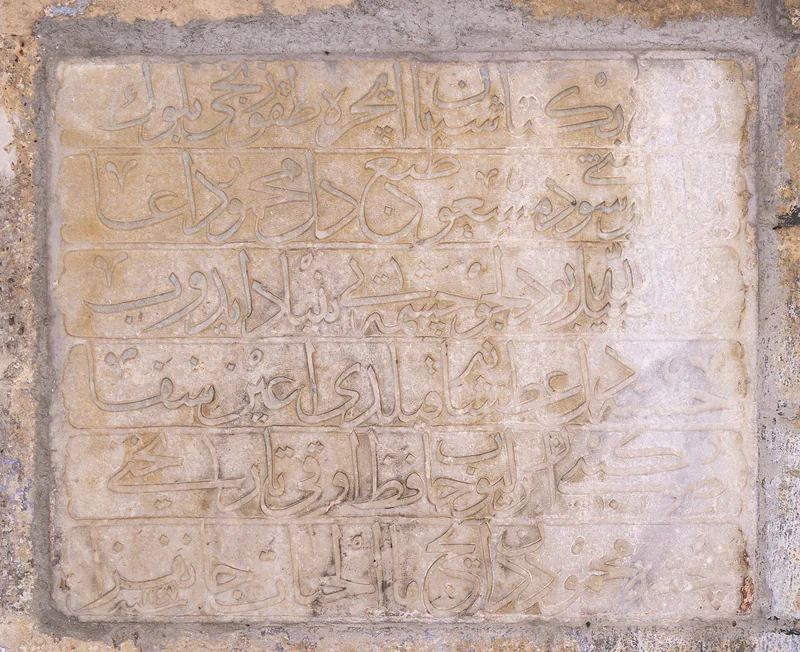
The art flourished especially in Persian, Ottoman and Mughal culture between the fifteenth and nineteenth centuries, and many dates in Islamic history are known from chronograms. For historians, chronograms are a practical source; for the culture that produced them, they expressed the conviction that language, number and time interlock.
786 and Devotional Uses in South Asia§
In South Asia and among its diaspora, the number 786 is widely written at the head of letters, documents, shop signs and wedding invitations. It is the abjad value of the basmala, the phrase bismillāh al-raḥmān al-raḥīm ("In the name of God, the Compassionate, the Merciful"), which opens all but one of the suras of the Qur'an. Writing the number avoids placing the sacred words on paper that may be thrown away. Some scholars have criticised the custom as an innovation that substitutes a number for God's name, and the debate continues.
Other devotional practices use abjad values to fix the number of times a divine name or prayer is to be repeated in dhikr, the remembrance of God; for example, a name might be recited as many times as its numerical value. Such practices are found in many Sufi orders, especially in the circles influenced by the science of letters.
The Science of Letters, Sufism and the Hurufis§
In Islamic esotericism, abjad values are the arithmetic of the science of letters (ʿilm al-ḥurūf), which treated the letters as the building blocks of creation and linked them to elements, planets and divine names. The lettrist tradition associated with Ahmad al-Buni (d. 1225), the magic squares (wafq) inscribed on talismans and the debate over their legitimacy are described in the Islamic occult sciences. The Andalusian mystic Ibn ʿArabi (1165–1240) devoted a long chapter of his Meccan Revelations to the letters, their degrees and their numbers, treating them as a key to the divine names; see Sufism.
In the late fourteenth century, the Persian mystic Fadlallah Astarabadi founded the Hurufi ("letterist") movement, which taught that God is manifested in the letters of the alphabet and in the human face, whose features he matched to the thirty-two letters of the Persian alphabet. Fadlallah was executed in 1394, and his follower the poet Nesimi was put to death in Aleppo in the early fifteenth century; Hurufi ideas later influenced the Bektashi order.
Abjad also shaped two nineteenth-century religious movements. The Bab (1819–1850) organised his teaching around 19, the value of wāḥid ("one"), and created a calendar of nineteen months of nineteen days, kept by the Baha'i Faith. Baha'is regard 9, the value of Bahāʾ ("glory"), as a symbol of completeness, which is why the nine-pointed star is their common emblem. In the 1970s the Egyptian-American chemist Rashad Khalifa (1935–1990) claimed to find a mathematical structure of 19s in the Qur'an, based on the verse "over it are nineteen" (74:30); his later claims, including the rejection of two verses, were rejected by mainstream Muslim scholars.
Abjad Divination: Names, Marriages and Contests§
Alongside these learned uses, abjad supported popular divination, attested in Arabic, Persian, Ottoman, Malay and other manuscripts. Typical methods included:
- Victor and vanquished. The values of two rivals' names are each divided by a fixed number (often 9) and the remainders compared on a table to predict which will prevail in a battle, lawsuit or game. This is closely related to the medieval European onomancy tables known as the "Sphere of Pythagoras".
- Marriage compatibility. The values of a couple's names, sometimes with their mothers' names, are added and divided by 4, 9 or 12; the remainder is matched to an element or zodiac sign to judge harmony.
- Illness and travel. A patient's name, the day of the week and the lunar mansion are combined to forecast recovery or the right day for a journey.
- Choosing names. Families consulted specialists to choose a child's name whose value suited the birth time or matched the parents' names.
Such practices still exist in some communities, particularly in South Asia, West Africa and Southeast Asia, often in the hands of religious specialists who also make amulets. They are described here historically; like all divination, they are no substitute for medical, legal or financial advice.
Islamic Views of Abjad Numerology§
Muslim attitudes have long distinguished between uses. Abjad as a system of numerals, as a mnemonic and as a poetic device for chronograms has been broadly accepted, and some early Qur'an commentators discussed abjad values in connection with the mysterious separated letters (al-ḥurūf al-muqaṭṭaʿāt) that open certain suras. Its use to foretell the future, by contrast, has often been condemned as a form of forbidden divination (kahāna), and the historian Ibn Khaldun, in his Muqaddimah (1377), dismissed letter magic and the related divinatory device known as the zāʾirja as unfounded. Modern reformist and Salafi scholars are especially critical, while many Sufi and popular traditions continue to value the science of letters.
The parallels with Jewish and Christian practice are close. Hebrew gematria reads the Bible through letter values; Christian writers read the numbers of Scripture allegorically, as described in biblical numerology; and modern Western numerology applied the same principle to the Latin alphabet, as told in Numerology: A Complete Guide.
Frequently asked questions§
What is abjad numerology?§
It is the system of giving each Arabic letter a numerical value, from alif (1) to ghayn (1000), and adding the values of words and names. It was used for numerals, chronograms, devotional practice, the science of letters and popular divination.
Why do Muslims write 786?§
In South Asia, 786 is the abjad value of the basmala, "In the name of God, the Compassionate, the Merciful". It is written as a substitute for the phrase so that the sacred words are not discarded with ordinary paper, though some scholars object to the custom.
Is abjad the same as Hebrew gematria?§
They are closely related. Both follow the old Semitic alphabet order and assign values by units, tens and hundreds; Arabic adds six letters at the end with values from 500 to 1000.
Is abjad numerology allowed in Islam?§
Using abjad for numerals, dating and poetry is widely accepted. Using it to predict the future has been condemned by many scholars as forbidden divination, though popular and Sufi practices that use letter values have persisted.
Sources and further reading§
- The Mystery of Numbers — Annemarie Schimmel, 1993
- Mystical Dimensions of Islam — Annemarie Schimmel, 1975
- The Muqaddimah: An Introduction to History — Ibn Khaldun, trans. Franz Rosenthal, 1958
- Islamic Occultism in Theory and Practice — Liana Saif, Francesca Leoni, Matthew Melvin-Koushki and Farouk Yahya (eds.), 2020
- Magic and Divination in Malay Illustrated Manuscripts — Farouk Yahya, 2016
- Coran et talismans: Textes et pratiques magiques en milieu musulman — Constant Hamès (ed.), 2007