Liber VII · Divination · Chapter IX: Numerology
Biblical Numerology: Augustine, Bede and Christian Numbers
Biblical numerology and Christian number symbolism from Augustine and Bede to Bullinger and the Bible Code, and how the churches have viewed numerology.

Biblical numerology is the interpretation of the numbers in Scripture as bearers of spiritual meaning, a practice that Christian writers inherited from Jewish exegesis and Pythagorean philosophy and developed into a learned discipline from Augustine (354–430) and Bede (c. 673–735) onward. It differs from modern personal numerology: its aim was to understand the hidden sense of the Bible and the order of creation, not to read an individual's character or future.
Numbers in Scripture: Counts, Patterns and Symbols§
The Bible is full of numbers, and many are simply records: censuses, ages, measurements, regnal years. Others clearly carry symbolic weight. Seven structures the creation week and the Sabbath, and the Book of Revelation is built on series of seven seals, trumpets and bowls; twelve marks the tribes of Israel and the apostles; forty recurs in periods of testing; and Revelation 13:18 invites the reader to "count the number of the beast", which is 666. The short overview of these numbers in number symbolism can be read alongside this article.
Biblical scholars generally accept that ancient Jewish and Christian authors used numbers rhetorically and symbolically, as did their neighbours. The 666 of Revelation is widely explained as the gematria of "Nero Caesar" in Hebrew letters, and its variant 616 as a different spelling of the same name; on the Hebrew method see gematria. Revelation's 144,000 (twelve times twelve times a thousand) expresses the completeness of the people of God. A verse from the Wisdom of Solomon, in the Greek Old Testament, gave later interpreters their charter: God has "ordered all things in measure and number and weight" (Wisdom 11:20).
Augustine and the Christian Science of Number§
Augustine of Hippo, trained in classical rhetoric and familiar with Platonist and Pythagorean ideas, made number interpretation a recognised part of Christian learning. In On Christian Doctrine (De doctrina christiana, begun in 396 and completed in 426–427) he argued that a Christian interpreter needs some knowledge of number, because many passages that speak figuratively and mystically through numbers cannot otherwise be understood. Number, for Augustine, was not a human invention but part of the order God had placed in things.
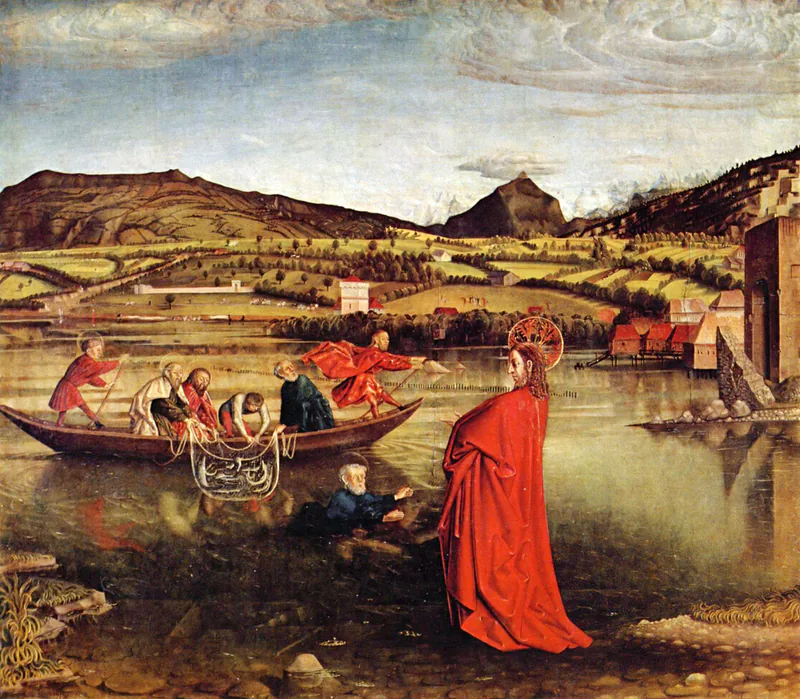
His works offer many examples that became standard:
- Six, in the City of God (XI.30), is a "perfect" number because it equals the sum of its divisors (1 + 2 + 3), and so God completed creation in six days. The perfection belongs to the number; it is not perfect because God used it.
- Forty is ten times four: the law (ten) fulfilled throughout the world, or through the four Gospels, which is why Moses, Elijah and Christ fasted forty days.
- Eleven signifies sin, because it oversteps the ten of the commandments; Augustine counted eleven generations in the line of Cain (City of God XV.20). Modern numerology's reverence for 11 as a master number reverses this view.
- 153, the number of fish caught in John 21:11, is in his Tractates on the Gospel of John (122) the sum of all numbers from 1 to 17, and 17 is ten (the law) plus seven (the Spirit's grace), so the catch represents all who are saved by law and grace together.
Augustine was equally clear about what number interpretation was not. He fiercely criticised the mathematici, the astrologers who claimed to read fate in the stars, and divination generally, as discussed in Augustine's City of God on magic and theurgy. Numbers in Scripture revealed God's meaning; numbers used to forecast a person's future were, in his view, a door to superstition and the demons.
Isidore, Bede and the Early Medieval Tradition§
Augustine's approach was systematised in the early Middle Ages. Isidore of Seville (c. 560–636) wrote a Book of Numbers which Occur in the Holy Scriptures (Liber numerorum), a handbook explaining numbers from one upward with their scriptural associations, and devoted a book of his Etymologies to arithmetic.
Bede, the Northumbrian monk of Wearmouth-Jarrow, joined number symbolism to the science of time. His On the Reckoning of Time (De temporum ratione, 725), the leading medieval textbook of computus (the calculation of Easter and the calendar), opens with a chapter on finger reckoning, a method of counting and signalling numbers on the hands. Bede developed Augustine's scheme of the six ages of the world, matching the six days of creation, from Adam to Noah, Noah to Abraham, Abraham to David, David to the Babylonian exile, the exile to Christ, and Christ to the end of time, with a seventh age of rest running alongside and an eighth of eternity to come. The chronology of history itself was shaped by number.
In his biblical commentaries, especially On the Tabernacle and On the Temple, Bede read the measurements and counts of the sacred buildings as figures of the Church: lengths, heights, numbers of pillars and curtains each pointing to virtues, ranks of believers or the sacraments. In the generation after him, Hrabanus Maurus (c. 780–856) composed In Praise of the Holy Cross, a series of figured poems in which letters arranged in grids form crosses and other shapes, carrying numerical and theological meaning.
Number Allegory in the High Middle Ages§
From the twelfth century, number became one of the standard tools of allegorical reading. Hugh of St Victor and other masters listed the ways numbers signify, by their order, their composition, their divisors and their relation to other numbers, and preachers drew on handbooks of number meanings. Architecture and art sometimes followed suit: modern historians have found deliberate numerical schemes in some churches and manuscripts, while warning that many proposed "sacred proportions" are the work of over-eager interpreters.
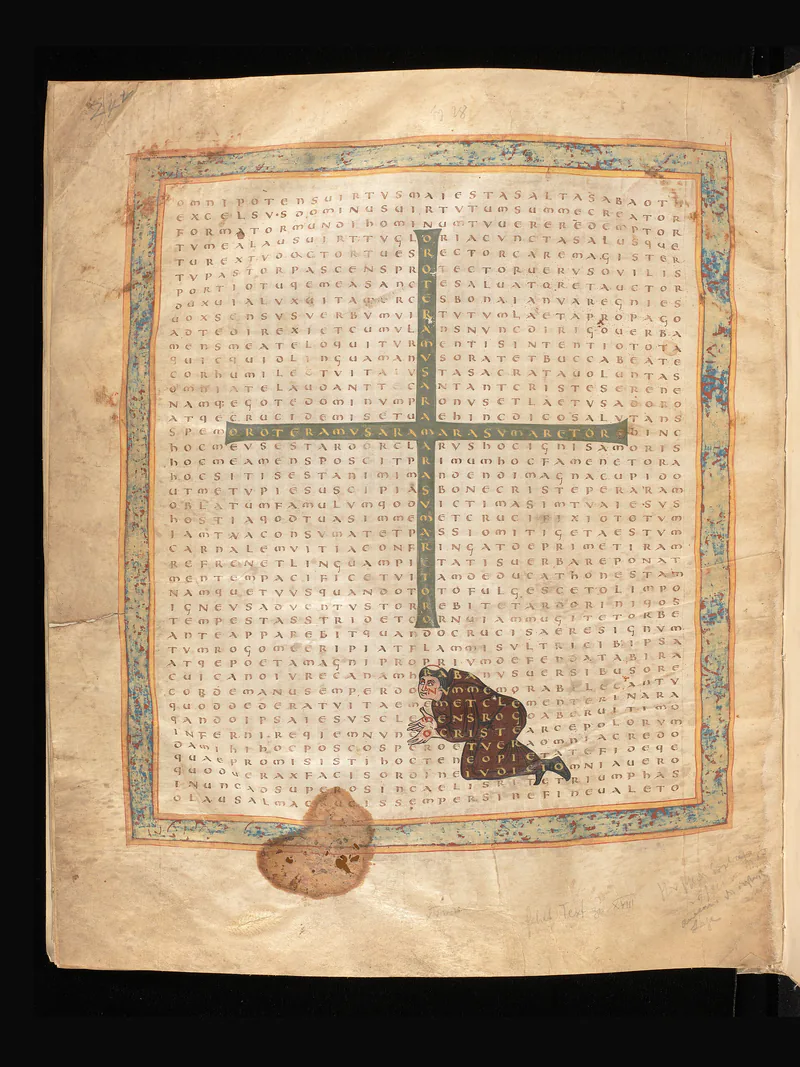
Literature offers the clearest case. Dante's Divine Comedy is built from one hundred cantos (one introductory canto and three parts of thirty-three), written in interlocking three-line stanzas, with the Trinity reflected at every level. In 1584–1585 the Italian cleric Pietro Bongo published Numerorum mysteria, a vast compendium gathering patristic, medieval and Renaissance number lore. Renaissance Christian Kabbalists such as Johann Reuchlin, by contrast, sought Christian doctrine in Hebrew gematria, a step towards the occult number philosophy of Agrippa.
Modern Bible Numerics and the Bible Code§
The modern period produced new attempts to prove the divine authorship of Scripture through its numbers. The English Anglican clergyman E. W. Bullinger published Number in Scripture (1894), a widely read catalogue of biblical numbers and their supposed spiritual meanings. The Russian-born American Ivan Panin (1855–1942) spent decades counting letters, words and numerical values in the Greek New Testament and claimed to find patterns of sevens too regular to be chance.
In the 1990s the "Bible Code" drew wide attention. A paper by Doron Witztum, Eliyahu Rips and Yoav Rosenberg in Statistical Science (1994) reported equidistant letter sequences in Genesis that seemed to encode the names and dates of famous rabbis, and Michael Drosnin's best-selling The Bible Code (1997) went much further, claiming predictions of modern events. In 1999 Brendan McKay, Dror Bar-Natan, Maya Bar-Hillel and Gil Kalai showed in the same journal that the original results could be explained by flexibility in the choice of names, spellings and dates, and that similar "codes" could be found in other long texts. Most mathematicians regard the case as closed.
Popular "biblical numerology" today blends these strands: the patristic meanings of 3, 7, 12 and 40, the claims of Bullinger and Panin, and features of modern numerology such as name values and angel numbers.
Christian Attitudes to Numerology§
The churches have generally drawn a line between interpreting numbers in Scripture and using numbers to divine. The Hebrew Bible forbids divination and soothsaying (Deuteronomy 18:10–12), Augustine condemned the astrologers and fortune-tellers of his day, and the Catechism of the Catholic Church rejects all forms of divination as attempts to gain power over time and history. Many Protestant writers take the same view of modern personal numerology, regarding the life path and personal year as a form of fortune-telling, while still valuing the symbolic reading of biblical numbers.
For historians, Christian number symbolism is one of the main channels through which Pythagorean ideas reached the modern world, and one of the sources from which early twentieth-century numerologists borrowed; see Pythagoras and Pythagorean number mysticism and Numerology: A Complete Guide.
Frequently asked questions§
Is numerology in the Bible?§
The Bible uses numbers symbolically, and early Jewish and Christian authors sometimes used letter values, as with the 666 of Revelation. Personal numerology based on names and birth dates, however, is a modern creation and is not found in Scripture.
What did Augustine say about numbers?§
Augustine taught that knowledge of numbers is needed to understand the figurative sense of Scripture and that numbers reflect the order God placed in creation. He gave influential readings of 6, 11, 40 and 153, while condemning divination by stars or numbers.
What is the meaning of 153 fish in John 21?§
Augustine noted that 153 is the sum of the numbers from 1 to 17, and that 17 combines the ten commandments of the law with the seven gifts of the Spirit. He read the catch as representing all who are saved; other interpreters have offered different explanations.
Do Christians believe in numerology?§
Most Christian churches reject numerology as divination, in line with biblical prohibitions and the teaching of Augustine. Symbolic reading of numbers within Scripture, by contrast, has a long and respected history in Christian exegesis.
Sources and further reading§
- On Christian Doctrine (De doctrina christiana) — Augustine of Hippo, 397
- The City of God — Augustine of Hippo, 426
- The Reckoning of Time — Bede, trans. Faith Wallis, 1999
- Medieval Number Symbolism: Its Sources, Meaning, and Influence on Thought and Expression — Vincent Foster Hopper, 1938
- Number Symbolism — Christopher Butler, 1970
- Number in Scripture: Its Supernatural Design and Spiritual Significance — E. W. Bullinger, 1894
- The Mystery of Numbers — Annemarie Schimmel, 1993