Liber VI · Christianity · Chapter II: The Bible & Its Canon
The Book of Revelation: History, Symbols and Interpretation
The Book of Revelation explained: who wrote the Apocalypse of John, its seals, beasts and number 666, its place in the canon and how it has been read.

The Book of Revelation, also called the Apocalypse of John, is the last book of the Christian New Testament: a visionary letter, written near the end of the first century by a prophet named John on the island of Patmos, that describes the overthrow of evil and the coming of a new heaven and a new earth. Its seals, trumpets, beasts and the number 666 have made it the most debated and most variously interpreted book of the Bible.
Authorship and Date of the Book of Revelation§
The author names himself John four times and says he received his visions on the island of Patmos because of his witness to Jesus (Revelation 1). He never claims to be an apostle, but by the mid-second century Justin Martyr and later Irenaeus identified him with John the son of Zebedee, the disciple traditionally credited with the Fourth Gospel.
Doubts arose early. Around 250 CE Dionysius, bishop of Alexandria, compared the Greek of Revelation with that of the Gospel and letters of John and concluded, on grounds of style and vocabulary, that they could not share an author; Revelation's Greek is rough and heavily Semitic. Most modern scholars agree and speak of "John of Patmos," a Jewish-Christian prophet who perhaps came from Palestine and was known to the churches of western Asia Minor.
Irenaeus dated the vision to the end of the reign of the emperor Domitian, around 95 CE, and this remains the majority view. A minority of scholars prefer a date around 68–69 CE, just after Nero's death.
Structure and Contents of the Apocalypse§
Revelation is carefully built, and much of its structure is organised in sevens.
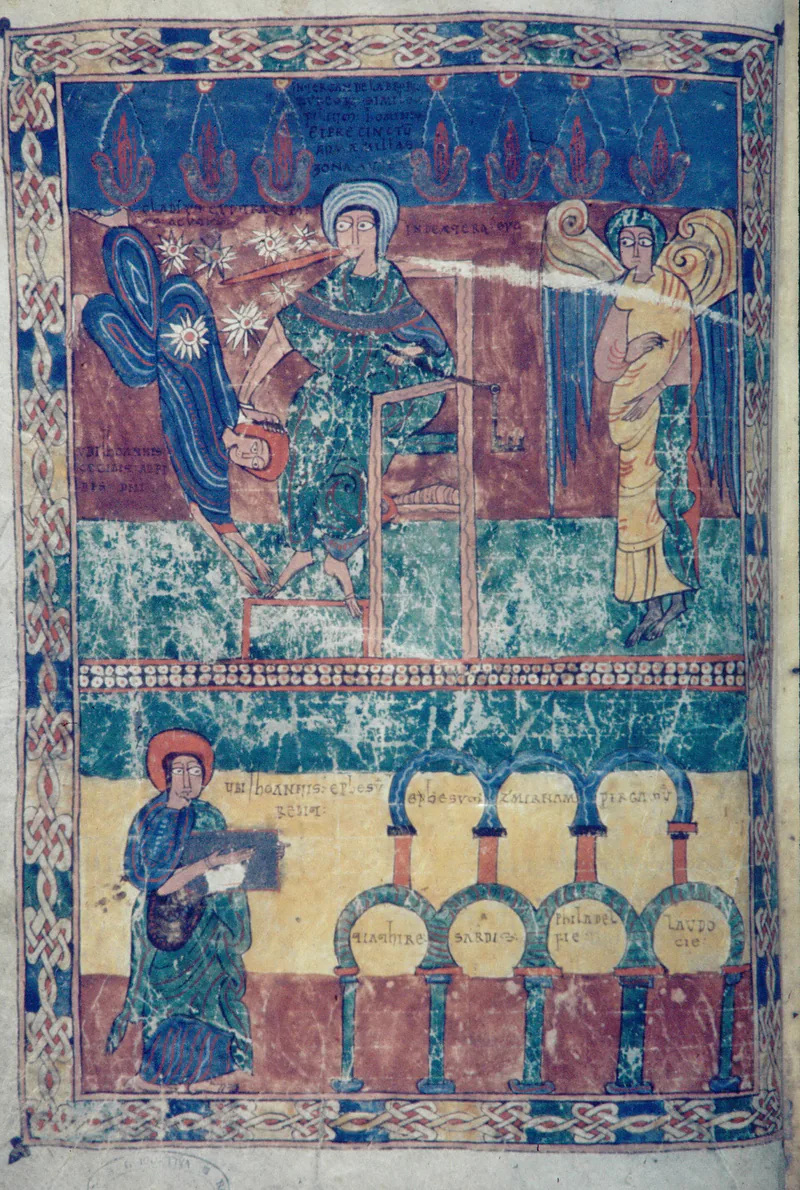
- Opening vision and the letters to the seven churches (chapters 1–3). The risen Christ dictates messages of praise and warning to Ephesus, Smyrna, Pergamum, Thyatira, Sardis, Philadelphia and Laodicea.
- The heavenly throne room (4–5). John sees God enthroned, surrounded by twenty-four elders and four living creatures, and a Lamb "as it had been slain" who alone can open a sealed scroll.
- The seven seals and seven trumpets (6–11). The opening of the seals releases the four horsemen — traditionally conquest, war, famine and death — and further disasters; seven angels then sound trumpets heralding plagues.
- The woman, the dragon and the beasts (12–14). A woman clothed with the sun gives birth to a child; a great red dragon, identified as the devil, is cast down from heaven by Michael; a beast rises from the sea and another from the land.
- The seven bowls and the fall of Babylon (15–18). Bowls of divine wrath are poured out, and "Babylon the great," a woman seated on a scarlet beast, is judged and mourned by kings and merchants.
- Victory, millennium and judgement (19–20). A rider on a white horse defeats the beast; Satan is bound for a thousand years; after a final rebellion of Gog and Magog comes the last judgement.
- The New Jerusalem (21–22). A new heaven and earth appear, and a jewelled city descends from God, with twelve gates and a river and tree of life. The whole is framed as a letter meant to be read aloud in worship.
Symbols and Numbers: The Lamb, the Beast and 666§
Revelation is written in the symbolic language of Jewish apocalyptic literature, and nearly every image echoes the Hebrew scriptures. The four living creatures recall Ezekiel's vision, the beasts from the sea recall the four beasts of Daniel 7, and Babylon stands for the oppressive imperial power that destroyed Jerusalem's Temple — for John's first readers, almost certainly Rome, the city on seven hills.
Numbers carry meaning. Seven, the number of completeness, structures the churches, seals, trumpets and bowls; twelve and its multiples (the twenty-four elders, the 144,000 sealed, the twelve gates) represent the people of God; three and a half years, or forty-two months, marks a limited time of persecution. These patterns are explored in Biblical Numerology and Christian Number Symbolism and The Number Seven in Religion and Myth.
The number of the beast§
The most famous number is that of the second beast: "Here is wisdom. Let him that hath understanding count the number of the beast" (Revelation 13:18), which is given as 666. Because Greek and Hebrew letters also served as numerals, many scholars think the riddle works by gematria: the name "Nero Caesar" written in Hebrew letters adds up to 666. Strikingly, some ancient manuscripts, including a papyrus fragment from Oxyrhynchus, read 616 instead, which matches the Latin spelling of Nero's name transliterated into Hebrew. Irenaeus already knew of both readings. Other candidates, from popes to Napoleon, have been proposed in every century, but historians mostly accept the Nero solution.
The dragon of chapter 12, called "that old serpent, called the Devil, and Satan," contributed powerfully to the later Christian picture of Satan as a cosmic rebel, as traced in The History of Satan and the Devil.
Revelation and the Christian Canon§
Revelation was widely read in the West from the second century and appears in the Muratorian list, but in the Greek East it was long contested. Its use by millenarian groups and Dionysius's doubts about its authorship made many Eastern bishops cautious. Eusebius of Caesarea, writing around 325, placed it awkwardly among both the accepted and the rejected books. Cyril of Jerusalem omitted it from his list, and it is absent from some later Syriac and Eastern canons.
Athanasius of Alexandria included Revelation among the twenty-seven books in his Easter letter of 367, and by the fifth century it was accepted almost everywhere. Even so, the Eastern Orthodox churches never read it in the Divine Liturgy. During the Reformation Martin Luther, in his 1522 preface, said he could not detect the Holy Spirit in it, though he later softened his view. The general history of these decisions is told in The Christian Bible and Its Canon.
Four Ways of Reading Revelation§
Interpreters are often grouped into four broad schools, which can be combined.
- Preterist. The visions refer mainly to the author's own time — the persecution of Christians, the Roman Empire and its emperors — and were meant to encourage first-century believers. Most academic biblical scholars read the book primarily in this historical way.
- Historicist. The book maps out the whole of church history in sequence. Medieval and Reformation writers used it this way, with many Protestants identifying the beast or Babylon with the papacy.
- Futurist. Most of the visions, from chapter 4 onward, describe events still to come at the end of history. This is the approach of modern dispensationalism.
- Idealist or symbolic. The book portrays the timeless struggle between good and evil and the certainty of God's victory, rather than particular events.
Augustine's City of God (book 20) was decisive for the West: he read the thousand years of chapter 20 as the present age of the Church, not a future earthly kingdom. This "amillennial" reading became the mainstream Catholic, Orthodox and much Protestant position.
Millennialism and the Apocalypse in History§
Many early Christians, including Papias, Justin Martyr and Irenaeus, expected a literal thousand-year reign of Christ on earth, a belief called chiliasm or millennialism. Although Augustine's interpretation displaced it, millennial hope repeatedly returned. The Calabrian abbot Joachim of Fiore (c. 1135–1202) divided history into three ages of Father, Son and Spirit and inspired radical Franciscans; Norman Cohn's The Pursuit of the Millennium traced how such expectations fed medieval revolutionary movements. In 1534–35 radical Anabaptists seized Münster in Westphalia and proclaimed it the New Jerusalem.
In the nineteenth century the American preacher William Miller calculated from Daniel and Revelation that Christ would return around 1844; the "Great Disappointment" that followed gave rise to the Seventh-day Adventists and other groups described in Adventist and Restorationist Movements. At the same time John Nelson Darby developed dispensationalism, with its teaching of a "rapture" of believers before a period of tribulation; popularised by the Scofield Reference Bible (1909) and later by best-selling novels, it remains influential among evangelical Protestants, especially in the United States.
The Apocalypse in Art and Esoteric Culture§
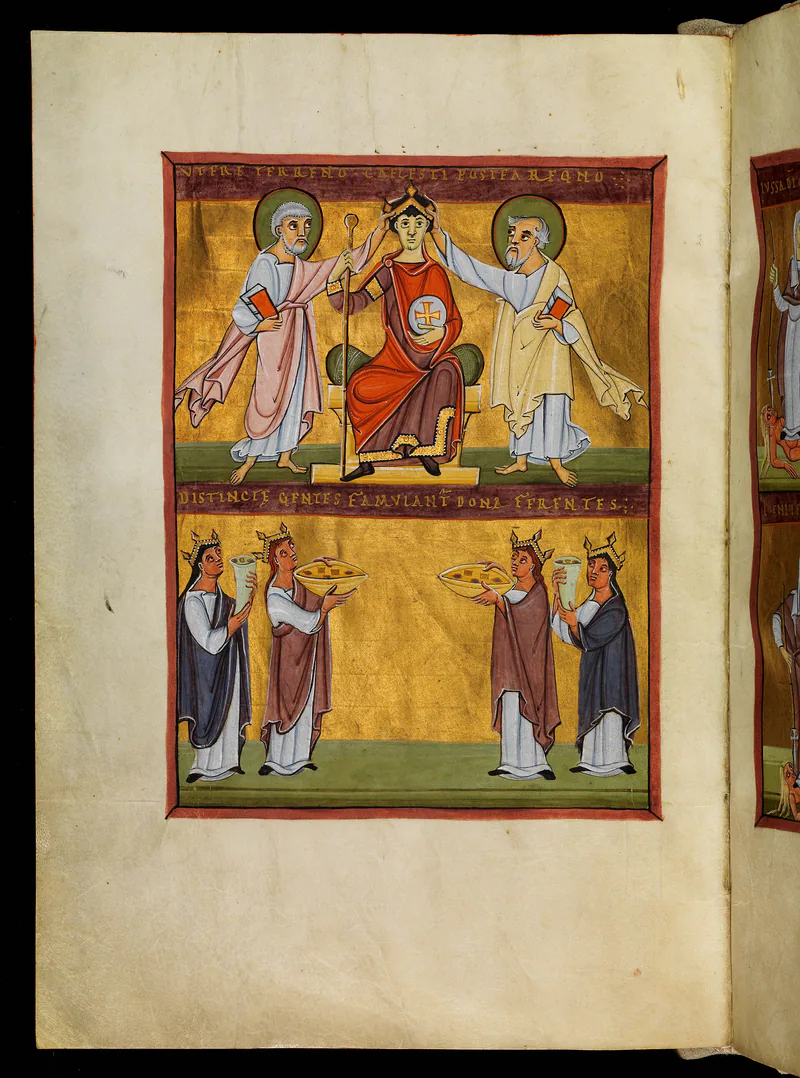
Revelation's visions have inspired some of the most remarkable works of Christian art: the illuminated commentaries of the Spanish monk Beatus of Liébana (first compiled around 776), the Ottonian Bamberg Apocalypse (around 1000), the huge Apocalypse Tapestry of Angers (woven in the 1370s–80s), and Albrecht Dürer's series of woodcuts published in 1498, whose Four Horsemen became one of the most reproduced images in European art. William Blake painted the Great Red Dragon.
Esoteric writers have drawn on it as well. Its number symbolism appealed to Christian Kabbalists and numerologists, and Aleister Crowley deliberately adopted the titles of the Beast 666 and of the Scarlet Woman, whom he associated with Babalon, inverting the book's imagery for his own religious system. Most historians, by contrast, read the original as resistance literature: a prophet's assurance to persecuted communities that empire would not have the last word.
Frequently asked questions§
Who wrote the Book of Revelation?§
The author calls himself John and says he was on Patmos. Christian tradition identified him with the apostle John, but since the third century some readers, and today most scholars, have judged on stylistic grounds that he was a different early Christian prophet, often called John of Patmos.
What does 666 mean in Revelation?§
Revelation 13 gives 666 as the number of the beast and invites readers to calculate it. The most widely accepted explanation is that it encodes the name of the emperor Nero in Hebrew letters; the variant 616, found in some manuscripts, fits a Latin form of the same name.
Is the Book of Revelation about the end of the world?§
It describes a final judgement and a new creation, so it is about the end in a theological sense. Whether its visions predict particular future events or speak symbolically about the author's own time and the timeless struggle of good and evil is the main point of disagreement among interpreters.
Why do Orthodox churches not read Revelation in the liturgy?§
Revelation was accepted late into the Eastern canon, after long doubts about its authorship and its use by millenarian groups. By the time it was received, the lectionary of the Divine Liturgy was already fixed, and it was never added.
Sources and further reading§
- The Apocalyptic Imagination — John J. Collins, 1984
- Crisis and Catharsis: The Power of the Apocalypse — Adela Yarbro Collins, 1984
- The Theology of the Book of Revelation — Richard Bauckham, 1993
- Revelations: Visions, Prophecy, and Politics in the Book of Revelation — Elaine Pagels, 2012
- The Pursuit of the Millennium — Norman Cohn, 1957
- The City of God — Augustine of Hippo, 426