Liber XXI · New Religions · Chapter I: Adventist & Restorationist Movements
Adventist and Restorationist Movements: Millerites to Witnesses
Adventist and Restorationist movements explained: the Stone-Campbell movement, William Miller and 1844, Seventh-day Adventists and Jehovah's Witnesses.

Adventist and Restorationist movements are families of Protestant-derived religious groups, most of them born in the United States in the nineteenth century, that sought either to restore the original church of the New Testament or to prepare for the imminent Second Coming (Advent) of Christ. Restorationism produced the Churches of Christ and the Disciples of Christ; the Adventist awakening led by William Miller ended in the "Great Disappointment" of 1844 and gave rise to the Seventh-day Adventist Church. The Bible Student movement of Charles Taze Russell, which became the Jehovah's Witnesses, shares both impulses. Together these movements now have tens of millions of members worldwide.
Religious Ferment in the Early American Republic§
The decades after American independence saw an explosion of religious enthusiasm known as the Second Great Awakening. Camp meetings drew thousands; Methodists and Baptists grew rapidly; and the absence of an established church, together with a culture of popular Bible reading, encouraged ordinary believers to interpret scripture for themselves and found new movements. The historian Nathan Hatch has called this the "democratization of American Christianity". Western New York was crossed by so many revivals that it was nicknamed the "burned-over district"; it was also the cradle of the Latter-day Saints and of Spiritualism.
Restorationism and the Stone-Campbell Movement§
Restorationists argued that the many Protestant denominations, with their creeds and clergy, had departed from the simplicity of the New Testament church. The most influential American movement was led by Barton W. Stone, a Presbyterian minister involved in the great camp meeting at Cane Ridge, Kentucky, in 1801, and by Thomas Campbell and his son Alexander Campbell, Scottish-Irish immigrants in western Pennsylvania. Their followers, calling themselves simply "Christians" or "Disciples of Christ", rejected creeds as tests of fellowship, practised believers' baptism by immersion and celebrated the Lord's Supper weekly. The Stone and Campbell groups united in 1832.

Disagreements later divided the movement into three main bodies: the Churches of Christ, which reject instrumental music in worship as unscriptural; the more liberal Christian Church (Disciples of Christ); and the independent Christian Churches. Restorationist ideas appear in many other movements, including the Latter-day Saints, who also claimed to restore the primitive church, though by new revelation rather than by Bible study alone.
William Miller and the Great Disappointment§
William Miller (1782–1849), a farmer and Baptist lay preacher from Low Hampton, New York, became convinced after years of Bible study that the prophecies of Daniel pointed to the imminent return of Christ. Central to his calculation was Daniel 8:14: "Unto two thousand and three hundred days; then shall the sanctuary be cleansed." Interpreting each day as a year and beginning from a decree of 457 BCE, he concluded that the cleansing of the sanctuary, which he understood as the Second Coming, would occur around 1843.
From 1840 the publicist Joshua V. Himes turned Miller's message into a mass movement with newspapers, charts and tent meetings, attracting perhaps fifty thousand committed believers and many more sympathisers. When the expected year passed, a follower named Samuel Snow set the date at 22 October 1844. Many Millerites left their crops unharvested and gave away possessions. The day passed without event, and the "Great Disappointment" scattered the movement. Miller himself admitted his error but continued to expect the Advent soon. Some ex-Millerites returned to their churches; others formed new groups, including the Advent Christian Church and the body that became the Seventh-day Adventists.
Seventh-day Adventists and Ellen G. White§
A small group of former Millerites reinterpreted the disappointment: the date had been right, but the event had been wrong. On 22 October 1844, they taught, Christ had entered the most holy place of the heavenly sanctuary to begin a final phase of his ministry, the "investigative judgment", before his return. Under the influence of Joseph Bates, a retired sea captain, they adopted the seventh-day Sabbath from the Seventh Day Baptists, keeping Saturday as the holy day in obedience to the fourth commandment.
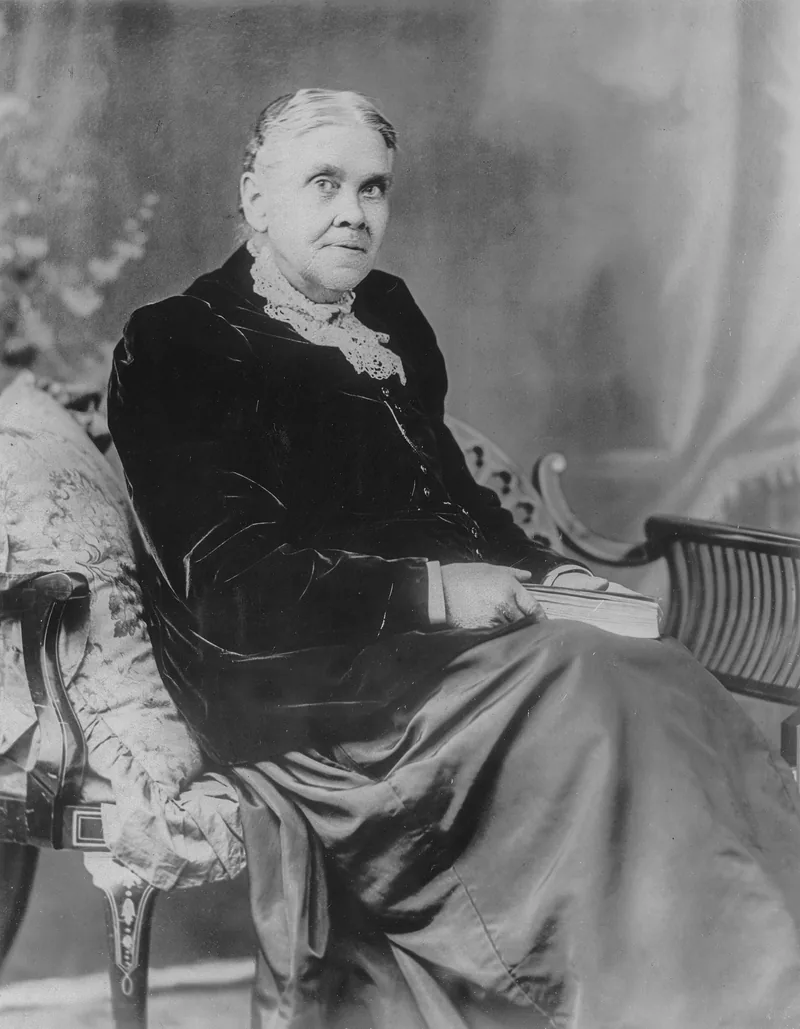
The young Ellen G. Harmon (1827–1915), who married the preacher James White in 1846, reported visions from December 1844 onward. Adventists regard her as a messenger with the "spirit of prophecy", whose writings, though not equal to the Bible, give inspired guidance; her major works include The Great Controversy (1888). The Seventh-day Adventist Church was formally organised at Battle Creek, Michigan, in 1863. Under White's influence it embraced health reform: vegetarianism, abstinence from alcohol and tobacco, and natural remedies. The Battle Creek Sanitarium, run by John Harvey Kellogg, popularised breakfast cereals before Kellogg's break with the church. Adventists read the three angels' messages of Revelation 14 as their mission and have built one of the largest Protestant school and hospital networks in the world, with more than twenty million baptised members.
Several groups later broke away. The Davidian movement founded by Victor Houteff in the 1930s gave rise to the Branch Davidians, whose siege at Waco, Texas, in 1993 ended in the deaths of some eighty people, an event discussed in Studying New Religious Movements.
The Bible Students and Jehovah's Witnesses§
Charles Taze Russell (1852–1916), a Pittsburgh businessman influenced by Adventist preachers, began a Bible study group in the 1870s and in 1879 founded the magazine Zion's Watch Tower and Herald of Christ's Presence. His followers, the Bible Students, taught that Christ's invisible presence had begun in the 1870s and expected decisive events in 1914; the outbreak of the First World War that year seemed to many to confirm their reading. Russell rejected the Trinity, the immortal soul and eternal hell, teaching instead that the wicked would be annihilated.
After Russell's death, Joseph F. Rutherford reorganised the Watch Tower Society under strong central authority, causing schisms, and in 1931 adopted the name Jehovah's Witnesses, emphasising the divine name as in Psalm 83:18 of the King James Version. Witnesses teach that 1914 marked the start of Christ's invisible reign in heaven and that the present system will end at Armageddon, after which the earth will become a paradise; a limited number of 144,000 will reign with Christ in heaven. They refuse military service, political participation, saluting flags and the celebration of birthdays and Christmas, and, since 1945, blood transfusions.
These positions brought persecution. Witnesses were imprisoned in Nazi concentration camps, where they wore a purple triangle; they faced mob violence in the United States during the Second World War and won landmark Supreme Court cases on religious freedom; and in 2017 Russia's Supreme Court banned their organisation as "extremist". Witnesses today report more than eight million active publishers who engage in public preaching.
Other Movements and Assessments§
The same milieu produced the Christadelphians, founded by John Thomas in the 1840s, and the twentieth-century Worldwide Church of God of Herbert W. Armstrong, which after his death in 1986 abandoned its distinctive teachings for evangelical orthodoxy, an unusual case of a new religion moving into the mainstream. Historians such as Ronald Numbers and George Knight have studied the Millerite experience as a model of apocalyptic expectation, and the psychologist Leon Festinger's research on failed prophecy drew on it explicitly. Related American movements of the same century are discussed in Christian Science and New Thought and What Is a New Religious Movement?.
Frequently asked questions§
What was the Great Disappointment?§
It was the failure of the Millerite prediction that Christ would return on 22 October 1844. Thousands of believers had prepared for the event, and when nothing happened the movement broke apart, though some of its members went on to found the Seventh-day Adventist Church.
Are Jehovah's Witnesses Adventists?§
Not formally. Charles Taze Russell was influenced by Adventist preachers and shared their focus on prophecy and the end times, but the Bible Students developed independently, and Jehovah's Witnesses today have distinct doctrines and organisation.
Why do Seventh-day Adventists worship on Saturday?§
They believe the fourth commandment's Sabbath, the seventh day, was never changed by God and should still be kept from Friday sunset to Saturday sunset. They regard Sabbath-keeping as a sign of loyalty to God in the last days.
Sources and further reading§
- The Disappointed: Millerism and Millenarianism in the Nineteenth Century — Ronald L. Numbers and Jonathan M. Butler (eds), 1987
- Millennial Fever and the End of the World — George R. Knight, 1993
- Seeking a Sanctuary: Seventh-day Adventism and the American Dream — Malcolm Bull and Keith Lockhart, 1989
- Prophetess of Health: A Study of Ellen G. White — Ronald L. Numbers, 1976
- The Great Controversy — Ellen G. White, 1888
- Apocalypse Delayed: The Story of Jehovah's Witnesses — M. James Penton, 1985
- The Democratization of American Christianity — Nathan O. Hatch, 1989