Liber XXXIII · Theosophy · Chapter IX: Spiritualism
Spiritualism: History of Mediums, Séances and Spirit Contact
History of Spiritualism from the Fox sisters' 1848 rappings to séances, famous mediums, Kardec's Spiritism, psychical research and the churches of today.

Spiritualism is a religious movement, born in upstate New York in 1848, built on the belief that the spirits of the dead survive and can communicate with the living through mediums. Beginning with the "rappings" reported around the Fox sisters of Hydesville, it spread rapidly across America and Europe through séances, trance lectures and spirit circles, and gave rise both to organised Spiritualist churches and to the scientific study of psychical phenomena. Its claims were dogged by exposures of fraud, but its religious and social influence was considerable.
Forerunners: Swedenborg, Mesmerism and the Poughkeepsie Seer§
Communication with the dead is ancient, but Spiritualism's immediate background lay in the eighteenth and early nineteenth centuries. The Swedish visionary Emanuel Swedenborg had described detailed conversations with angels and departed souls, and his Heaven and Hell (1758) offered a picture of the afterlife as an orderly continuation of character and affection. Mesmerism, or animal magnetism, popularised the trance state; some mesmerised subjects claimed to see distant places or converse with spirits.
The most important American forerunner was Andrew Jackson Davis (1826–1910), the "Poughkeepsie Seer", who dictated The Principles of Nature, Her Divine Revelations (1847) while in a mesmeric trance. Davis described a progressive universe in which spirits advance through a series of spheres, the higher of which he called the "Summerland", and predicted that open communication between the worlds would soon begin.
The Fox Sisters and the Hydesville Rappings, 1848§
In March 1848 the Fox family of Hydesville, near Rochester, reported unexplained knocking sounds in their house. The younger daughters, Margaretta (Maggie) and Catherine (Kate), appeared to communicate with the source by asking questions and receiving raps in reply, and the family came to believe it was the spirit of a murdered peddler. Their elder sister Leah soon organised public demonstrations, and by 1850 the sisters were famous in New York.
In 1888 Maggie Fox publicly confessed that the raps had been produced by cracking the joints of her toes, and demonstrated the method on a stage in New York; she later retracted the confession. Despite this troubled history, Spiritualists continue to honour 31 March 1848 as the movement's birthday.
The Séance and the Mediums§
Spiritualism spread with astonishing speed. Within a few years there were thousands of home circles in the United States, and in 1853 a craze for "table-turning" swept Europe. In that year the physicist Michael Faraday showed, using simple apparatus, that tables moved through the unconscious muscular action of the sitters, an explanation later called the ideomotor effect, which also applies to planchettes and the Ouija board.
Séance phenomena ranged from simple raps and automatic writing to trance speaking, levitation, spirit hands, musical instruments that played in the dark and, later, full-form "materialisations" and the substance the physiologist Charles Richet named "ectoplasm". Prominent mediums included:
- Daniel Dunglas Home (1833–1886), a Scottish-born medium famous for levitations, who was never publicly exposed and was tested by the chemist William Crookes.
- The Davenport brothers, whose "spirit cabinet" act was imitated by stage conjurors.
- Florence Cook, whose materialised spirit "Katie King" Crookes claimed to have photographed in the 1870s.
- Eusapia Palladino, an Italian medium studied by many scientists and caught cheating on several occasions.
- Leonora Piper, a Boston trance medium whom William James studied for years and considered his "white crow".
Spirit photography, introduced by William Mumler in Boston in the early 1860s, used double exposures to show faint figures beside the living; Mumler was tried for fraud in New York in 1869 and acquitted.
Spiritualism and social reform§
Historians such as Ann Braude have shown how closely early American Spiritualism was linked to radical causes, particularly women's rights and the abolition of slavery. Trance mediumship gave women a public voice at a time when they were rarely allowed to lecture, and many mediums spoke for reform.
Allan Kardec and Spiritism§
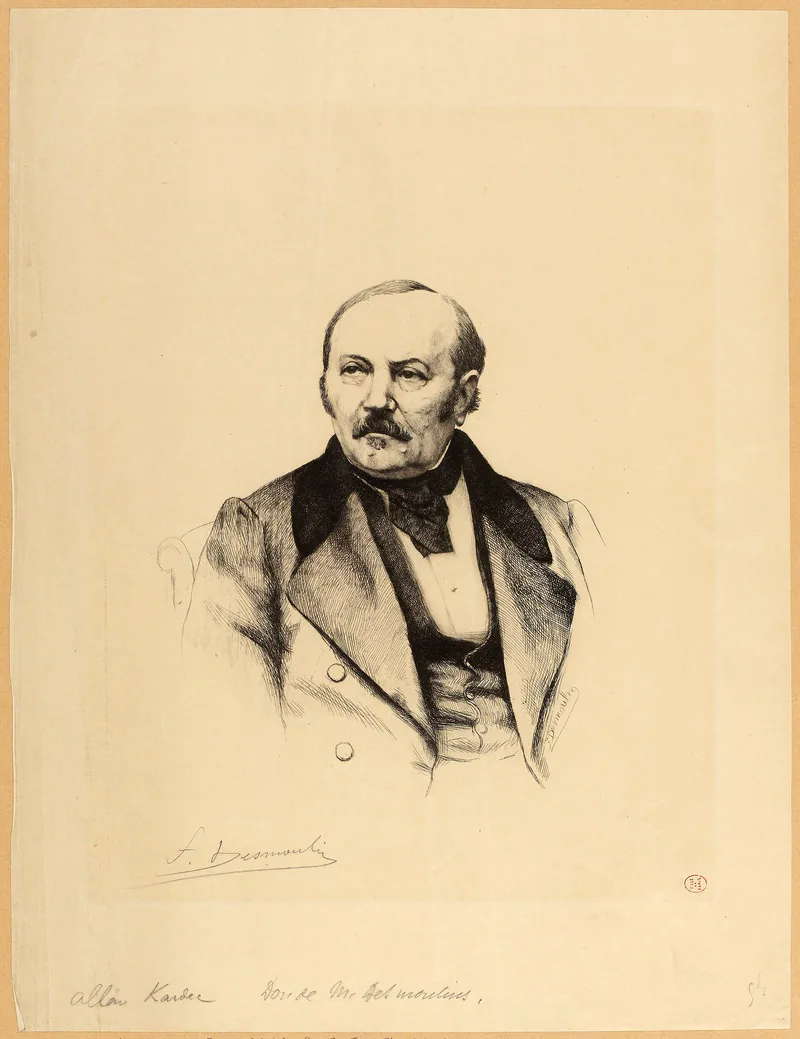
In France, the educator Hippolyte Léon Denizard Rivail, writing as Allan Kardec, compiled answers obtained from mediums into The Spirits' Book (Le Livre des Esprits, 1857). Kardec's Spiritism differed from Anglo-American Spiritualism chiefly in teaching reincarnation as the means of the soul's moral progress. Spiritism became a major religious movement in Brazil, where the medium Chico Xavier (1910–2002) was a national figure, and it influenced popular religion elsewhere in Latin America. For more on rebirth, see our guide to reincarnation and the afterlife.
Psychical Research and Exposure§
In 1882 a group of Cambridge scholars, including Henry Sidgwick, Frederic W. H. Myers and Edmund Gurney, founded the Society for Psychical Research in London to investigate mediumship, apparitions and telepathy with scientific methods; an American society followed in 1885. The SPR exposed numerous fraudulent mediums and, in 1885, published a damning report on Helena Blavatsky, whose Theosophy itself had emerged from the Spiritualist milieu. Its large studies of apparitions also shaped later thinking about ghosts and hauntings.
Stage magicians proved effective critics, since many séance effects resembled conjuring tricks. Harry Houdini, whose friendship with Arthur Conan Doyle collapsed over the subject, exposed mediums in the 1920s and wrote A Magician Among the Spirits (1924). Doyle, for his part, wrote The History of Spiritualism (1926) in defence of the movement.
Scientific opinion today holds that there is no reliable evidence that mediums communicate with the dead. Physical phenomena have repeatedly been traced to trickery, and the apparent accuracy of mental mediums is generally explained by cold reading, prior information and the willingness of sitters to interpret vague statements.
Spiritualism After the First World War§
The mass bereavement of the First World War brought a revival of Spiritualism in Britain and elsewhere, as families sought contact with the dead of the trenches. The physicist Sir Oliver Lodge, whose son Raymond was killed in 1915, published Raymond (1916), describing messages he believed came from him.
Organised churches formalised the movement: the National Spiritualist Association of Churches was founded in the United States in 1893 and the Spiritualists' National Union in Britain in the early twentieth century. The community of Lily Dale in New York state remains a well-known Spiritualist centre. In Britain the wartime prosecution of the medium Helen Duncan in 1944 under the Witchcraft Act of 1735 caused controversy, and the Act was replaced in 1951 by the Fraudulent Mediums Act. Spiritualist ideas about spirit guides, the Summerland and continuing bonds with the dead remain influential in popular culture and the New Age.
Frequently asked questions§
When did Spiritualism start?§
Modern Spiritualism is usually dated to 31 March 1848, when the Fox family in Hydesville, New York, reported communicating with a spirit through rapping sounds. Its ideas had forerunners in Swedenborg, mesmerism and the writings of Andrew Jackson Davis.
What is the difference between Spiritualism and Spiritism?§
Both believe the dead communicate through mediums. Spiritism, founded by Allan Kardec in France in 1857, also teaches reincarnation as the path of moral progress and became especially widespread in Brazil, while most Anglo-American Spiritualists did not traditionally teach reincarnation.
Did the Fox sisters admit to fraud?§
In 1888 Margaretta Fox publicly confessed that the raps were made by cracking her toe joints, and her sister Kate supported the statement. Margaretta retracted the confession a year later, but most historians accept that the original phenomena were produced by the sisters.
Sources and further reading§
- Heaven and Hell — Emanuel Swedenborg, 1758
- The Principles of Nature, Her Divine Revelations — Andrew Jackson Davis, 1847
- The Spirits' Book — Allan Kardec, 1857
- A Magician Among the Spirits — Harry Houdini, 1924
- The History of Spiritualism — Arthur Conan Doyle, 1926
- In Search of White Crows: Spiritualism, Parapsychology, and American Culture — R. Laurence Moore, 1977
- The Other World: Spiritualism and Psychical Research in England, 1850–1914 — Janet Oppenheim, 1985
- The Darkened Room: Women, Power and Spiritualism in Late Victorian England — Alex Owen, 1989
- Radical Spirits: Spiritualism and Women's Rights in Nineteenth-Century America — Ann Braude, 1989
- Ghosts of Futures Past: Spiritualism and the Cultural Politics of Nineteenth-Century America — Molly McGarry, 2008