Liber XXX · Symbols · Chapter II: Number Symbolism
Number Symbolism: Sacred Numbers from Pythagoras to Kabbalah
Number symbolism explained: Pythagorean arithmology, biblical numbers, gematria and the sefirot, abjad, magic squares and the meanings of 3, 7, 12 and 40.

Number symbolism is the attribution of religious, cosmic or moral meaning to particular numbers. It runs through almost every tradition: the Pythagoreans saw numbers as the principles of reality, biblical writers built their texts on sevens, twelves and forties, Jewish mystics read the Hebrew alphabet as a set of numbers, and Islamic, Chinese and Indian cultures developed their own sacred numerologies. Modern popular numerology is a recent descendant of this long history, distinct from the scholarly and theological arithmology of earlier centuries.
Pythagoras and the Philosophy of Number§
The Pythagoreans of the sixth and fifth centuries BCE, as reported by Aristotle and later writers, held that the principles of number were the principles of all things. They distinguished odd numbers (limited, associated with the masculine) from even (unlimited, associated with the feminine), discovered the numerical ratios of musical intervals and revered the tetractys, the sum of 1 + 2 + 3 + 4 = 10, arranged as a triangle. Ten, the "decad", was the perfect number that contained all others.
Later Platonists systematised this "arithmology". Nicomachus of Gerasa, around 100 CE, wrote an Introduction to Arithmetic and a Theology of Arithmetic (now lost but used in the later Theologumena arithmeticae, attributed to Iamblichus), which assigned qualities and even gods to each number from one to ten. The monad (one) was the source of all, identified with God or Apollo; the dyad (two) with matter, difference and boldness; the triad with harmony, beginning, middle and end; the tetrad with the four elements and the seasons. Philo of Alexandria, a Jewish philosopher of the first century, applied similar ideas to the Bible, praising seven as the number of the Sabbath and of perfection. Scholars such as Walter Burkert have shown how much of this tradition was elaborated after Pythagoras himself.
Numbers in the Bible and Christian Exegesis§
The Hebrew Bible and the New Testament use numbers with clear symbolic intent.

- Three marks completeness and divine presence: three days of Jonah in the fish, Christ's resurrection on the third day, and later the Christian Trinity.
- Seven is the number of creation and covenant: seven days of creation, the Sabbath, seven-branched menorah, and the sevens of the Book of Revelation (seals, trumpets, bowls).
- Twelve expresses the people of God: the twelve tribes of Israel and the twelve apostles.
- Forty marks trial and transition: forty days of the Flood, Moses's forty days on Sinai, Israel's forty years in the wilderness and Christ's forty days in the desert, from which the Christian Lent derives.
- 666 is the "number of the beast" in Revelation 13:18; many scholars believe it encodes the name of the emperor Nero by gematria, and some early manuscripts read 616, which fits a variant spelling of the name.
Church Fathers made such interpretation a discipline. Augustine of Hippo, in The City of God (XI.30), explained that God created in six days because six is a "perfect" number, equal to the sum of its divisors (1 + 2 + 3). He also interpreted the 153 fish of John 21:11 as the triangular number of 17, itself the sum of the Ten Commandments and the seven gifts of the Spirit. Medieval writers such as Bede, Hrabanus Maurus and Hugh of St Victor developed this further, and in 1584–1585 Pietro Bongo published Numerorum mysteria, a vast compendium of number symbolism. Dante structured his Divine Comedy on threes, with one hundred cantos in three parts and terza rima verse.
Gematria, the Sefirot and Jewish Number Mysticism§
In Hebrew, as in Greek, letters also served as numerals: aleph = 1, bet = 2, up to tav = 400. This made possible gematria, the interpretation of words through their numerical values, used in rabbinic midrash and greatly developed by medieval German Pietists and Kabbalists. A frequently cited example: the word chai ("life") totals 18, which is why gifts in multiples of 18 are customary in Jewish life.
The Sefer Yetzirah, an early and enigmatic Hebrew text, describes the world as created through "thirty-two wondrous paths of wisdom": the ten sefirot (originally perhaps meaning numbers or numerations) and the twenty-two letters of the Hebrew alphabet. Later Kabbalah transformed the sefirot into the ten divine emanations of the Tree of Life. Other significant numbers include the 72-letter divine name derived from Exodus 14:19–21 and the 613 commandments of the Torah.
Abjad, Magic Squares and Number in the Islamic World and Asia§
Arabic used a similar system, the abjad numerals, which allowed poets to encode dates in chronograms and mystics to calculate the values of divine names. In South Asia the number 786, the abjad value of the Bismillah ("In the name of God, the Merciful, the Compassionate"), is widely written in its place. Islamic tradition speaks of the 99 names of God, and prayer beads are often strung in multiples of 33.
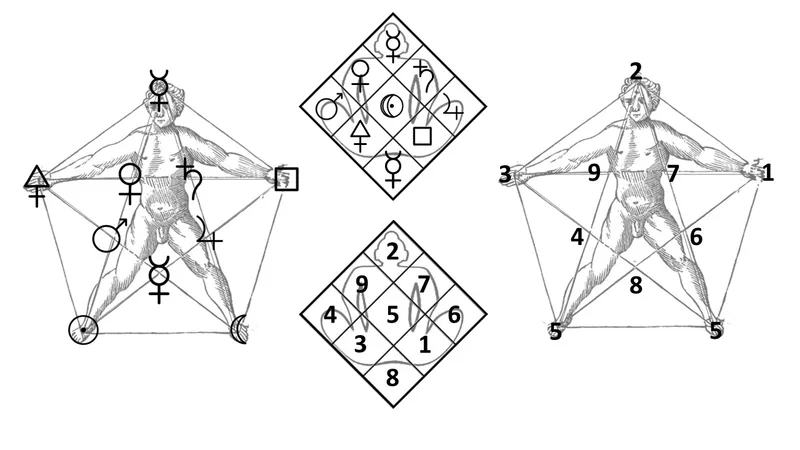
Magic squares, grids in which every row, column and diagonal sums to the same total, were known in China, where the 3×3 Luoshu square is associated with ancient legends of the River Luo, and became an important part of Islamic talismanic practice in the medieval period. Through Arabic and Hebrew intermediaries they reached Renaissance Europe, where Agrippa published squares for each of the seven planets (see Agrippa's Three Books of Occult Philosophy).
In China, odd numbers are yang and even numbers yin; nine, the highest single-digit odd number, was associated with the emperor, while popular culture favours eight (whose word sounds like "prosper") and avoids four (which sounds like "death"). In Indian religions 108 is sacred, the number of beads on a mala and of many lists of divine names.
A Short Dictionary of Sacred Numbers§
- One: unity, the source, the One God or the Neoplatonic One.
- Two: duality, opposition and partnership; matter in Pythagorean thought.
- Three: completeness, harmony, the Trinity, the Hindu trimurti, the triple goddesses of antiquity.
- Four: the material world, four elements, directions, seasons, evangelists; the four-letter divine name (Tetragrammaton).
- Five: the human being and the senses; the pentagram.
- Seven: the classical planets, days of the week, sacraments, heavens; completion.
- Ten: perfection and totality; the tetractys, the commandments, the sefirot.
- Twelve: cosmic order, the zodiac, tribes and apostles, months.
- Forty: trial, purification and transition.
- Seventy-two: the nations of the world in Jewish tradition, the translators of the Septuagint, the spirits of the Ars Goetia and the Shem ha-Mephorash.
Numbers also shape space; see Sacred Geometry.
From Number Mysticism to Modern Numerology§
Popular numerology, which derives "life path" and "destiny" numbers from birth dates and from names converted into digits, is often called "Pythagorean", but it is largely a modern system. Its development is usually traced to the late nineteenth and early twentieth centuries, especially to the American writer L. Dow Balliett, whose The Philosophy of Numbers appeared in 1908, and to later authors who adapted Hebrew gematria to the Latin alphabet. The mathematician Underwood Dudley's Numerology: Or What Pythagoras Wrought (1997) offers a sceptical survey.
Historians distinguish this practice from the older arithmology of philosophers and theologians, who saw numbers as keys to the structure of creation and of scripture rather than as tools for personal prediction. Both, however, share the ancient intuition that number is more than quantity.
Frequently asked questions§
Why is seven considered a sacred number?§
Seven recurs in ancient cosmology and scripture: seven classical planets, seven days of creation and of the week, the Sabbath, and the many sevens of the Book of Revelation. Pythagorean and Jewish thinkers such as Philo praised it as a number of perfection.
What does the number 666 mean?§
It is the "number of the beast" in Revelation 13:18. Many scholars think it is a gematria for the emperor Nero, written in Hebrew letters; a variant reading of 616 matches another spelling of his name.
Is numerology the same as Pythagorean number mysticism?§
No. Ancient Pythagoreans attributed philosophical qualities to numbers, but modern numerology, with its birth-date calculations, was developed mainly in the late nineteenth and twentieth centuries.
What is the significance of the number 40?§
In the Bible, forty marks periods of trial and preparation: the Flood, Moses on Sinai, Israel in the wilderness and Christ in the desert. The word "quarantine" comes from the Italian for forty days.
Sources and further reading§
- Medieval Number Symbolism — Vincent Foster Hopper, 1938
- Number Symbolism — Christopher Butler, 1970
- The Mystery of Numbers — Annemarie Schimmel, 1993
- Lore and Science in Ancient Pythagoreanism — Walter Burkert, 1972
- Number in Scripture: Its Supernatural Design and Spiritual Significance — E. W. Bullinger, 1894
- The Theology of Arithmetic — Iamblichus (attributed), Robin Waterfield (trans.), 1988
- Numerology: Or What Pythagoras Wrought — Underwood Dudley, 1997