Liber XXX · Symbols · Chapter I: Alchemical Symbols
The Rebis: Alchemy's Divine Hermaphrodite and Its Meaning
The Rebis, alchemy's two-headed hermaphrodite: its meaning as the union of sun and moon, its images in the Rosarium and Basil Valentine, and Jung's reading.
The Rebis is the alchemical "double thing" (Latin res bina), the product of the marriage of opposite principles, usually shown as a crowned human figure with one body and two heads, male and female. It stands for the union of Sun and Moon, sulphur and mercury, King and Queen, the stage of the Great Work in which divided substances become one perfected matter. Drawn in manuscripts from the early fifteenth century and in famous printed woodcuts of the sixteenth and seventeenth, the Rebis later became, through Carl Jung, a symbol of psychological wholeness.
What the Rebis Means: The "Double Thing"§
Medieval and early modern alchemy explained metals as compounds of two principles: a hot, dry, active sulphur, imagined as masculine, and a cold, moist, receptive mercury, imagined as feminine. The theory goes back to the Arabic writings attributed to Jabir ibn Hayyan and was standard in Latin alchemy from the thirteenth century. To make the Philosopher's Stone, the alchemist had to separate these principles, purify them and then join them in a lasting union, the coniunctio. The result was a single substance that held both natures in balance. Alchemists called it rebis, and drew it as a person in whom the two sexes are joined.
The image condensed several pairs of opposites at once:
- Sun and Moon, gold and silver, often shown as the King and Queen;
- Sulphur and mercury, the active and receptive principles of metals;
- Fixed and volatile, the parts of the matter that resist fire and those that fly up in distillation;
- Body and spirit, which spiritual interpreters saw as reunited in the purified soul.
The Rebis is closely related to the alchemists' "philosophical mercury", which was itself often called double or hermaphroditic because it was believed to contain both principles. In many texts the Rebis is thus both the starting matter, understood in its hidden potential, and the finished product in which that potential is realised. Its place among the other emblems of the art is surveyed in Alchemical Symbols: Metals, Elements and Emblems.
The Chemical Wedding of King and Queen§
The Rebis is the climax of a story that alchemical imagery told again and again: the wedding of King and Queen. The most influential version is the sequence of twenty woodcuts in the Rosarium philosophorum ("Rosary of the Philosophers"), an anthology of alchemical sayings printed at Frankfurt in 1550 and based on manuscripts circulating from the fourteenth or fifteenth century. In the pictures, the crowned King and Queen meet, undress, and enter a bath; they embrace, and their united body lies dead in a tomb. A small figure, the soul, rises to heaven, dew falls to wash the corpse, and the soul returns. The sequence ends with a crowned, winged hermaphrodite standing on a crescent moon and holding serpents. This is the Rebis reborn, glorified matter that can no longer be divided.
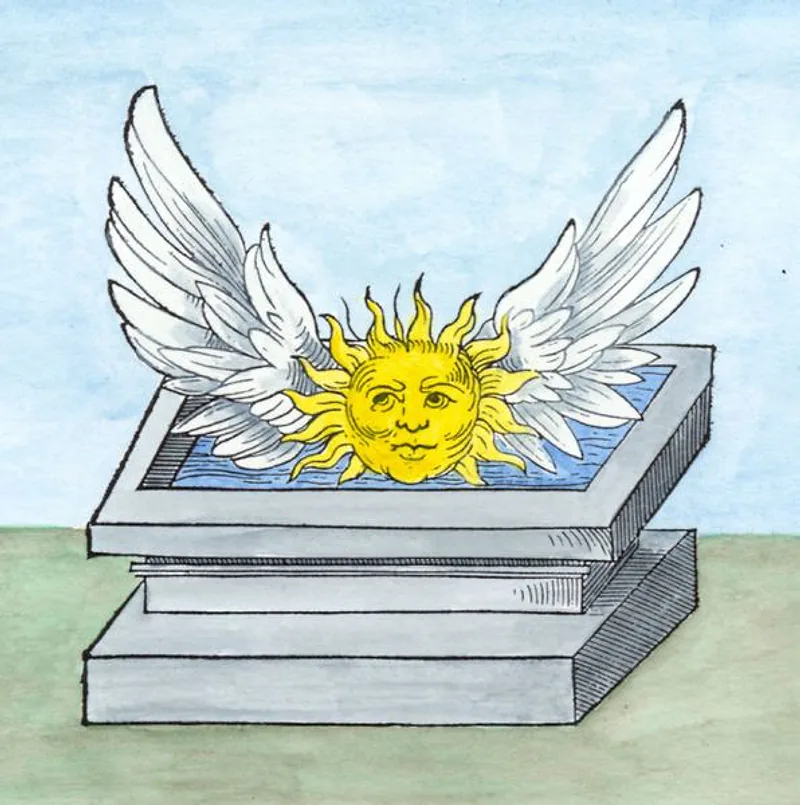
The imagery is openly erotic and funereal at once. Death and decay, the nigredo, are necessary stages: the united pair must die and rot before they can be raised in a new body. Writers drew on the language of the Song of Songs, of resurrection and of the Christian sacraments, so that the chemical process was described as a mystery of marriage, death and rising again.
The same narrative shaped the Rosicrucian romance The Chymical Wedding of Christian Rosenkreutz (1616), in which a royal wedding is followed by the beheading and alchemical resurrection of the royal couple. An English translation of 1690 can be read in the site's reading room.
Ancient Roots: Hermaphroditus and Plato's Androgynes§
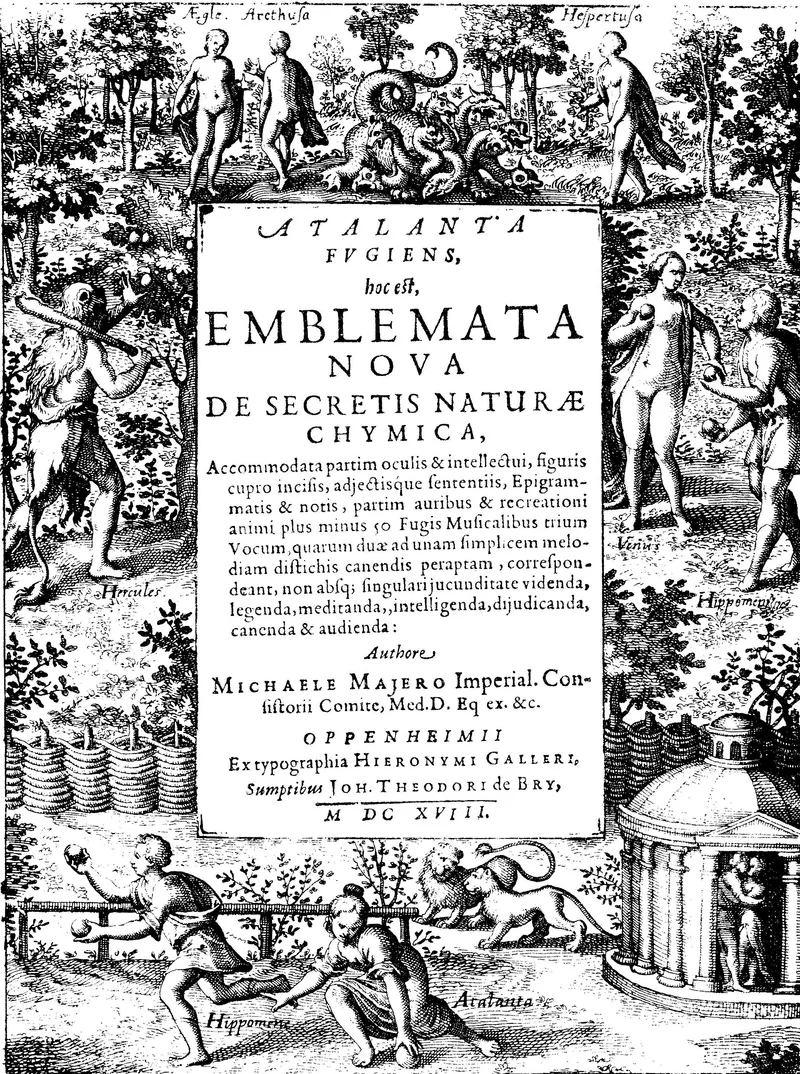
The alchemists inherited two classical images of a being with both sexes. The first is Hermaphroditus, son of Hermes and Aphrodite. In Ovid's Metamorphoses (Book IV), the nymph Salmacis embraces him in her pool and prays never to be separated from him, and the gods merge the two into one body. Because Hermes and Aphrodite were the gods of the planets Mercury and Venus, and therefore of the metals quicksilver and copper, alchemists found the myth irresistible. Michael Maier's Atalanta fugiens (1617) devotes one of its emblems to the Rebis, born "like Hermaphroditus" from two mountains, of Mercury and Venus.
The second is the speech of Aristophanes in Plato's Symposium (c. 385–370 BCE), which tells of original human beings who were double, with four arms, four legs and two faces; one of their three kinds was male-female, the "androgynous". Zeus split them in half, and love is the longing of each half for its other. Renaissance Platonists such as Marsilio Ficino, in his commentary on the Symposium, made the myth an allegory of the soul's search for its divine wholeness, preparing the ground for alchemical readings.
The Rebis in the Emblem Books: Basil Valentine and Michael Maier§
Hermaphroditic figures appear in alchemical manuscripts well before print. The German Buch der heiligen Dreifaltigkeit ("Book of the Holy Trinity"), composed in the early fifteenth century, includes hermaphroditic figures that link the alchemical union with Christian theology, and the illustrated Aurora consurgens manuscripts of the same century also show hermaphrodites.
The most famous single image appears in the Azoth attributed to Basil Valentine, a supposed fifteenth-century Benedictine whose writings were published from 1599 onwards and are now thought to be later compositions. A woodcut in editions of the Azoth from 1613 shows a two-headed Rebis, one head male and one female, holding a compass and a square. The figure stands on a fire-breathing dragon, which rests on a winged globe inscribed with a triangle and a square, and planetary signs are set around it. The compass and square, tools of measure, suggest that the Rebis is the perfectly proportioned product of the art; the dragon beneath stands for the raw matter it has mastered. Because compass and square later became the emblem of Freemasonry, the image is often reproduced in Masonic and esoteric books, although the two uses developed separately.
The great emblem books of the early seventeenth century, Maier's Atalanta fugiens, the Viridarium chymicum (1624) of Daniel Stolcius and the collections later gathered in the Musaeum hermeticum (1625, enlarged 1678), spread such images across Europe. In them the Rebis stands on the threshold of the final stages of the Great Work, between the union of opposites and the perfected Stone.
Adam Androgynos: Jewish and Christian Mystical Parallels§
The alchemical Rebis echoes a strand of biblical interpretation. Genesis 1:27 says that God created humankind "male and female" in the divine image (Genesis 1), and the second account of creation describes Eve formed from Adam's side. Rabbinic midrash, notably Genesis Rabbah, records the opinion that the first human was created as an androgynos, a two-faced being later divided. The kabbalists developed the idea further in their teaching on the union of masculine and feminine aspects of the divine, including the Shekhinah.
Among Christians, the Gospel of Thomas (saying 22) speaks of entering the kingdom when "the male and the female" are made one, a saying that has been read in many ways. The German mystic Jacob Boehme (1575–1624), who used alchemical language throughout his works, taught that Adam was originally a "manly virgin" holding both tinctures within himself and that his fall was marked by division into two sexes. Boehme's followers made the restoration of this inner wholeness a goal of spiritual life. These parallels explain why the Rebis could be read not only as a chemical product but as an image of the restored, unfallen human being, the theme of spiritual alchemy.
Jung and the Modern Interpretation of the Rebis§
In the twentieth century, Carl Jung gave the Rebis a new career. In The Psychology of the Transference (1946) he used the ten main woodcuts of the Rosarium philosophorum to describe the relationship between analyst and patient and the encounter of the conscious ego with the unconscious, personified as the contrasexual anima or animus. In Psychology and Alchemy and Mysterium Coniunctionis (1955–56) he treated the hermaphrodite as a symbol of the self, the totality of the psyche in which opposites are united. Jung's readings have been enormously influential and have made the Rebis familiar to many who know nothing of laboratory alchemy, but historians stress that they reinterpret early modern texts through a modern theory.
The Rebis also influenced nineteenth-century occultism. Eliphas Lévi's drawing of Baphomet (1856) gives the figure both male and female features and the inscriptions solve and coagula, an explicit borrowing from alchemical language about dissolving and reuniting opposites. Twentieth-century artists, especially the Surrealists, were drawn to the image as well. In contemporary esoteric writing the Rebis is commonly treated as an emblem of balance between masculine and feminine qualities, a meaning broad enough to accommodate many modern concerns but rooted in a quite specific chemical theory.
Frequently asked questions§
What does Rebis mean?§
It comes from Latin res bina, "double thing". Alchemists used it for the united matter formed when the masculine and feminine principles, sulphur and mercury or Sun and Moon, are joined in the Great Work.
Why is the Rebis shown as a hermaphrodite?§
Because alchemists described their two principles in terms of male and female, their union was naturally pictured as a single body with both sexes. The classical myth of Hermaphroditus and Plato's androgynes supplied a ready-made image.
Is the Rebis the same as Baphomet?§
No. The Rebis is an alchemical figure of the late Middle Ages and Renaissance, while Lévi's Baphomet is a nineteenth-century occult image. Lévi did, however, borrow from alchemical symbolism, including the union of opposites.
Sources and further reading§
- The Rosary of the Philosophers — Adam McLean, 1980
- Atalanta Fugiens — Michael Maier, 1617
- The Chemical Wedding of Christian Rosenkreutz — Johann Valentin Andreae, 1616
- The Psychology of the Transference — C. G. Jung, 1946
- Mysterium Coniunctionis — C. G. Jung, 1956
- Alchemy: The Secret Art — Stanislas Klossowski de Rola, 1973
- A Dictionary of Alchemical Imagery — Lyndy Abraham, 1998
- Hermaphrodites in Renaissance Europe — Kathleen P. Long, 2006