Liber XXX · Symbols · Chapter I: Alchemical Symbols
The Ouroboros: Meaning and History of the Tail-Eating Serpent
The ouroboros, the serpent devouring its own tail: its Egyptian origins, Greek magic, Gnostic and Norse parallels, alchemical meaning and Jung's reading.

The ouroboros is the image of a serpent or dragon biting or swallowing its own tail, so that its body forms a closed circle. It first appears in ancient Egypt as a guardian coiled around the sun and the dead, passed into Greek magic and Gnostic cosmology as an image of the bounded universe, and became one of the central emblems of alchemy, where it stands for the unity of matter and the endless cycle of dissolution and renewal. In modern times Carl Jung made it a symbol of the undivided psyche, and it is now a common emblem of eternity and cyclical time.
What the Ouroboros Symbolises§
A serpent that eats itself is a paradox made visible: it destroys and feeds itself at once, has no beginning and no end, and encloses a space that it alone defines. Different traditions emphasised different sides of this paradox. For Egyptian priests the coiled serpent was above all a protective boundary, the edge of ordered creation surrounding the sun god and the reborn dead. For Greek philosophers and magicians it was the cosmos itself, a self-sufficient sphere. For alchemists it was matter in its cycle, the substance that dies, rots and is reborn as the Philosopher's Stone, and also the unity behind the many forms of nature.
Several meanings recur across these settings:
- Eternity and cyclical time: the year, the course of the sun, the return of the seasons.
- Totality: the world-encircling boundary, or the "One" that contains all things.
- Self-renewal: the serpent sheds its skin and, in feeding on itself, needs nothing outside itself.
- Union of opposites: in many alchemical drawings the serpent is half dark and half light, or a winged dragon devours a wingless one.
Because the image is so simple, similar circular serpents have arisen in unrelated cultures. Historians are cautious about treating every coiled snake as an "ouroboros", and the term properly belongs to the Greek and later European tradition.
Egyptian Origins: The Encircling Serpent of the Netherworld§
The oldest secure examples come from New Kingdom Egypt. On the second of the gilded shrines that enclosed the sarcophagus of Tutankhamun (reigned c. 1332–1323 BCE) is a so-called enigmatic netherworld book, written partly in cryptographic hieroglyphs. One scene shows a large mummiform figure whose head and feet are each encircled by a serpent biting its tail. Egyptologists such as John Coleman Darnell read the composition as an image of the union of the sun god Ra and Osiris, lord of the dead: the serpents enclose the moment at which the setting sun merges with the corpse of Osiris and is regenerated.
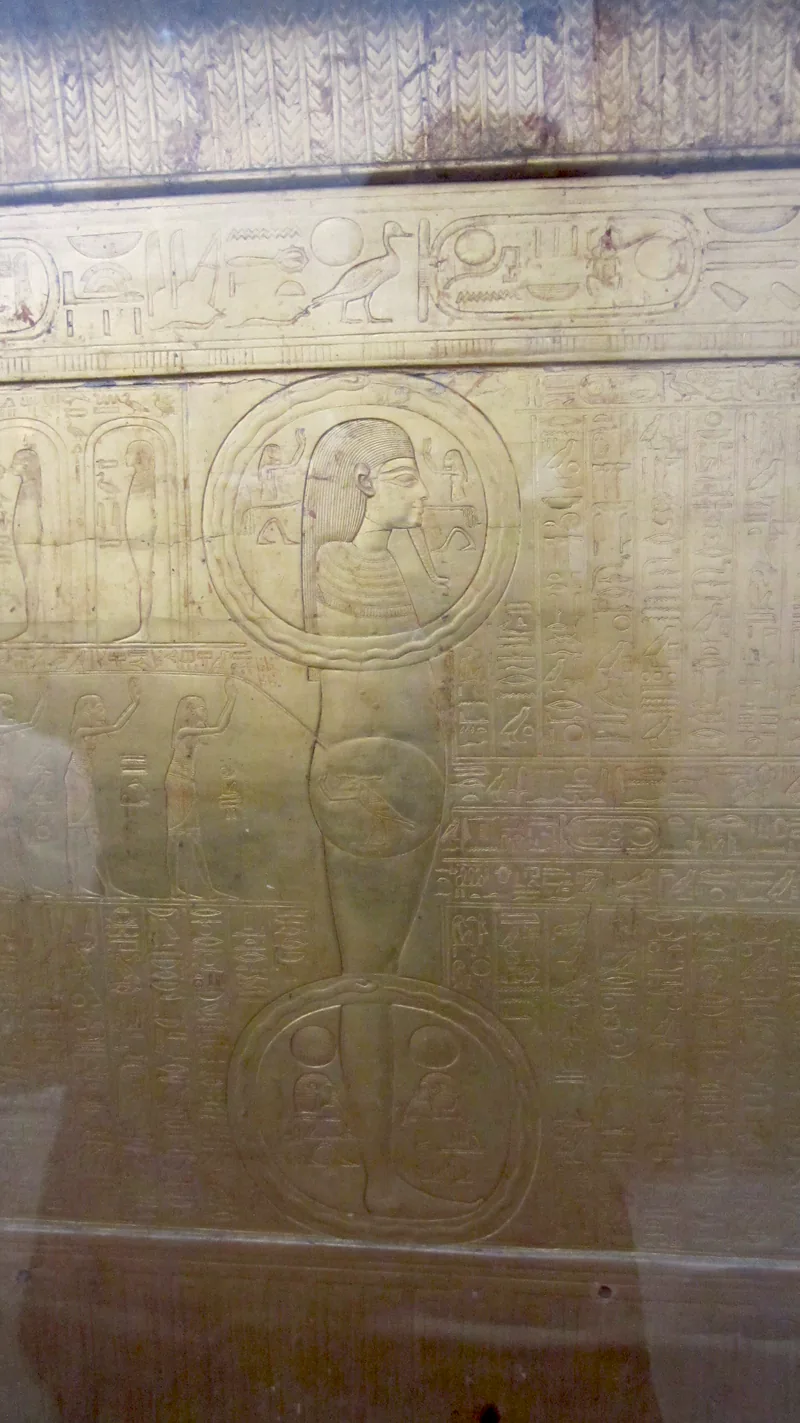
The motif belongs to a wider Egyptian family of protective serpents. The serpent Mehen, "the Coiled One", wraps around the sun god in his night barque in the Books of the Netherworld, shielding him from the chaos serpent Apophis as he passes through the twelve hours of night (see ancient Egyptian religion). In later periods, serpents biting their tails surround the solar disc on amulets, coffins and magical stelae. The Egyptian ouroboros is therefore less an abstract symbol of eternity than the boundary of the created world, the edge beyond which lie the undifferentiated waters of Nun.
Greek Magic, Gnostics and the Serpent of the Cosmos§
When Greek speakers absorbed Egyptian imagery, they gave the serpent its name, from oura ("tail") and boros ("eating"). The Hieroglyphica attributed to Horapollo, a Greek treatise usually dated to the fifth century CE on the supposed meaning of Egyptian signs, states near its opening that the Egyptians represented the universe by a serpent devouring its own tail, its scales standing for the stars. Renaissance humanists, who took Horapollo as a genuine key to hieroglyphs, made this one of the best-known "Egyptian" symbols in Europe.
The circle of the serpent had a philosophical counterpart in Plato's Timaeus (c. 360 BCE), which describes the world as a perfect sphere with no organs and no need of anything outside itself, nourished by its own waste. Later readers linked the two images, although Plato himself does not mention a serpent.
In practical magic the ouroboros was a frame of power. Several spells in the Greek Magical Papyri, written in Roman Egypt between roughly the second century BCE and the fifth century CE, instruct the practitioner to draw a serpent biting its tail around a figure, a list of divine names or the engraving of a gem. Magical gems of the same period show the lion-headed serpent Chnoubis or the god Harpocrates within such a circle. The serpent encloses and protects whatever lies inside it, much as it did in the Egyptian netherworld books.
Some Gnostic writers used the same image for the outer limit of the cosmos. The Pistis Sophia, a Coptic text of perhaps the third or fourth century, describes the outer darkness as a great dragon whose tail is in its mouth, surrounding the whole world and containing places of punishment. Here the encircling serpent is not a benevolent guardian but the prison wall of a fallen creation, an inversion typical of Gnostic cosmology.
The Ouroboros in Alchemy: "The All Is One"§
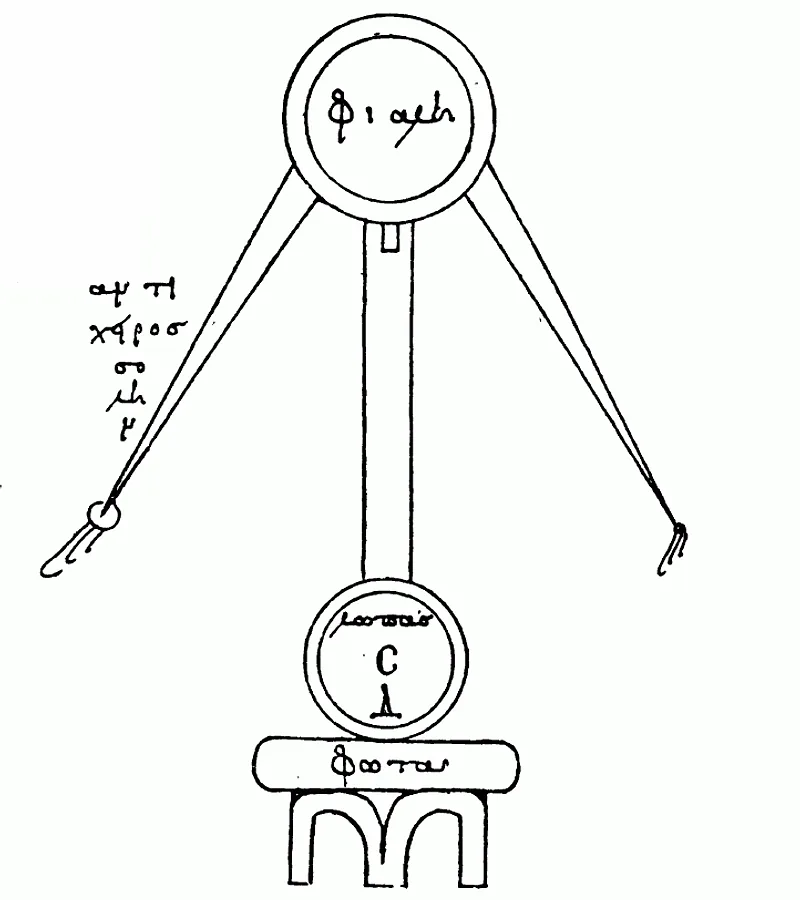
The ouroboros became a lasting emblem through Greek alchemy. A single sheet of drawings known as the Chrysopoeia of Cleopatra, "gold-making of Cleopatra", is preserved in a tenth- or eleventh-century Byzantine manuscript in Venice (Marcianus graecus 299), though its content is probably several centuries older. It shows a serpent forming a circle around the Greek words hen to pan, "the All is One", alongside diagrams of distillation apparatus. The message was central to alchemical theory: all metals are forms of one underlying matter, which can be dissolved and brought to perfection. The serpent's body, half dark and half light in some copies, represents that matter passing through its opposite states.
A celebrated drawing in a Greek alchemical manuscript copied in 1478 by Theodoros Pelecanos, in a treatise attributed to Synesius, shows a coiled serpent biting its tail. It has become one of the most reproduced images of alchemy.
In the Latin West the ouroboros was often shown as a dragon. Michael Maier's emblem book Atalanta fugiens (1617) devotes its fourteenth emblem to a dragon devouring its own tail, explained as the matter that consumes and regenerates itself. Later prints often pair a winged and a wingless dragon biting each other's tails, an image of the volatile and the fixed principles joined, and ouroboros figures appear in the Uraltes chymisches Werk attributed to Abraham Eleazar (first printed 1735, though claiming far older origin). In alchemical language the serpent eating itself pictured the closed vessel in which matter is repeatedly distilled and returned to itself, the circulation that drives the Great Work toward the Philosopher's Stone. For the wider vocabulary of signs see Alchemical Symbols: Metals, Elements and Emblems, and for the related image of a creature consuming the sun, the Green Lion.
Jörmungandr and Other World-Serpents§
Northern Europe produced a serpent that encircles the world without any known borrowing from Egypt. In Snorri Sturluson's Prose Edda (c. 1220), the god Odin throws Jörmungandr, a child of Loki, into the ocean, where it grows until it lies around the whole of Midgard, the inhabited world, biting its own tail. At Ragnarök it releases its tail, rises from the sea and fights Thor, and the two kill each other. The image belongs to a wider Norse cosmology described in Norse and Germanic religion, and its similarity to the Greek ouroboros is best explained by the common idea of an ocean surrounding the earth rather than by direct transmission.
Writers on symbolism often collect such world-serpents together, but each must be read in its own story: a snake coiled around the world can mean protection, imprisonment or the threat of chaos.
Jung, Kekulé and the Modern Ouroboros§
The modern reputation of the ouroboros owes much to depth psychology. In Psychology and Alchemy (1944) and later works, Carl Jung read the tail-eating serpent as an image of the psyche before differentiation and of the self-renewing process of individuation, in which opposites are integrated. His student Erich Neumann, in The Origins and History of Consciousness (1949), made the "uroboros" the first stage of human development, the undivided state from which the conscious ego later emerges. These interpretations are influential in modern esotericism but are psychological readings, not descriptions of what ancient or early modern users meant.
A famous anecdote concerns the chemist August Kekulé, who in a speech of 1890 said that the ring structure of benzene, which he had proposed in 1865, came to him in a reverie in which atoms twisted like snakes and one seized its own tail. Historians debate how literally the story should be taken, but it has made the ouroboros a symbol of creative insight in science.
Nineteenth-century occultism adopted the serpent readily. The seal of the Theosophical Society, founded in 1875, places interlaced triangles and an ankh within a serpent biting its tail, joining Egyptian, Hermetic and Indian emblems in one design. Today the ouroboros appears in jewellery, tattoos, literature and film as a sign of infinity, rebirth or self-reference, often far removed from its alchemical meaning. Its history is told more fully against the background of Western alchemy.
Frequently asked questions§
What does the ouroboros mean?§
It generally signifies eternity, cyclical renewal and the unity of all things. In Egypt it was a protective boundary around the sun and the dead; in alchemy it represented the one matter that dies and is reborn in the vessel.
Is the ouroboros a good or evil symbol?§
Neither in itself. Most uses are protective or cosmological, but in the Gnostic Pistis Sophia the encircling dragon is the dark boundary of a fallen world, and in Norse myth the world-serpent is Thor's enemy.
Where does the word ouroboros come from?§
It is Greek, combining oura, "tail", and boros, "devouring". The name was applied in late antiquity to a motif that had already existed in Egypt for more than a thousand years.
What is the difference between the ouroboros and the infinity sign?§
The infinity sign (∞) was introduced by the mathematician John Wallis in 1655 and has no serpent origin. Some modern designs twist the ouroboros into a figure-eight, but the two symbols have separate histories.
Sources and further reading§
- The Enigmatic Netherworld Books of the Solar-Osirian Unity — John Coleman Darnell, 2004
- The Hieroglyphics of Horapollo — Horapollo, 1950
- The Greek Magical Papyri in Translation — Hans Dieter Betz, 1986
- Pistis Sophia — G. R. S. Mead, 1896
- The Prose Edda — Snorri Sturluson, c. 1220
- Atalanta Fugiens — Michael Maier, 1617
- Psychology and Alchemy — C. G. Jung, 1944
- The Origins and History of Consciousness — Erich Neumann, 1949
- Alchemy & Mysticism — Alexander Roob, 1997