Liber XVI · Indigenous & Ancient Religions · Chapter VIII: Norse & Germanic Religion
Norse and Germanic Religion: Gods, Cult and Cosmology
Norse and Germanic religion explained: Odin, Thor and Freyja, Yggdrasil and Ragnarök, blót and temples, seiðr, burial customs and the conversion.

Norse and Germanic religion is the pre-Christian religion of the Germanic-speaking peoples of northern and central Europe, from the tribes described by Roman writers to the Scandinavians of the Viking Age, who were among the last to convert, around the eleventh century. Its gods included Odin (Woden), Thor (Donar), Týr, Frigg, Freyr and Freyja; its cosmology centred on the world tree Yggdrasil and the coming destruction of Ragnarök; and its cult was conducted through feasts, sacrifices (blót) and offerings by local chieftains and households. Because most written sources date from after the conversion, scholars reconstruct this religion cautiously from many kinds of evidence.
Sources and Their Problems§
No pagan Germanic people wrote down its own theology. Historians work with four main kinds of evidence, each with its limitations. Roman writers, above all Tacitus in his Germania (98 CE), described the gods and rites of the continental tribes in Roman terms. Runic inscriptions, from the second century onward, contain a few divine names and formulas; see Runes. Medieval literature includes the Old English, Old High German and above all Old Norse texts: the eddic poems, skaldic verse composed for chieftains in the Viking Age, the Prose Edda of Snorri Sturluson (c. 1220), and the Icelandic sagas. Archaeology has uncovered cult buildings, graves, amulets and offerings.
The Old Norse texts are the richest but were written two centuries or more after conversion by Christians, some of whom presented the gods as deified ancient kings. Scholars such as Neil Price and Terry Gunnell stress that Norse religion was regionally varied and changed over time; "Norse mythology" as a neat system is partly Snorri's achievement.
The Gods: Æsir and Vanir§
The Norse gods were divided into two families. The Æsir included Odin, the one-eyed god of wisdom, poetry, war, death and ecstasy, who sacrificed himself on the world tree to win the runes and who gathered slain warriors in Valhalla; Thor, son of Odin, the thunder god whose hammer Mjöllnir protected gods and humans against giants; Týr, a god of law and war who lost his hand binding the wolf Fenrir; Frigg, Odin's wife; Baldr, the beautiful god whose death foreshadows the end of the world; and Heimdallr, watchman of the gods. Loki, a giant's son counted among the Æsir, was a shape-shifting trickster who became the gods' enemy.
The Vanir, associated with fertility, wealth and the sea, included Njörðr and his children Freyr and Freyja. After a war between the two families, they exchanged hostages, which explains why Vanir lived among the Æsir. Freyr was worshipped for peace and good harvests; Freyja, goddess of love, gold and magic, received half the battle-dead.
Continental and English evidence shows related figures under older names: Wodan or Woden, Donar or Thunor, Tiw, and Frija or Frige. The tenth-century Merseburg Charms from Germany name Wodan and several goddesses, and an Old Saxon baptismal vow of the eighth or ninth century required converts to renounce Thunaer, Woden and Saxnot. Bede mentions Anglo-Saxon goddesses called Hretha and Eostre, the latter giving her name to Easter, though some scholars doubt his explanation.
Cosmology: Yggdrasil, the Worlds and Ragnarök§
According to the Völuspá ("Prophecy of the Seeress") and Snorri, the world began in the void of Ginnungagap between the fire of Muspelheim and the ice of Niflheim. From the melting ice came the giant Ymir, whom Odin and his brothers killed, making the earth from his flesh, the sea from his blood and the sky from his skull. The gods then created the first humans, Askr and Embla, from trees.
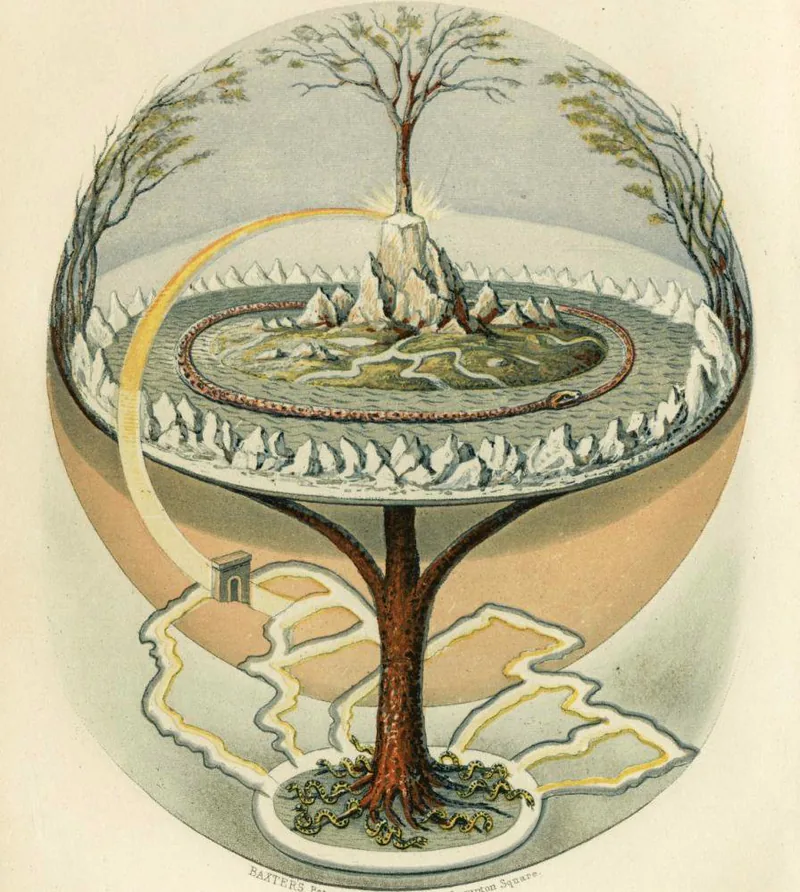
At the centre of the cosmos stands Yggdrasil, an ash tree whose roots and branches link the worlds of gods, humans, giants, elves and the dead; the later count of "nine worlds" comes from these poems. The Norns, female figures of fate, water the tree at the well of Urðr. Midgard, the human world, is surrounded by the ocean and the serpent Jörmungandr, and fortified against the giants of Jötunheimr.
The world will end at Ragnarök, the "doom of the gods": after a long winter, Loki and the giants will attack, Odin will be swallowed by Fenrir, Thor and the serpent will kill each other, and fire will consume the world. Yet the Völuspá also tells of a green earth rising again and the return of Baldr. How far this account reflects Christian influence is still debated.
Cult, Feasts and Sacred Places§
Germanic worship was led not by a professional priesthood but by heads of households, chieftains and kings. In Iceland the goði was both a chieftain and a cult leader. The central rite was the blót, a sacrificial feast in which animals, often horses or cattle, were killed and eaten; the blood was sprinkled and toasts were drunk to the gods for good harvests, peace and victory. Feasts were held at seasonal turning points, such as the midwinter feast of Yule. These practices are described historically; modern Heathens, as Heathenry and the Runes explains, use offerings of food and drink.
Tacitus describes sacred groves rather than temples, and the procession of the goddess Nerthus, whose wagon toured the land among one group of tribes before being washed in a hidden lake. In Scandinavia, archaeology at sites such as Uppåkra in Sweden and Tissø in Denmark has revealed special cult buildings attached to aristocratic halls. Adam of Bremen, writing in the 1070s, describes a great temple at Uppsala with images of Thor, Wodan and Fricco (probably Freyr) and a festival every nine years at which men and animals were hanged in a sacred grove. His account, written by a hostile missionary cleric, is debated, though excavations at Gamla Uppsala have found evidence of large halls and rows of posts. Small sanctuaries (hörgr) and outdoor offering places at lakes and springs were also common.
Seiðr, Seeresses and the Dead§
Norse religion included specialists in magic and prophecy. The völva, a seeress, travelled between farms to foretell the future, as in the description of Þorbjörg in Eiríks saga rauða. Seiðr was a form of magic associated with Freyja and Odin, involving trance and the summoning of spirits; it was considered shameful for men. Scholars such as Neil Price have compared it with Sámi and Siberian practices discussed in Shamanism, though how far the comparison holds is debated.
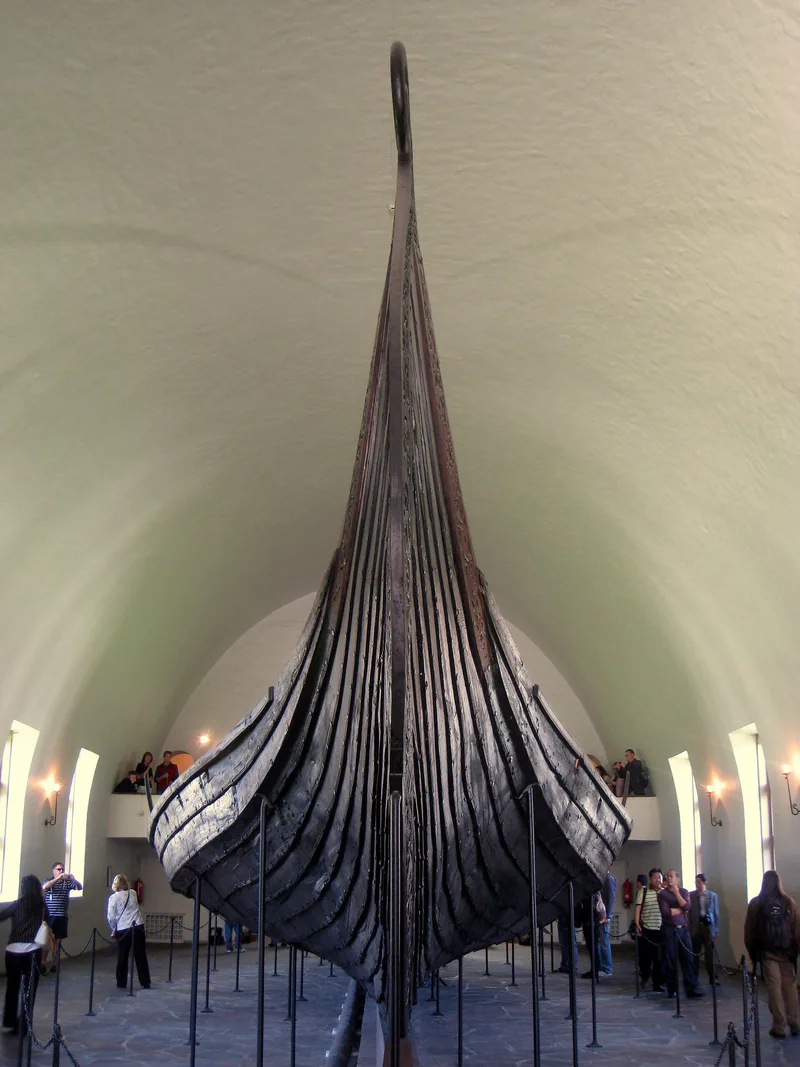
Burial customs varied: cremation and inhumation, mounds and stone ship-settings. The Oseberg ship burial in Norway, dated to 834, held two women with a rich array of goods. The Arab traveller Ibn Faḍlān described a funeral among the Rus' on the Volga in 922, including the cremation of a chieftain in his ship and the killing of a slave woman, an account that historians treat as valuable but filtered through an outsider's eyes. The dead were believed to go to different places, including Valhalla, Freyja's hall Fólkvangr, the realm of Hel and the grave mound itself.
Conversion and Survival§
Christianity reached the continental Germanic peoples from late antiquity onward; the Anglo-Saxons converted in the seventh century and Saxony under Charlemagne's forced conversions in the late eighth. Denmark's king Harald Bluetooth proclaimed on the Jelling stone (c. 965) that he had "made the Danes Christian", and Norway was converted under the kings Olaf Tryggvason and Olaf Haraldsson. In Iceland the Althing decided around 999 or 1000, on the arbitration of the law-speaker Þorgeirr, that all should be baptised, though private pagan worship was briefly tolerated. Sweden's conversion was gradual and largely complete by the twelfth century.
The old gods survived in place-names, folklore, weekday names and literature. From the nineteenth century the myths fed Romantic nationalism and art, Wagner's operas, and in the twentieth century they were also exploited by racial ideologies. Modern revivals and their debates are discussed in Heathenry and the Runes, and modern Pagan devotion in Gods and Goddesses.
Frequently asked questions§
What is the difference between Norse and Germanic religion?§
Germanic religion is the broader term for the related pre-Christian religions of all Germanic-speaking peoples, including Goths, Saxons, Anglo-Saxons and Scandinavians. Norse religion is its Scandinavian form, best known from Viking Age evidence and Icelandic texts.
Did the Vikings have priests?§
There was no separate professional priesthood in most of Scandinavia. Chieftains, kings and heads of households led sacrifices and feasts; in Iceland the goði combined political and religious roles. Seeresses and practitioners of seiðr had special ritual skills.
Is the Prose Edda a pagan text?§
No. Snorri Sturluson was a Christian writing around 1220, more than two centuries after Iceland's conversion. He preserved much older poetry and lore, but organised and interpreted it for a Christian audience interested in poetic tradition.
Sources and further reading§
- The Poetic Edda — Carolyne Larrington (trans.), 1996
- The Prose Edda — Snorri Sturluson, c. 1220
- Germania — Tacitus, 98 CE
- Gods and Myths of Northern Europe — H. R. Ellis Davidson, 1964
- Myth and Religion of the North — E. O. G. Turville-Petre, 1964
- Norse Mythology: A Guide to the Gods, Heroes, Rituals, and Beliefs — John Lindow, 2001
- Dictionary of Northern Mythology — Rudolf Simek, 1993
- The Viking Way: Magic and Mind in Late Iron Age Scandinavia — Neil Price, 2002